Attorney-Verified  Employee Handbook Document for Florida

Attorney-Verified Employee Handbook Document for Florida

The Florida Employee Handbook form is a crucial document that outlines the policies, procedures, and expectations for employees within a company. This form serves as a guide to help both employers and employees understand their rights and responsibilities in the workplace. To ensure your business is compliant and your employees are well-informed, consider filling out the form by clicking the button below.

Article Guide

Creating a comprehensive employee handbook is a critical step for any business operating in Florida. This document serves as a foundational resource, outlining essential policies, procedures, and expectations for employees. Among its major aspects, the handbook typically includes sections on workplace conduct, anti-discrimination policies, and employee benefits. It also addresses attendance and punctuality, outlining the importance of reliability in the workplace. Additionally, the handbook may detail the process for reporting grievances and the company's commitment to maintaining a safe and respectful work environment. By providing clear guidelines, the employee handbook not only helps to protect the rights of workers but also fosters a culture of transparency and accountability within the organization. Ensuring that this document is well-structured and up-to-date is vital for compliance with state laws and for promoting a positive workplace atmosphere.

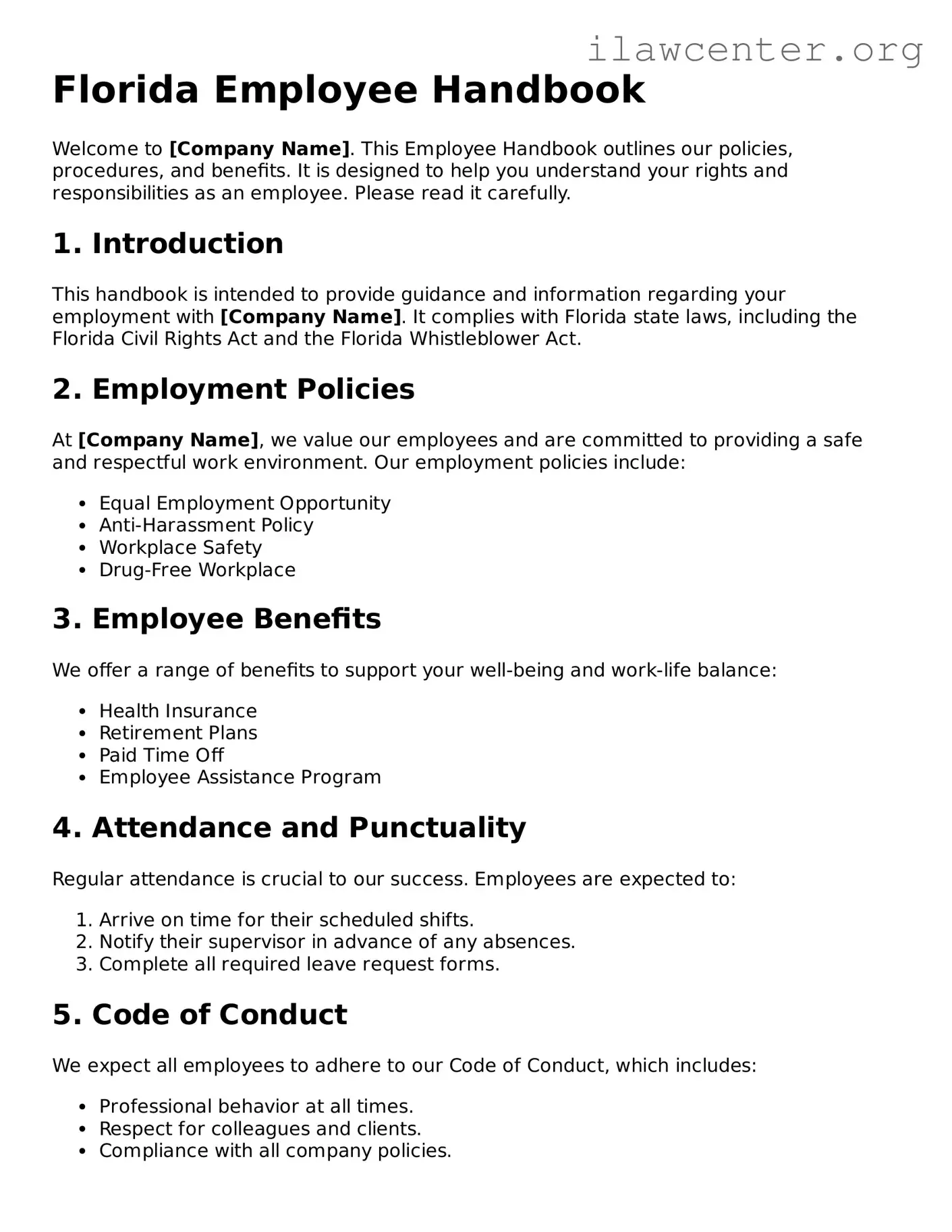
Florida Employee Handbook Preview

Florida Employee Handbook

Welcome to [Company Name]. This Employee Handbook outlines our policies, procedures, and benefits. It is designed to help you understand your rights and responsibilities as an employee. Please read it carefully.

1. Introduction

This handbook is intended to provide guidance and information regarding your employment with [Company Name]. It complies with Florida state laws, including the Florida Civil Rights Act and the Florida Whistleblower Act.

2. Employment Policies

At [Company Name], we value our employees and are committed to providing a safe and respectful work environment. Our employment policies include:

  • Equal Employment Opportunity
  • Anti-Harassment Policy
  • Workplace Safety
  • Drug-Free Workplace

3. Employee Benefits

We offer a range of benefits to support your well-being and work-life balance:

  • Health Insurance
  • Retirement Plans
  • Paid Time Off
  • Employee Assistance Program

4. Attendance and Punctuality

Regular attendance is crucial to our success. Employees are expected to:

  1. Arrive on time for their scheduled shifts.
  2. Notify their supervisor in advance of any absences.
  3. Complete all required leave request forms.

5. Code of Conduct

We expect all employees to adhere to our Code of Conduct, which includes:

  • Professional behavior at all times.
  • Respect for colleagues and clients.
  • Compliance with all company policies.

6. Disciplinary Procedures

Failure to comply with company policies may result in disciplinary action. This may include:

  • Verbal warning
  • Written warning
  • Suspension
  • Termination

7. Acknowledgment of Receipt

By signing below, you acknowledge that you have received and read the [Company Name] Employee Handbook:

Employee Name: ___________________________

Date: ___________________________

Thank you for being a part of [Company Name]. We look forward to working together to achieve great things!

PDF Form Characteristics

Fact Name Description
Purpose The Florida Employee Handbook serves as a guide for employees regarding company policies and procedures.
Governing Law The handbook is governed by Florida Statutes, particularly those relating to employment and labor laws.
Mandatory Policies Employers must include certain policies, such as anti-discrimination and harassment policies, in the handbook.
At-Will Employment Florida is an at-will employment state, meaning employers can terminate employees for almost any reason, as long as it is not illegal.
Employee Acknowledgment Employees should sign an acknowledgment form indicating they have received and understood the handbook.
Updates Employers are encouraged to regularly update the handbook to reflect changes in laws and company policies.
Legal Protection A well-drafted handbook can provide legal protection for employers by clearly outlining expectations and procedures.

Instructions on Utilizing Florida Employee Handbook

Completing the Florida Employee Handbook form is an important step in ensuring that employees understand company policies and procedures. Follow the steps below to accurately fill out the form.

  1. Begin by entering the date at the top of the form.
  2. Provide the employee's full name in the designated section.
  3. Fill in the employee's job title and department.
  4. Write the employee's start date in the appropriate field.
  5. Review the company's policies outlined in the handbook.
  6. Sign and date the acknowledgment section to confirm understanding of the handbook.
  7. Submit the completed form to the HR department or designated supervisor.

Important Facts about Florida Employee Handbook

What is the Florida Employee Handbook form?

The Florida Employee Handbook form is a document that outlines the policies, procedures, and expectations for employees working in Florida. It serves as a guide for both employers and employees, ensuring that everyone understands their rights and responsibilities in the workplace. This handbook can cover topics such as workplace conduct, benefits, and company policies.

Why is it important to have an Employee Handbook?

An Employee Handbook is important because it helps create a clear understanding of workplace rules and expectations. It can reduce confusion and misunderstandings between employers and employees. Additionally, having a well-documented handbook can protect employers from potential legal issues by demonstrating that they have communicated their policies effectively.

Who should receive a copy of the Employee Handbook?

Every employee should receive a copy of the Employee Handbook. This includes new hires as part of their onboarding process. It is also a good practice to provide existing employees with updated versions whenever significant changes occur. Ensuring that all employees have access to the handbook promotes transparency and accountability.

How often should the Employee Handbook be updated?

The Employee Handbook should be reviewed and updated regularly. It is advisable to do this at least once a year or whenever there are changes in laws, regulations, or company policies. Keeping the handbook current ensures that employees are aware of any new rules or benefits that may affect them.

What should be included in the Employee Handbook?

The Employee Handbook should include essential information such as company history, mission, and values. It should also cover workplace policies, employee benefits, codes of conduct, and procedures for reporting grievances. Including a section on legal rights and responsibilities is also beneficial for both employees and employers.

Can an Employee Handbook be legally binding?
Common mistakes

Filling out the Florida Employee Handbook form can be a straightforward process, yet many individuals encounter common mistakes that can lead to confusion or complications. Understanding these pitfalls can help ensure that the form is completed accurately and efficiently.

One frequent mistake is failing to read the instructions thoroughly. Many individuals rush through the process, overlooking important guidelines that clarify how to fill out the form correctly. Taking the time to review the instructions can prevent errors and misunderstandings.

Another common error is not providing complete information. Incomplete forms can delay processing and may require additional follow-up. It is essential to ensure that all required fields are filled in completely and accurately to avoid any unnecessary delays.

Some people neglect to double-check their entries. Simple typographical errors, such as misspelled names or incorrect dates, can cause significant issues. A careful review of the form before submission can catch these mistakes and save time in the long run.

In addition, individuals often forget to sign and date the form. A signature is a crucial part of the document, as it indicates acknowledgment and agreement to the terms outlined. Without a signature, the form may be considered invalid.

Another mistake is not keeping a copy of the completed form. Retaining a copy is important for personal records and can be useful if any questions arise in the future. This step can provide peace of mind and clarity regarding the information submitted.

Some individuals may also overlook the importance of updating the form when personal information changes. Life events such as marriage, divorce, or relocation can affect the details provided. Keeping the form current ensures that the employer has the most accurate information.

Lastly, people sometimes fail to ask questions if they are unsure about any part of the form. Seeking clarification from a supervisor or human resources can help resolve uncertainties and lead to a smoother completion process. It is always better to ask than to make assumptions that could lead to errors.

Documents used along the form

The Florida Employee Handbook serves as a vital resource for both employers and employees, outlining workplace policies, procedures, and expectations. In addition to the handbook, several other forms and documents are commonly used to ensure compliance with state and federal regulations. Below is a list of these important documents.

  • Employment Application: This form collects essential information from job applicants, including personal details, work history, and references. It helps employers assess candidate qualifications and fit for the position.
  • Employee Offer Letter: This document formally extends a job offer to a candidate. It typically includes details about the position, salary, benefits, and start date, ensuring both parties have a clear understanding of the employment terms.
  • W-4 Form: Employees complete this IRS form to indicate their tax withholding preferences. Accurate completion ensures the correct amount of federal income tax is withheld from their paychecks.
  • Direct Deposit Authorization Form: This form allows employees to authorize their employer to deposit their pay directly into their bank account. It streamlines the payment process and ensures timely access to wages.
  • Non-Disclosure Agreement (NDA): This legal document protects sensitive company information by prohibiting employees from sharing proprietary knowledge with outside parties. It is crucial for maintaining confidentiality in the workplace.

These documents, when used alongside the Florida Employee Handbook, contribute to a well-structured and compliant workplace. Proper management of these forms helps protect both the employer and employees, fostering a positive work environment.

Similar forms

The Employee Handbook serves as a crucial document within an organization, outlining policies, procedures, and expectations for employees. Several other documents share similarities with the Employee Handbook in terms of purpose and content. Below is a list of ten such documents, each with a brief explanation of how they relate to the Employee Handbook.

  • Company Policies Manual: This document details specific policies regarding workplace behavior, attendance, and performance standards, similar to the guidelines provided in the Employee Handbook.
  • Onboarding Guide: An onboarding guide introduces new employees to the company culture and procedures, paralleling the Employee Handbook's role in familiarizing staff with organizational expectations.
  • Code of Conduct: The Code of Conduct outlines acceptable behaviors and ethical standards for employees, much like the behavioral expectations set forth in the Employee Handbook.
  • Safety Manual: This manual provides safety protocols and emergency procedures, akin to the Employee Handbook's inclusion of workplace safety policies.
  • Benefits Guide: A benefits guide details employee benefits, such as health insurance and retirement plans, which are often summarized in the Employee Handbook.
  • Job Descriptions: Job descriptions define the roles and responsibilities of employees, similar to how the Employee Handbook describes employee expectations and duties.
  • Performance Review Policy: This document outlines the process and criteria for employee evaluations, echoing the performance-related policies found in the Employee Handbook.
  • Leave of Absence Policy: This policy explains the procedures for requesting time off, reflecting the leave policies outlined in the Employee Handbook.
  • Training Manual: A training manual provides instructions for specific job functions and ongoing training, paralleling the Employee Handbook's guidance on professional development.
  • Disciplinary Procedures Document: This document lays out the steps for addressing employee misconduct, similar to the disciplinary guidelines included in the Employee Handbook.

Dos and Don'ts

When filling out the Florida Employee Handbook form, it is essential to follow certain guidelines to ensure accuracy and compliance. Below is a list of things you should and shouldn't do.

  • Do read the entire handbook carefully before filling out the form.
  • Do provide accurate personal information, including your full name and contact details.
  • Do ask questions if you do not understand any section of the handbook.
  • Do keep a copy of the completed form for your records.
  • Don't leave any required fields blank.
  • Don't use abbreviations or slang when filling out the form.
  • Don't submit the form without reviewing it for errors.
  • Don't ignore deadlines for submitting the form.

Misconceptions

Understanding the Florida Employee Handbook form can be challenging, and misconceptions can lead to confusion for both employers and employees. Here are eight common misconceptions about this important document:

  1. Employee Handbooks are not legally required.

    While Florida law does not mandate that employers provide an employee handbook, having one can help clarify policies and expectations. It serves as a valuable resource for both parties.

  2. All handbooks must be the same.

    Each employee handbook should reflect the unique culture and policies of the organization. There is no one-size-fits-all approach; customization is key to addressing specific workplace needs.

  3. Once created, handbooks never need to be updated.

    Policies and laws change frequently. Regular updates ensure that the handbook remains relevant and compliant with current regulations, protecting both the employer and employees.

  4. Employee handbooks are only for large companies.

    Small businesses can benefit just as much from having an employee handbook. It helps establish clear guidelines and can prevent misunderstandings, regardless of the company size.

  5. Handbooks are just a formality.

    While some may view handbooks as mere paperwork, they play a crucial role in setting expectations and outlining rights and responsibilities. They can also serve as a reference in disputes.

  6. Employees do not need to read the handbook.

    It is essential for employees to read and understand the handbook. By doing so, they become aware of company policies and procedures, which can enhance workplace harmony.

  7. Handbooks can include any policy the employer wants.

    While employers have the freedom to create policies, they must comply with federal and state laws. Policies that violate laws or regulations can lead to legal issues.

  8. Signing the handbook means employees agree to everything in it.

    Signing an acknowledgment of receipt does not equate to agreement with every policy. It simply indicates that the employee has received the handbook and understands its existence.

By addressing these misconceptions, both employers and employees can better navigate the complexities of the Florida Employee Handbook form. Awareness and understanding are key to fostering a positive work environment.

Key takeaways

When filling out and using the Florida Employee Handbook form, there are several important points to consider. Below are key takeaways that can help ensure the process is smooth and effective.

  • Understand the Purpose: The Employee Handbook serves as a guide for employees regarding company policies, procedures, and expectations.
  • Customize the Content: Tailor the handbook to reflect the specific culture and values of your organization.
  • Include Essential Policies: Make sure to cover topics such as attendance, dress code, and workplace conduct.
  • Legal Compliance: Ensure that the handbook complies with federal, state, and local employment laws.
  • Review Regularly: Regular updates are necessary to keep the handbook current with changing laws and company practices.
  • Employee Acknowledgment: Require employees to sign an acknowledgment form to confirm they have received and understood the handbook.
  • Accessibility: Make the handbook easily accessible to all employees, whether in print or digital format.
  • Training and Orientation: Incorporate the handbook into employee training and orientation programs to reinforce its importance.

By considering these takeaways, employers can create a comprehensive and effective Employee Handbook that serves both the organization and its employees well.