Attorney-Verified  Employment Verification Document for Florida

Attorney-Verified Employment Verification Document for Florida

The Florida Employment Verification form is a document used to confirm an individual's employment status and history within the state. This form serves as an essential tool for employers and employees alike, facilitating the verification process for various purposes, such as loan applications or background checks. To ensure accuracy and compliance, it is important to fill out the form correctly; you can get started by clicking the button below.

Article Guide

The Florida Employment Verification form is an essential document for both employers and employees, serving as proof of employment and verifying an individual's work history. This form is often required when applying for loans, housing, or other opportunities that necessitate confirmation of income and job stability. Employers typically fill out the form, detailing the employee’s job title, dates of employment, and salary information. Additionally, it may include the employer's contact information, which allows third parties to reach out for further verification if needed. Understanding how to properly complete and submit this form is crucial for ensuring that the verification process goes smoothly. For employees, having accurate and up-to-date information on the form can make a significant difference in securing financial approvals or new job opportunities.

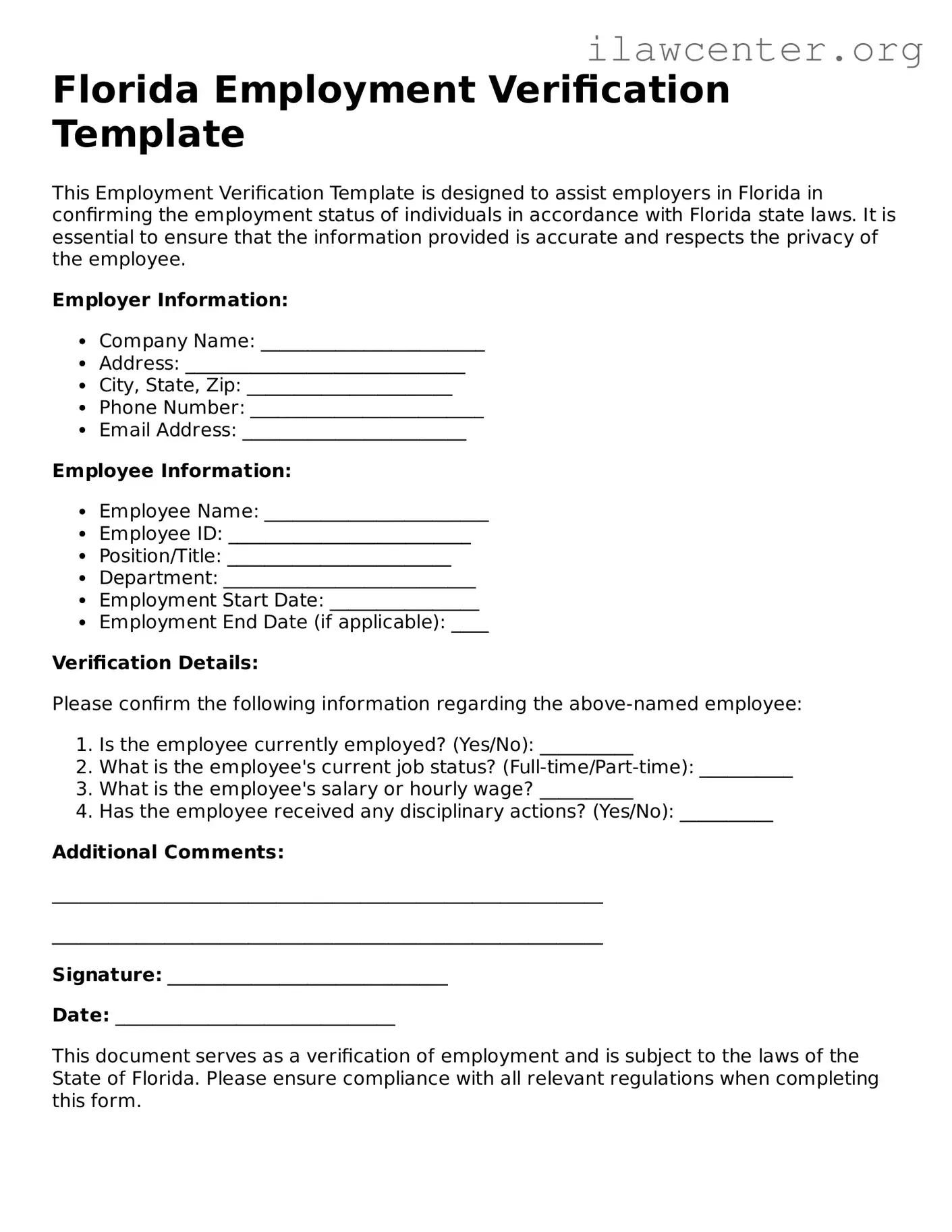
Florida Employment Verification Preview

Florida Employment Verification Template

This Employment Verification Template is designed to assist employers in Florida in confirming the employment status of individuals in accordance with Florida state laws. It is essential to ensure that the information provided is accurate and respects the privacy of the employee.

Employer Information:

  • Company Name: ________________________
  • Address: ______________________________
  • City, State, Zip: ______________________
  • Phone Number: _________________________
  • Email Address: ________________________

Employee Information:

  • Employee Name: ________________________
  • Employee ID: __________________________
  • Position/Title: ________________________
  • Department: ___________________________
  • Employment Start Date: ________________
  • Employment End Date (if applicable): ____

Verification Details:

Please confirm the following information regarding the above-named employee:

  1. Is the employee currently employed? (Yes/No): __________
  2. What is the employee's current job status? (Full-time/Part-time): __________
  3. What is the employee's salary or hourly wage? __________
  4. Has the employee received any disciplinary actions? (Yes/No): __________

Additional Comments:

___________________________________________________________

___________________________________________________________

Signature: ______________________________

Date: ______________________________

This document serves as a verification of employment and is subject to the laws of the State of Florida. Please ensure compliance with all relevant regulations when completing this form.

PDF Form Characteristics

Fact Name Details
Purpose The Florida Employment Verification form is used to confirm an employee's work eligibility and employment status.
Governing Law This form is governed by Florida Statutes, specifically under Title XXXI, Chapter 448, which addresses employment practices.
Required Information Employers must provide details such as the employee's name, position, and dates of employment.
Usage It is commonly utilized by employers for background checks, loan applications, and other verification processes.
Retention Period Employers are advised to retain the completed form for at least three years after the employee's termination.

Instructions on Utilizing Florida Employment Verification

After obtaining the Florida Employment Verification form, you will need to complete it accurately to ensure that the verification process proceeds smoothly. Follow these steps to fill out the form correctly.

  1. Begin by entering your personal information in the designated fields. This includes your full name, address, and contact information.
  2. Provide your Social Security number. Ensure that this information is accurate to avoid any delays.
  3. Fill in your employment details. Include your job title, the name of your employer, and the dates of your employment.
  4. Indicate your employment status. Specify whether you are currently employed, have been laid off, or have resigned.
  5. Complete any additional sections required by the form. This may include information regarding your salary or hours worked.
  6. Review all the information you have entered to ensure accuracy and completeness.
  7. Sign and date the form in the appropriate sections to validate your submission.
  8. Submit the form as instructed, whether electronically or by mail, according to the guidelines provided.

Important Facts about Florida Employment Verification

What is the Florida Employment Verification form?

The Florida Employment Verification form is a document used to confirm an individual's employment status and details. Employers typically complete this form to provide information about an employee's job title, dates of employment, and salary. This form is often required for various purposes, such as applying for loans, housing, or government assistance programs.

Who needs to complete the Florida Employment Verification form?

Employers are responsible for completing the Florida Employment Verification form when requested by an employee or a third party. Employees may need this verification for job applications, loan approvals, or other situations where proof of employment is necessary. It's important for both parties to ensure the information provided is accurate and up-to-date.

How can I obtain the Florida Employment Verification form?

You can typically obtain the Florida Employment Verification form directly from your employer's human resources department. If you are an employer, you may find templates online or create your own based on the necessary information to include. Ensure that the form captures all relevant details to avoid any delays in processing requests.

What should I do if my employer refuses to complete the form?

If your employer refuses to complete the Florida Employment Verification form, start by discussing your needs with them. Explain why you require the verification and how it will benefit you. If they still decline, consider checking your employee handbook or company policies regarding employment verification. You may also seek assistance from a labor rights organization or legal counsel if necessary.

Common mistakes

Filling out the Florida Employment Verification form can seem straightforward, but many individuals stumble on various aspects. One common mistake is failing to provide accurate employee information. This includes the name, Social Security number, and employment dates. Even minor errors can lead to delays in processing, so double-checking this information is crucial.

Another frequent error involves the employer's section. Often, people neglect to include the correct company name or contact information. This oversight can create confusion and hinder communication between the employer and the verifying agency. Always ensure that the details provided are current and precise.

In addition, some individuals overlook the importance of signatures. The form typically requires both the employee’s and the employer’s signatures to validate the information. Missing a signature can render the form incomplete, leading to unnecessary back-and-forth that delays the verification process.

Additionally, failing to specify the purpose of the verification can be problematic. The form may ask for the reason behind the request, such as applying for a loan or seeking new employment. Not providing this information can lead to questions and further complications.

Another mistake often made is not keeping a copy of the completed form. After submitting the verification request, it’s wise to retain a copy for personal records. This can be invaluable if any issues arise or if follow-up is needed.

People also frequently misinterpret the instructions. Each section of the form typically has specific requirements, and misunderstanding these can lead to incomplete or incorrect submissions. Taking the time to read through the instructions carefully can save a lot of hassle later on.

Lastly, individuals sometimes fail to follow up after submission. Once the form is sent off, it’s important to check in with the employer or the verifying agency to ensure everything is on track. A proactive approach can help address any potential issues before they escalate.

Documents used along the form

The Florida Employment Verification form is an essential document for confirming an individual's employment status. It is often used in various situations, such as loan applications, housing requests, or background checks. Alongside this form, several other documents may be required to provide a comprehensive view of an individual’s employment history and financial stability. Below is a list of commonly used forms and documents that complement the Employment Verification form.

  • W-2 Form: This form reports an employee's annual wages and the taxes withheld from their paycheck. It is often used to verify income for loan applications or tax purposes.
  • Pay Stubs: Recent pay stubs provide a detailed breakdown of an employee's earnings and deductions. They serve as proof of current income and employment status.
  • Job Offer Letter: A letter from an employer offering a position to an individual. It outlines the job title, salary, and terms of employment, helping to confirm job status.
  • Employment Contract: This document outlines the terms and conditions of employment. It can provide insight into job responsibilities, salary, and duration of employment.
  • Tax Returns: Personal tax returns can demonstrate an individual’s income over the past years, offering a broader financial picture for lenders or landlords.
  • Reference Letters: Letters from previous employers or colleagues can validate an individual's work history and character, supporting their employment verification.
  • Social Security Card: This card verifies an individual’s identity and eligibility to work in the U.S., which can be crucial in employment verification processes.
  • Driver’s License: A valid driver's license serves as a form of identification and can help confirm an individual's identity during the verification process.
  • Background Check Authorization: This document allows an employer to conduct a background check, which may include employment history verification and criminal record checks.

These documents, when used in conjunction with the Florida Employment Verification form, help create a complete picture of an individual’s employment and financial situation. They are vital for ensuring that all necessary information is available for decision-making processes, whether for loans, housing, or other significant transactions.

Similar forms

The Employment Verification form serves a specific purpose in confirming an individual's employment status. Several other documents share similarities in their function and usage. Below are four such documents:

  • W-2 Form: This document provides information about an employee's annual wages and the taxes withheld from their paycheck. Like the Employment Verification form, it verifies employment and income, often required for loan applications or tax purposes.
  • Pay Stubs: Pay stubs detail an employee's earnings for a specific pay period, including deductions. They serve a similar purpose to the Employment Verification form by providing proof of employment and income history.
  • Offer Letter: An offer letter outlines the terms of employment, including job title, salary, and start date. This document confirms the employment relationship, much like the Employment Verification form, and is often requested by landlords or financial institutions.
  • Reference Letter: A reference letter from an employer or supervisor can attest to an individual's work history and performance. This document, while more subjective, serves to validate employment claims, paralleling the Employment Verification form's objective of confirming employment status.

Dos and Don'ts

When filling out the Florida Employment Verification form, it's essential to approach the task with care. Below are some important dos and don'ts to keep in mind.

  • Do double-check all information for accuracy before submitting the form.
  • Do provide complete contact information for your employer.
  • Do ensure that the dates of employment are clearly stated.
  • Don't leave any sections of the form blank unless instructed otherwise.
  • Don't provide misleading information, as this can have serious consequences.
  • Don't forget to sign and date the form where required.

Misconceptions

Understanding the Florida Employment Verification form is important for both employers and employees. However, several misconceptions exist about this form. Here are six common misunderstandings:

  • It's only for new employees. Many believe that the form is only necessary for new hires. In reality, it can also be used for current employees when verifying employment status or for loan applications.
  • Employers must fill it out for every employee. Some think that every employee needs to have this form completed. This is not true; it is only required when verification is requested by a third party.
  • The form is the same as a W-2. Many confuse the Employment Verification form with the W-2 tax form. They serve different purposes. The W-2 reports income for tax purposes, while the Employment Verification form confirms employment status.
  • It can be filled out by anyone. Some people assume that any staff member can complete the form. However, it should be filled out by someone with authority, typically a human resources representative.
  • There are no consequences for not using it. Some believe that skipping the form is harmless. Not using it when required can lead to complications in employment verification processes, especially for loans or background checks.
  • It's a lengthy process. Many think that completing the Employment Verification form takes a lot of time. In fact, it is usually a straightforward process that can be completed quickly if the necessary information is readily available.

By addressing these misconceptions, both employers and employees can better navigate the employment verification process in Florida.

Key takeaways

When completing and using the Florida Employment Verification form, it is important to keep several key points in mind.

  • Accuracy is essential. Ensure that all information provided is correct and up-to-date to avoid delays in processing.
  • Provide complete details. Include all required fields such as employee name, job title, and dates of employment.
  • Signature requirement. The form must be signed by the employer or authorized representative to validate the information.
  • Confidentiality matters. Handle the completed form with care to protect the privacy of the employee's information.
  • Submission method. Know the proper channels for submitting the form, whether electronically or by mail, as specified by the requesting party.
  • Keep a copy. Retain a copy of the completed form for your records in case of future inquiries or disputes.