







Florida Financial Affidavit Short 12.902(b) PDF Template

Florida Financial Affidavit Short 12.902(b) PDF Template

The Florida Financial Affidavit Short 12.902(b) form is a crucial document used in family law cases to provide a snapshot of an individual's financial situation. This form helps the court assess income, expenses, assets, and liabilities, ensuring fair decisions in matters such as child support and alimony. Ready to take the next step? Fill out the form by clicking the button below.

Article Guide

The Florida Financial Affidavit Short 12.902(b) form plays a crucial role in family law proceedings, particularly in divorce and child support cases. This document serves as a streamlined way for individuals to disclose their financial situation to the court. It requires the disclosure of essential financial information, including income, expenses, assets, and liabilities, but in a more concise format compared to its longer counterpart. By utilizing this form, parties can efficiently communicate their financial circumstances, ensuring that the court has a clear understanding of their economic standing. The short form is particularly beneficial for those with straightforward financial situations, allowing them to avoid the complexities of more detailed financial disclosures. Completing the 12.902(b) form accurately is vital, as it can significantly impact decisions regarding alimony, child support, and equitable distribution of assets. Understanding how to fill out this form correctly can help individuals navigate the often challenging waters of family law with greater confidence and clarity.

Florida Financial Affidavit Short 12.902(b) Preview

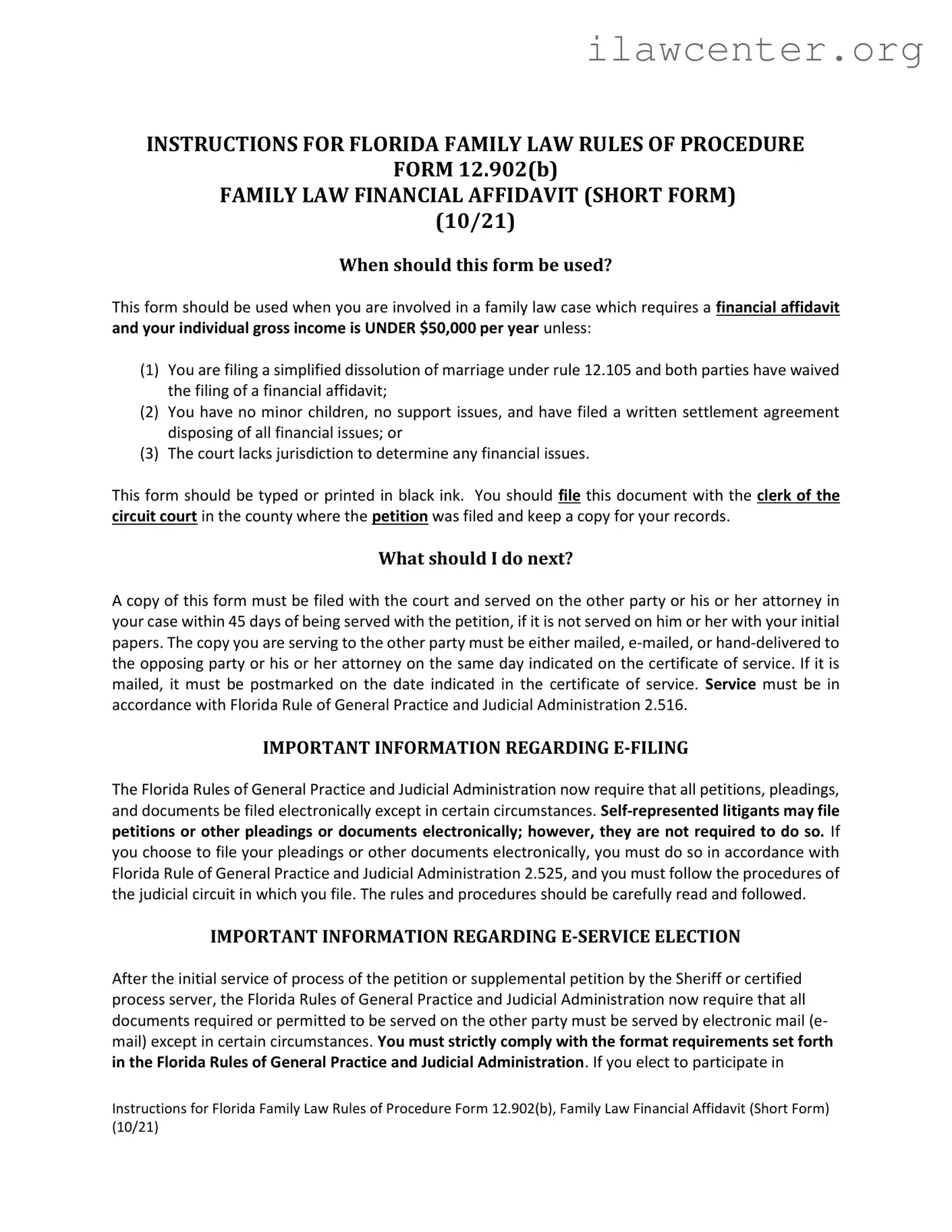
INSTRUCTIONS FOR FLORIDA FAMILY LAW RULES OF PROCEDURE
FORM 12.902(b)
FAMILY LAW FINANCIAL AFFIDAVIT (SHORT FORM)
(10/21)
When should this form be used?
This form should be used when you are involved in a family law case which requires a financial affidavit
and your individual gross income is UNDER $50,000 per year unless:
(1) You are filing a simplified dissolution of marriage under rule 12.105 and both parties have waived
the filing of a financial affidavit;
(2) You have no minor children, no support issues, and have filed a written settlement agreement
disposing of all financial issues; or
(3) The court lacks jurisdiction to determine any financial issues.
This form should be typed or printed in black ink. You should file this document with the clerk of the
circuit court in the county where the petition was filed and keep a copy for your records.
What should I do next?
A copy of this form must be filed with the court and served on the other party or his or her attorney in
your case within 45 days of being served with the petition, if it is not served on him or her with your initial
papers. The copy you are serving to the other party must be either mailed, e-mailed, or hand-delivered to
the opposing party or his or her attorney on the same day indicated on the certificate of service. If it is
mailed, it must be postmarked on the date indicated in the certificate of service. Service must be in
accordance with Florida Rule of General Practice and Judicial Administration 2.516.
IMPORTANT INFORMATION REGARDING E-FILING
The Florida Rules of General Practice and Judicial Administration now require that all petitions, pleadings,
and documents be filed electronically except in certain circumstances. Self-represented litigants may file
petitions or other pleadings or documents electronically; however, they are not required to do so. If
you choose to file your pleadings or other documents electronically, you must do so in accordance with
Florida Rule of General Practice and Judicial Administration 2.525, and you must follow the procedures of
the judicial circuit in which you file. The rules and procedures should be carefully read and followed.
IMPORTANT INFORMATION REGARDING E-SERVICE ELECTION
After the initial service of process of the petition or supplemental petition by the Sheriff or certified
process server, the Florida Rules of General Practice and Judicial Administration now require that all
documents required or permitted to be served on the other party must be served by electronic mail (e-
mail) except in certain circumstances. You must strictly comply with the format requirements set forth
in the Florida Rules of General Practice and Judicial Administration. If you elect to participate in
Instructions for Florida Family Law Rules of Procedure Form 12.902(b), Family Law Financial Affidavit (Short Form)
(10/21)
electronic service, which means serving or receiving pleadings by electronic mail (e-mail), or through the
Florida Courts E-Filing Portal, you must review Florida Rule of General Practice and Judicial
Administration 2.516. You may find this rule at www.flcourts.org through the link to the Rules of General
Practice and Judicial Administration provided under either Family Law Forms: Getting Started, or Rules
of Court in the A-Z Topical Index.
SELF-REPRESENTED LITIGANTS MAY SERVE DOCUMENTS BY E-MAIL; HOWEVER, THEY ARE NOT
REQUIRED TO DO SO. If a self-represented litigant elects to serve and receive documents by email, the
procedures must always be followed once the initial election is made.
To serve and receive documents by e-mail, you must designate your e-mail addresses by using the
Designation of Current Mailing and E-mail Address, Florida Supreme Court Approved Family Law Form
12.915, and you must provide your e-mail address on each form on which your signature appears.
Please CAREFULLY read the rules and instructions for: Certificate of Service (General), Florida Supreme
Court Approved Family Law Form 12.914; Designation of Current Mailing and E-mail Address, Florida
Supreme Court Approved Family Law Form 12.915; and Florida Rule of General Practice and Judicial
Administration 2.516.
Where can I look for more information?
Before proceeding, you should read “General Information for Self-Represented Litigants” found at the
beginning of these forms. The words that are in “bold underline” in these instructions are defined there.
For further information, see Florida Family Law Rule of Procedure 12.285.
Special notes . . .
If you want to keep your address confidential because you have been found by a judge to be the victim of
sexual battery, aggravated child abuse, aggravated stalking, harassment, aggravated battery, or domestic
violence, do not enter the address, telephone, and fax information at the bottom of this form. Instead,
file Request for Confidential Filing of Address, Florida Supreme Court Approved Family Law Form
12.980(h).
The affidavit must be completed using monthly income and expense amounts. If you are paid or your
bills are due on a schedule which is not monthly, you must convert those amounts. Hints are provided
below for making these conversions.
Hourly - If you are paid by the hour, you may convert your income to monthly as follows:
Hourly amount x Hours worked per week = Weekly amount
Weekly amount x 52 Weeks per year = Yearly amount
Yearly amount ÷ 12 Months per year = Monthly Amount
Daily - If you are paid by the day, you may convert your income to monthly as follows:
Daily amount x Days worked per week = Weekly amount
Weekly amount x 52 Weeks per year = Yearly amount
Yearly amount ÷ 12 Months per year = Monthly Amount
Weekly - If you are paid by the week, you may convert your income to monthly as follows:
Weekly amount x 52 Weeks per year = Yearly amount
Instructions for Florida Family Law Rules of Procedure Form 12.902(b), Family Law Financial Affidavit (Short Form)
(10/21)
Yearly amount ÷ 12 Months per year = Monthly Amount
Bi-weekly - If you are paid every two weeks, you may convert your income to monthly as follows:
Bi-weekly amount x 26 = Yearly amount
Yearly amount ÷ 12 Months per year = Monthly Amount
Semi-monthly - If you are paid twice per month, you may convert your income to monthly as follows:
Semi-monthly amount x 2 = Monthly Amount
Expenses may be converted in the same manner.
Remember, a person who is NOT an attorney is called a nonlawyer. If a nonlawyer helps you fill out these
forms, that person must give you a copy of a Disclosure from Nonlawyer, Florida Family Law Rules of
Procedure Form 12.900(a), before he or she helps you. A nonlawyer helping you fill out these forms also
must put his or her name, address, and telephone number on the bottom of the last page of every form
he or she helps you complete.
Instructions for Florida Family Law Rules of Procedure Form 12.902(b), Family Law Financial Affidavit (Short Form)
(10/21)
IN THE CIRCUIT COURT OF THE JUDICIAL CIRCUIT,
IN AND FOR COUNTY, FLORIDA
Case No.:
Division:
,
Petitioner,
and
,
Respondent.
FAMILY LAW FINANCIAL AFFIDAVIT (SHORT FORM)
(Under $50,000 Individual Gross Annual Income)
I, {full legal name} , being sworn, certify that the following
information is true:
My Occupation: Employed by: ___________________________
Business Address: _______________________________________________________________
Pay rate: $ ( ) every week ( ) every other week ( ) twice a month ( ) monthly
( ) other: ____________
___ Check here if unemployed and explain on a separate sheet your efforts to find employment.
SECTION I. PRESENT MONTHLY GROSS INCOME:
All amounts must be MONTHLY. See the instructions with this form to figure out money amounts for
anything that is NOT paid monthly. Attach more paper, if needed. Items included under “other” should
be listed separately with separate dollar amounts.
1. $______ Monthly gross salary or wages
2. ______ Monthly bonuses, commissions, allowances, overtime, tips, and similar payments
3. _______ Monthly business income from sources such as self-employment, partnerships, close
corporations, and/or independent contracts (gross receipts minus ordinary and necessary
expenses required to produce income) (Attach sheet itemizing such income and expenses.)
4. _______ Monthly disability benefits/SSI
5. _______ Monthly Workers’ Compensation
6. _______ Monthly Unemployment Compensation
7. _______ Monthly pension, retirement, or annuity payments
8. _______ Monthly Social Security benefits
9. _______ Monthly alimony actually received (Add 9a and 9b)
9a. From this case: $ _______
9b. From other case(s): $ _______
Florida Family Law Rules of Procedure Form 12.902(b), Family Law Financial Affidavit (Short Form) (10/21)
10. _______ Monthly interest and dividends
11. _______ Monthly rental income (gross receipts minus ordinary and necessary expenses
required to produce income) (Attach sheet itemizing such income and expense items.)
12. _______ Monthly income from royalties, trusts, or estates
13. _______ Monthly reimbursed expenses and in-kind payments to the extent that they
reduce personal living expenses
14. _______ Monthly gains derived from dealing in property (not including nonrecurring gains)
15. _______ Any other income of a recurring nature (list source) _________________________
16. __________________________________________________________________________
17. $ _______ TOTAL PRESENT MONTHLY GROSS INCOME (Add lines 1–16)
PRESENT MONTHLY DEDUCTIONS:
18. $______ Monthly federal, state, and local income tax (corrected for filing status and allowable
dependents and income tax liabilities)
a. Filing Status ____________
b. Number of dependents claimed _______
19. _______ Monthly FICA or self-employment taxes
20. _______ Monthly Medicare payments
21. _______ Monthly mandatory union dues
22. _______ Monthly mandatory retirement payments
23. _______ Monthly health insurance payments (including dental insurance), excluding portion
paid for any minor children of this relationship
24. _______ Monthly court-ordered child support actually paid for children from another
relationship
25. _______ Monthly court-ordered alimony actually paid (Add 25a and 25b)
25a. from this case: $ _______
25b. from other case(s): $ _______
26. $_______ TOTAL DEDUCTIONS ALLOWABLE UNDER SECTION 61.30, FLORIDA STATUTES
(Add lines 18 through 25)
27. $_______ PRESENT NET MONTHLY INCOME (Subtract line 26 from line 17)
Florida Family Law Rules of Procedure Form 12.902(b), Family Law Financial Affidavit (Short Form) (10/21)
SECTION II. AVERAGE MONTHLY EXPENSES
Proposed/Estimated Expenses. If this is a dissolution of marriage case and your expenses as listed
below do not reflect what you actually pay currently, you should write “estimate next to each amount
that is estimated.
A. HOUSEHOLD:
Mortgage or rent $
Property taxes $
Utilities $
Telephone $
Food $
Meals outside home $
Maintenance/Repairs $
Other: __________ $
B. AUTOMOBILE
Gasoline $
Repairs $
Insurance $
C. CHILD(REN)’S EXPENSES
Day care $
Lunch money $
Clothing $
Grooming $
Gifts for holidays $
Medical/Dental (uninsured) $
Other: ______________ $
D. INSURANCE
Medical/Dental (if not listed on
lines 23 or 45) $
Child(ren)’s medical/dental $
Life $
Other: $
_
_
_
_
_
_
_
_
_
_
_
_
_
_
_
_
_
_
_
_
_
_
E. OTHER EXPENSES NOT LISTED ABOVE
Clothing $ _
Medical/Dental (uninsured) $ _
Grooming $ _
Entertainment $ _
Gifts $ _
Religious organizations $ _
Miscellaneous $ _
Other: ______________ $ _
____________________ $ _
____________________ $ _
____________________ $ _
____________________ $ _
____________________ $ _
F. PAYMENTS TO CREDITORS
CREDITOR: MONTHLY
PAYMENT
____________________ $ _
____________________ $ _
____________________ $ _ _
____________________ $ _
____________________ $ _
____________________ $ _
____________________ $ _
____________________ $ _
____________________ $ _
____________________ $ _
____________________ $ _
Florida Family Law Rules of Procedure Form 12.902(b), Family Law Financial Affidavit (Short Form) (10/21)
28. $_______ TOTAL MONTHLY EXPENSES (add ALL monthly amounts in A through F above)
SUMMARY
29. $_______ TOTAL PRESENT MONTHLY NET INCOME (from line 27 of SECTION I. INCOME)
30. $_______ TOTAL MONTHLY EXPENSES (from line 28 above)
31. $_______ SURPLUS (If line 29 is more than line 30, subtract line 30 from line 29. This is the amount
of your surplus. Enter that amount here.)
32. ($_______) (DEFICIT) (If line 30 is more than line 29, subtract line 29 from line 30. This is the amount
of your deficit. Enter that amount here.)
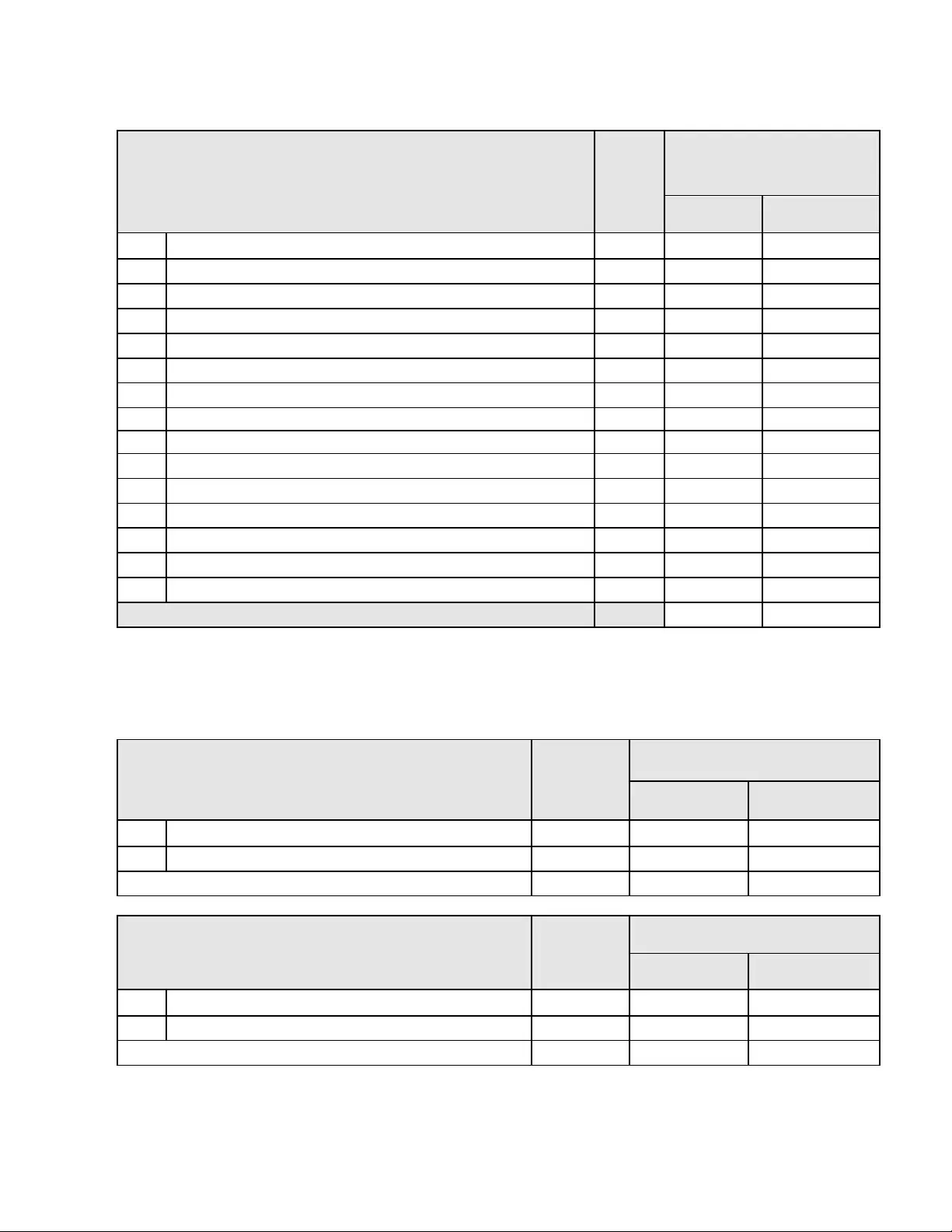
SECTION III. ASSETS AND LIABILITIES
Use the nonmarital column only if this is a petition for dissolution of marriage and you believe an item
is “nonmarital,” meaning it belongs to only one of you and should not be divided. You should indicate
to whom you believe the item(s) or debt belongs. (Typically, you will only use this column if property/debt
was owned/owed by one spouse before the marriage. See the “General Information for Self-
Represented Litigants” found at the beginning of these forms and section 61.075(1), Florida Statutes, for
definitions of “marital” and “nonmarital” assets and liabilities.)
A. ASSETS:
DESCRIPTION OF ITEM(S). List a description of each separate
item owned by you (and/or your spouse, if this is a petition
for dissolution of marriage). LIST ONLY LAST 4 DIGITS OF
ACCOUNT NUMBERS. Check the line next to any asset(s)
which you are requesting
the judge award to you.
Current
Fair
Market
Value
Nonmarital
(check correct column)
Petitioner
Respondent
Cash (on hand)
Cash (in banks or credit unions)
Stocks, Bonds, Notes
Real estate: (Home)
(Other)
Automobiles
Other personal property
Retirement plans (Profit Sharing, Pension, IRA, 401(k)s, etc.)
Other
____Check here if additional
pages are attached.
Total Assets
(add next column)
$
Florida Family Law Rules of Procedure Form 12.902(b), Family Law Financial Affidavit (Short Form) (10/21)
B. LIABILITIES:
DESCRIPTION OF ITEM(S). List a description of each separate
debt owed by you (and/or your spouse, if this is a petition for
dissolution of marriage). LIST ONLY LAST 4 DIGITS OF
ACCOUNT NUMBERS. Check the line next to any debt(s) for
which you believe you
should be responsible.
Current
Amount
Owed
Nonmarital
(check correct column)
Petitioner
Respondent
Mortgages on real estate: First mortgage on home
Second mortgage on home
Other mortgages
Auto loans
Charge/credit card accounts
Other
____Check here if additional pages are attached.
Total Debts
(add next column)
$
C. CONTINGENT ASSETS AND LIABILITIES:
INSTRUCTIONS: If you have any POSSIBLE assets (income potential, accrued vacation or sick leave, bonus,
inheritance, etc.) or POSSIBLE liabilities (possible lawsuits, future unpaid taxes, contingent tax liabilities,
debts assumed by another), you must list them here.
Contingent Assets
Check the line next to any contingent asset(s) which you
are requesting the judge award to you.
Possible
Value
Nonmarital
(check correct column)
Petitioner
Respondent
Total Contingent Assets
$
Contingent Liabilities
Possible
Nonmarital
(check correct column)
Check the line next to any contingent debt(s) for which
you believe you
should be responsible.
Amount
Owed
Petitioner
Respondent
Total Contingent Liabilities
$
Florida Family Law Rules of Procedure Form 12.902(b), Family Law Financial Affidavit (Short Form) (10/21)
SECTION IV. CHILD SUPPORT GUIDELINES WORKSHEET
(Florida Family Law Rules of Procedure Form 12.902(e), Child Support Guidelines Worksheet, MUST be
filed with the court at or prior to a hearing to establish or modify child support. This requirement cannot
be waived by the parties.)
[Check one only]
____ A Child Support Guidelines Worksheet IS or WILL BE filed in this case. This case involves the
establishment or modification of child support.
____ A Child Support Guidelines Worksheet IS NOT being filed in this case. The establishment or
modification of child support is not an issue in this case.
I certify that a copy of this document was [check all used]: ( ) e-mailed ( ) mailed ( ) faxed
( ) hand delivered to the person(s) listed below on {date} ________________________________.
Other party or his/her attorney:
Name:
Address:
City, State, Zip:
Telephone Number:
Fax Number:
E-mail Address(es):
Under penalties of perjury, I declare that I have read this document and the facts stated in it are true.
Dated:
Signature of Party
Printed Name:
Address:
City, State, Zip:
Telephone Number:
Fax Number:
E-mail Address(es):
IF A NONLAWYER HELPED YOU FILL OUT THIS FORM, HE/SHE MUST FILL IN THE BLANKS BELOW:
[fill in all blanks] This form was prepared for the: {choose only one} ( ) Petitioner ( ) Respondent
This form was completed with the assistance of:
{name of individual} ,
{name of business} ,
{address} ,
{city} __________________, {state} ____, {zip code} ______, {telephone number} .
Florida Family Law Rules of Procedure Form 12.902(b), Family Law Financial Affidavit (Short Form) (10/21)

File Properties

Fact Name Details
Purpose The Florida Financial Affidavit Short (Form 12.902(b)) is used to disclose financial information during family law proceedings, such as divorce or child support cases.
Governing Law This form is governed by the Florida Family Law Rules of Procedure and relevant Florida Statutes.
Eligibility It is intended for use by individuals whose financial circumstances are straightforward and do not require a detailed financial affidavit.
Information Required The form requires information about income, expenses, assets, and liabilities to provide a clear picture of an individual's financial situation.
Filing Process After completing the form, it must be filed with the court and served to the other party involved in the legal proceedings.
Signature Requirement The affidavit must be signed under penalty of perjury, affirming that the information provided is true and accurate.
Updates and Changes If there are significant changes in financial circumstances, the form may need to be updated and resubmitted to the court.

Instructions on Utilizing Florida Financial Affidavit Short 12.902(b)

The Florida Financial Affidavit Short 12.902(b) form is essential for individuals involved in family law cases, particularly those related to divorce or child support. Completing this form accurately is crucial for ensuring that financial disclosures are clear and comprehensive. Follow the steps below to fill out the form correctly.

  1. Obtain the Form: Download the Florida Financial Affidavit Short 12.902(b) form from the Florida Courts website or acquire a physical copy from your local courthouse.
  2. Personal Information: Fill in your full name, address, and contact information at the top of the form. Ensure that this information is accurate and up-to-date.
  3. Income Section: Report all sources of income. This includes wages, salaries, bonuses, and any other earnings. Provide the amount received per month.
  4. Expenses Section: List your monthly expenses, such as housing costs, utilities, food, transportation, and any other necessary expenditures. Be as detailed as possible.
  5. Assets Section: Identify your assets, including bank accounts, real estate, vehicles, and other valuable property. Include approximate values for each item.
  6. Liabilities Section: Document any debts or obligations you have, such as credit card balances, loans, or mortgages. Clearly state the amounts owed.
  7. Review: Carefully review all entries for accuracy. Ensure that there are no omissions or errors that could affect your financial disclosure.
  8. Sign and Date: Once you have completed the form, sign and date it at the designated area. This signifies that the information provided is true and correct to the best of your knowledge.
  9. File the Form: Submit the completed form to the appropriate court as part of your case. Keep a copy for your records.

Important Facts about Florida Financial Affidavit Short 12.902(b)

What is the Florida Financial Affidavit Short 12.902(b) form?

The Florida Financial Affidavit Short 12.902(b) form is a document used in family law cases, such as divorce or child support proceedings. It provides a snapshot of an individual's financial situation, including income, expenses, assets, and liabilities. This form helps the court assess financial needs and obligations when making decisions regarding support and division of assets.

Who needs to fill out the Florida Financial Affidavit Short 12.902(b) form?

How do I complete the Florida Financial Affidavit Short 12.902(b) form?

Is there a filing fee associated with the Florida Financial Affidavit Short 12.902(b) form?

What happens after I submit the Florida Financial Affidavit Short 12.902(b) form?

Common mistakes

Filling out the Florida Financial Affidavit Short 12.902(b) form can be a straightforward process, but many people make common mistakes that can lead to delays or complications in their legal proceedings. One frequent error is failing to provide accurate income information. It’s essential to list all sources of income, including wages, bonuses, and any side jobs. Omitting even a small source can create discrepancies that may raise red flags.

Another common mistake is not updating the affidavit with current financial information. If circumstances change, such as a new job or a significant expense, it’s crucial to reflect those changes in the affidavit. Submitting outdated information can misrepresent your financial situation and impact the outcome of your case.

People often overlook the importance of signing and dating the affidavit. A form that is unsigned or undated may be considered incomplete, leading to unnecessary delays. Always double-check that you have signed the document before submitting it.

Additionally, individuals sometimes miscalculate their expenses. It’s important to provide an accurate account of monthly expenses, including housing, utilities, and any debts. Underestimating expenses can give a false impression of financial stability, which may not align with reality.

Another mistake occurs when individuals fail to disclose assets. All assets, including bank accounts, real estate, and investments, must be listed. Not declaring assets can result in legal consequences and undermine the credibility of the affidavit.

Some people also struggle with clarity in their descriptions. Using vague terms or failing to provide detailed information can lead to confusion. Clear and specific descriptions help ensure that your financial situation is understood without ambiguity.

Moreover, individuals sometimes forget to include necessary documentation. Supporting documents, such as pay stubs or tax returns, should accompany the affidavit to provide evidence of the financial information listed. Without these documents, the affidavit may not be taken seriously.

Another frequent oversight is not reviewing the form before submission. Taking the time to proofread can catch simple errors, such as typos or incorrect figures, that could potentially affect the outcome of your case.

People also tend to underestimate the importance of consistency across documents. Ensure that the information on the financial affidavit aligns with other legal documents, such as divorce petitions or child support forms. Inconsistencies can lead to questions about credibility.

Finally, individuals may not seek help when needed. If there is confusion about how to fill out the form, it’s wise to consult a legal professional. Avoiding assistance can lead to mistakes that might have been easily corrected with expert guidance.

Documents used along the form

When navigating financial matters in Florida, particularly during divorce or family law proceedings, the Florida Financial Affidavit Short 12.902(b) form is often accompanied by several other important documents. Each of these forms serves a specific purpose and helps ensure that financial disclosures are complete and accurate.

  • Florida Financial Affidavit Long 12.902(a): This form provides a more detailed account of an individual's financial situation. It includes extensive information about income, expenses, assets, and liabilities, making it suitable for more complex cases.
  • Child Support Guidelines Worksheet: This document calculates the amount of child support one parent may owe to the other. It considers various factors, including income, expenses, and the needs of the child.
  • Marital Settlement Agreement: This is a written agreement between spouses that outlines the terms of their divorce, including asset division, alimony, and child custody arrangements. It often relies on the financial information provided in the affidavits.
  • Income Verification Documents: These may include pay stubs, tax returns, or other proof of income. They support the figures provided in the financial affidavits and ensure transparency in financial disclosures.
  • Affidavit of Compliance: This document confirms that both parties have complied with the financial disclosure requirements set by the court. It is essential for maintaining accountability throughout the process.
  • Notice of Hearing: This form informs all parties involved of upcoming court dates related to financial matters. It ensures that everyone has the opportunity to participate in hearings regarding financial disclosures and obligations.

Understanding these forms and their purposes can significantly streamline the financial aspect of legal proceedings. Being prepared with the right documents helps ensure clarity and fairness, ultimately leading to a more efficient resolution.

Similar forms

The Florida Financial Affidavit Short 12.902(b) form is a crucial document in family law cases, particularly in divorce and child support matters. It provides a snapshot of an individual's financial situation. Several other documents serve similar purposes in different contexts. Here are ten documents that share similarities with the Florida Financial Affidavit Short 12.902(b):

  • Florida Financial Affidavit Long 12.902(a) - This is a more detailed version of the financial affidavit, requiring additional information about income, expenses, assets, and liabilities.
  • Income Statement - Often used in various legal and financial contexts, this document outlines an individual's earnings over a specific period, similar to the income section of the financial affidavit.
  • Expense Report - This document lists monthly or annual expenses, paralleling the expense section of the Florida Financial Affidavit Short.
  • Net Worth Statement - This provides a summary of an individual's assets and liabilities, akin to the balance sheet aspect of the financial affidavit.
  • Child Support Guidelines Worksheet - Used to calculate child support obligations, this worksheet requires financial disclosures similar to those found in the financial affidavit.
  • Spousal Support Worksheet - This document helps determine alimony amounts and requires financial information, reflecting the same financial data needed in the affidavit.
  • Bankruptcy Schedules - In bankruptcy filings, individuals must disclose their financial situation, which is similar in nature to the information required in a financial affidavit.
  • Financial Disclosure Statement - Common in various legal proceedings, this statement requires parties to disclose their financial status, much like the Florida Financial Affidavit.
  • Loan Application - When applying for a loan, individuals must provide financial information that mirrors the income and expense details in the affidavit.
  • Tax Returns - These documents detail an individual’s income and deductions, serving as a financial snapshot that can be used in legal contexts similar to the financial affidavit.

Dos and Don'ts

When filling out the Florida Financial Affidavit Short 12.902(b) form, it is essential to approach the process with care. This form plays a crucial role in family law cases, particularly in divorce and child support matters. Here are some important dos and don'ts to consider:

  • Do read the instructions carefully before starting. Understanding what is required can save time and prevent mistakes.
  • Do provide accurate and complete information. This ensures that the court has a clear picture of your financial situation.
  • Do include all sources of income. This includes wages, bonuses, rental income, and any other earnings.
  • Do keep a copy of the completed form for your records. This will be useful for future reference or if any questions arise.
  • Don't omit any debts or expenses. Full disclosure is critical, as it affects the court's decisions regarding support and asset division.
  • Don't rush through the form. Taking your time can help you avoid errors that might require corrections later.
  • Don't forget to sign and date the affidavit. An unsigned form may be rejected by the court.

Misconceptions

Understanding the Florida Financial Affidavit Short 12.902(b) form is essential for anyone going through a divorce or financial dispute in Florida. However, several misconceptions can lead to confusion. Here are six common misunderstandings:

  • It is only for divorce cases. Many believe this form is exclusively for divorce proceedings. In reality, it can be used in various family law cases, including child support and alimony determinations.
  • It must be completed by a lawyer. Some think that only attorneys can fill out this form. However, individuals can complete it themselves, although legal advice can be beneficial.
  • All financial information must be disclosed. There is a belief that every single financial detail must be included. While it is important to provide accurate information, only relevant financial details need to be disclosed.
  • It is a lengthy and complicated process. Many feel overwhelmed by the idea of completing the form. In truth, the form is designed to be straightforward, making it manageable for most individuals.
  • Submitting the form is optional. Some individuals think they can choose whether or not to submit this form. However, in many cases, it is a required document that must be filed with the court.
  • Once submitted, the information cannot be changed. There is a misconception that any mistakes made on the form are permanent. In fact, individuals can amend the affidavit if they discover errors or changes in their financial situation.

By addressing these misconceptions, individuals can approach the Florida Financial Affidavit Short 12.902(b) form with greater confidence and clarity.

Key takeaways

When filling out and using the Florida Financial Affidavit Short 12.902(b) form, consider the following key takeaways:

  • Purpose: This form is primarily used in family law cases to provide a clear picture of an individual's financial situation.
  • Accuracy: Ensure that all information is accurate and up-to-date. Inaccurate information can lead to legal complications.
  • Completeness: Fill out all sections of the form. Omitting information can raise questions and affect your case.
  • Income Disclosure: Clearly list all sources of income, including salary, bonuses, and any side jobs.
  • Expense Reporting: Be thorough when detailing monthly expenses. This includes housing costs, utilities, and other necessary expenditures.
  • Documentation: Keep supporting documents, such as pay stubs and bank statements, to verify the information provided.
  • Review: Double-check the form for any errors before submission. Mistakes can cause delays in the legal process.
  • Filing: Submit the completed form to the appropriate court. Check for specific filing requirements in your jurisdiction.
  • Updates: If your financial situation changes, update the affidavit as required by the court.