Attorney-Verified  Independent Contractor Agreement Document for Florida

Attorney-Verified Independent Contractor Agreement Document for Florida

The Florida Independent Contractor Agreement is a legal document that outlines the terms and conditions between a business and an independent contractor. This agreement clarifies the nature of the working relationship, including payment, responsibilities, and confidentiality. To ensure a smooth collaboration, it’s essential to fill out the form correctly—click the button below to get started.

Article Guide

In Florida, the Independent Contractor Agreement form serves as a crucial document for establishing clear terms between a business and an independent contractor. This agreement outlines the scope of work, payment terms, and the duration of the contract, ensuring that both parties understand their rights and responsibilities. It addresses key elements such as confidentiality, dispute resolution, and liability, which are essential for protecting the interests of both the contractor and the hiring entity. By clearly defining the nature of the relationship, this form helps to avoid potential misunderstandings and legal disputes down the line. Additionally, it specifies the conditions under which the contractor operates, reinforcing their status as an independent entity rather than an employee. Properly executed, this agreement can provide peace of mind and a solid foundation for a successful working relationship.

Florida Independent Contractor Agreement Preview

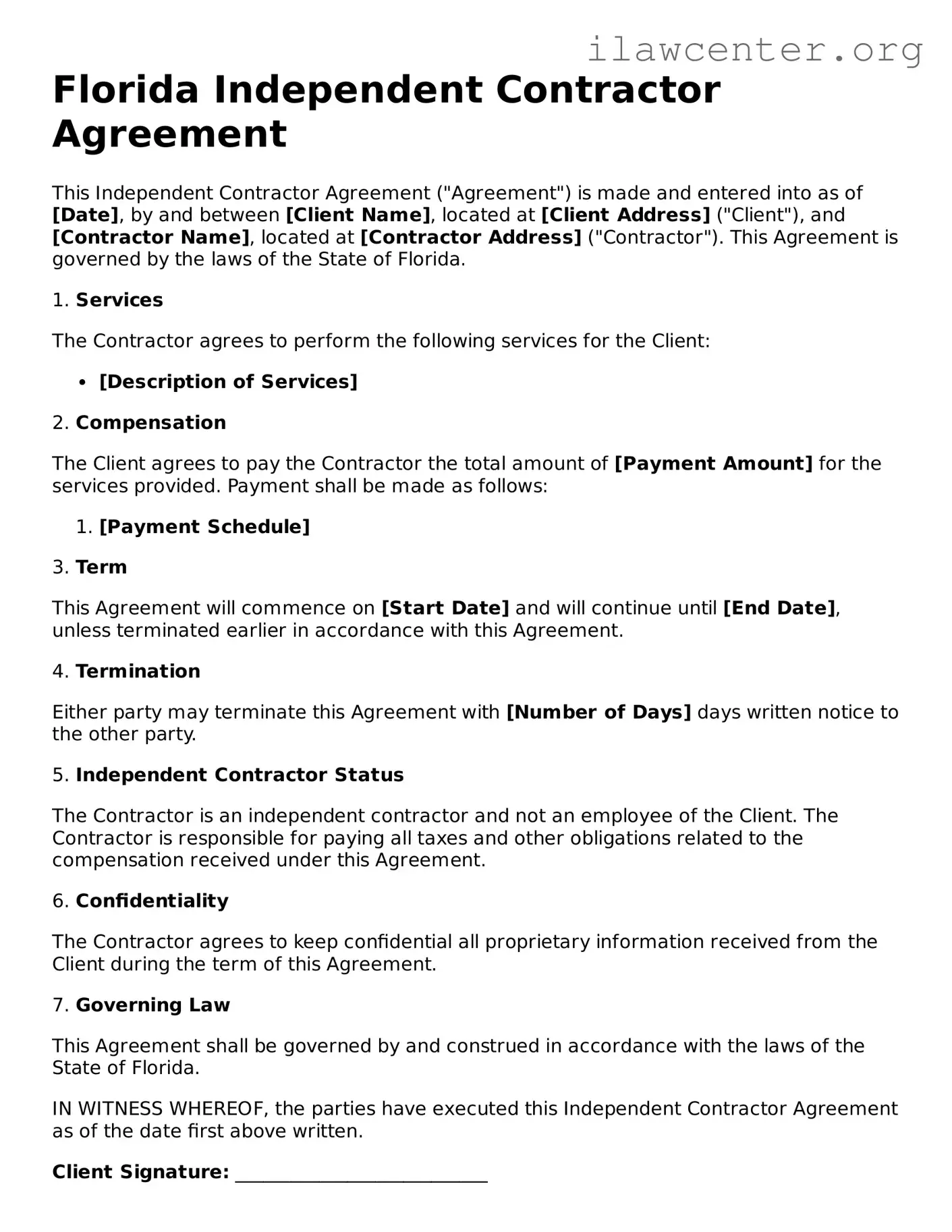
Florida Independent Contractor Agreement

This Independent Contractor Agreement ("Agreement") is made and entered into as of [Date], by and between [Client Name], located at [Client Address] ("Client"), and [Contractor Name], located at [Contractor Address] ("Contractor"). This Agreement is governed by the laws of the State of Florida.

1. Services

The Contractor agrees to perform the following services for the Client:

  • [Description of Services]

2. Compensation

The Client agrees to pay the Contractor the total amount of [Payment Amount] for the services provided. Payment shall be made as follows:

  1. [Payment Schedule]

3. Term

This Agreement will commence on [Start Date] and will continue until [End Date], unless terminated earlier in accordance with this Agreement.

4. Termination

Either party may terminate this Agreement with [Number of Days] days written notice to the other party.

5. Independent Contractor Status

The Contractor is an independent contractor and not an employee of the Client. The Contractor is responsible for paying all taxes and other obligations related to the compensation received under this Agreement.

6. Confidentiality

The Contractor agrees to keep confidential all proprietary information received from the Client during the term of this Agreement.

7. Governing Law

This Agreement shall be governed by and construed in accordance with the laws of the State of Florida.

IN WITNESS WHEREOF, the parties have executed this Independent Contractor Agreement as of the date first above written.

Client Signature: ___________________________

Contractor Signature: ______________________

Date: ___________________________

PDF Form Characteristics

Fact Name Description
Definition The Florida Independent Contractor Agreement outlines the terms between a business and an independent contractor.
Purpose This agreement clarifies the relationship and expectations between the contractor and the hiring entity.
Governing Law The agreement is governed by the laws of the State of Florida.
Tax Responsibilities Independent contractors are responsible for their own taxes, unlike employees.
Payment Terms The agreement should specify payment terms, including rates and schedules.
Scope of Work Clearly define the services the contractor will provide to avoid misunderstandings.
Termination Clause The agreement should include conditions under which either party can terminate the contract.
Confidentiality A confidentiality clause may be included to protect sensitive information.
Indemnification Contractors may be required to indemnify the hiring party against certain claims.
Dispute Resolution The agreement can outline methods for resolving disputes, such as mediation or arbitration.

Instructions on Utilizing Florida Independent Contractor Agreement

Filling out the Florida Independent Contractor Agreement form is an important step in establishing a clear understanding between a contractor and a client. This form outlines the terms of the working relationship, ensuring both parties are on the same page regarding expectations and responsibilities. Below are the steps to complete the form accurately.

  1. Start with the date at the top of the form. Write the date when the agreement is being filled out.
  2. Next, enter the name of the client or business hiring the contractor. This should include the full legal name.
  3. Provide the address of the client. This should be the physical address where the business is located.
  4. Then, write the name of the independent contractor. Again, use the full legal name.
  5. Fill in the contractor’s address, ensuring it is a valid and current address.
  6. Specify the services to be provided by the contractor. Be clear and detailed to avoid misunderstandings.
  7. Indicate the payment terms. This includes the amount to be paid and the schedule for payments (e.g., weekly, bi-weekly, or upon completion of the project).
  8. Include the duration of the agreement. State the start date and, if applicable, the end date of the contract.
  9. Identify any specific conditions or requirements for the work. This might include deadlines, milestones, or quality standards.
  10. Both parties should sign and date the agreement at the bottom of the form. This signifies that both agree to the terms outlined.

After completing the form, it’s advisable to keep a copy for your records. Both parties should also retain a signed copy for future reference. This will help in maintaining clarity and accountability throughout the duration of the contract.

Important Facts about Florida Independent Contractor Agreement

What is a Florida Independent Contractor Agreement?

A Florida Independent Contractor Agreement is a legal document that outlines the terms of work between a business and an independent contractor. This agreement specifies the nature of the work, payment terms, and the responsibilities of both parties. It helps to clarify the relationship and protect the rights of both the contractor and the business.

Why is it important to have an Independent Contractor Agreement?

Having an Independent Contractor Agreement is crucial for several reasons. It helps prevent misunderstandings by clearly defining the scope of work and payment terms. Additionally, it protects both parties in case of disputes. This document serves as a reference point for expectations and obligations, making it easier to resolve any issues that may arise.

What should be included in the agreement?

The agreement should include key elements such as the names of both parties, a description of the services to be provided, payment details, deadlines, and confidentiality clauses. It may also outline conditions for termination and liability limitations. Including these details ensures that both parties have a clear understanding of their roles and responsibilities.

How does the payment structure work in the agreement?

Payment structures can vary depending on the nature of the work. The agreement should specify whether the contractor will be paid hourly, per project, or on a commission basis. It should also detail when payments will be made, such as upon completion of work or at regular intervals. Clear payment terms help avoid disputes regarding compensation.

Can an Independent Contractor Agreement be modified?

Yes, an Independent Contractor Agreement can be modified, but both parties must agree to any changes. It’s important to document any modifications in writing. This ensures that both parties are aware of the new terms and can refer back to them if needed. Always communicate openly when discussing changes to the agreement.

What happens if there is a dispute?

If a dispute arises, the agreement should outline the process for resolution. This may include mediation or arbitration before pursuing legal action. Having a clear dispute resolution process can save time and money for both parties. It encourages open communication and helps maintain a professional relationship.

Is it necessary to have a lawyer review the agreement?

While it is not legally required to have a lawyer review the agreement, it is highly recommended. A legal professional can ensure that the document complies with Florida laws and adequately protects your interests. Their expertise can help identify any potential issues before they become problems.

How long does the agreement last?

The duration of the agreement can vary based on the project and the terms set by both parties. Some agreements are for a specific project, while others may be ongoing. It’s important to include a start and end date in the agreement or specify conditions for termination. This clarity helps both parties manage their expectations effectively.

Common mistakes

Filling out the Florida Independent Contractor Agreement can be a straightforward process, but many individuals make common mistakes that could lead to misunderstandings or legal issues down the line. One of the most frequent errors is failing to clearly define the scope of work. Without a detailed description of the tasks and responsibilities, both parties may have different expectations, which can lead to disputes.

Another mistake is not including the payment terms. It’s essential to specify how much the contractor will be paid, the payment schedule, and the method of payment. Omitting these details can result in confusion and potential conflicts regarding compensation.

People often overlook the importance of including a termination clause. This clause should outline the conditions under which either party can terminate the agreement. Without it, one party may find themselves stuck in a contract that no longer serves their interests.

Additionally, failing to specify the duration of the contract is a common oversight. It’s crucial to state whether the agreement is for a fixed term or ongoing until either party decides to terminate it. This clarity helps both parties understand their commitments.

Another mistake is neglecting to include a confidentiality clause when sensitive information is involved. Protecting proprietary information is vital, and without this clause, a contractor might share information that could harm your business.

Some individuals forget to include liability and indemnification provisions. These sections are important as they outline who is responsible for damages or legal claims that may arise during the course of the contract. Not addressing these issues can leave you vulnerable.

Moreover, using vague language can lead to misinterpretation. Clear and concise wording is essential. Ambiguities can create loopholes that may be exploited, potentially leading to disputes that could have been easily avoided.

Finally, many people fail to sign and date the agreement properly. An unsigned or improperly dated contract may not hold up in court. Ensure that both parties sign and date the document to validate the agreement.

Documents used along the form

When entering into a working relationship with an independent contractor in Florida, it's essential to have the right documentation in place. While the Florida Independent Contractor Agreement is a crucial component, several other forms and documents can help clarify the terms of engagement and protect both parties. Here’s a list of commonly used forms that complement the Independent Contractor Agreement.

  • W-9 Form: This form is used to collect the contractor's taxpayer identification information. It is essential for reporting income to the IRS and ensuring proper tax compliance.
  • Invoice Template: An invoice template allows the contractor to bill for services rendered. It should include details like the services provided, payment terms, and due dates.
  • Non-Disclosure Agreement (NDA): This document protects sensitive information shared during the course of the working relationship. It ensures that confidential information remains private.
  • Scope of Work (SOW): The SOW outlines specific tasks, deliverables, and timelines. It provides clarity on what is expected from the contractor and helps prevent misunderstandings.
  • Payment Agreement: This form specifies the payment terms, including rates, payment methods, and schedules. It helps both parties agree on how and when payments will be made.
  • Termination Letter: If the working relationship needs to end, a termination letter provides a formal way to communicate this decision. It should outline the reasons for termination and any final obligations.
  • Insurance Certificate: Depending on the nature of the work, contractors may need to provide proof of insurance. This document verifies that the contractor has the necessary coverage to protect against liabilities.

Having these forms in place not only streamlines the working relationship but also ensures that both parties are on the same page. By taking the time to prepare these documents, you can foster a professional environment that benefits everyone involved.

Similar forms

  • Employment Agreement: This document outlines the terms of employment between an employer and an employee. Like the Independent Contractor Agreement, it specifies duties, compensation, and duration of the relationship.
  • Service Agreement: A service agreement details the services to be provided by one party to another. Similar to the Independent Contractor Agreement, it includes terms related to service delivery and payment.
  • Consulting Agreement: This document is used when hiring a consultant to provide expertise. It shares similarities with the Independent Contractor Agreement in defining the scope of work and payment terms.
  • Freelance Agreement: A freelance agreement is for individuals offering services on a project basis. It mirrors the Independent Contractor Agreement by outlining project specifics and compensation.
  • Partnership Agreement: This document establishes the terms between partners in a business. While it differs in nature, it also details roles and responsibilities, similar to how an Independent Contractor Agreement does.
  • Non-Disclosure Agreement (NDA): An NDA protects confidential information shared between parties. While not directly related to work scope, it often accompanies Independent Contractor Agreements to safeguard sensitive information.
  • Non-Compete Agreement: This document prevents a contractor from competing with a business after the relationship ends. It complements the Independent Contractor Agreement by addressing post-relationship obligations.
  • Work for Hire Agreement: This agreement specifies that work created by a contractor belongs to the hiring party. It aligns with the Independent Contractor Agreement by clarifying ownership of work produced.
  • Letter of Agreement: A letter of agreement is a simpler form of contract that outlines the terms of a relationship. It is similar to the Independent Contractor Agreement in that it establishes the expectations between parties.

Dos and Don'ts

When filling out the Florida Independent Contractor Agreement form, it's important to follow certain guidelines to ensure accuracy and compliance. Here are seven things to keep in mind:

  • Do read the entire agreement carefully before filling it out. Understanding the terms is crucial.
  • Don't leave any sections blank. Every part of the form should be completed to avoid delays.
  • Do provide accurate personal and business information. This includes your name, address, and tax identification number.
  • Don't use vague language. Be specific about the services you will provide.
  • Do review the payment terms and conditions. Ensure they are clear and acceptable to both parties.
  • Don't ignore the termination clause. Understand how either party can end the agreement.
  • Do keep a copy of the signed agreement for your records. This is important for future reference.

Misconceptions

When it comes to the Florida Independent Contractor Agreement, several misconceptions can lead to confusion for both contractors and businesses. Here are eight common misunderstandings:

  1. All independent contractors are the same. Many believe that all independent contractors operate under the same rules. In reality, each agreement can vary based on the nature of the work and the relationship between the contractor and the business.
  2. Independent contractors don’t need contracts. Some people think that verbal agreements are sufficient. However, having a written contract is crucial for clarifying expectations and protecting both parties.
  3. Independent contractors are not entitled to any benefits. While it’s true that independent contractors typically don’t receive employee benefits, they may still be eligible for certain benefits depending on the contract terms.
  4. Independent contractors have complete freedom. Many assume that independent contractors can do whatever they want. However, the agreement often outlines specific tasks, deadlines, and methods of work.
  5. Tax obligations are the same as for employees. A common misconception is that independent contractors pay the same taxes as employees. In fact, contractors are responsible for self-employment taxes and may have different tax deductions available.
  6. Independent contractors cannot be fired. Some believe that once a contractor is hired, they cannot be terminated. In truth, a contractor can be let go if they fail to meet the terms of the agreement.
  7. Only large companies need Independent Contractor Agreements. Many think that only big businesses require these agreements. However, any individual or small business hiring a contractor can benefit from having a clear contract.
  8. Independent Contractor Agreements are unnecessary for short-term projects. Some may feel that short-term work doesn’t require a formal agreement. Yet, even brief engagements can benefit from a written contract to ensure clarity and protect interests.

Understanding these misconceptions can help both independent contractors and businesses navigate their working relationships more effectively.

Key takeaways

When filling out and using the Florida Independent Contractor Agreement form, keep these key takeaways in mind:

  • Ensure that both parties' names and contact information are clearly stated at the beginning of the agreement.
  • Define the scope of work. Specify the tasks the contractor will perform to avoid misunderstandings.
  • Include payment terms. Clearly outline how much the contractor will be paid and when payments will be made.
  • Specify the duration of the agreement. State the start and end dates, or indicate if the contract is ongoing.
  • Address confidentiality and non-compete clauses if necessary. Protect sensitive information and outline any restrictions on future work.
  • Both parties should sign and date the agreement. This confirms acceptance of the terms outlined in the document.