Attorney-Verified  Loan Agreement Document for Florida

Attorney-Verified Loan Agreement Document for Florida

A Florida Loan Agreement form is a legal document that outlines the terms and conditions of a loan between a lender and a borrower. This form serves to protect both parties by clearly stating the loan amount, interest rate, repayment schedule, and any collateral involved. If you're ready to formalize a loan, fill out the form by clicking the button below.

Article Guide

In the state of Florida, individuals and businesses often rely on loan agreements to formalize the terms of a loan between a lender and a borrower. This essential document serves as a written record, outlining the specific details of the loan, including the principal amount, interest rate, repayment schedule, and any collateral involved. A well-structured loan agreement not only protects the rights of both parties but also ensures clarity and understanding throughout the lending process. Additionally, it may include provisions for late payments, default consequences, and other important terms that govern the relationship between the lender and borrower. By addressing these key aspects, the Florida Loan Agreement form fosters transparency and helps prevent misunderstandings, making it a vital tool for anyone engaging in a lending transaction.

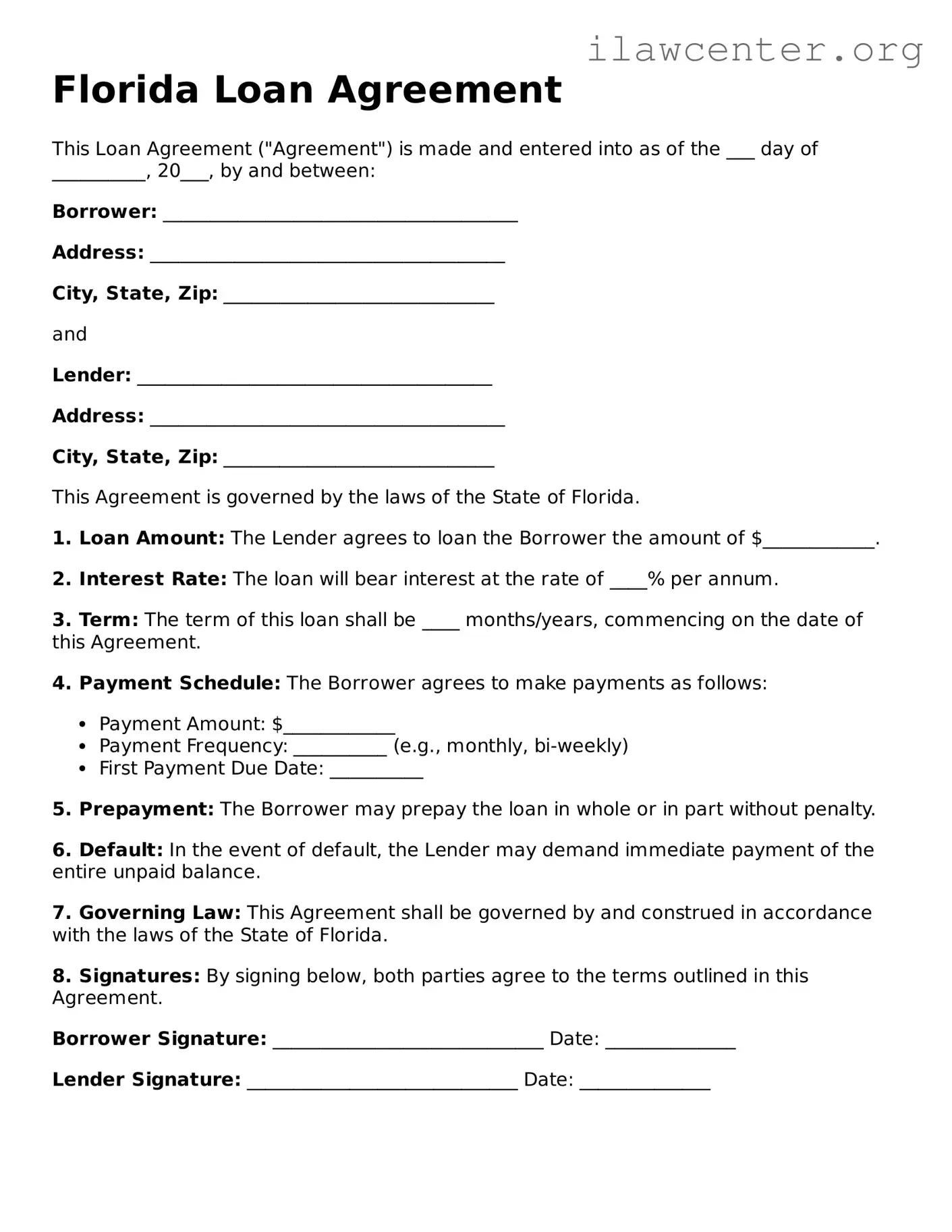
Florida Loan Agreement Preview

Florida Loan Agreement

This Loan Agreement ("Agreement") is made and entered into as of the ___ day of __________, 20___, by and between:

Borrower: ______________________________________

Address: ______________________________________

City, State, Zip: _____________________________

and

Lender: ______________________________________

Address: ______________________________________

City, State, Zip: _____________________________

This Agreement is governed by the laws of the State of Florida.

1. Loan Amount: The Lender agrees to loan the Borrower the amount of $____________.

2. Interest Rate: The loan will bear interest at the rate of ____% per annum.

3. Term: The term of this loan shall be ____ months/years, commencing on the date of this Agreement.

4. Payment Schedule: The Borrower agrees to make payments as follows:

  • Payment Amount: $____________
  • Payment Frequency: __________ (e.g., monthly, bi-weekly)
  • First Payment Due Date: __________

5. Prepayment: The Borrower may prepay the loan in whole or in part without penalty.

6. Default: In the event of default, the Lender may demand immediate payment of the entire unpaid balance.

7. Governing Law: This Agreement shall be governed by and construed in accordance with the laws of the State of Florida.

8. Signatures: By signing below, both parties agree to the terms outlined in this Agreement.

Borrower Signature: _____________________________ Date: ______________

Lender Signature: _____________________________ Date: ______________

PDF Form Characteristics

Fact Name Details
Definition The Florida Loan Agreement form is a legal document outlining the terms of a loan between a lender and a borrower in Florida.
Governing Law This agreement is governed by the laws of the State of Florida.
Parties Involved The form includes sections for the lender and borrower to provide their names and contact information.
Loan Amount The specific amount being borrowed must be clearly stated in the agreement.
Interest Rate The form requires the interest rate to be disclosed, which can be fixed or variable.
Repayment Terms Details about repayment schedules, including due dates and payment methods, are outlined in the agreement.
Default Conditions The agreement specifies what constitutes a default and the consequences that follow.

Instructions on Utilizing Florida Loan Agreement

Filling out the Florida Loan Agreement form is a straightforward process that requires careful attention to detail. After completing the form, you will be ready to proceed with the loan transaction, ensuring that all parties involved are clear on the terms and conditions outlined in the agreement.

  1. Begin by entering the date at the top of the form.
  2. Fill in the names and addresses of both the borrower and the lender in the designated sections.
  3. Clearly state the loan amount in the appropriate field.
  4. Specify the interest rate applicable to the loan.
  5. Indicate the repayment terms, including the duration of the loan and payment schedule.
  6. Include any collateral information if applicable, detailing what is being used as security for the loan.
  7. Review any additional terms or conditions that may need to be included.
  8. Both the borrower and lender should sign and date the form at the bottom.

Important Facts about Florida Loan Agreement

What is a Florida Loan Agreement form?

The Florida Loan Agreement form is a legal document that outlines the terms and conditions under which one party lends money to another. This form serves to protect both the lender and the borrower by clearly defining the obligations and rights of each party involved in the transaction. It typically includes details such as the loan amount, interest rate, repayment schedule, and any collateral involved.

Who should use a Florida Loan Agreement form?

This form is suitable for individuals or businesses looking to formalize a loan arrangement. Whether you are lending money to a friend, family member, or a business partner, having a written agreement can help prevent misunderstandings and disputes down the line. It is especially important in larger transactions where the stakes are higher.

What are the key components of a Florida Loan Agreement?

A comprehensive Florida Loan Agreement generally includes several essential components: the names and addresses of both the lender and borrower, the loan amount, the interest rate, the repayment terms (including due dates), any collateral securing the loan, and the consequences of default. Additionally, it may outline any fees associated with the loan and the governing law under which the agreement falls.

Is it necessary to have a lawyer review the Loan Agreement?

While it is not legally required to have a lawyer review your Loan Agreement, it is often a wise decision, especially for larger loans or complex arrangements. An attorney can help ensure that the document complies with Florida laws and that your interests are adequately protected. Their expertise can also help clarify any confusing terms or conditions.

Can a Florida Loan Agreement be modified after it is signed?

Yes, a Florida Loan Agreement can be modified after it is signed, but both parties must agree to the changes. It is crucial to document any modifications in writing and have both parties sign the updated agreement. This helps maintain clarity and provides a record of the agreed-upon terms, reducing the risk of future disputes.

What happens if the borrower defaults on the loan?

If the borrower defaults on the loan, the lender has several options, which should be outlined in the Loan Agreement. Typically, the lender may pursue legal action to recover the owed amount or take possession of any collateral specified in the agreement. It's important for both parties to understand the consequences of default before entering into the agreement.

Are there any specific laws governing Loan Agreements in Florida?

Yes, Florida has specific laws that govern loan agreements, including regulations related to interest rates, lending practices, and consumer protection. It is essential to ensure that your Loan Agreement complies with these laws to avoid potential legal issues. Familiarizing yourself with Florida's lending laws can help you create a more effective and compliant agreement.

Can I use a Florida Loan Agreement for business loans?

Absolutely! A Florida Loan Agreement can be used for both personal and business loans. When using it for business purposes, it is crucial to include specific terms relevant to the business context, such as repayment schedules that align with cash flow or terms that accommodate the nature of the business. This ensures that the agreement meets the unique needs of the business environment.

Is a Florida Loan Agreement enforceable in court?

Yes, a properly drafted and signed Florida Loan Agreement is generally enforceable in court, provided it meets the legal requirements. This includes having clear terms, mutual consent, and compliance with relevant laws. If disputes arise, a well-structured agreement can serve as a strong foundation for legal recourse.

Where can I obtain a Florida Loan Agreement form?

Florida Loan Agreement forms can be obtained from various sources, including legal stationery stores, online legal document providers, or through a lawyer. It’s advisable to use a reputable source to ensure that the form complies with current Florida laws and adequately addresses your specific needs.
Common mistakes

Filling out a Florida Loan Agreement form can be a straightforward process, but there are common mistakes that individuals often make. One frequent error is failing to provide accurate personal information. This includes names, addresses, and social security numbers. Inaccurate details can lead to complications in the loan approval process or even legal issues down the line.

Another mistake involves overlooking the loan amount and terms. Borrowers sometimes do not double-check the figures they enter, which can result in discrepancies. Entering an incorrect loan amount can affect repayment schedules and interest calculations, leading to financial strain.

People often neglect to read the terms and conditions of the agreement thoroughly. Understanding the implications of interest rates, repayment schedules, and any fees associated with the loan is crucial. Without this knowledge, borrowers may inadvertently agree to unfavorable terms.

Additionally, signatures are sometimes missing or improperly executed. A signature is a critical part of the agreement, and without it, the document may not be legally binding. Some individuals may also forget to date the agreement, which can create confusion regarding when the loan terms take effect.

Lastly, many fail to keep a copy of the completed Loan Agreement. Documentation is essential for both parties in a loan transaction. Without a copy, borrowers may find it challenging to reference the terms later, leading to misunderstandings or disputes about the agreement.

Documents used along the form

A Florida Loan Agreement form is often accompanied by various other documents that help clarify the terms and conditions of the loan. These additional forms serve to protect both the lender and the borrower, ensuring that all parties understand their rights and responsibilities. Below is a list of common forms and documents used in conjunction with a Florida Loan Agreement.

  • Promissory Note: This document outlines the borrower's promise to repay the loan amount, including details about the interest rate and repayment schedule.
  • Loan Disclosure Statement: This statement provides important information about the loan terms, including fees, interest rates, and the total cost of the loan over its term.
  • Security Agreement: If the loan is secured by collateral, this agreement specifies the collateral and the rights of the lender in case of default.
  • Personal Guarantee: This document may require an individual to guarantee the loan, making them personally liable for repayment if the borrower defaults.
  • Credit Application: Borrowers typically complete this form to provide the lender with their financial history and creditworthiness before the loan is approved.
  • Repayment Schedule: This document details the timeline and amounts for each payment, ensuring clarity about when payments are due.
  • Loan Agreement Addendum: Any changes or additional terms agreed upon after the initial loan agreement can be documented in this addendum.
  • Title Transfer Documents: If the loan involves real estate, these documents facilitate the transfer of title, ensuring the lender has a claim to the property.
  • Insurance Policy: Lenders may require proof of insurance on collateral to protect their investment in case of damage or loss.

Understanding these documents is crucial for anyone entering into a loan agreement in Florida. Each form plays a vital role in the overall transaction, providing clarity and legal protection for both parties involved.

Similar forms

  • Promissory Note: This document outlines the borrower's promise to repay the loan, detailing the loan amount, interest rate, and repayment schedule.
  • Mortgage Agreement: Similar to a loan agreement, this document secures the loan against a property, ensuring the lender can claim the asset if the borrower defaults.
  • Credit Agreement: This document governs the terms of credit extended to a borrower, including limits, fees, and repayment terms, similar to a loan agreement but often for revolving credit.
  • Security Agreement: This outlines the collateral provided by the borrower to secure a loan, detailing what happens in case of default, akin to aspects of a loan agreement.
  • Lease Agreement: While primarily for renting property, it shares similarities in terms of payment obligations and duration, similar to the repayment terms of a loan agreement.
  • Debt Settlement Agreement: This document outlines terms for settling a debt for less than the full amount owed, reflecting negotiation aspects found in loan agreements.
  • Forbearance Agreement: This document allows a borrower to temporarily pause or reduce payments, similar to provisions in a loan agreement for handling financial hardship.
  • Loan Modification Agreement: This alters the terms of an existing loan, such as interest rates or repayment schedules, paralleling aspects of negotiation found in the original loan agreement.

Dos and Don'ts

When filling out the Florida Loan Agreement form, it’s important to be thorough and accurate. Here’s a list of things you should and shouldn’t do to ensure the process goes smoothly.

  • Do read the entire agreement before filling it out.
  • Do provide accurate personal and financial information.
  • Do double-check all figures and amounts.
  • Do sign and date the form where required.
  • Do keep a copy of the completed agreement for your records.
  • Don't leave any sections blank unless instructed.
  • Don't use white-out or erase any information.
  • Don't rush through the process; take your time.
  • Don't forget to read the terms and conditions carefully.
  • Don't hesitate to ask for clarification on any unclear terms.

Following these guidelines can help prevent issues down the line. Take your time and ensure everything is filled out correctly.

Misconceptions

When dealing with the Florida Loan Agreement form, several misconceptions can lead to confusion. Understanding these misconceptions can help borrowers and lenders navigate the process more effectively.

  • Misconception 1: The Florida Loan Agreement form is the same for all types of loans.
  • This is not true. Different types of loans, such as personal loans, mortgages, or business loans, may have specific requirements and terms that need to be addressed in the agreement. Using a one-size-fits-all approach can lead to misunderstandings.

  • Misconception 2: Once signed, the terms of the loan cannot be changed.
  • While a signed agreement is binding, it is possible to amend the terms if both parties agree. Changes may be necessary due to unforeseen circumstances or negotiations. Always document any changes formally.

  • Misconception 3: The Florida Loan Agreement form protects only the lender.
  • This is a common belief, but the agreement is designed to protect both parties. It outlines the rights and responsibilities of each party, ensuring that both the lender and borrower are aware of their obligations.

  • Misconception 4: All loan agreements in Florida must be notarized.
  • Not all loan agreements require notarization. While some may benefit from having a notary present to witness the signing, it is not a legal requirement for every agreement. It is essential to check the specific requirements for your loan type.

  • Misconception 5: The Florida Loan Agreement form is only necessary for large loans.
  • This misconception can lead to significant risks. Regardless of the loan amount, having a formal agreement in place is crucial. It clarifies the terms and protects both parties, no matter the size of the loan.

Key takeaways

When dealing with a Florida Loan Agreement form, there are several important aspects to keep in mind. Here are some key takeaways to ensure a smooth process:

  • Understand the Terms: Before signing, carefully read the terms of the loan. This includes the interest rate, repayment schedule, and any fees associated with the loan.
  • Be Clear on the Purpose: Clearly state the purpose of the loan within the agreement. This helps both parties understand the expectations and intentions behind the loan.
  • Document Everything: Keep a copy of the signed agreement for your records. Documentation is crucial should any disputes arise in the future.
  • Consult a Professional: If you have any doubts or questions about the agreement, consider seeking advice from a legal professional. They can provide clarity and ensure your interests are protected.

By following these guidelines, you can navigate the Florida Loan Agreement form with confidence and security.