Attorney-Verified  Marital Separation Agreement Document for Florida

Attorney-Verified Marital Separation Agreement Document for Florida

A Florida Marital Separation Agreement form is a legal document that outlines the terms of a couple's separation, including issues like property division, child custody, and financial responsibilities. This agreement helps both parties clarify their rights and obligations during the separation process. To get started on your own agreement, fill out the form by clicking the button below.

Article Guide

The Florida Marital Separation Agreement form serves as a crucial document for couples who have decided to live apart while addressing various aspects of their relationship. This agreement outlines the rights and responsibilities of each spouse during the separation period. Key components include the division of assets and debts, child custody arrangements, and spousal support, if applicable. By clearly defining these elements, the form helps to prevent misunderstandings and disputes down the line. It can also provide a framework for future negotiations, ensuring that both parties are on the same page. Understanding how to properly complete this form is essential for anyone navigating the complexities of separation in Florida.

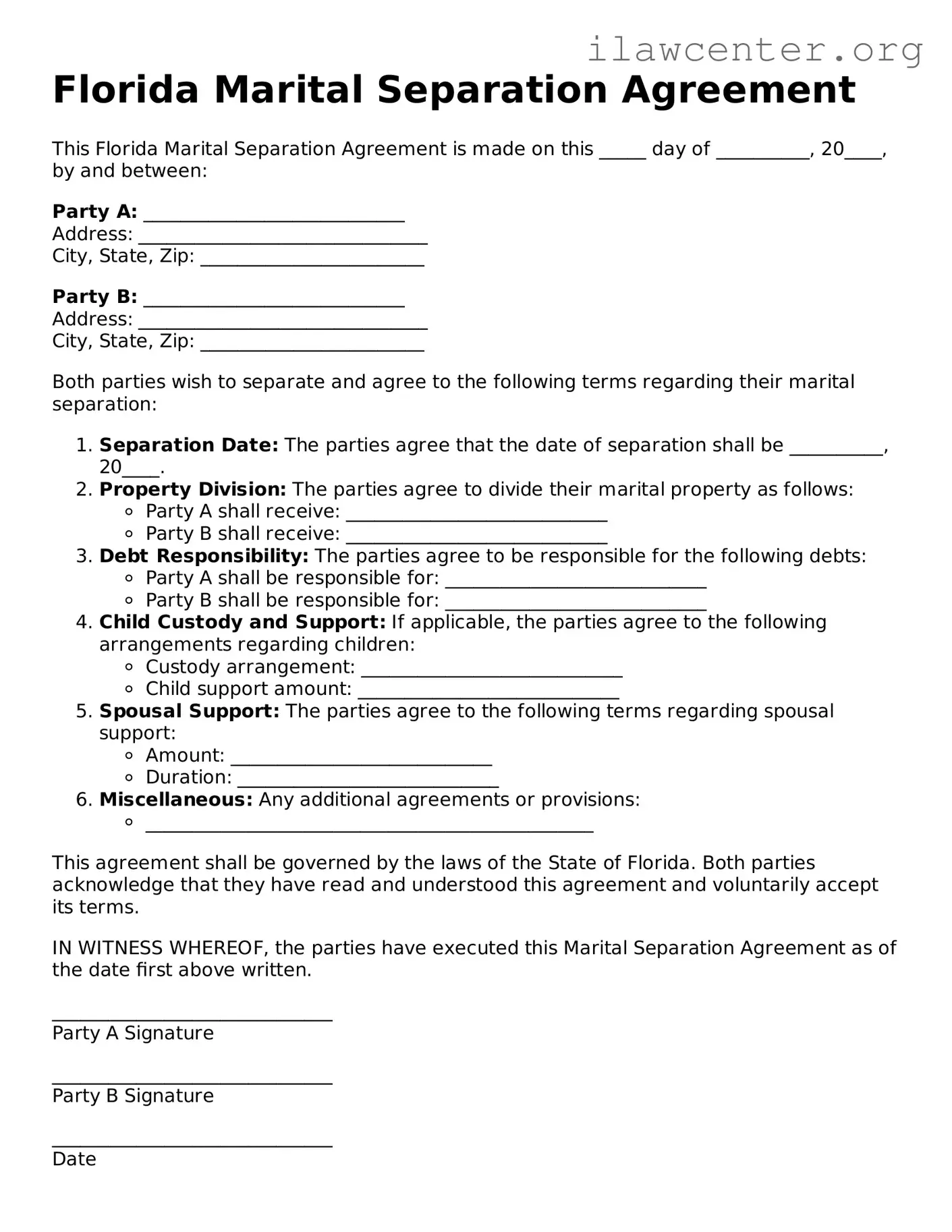
Florida Marital Separation Agreement Preview

Florida Marital Separation Agreement

This Florida Marital Separation Agreement is made on this _____ day of __________, 20____, by and between:

Party A: ____________________________
Address: _______________________________
City, State, Zip: ________________________

Party B: ____________________________
Address: _______________________________
City, State, Zip: ________________________

Both parties wish to separate and agree to the following terms regarding their marital separation:

  1. Separation Date: The parties agree that the date of separation shall be __________, 20____.
  2. Property Division: The parties agree to divide their marital property as follows:
    • Party A shall receive: ____________________________
    • Party B shall receive: ____________________________
  3. Debt Responsibility: The parties agree to be responsible for the following debts:
    • Party A shall be responsible for: ____________________________
    • Party B shall be responsible for: ____________________________
  4. Child Custody and Support: If applicable, the parties agree to the following arrangements regarding children:
    • Custody arrangement: ____________________________
    • Child support amount: ____________________________
  5. Spousal Support: The parties agree to the following terms regarding spousal support:
    • Amount: ____________________________
    • Duration: ____________________________
  6. Miscellaneous: Any additional agreements or provisions:
    • ________________________________________________

This agreement shall be governed by the laws of the State of Florida. Both parties acknowledge that they have read and understood this agreement and voluntarily accept its terms.

IN WITNESS WHEREOF, the parties have executed this Marital Separation Agreement as of the date first above written.

______________________________
Party A Signature

______________________________
Party B Signature

______________________________
Date

PDF Form Characteristics

Fact Name Description
Purpose The Florida Marital Separation Agreement outlines the terms of separation between spouses, including asset division, child custody, and support arrangements.
Governing Law This agreement is governed by Florida Statutes, specifically Chapter 61, which pertains to dissolution of marriage and related matters.
Voluntary Agreement Both parties must voluntarily agree to the terms without coercion. This ensures that the agreement reflects the true intentions of both spouses.
Notarization While notarization is not required, having the agreement notarized can provide additional legal protection and validity.
Modification The terms of the agreement can be modified if both parties consent to the changes in writing.
Enforcement If one party fails to comply with the terms, the other party can seek enforcement through the court system.

Instructions on Utilizing Florida Marital Separation Agreement

After completing the Florida Marital Separation Agreement form, the next steps involve reviewing the document for accuracy and ensuring that both parties understand and agree to the terms outlined. Once finalized, the agreement can be submitted to the appropriate court for approval, if necessary.

  1. Begin by downloading the Florida Marital Separation Agreement form from a reliable source or the official state website.
  2. Fill in the names of both spouses at the top of the form, ensuring that the full legal names are used.
  3. Provide the date of marriage and the date of separation in the designated sections.
  4. List the addresses of both spouses, including the current residence of each party.
  5. Detail any children from the marriage, including their names and birthdates, if applicable.
  6. Outline the terms of property division, specifying which assets and debts belong to each spouse.
  7. Include any agreements regarding spousal support or alimony, if applicable.
  8. Indicate how child custody and visitation will be handled, if children are involved.
  9. Both parties should sign and date the form at the end, confirming their agreement to the terms.
  10. Make copies of the completed form for both parties' records before submission.

Important Facts about Florida Marital Separation Agreement

What is a Florida Marital Separation Agreement?

A Florida Marital Separation Agreement is a legal document that outlines the terms and conditions agreed upon by spouses who wish to separate without filing for divorce. This agreement typically addresses issues such as asset division, debt responsibility, child custody, and support arrangements. It serves to clarify each party's rights and obligations during the separation period.

Is a Marital Separation Agreement legally binding in Florida?

Yes, a Marital Separation Agreement can be legally binding in Florida, provided that both parties voluntarily agree to its terms and sign the document. It is advisable to have the agreement reviewed by an attorney to ensure it complies with state laws and adequately protects both parties' interests.

Can a Marital Separation Agreement be modified?

Yes, a Marital Separation Agreement can be modified if both parties agree to the changes. It is important to document any modifications in writing and have both parties sign the updated agreement. This ensures that the new terms are enforceable and clear to both parties.

Do I need an attorney to create a Marital Separation Agreement?

While it is not legally required to have an attorney to create a Marital Separation Agreement, consulting with one is highly recommended. An attorney can help ensure that the agreement is fair, comprehensive, and compliant with Florida law. They can also provide guidance on important considerations that may be overlooked.

What happens if one party does not comply with the Marital Separation Agreement?

If one party fails to comply with the terms of the Marital Separation Agreement, the other party may seek legal recourse. This can include filing a motion with the court to enforce the agreement. The court may order compliance or address any violations, depending on the circumstances and the specific terms outlined in the agreement.

Common mistakes

Filling out the Florida Marital Separation Agreement form can be a daunting task, and many individuals make common mistakes that could lead to complications down the road. One frequent error is failing to provide accurate personal information. It's essential to ensure that names, addresses, and contact details are correct. Inaccuracies can create confusion and may even delay the legal process.

Another common mistake is overlooking the importance of full financial disclosure. Both parties must list all assets and liabilities. Omitting any financial information can lead to disputes later, as one party may feel cheated if they discover hidden assets. Transparency is key to a smooth separation.

Many individuals also neglect to consider the implications of child custody and support arrangements. It's crucial to address these issues in the agreement. Failing to outline custody arrangements can lead to misunderstandings and conflicts, which can be emotionally taxing for everyone involved, especially the children.

Some people make the mistake of not specifying how debts will be handled. It’s important to clarify who is responsible for which debts in the agreement. If this is not addressed, one party may find themselves unfairly burdened with debts they did not incur.

Additionally, individuals sometimes forget to include a timeline for the separation. This timeline can help both parties understand the duration of the separation and any deadlines for specific actions. Without it, there may be confusion about when certain responsibilities begin or end.

Another mistake is not seeking legal advice before finalizing the agreement. While it may seem tempting to handle everything independently, having a legal professional review the document can provide peace of mind. They can catch errors that might have been overlooked and ensure that the agreement complies with Florida law.

Finally, many individuals fail to keep a copy of the signed agreement. After everything is finalized, it’s essential to retain a copy for your records. Without it, one party may have difficulty enforcing the terms of the agreement in the future, leading to unnecessary complications.

Documents used along the form

A Florida Marital Separation Agreement is an important document that outlines the terms of separation between spouses. However, several other forms and documents may be necessary to ensure a smooth separation process. Below is a list of commonly used documents that complement the Marital Separation Agreement.

  • Parenting Plan: This document details the custody arrangements for any children involved. It specifies visitation rights, decision-making responsibilities, and schedules to ensure the best interests of the children are prioritized.
  • Child Support Agreement: This form outlines the financial support one parent will provide to the other for the children. It includes details on payment amounts, frequency, and any adjustments that may be necessary over time.
  • Property Settlement Agreement: This document details how marital assets and debts will be divided between the spouses. It ensures clarity and fairness in the distribution of property and financial obligations.
  • Financial Affidavit: This form provides a complete picture of each spouse's financial situation, including income, expenses, assets, and liabilities. It is often required in divorce proceedings to ensure equitable distribution.
  • Quit Claim Deed: If real estate is involved, this document is used to transfer ownership of property from one spouse to another. It is crucial for clarifying property rights after separation.
  • Release of Claims: This form is used to waive any future claims against one another regarding property or financial matters. It helps prevent disputes after the separation is finalized.
  • Notice of Intent to Relocate: If one parent wishes to move away with the children, this document notifies the other parent. It is essential for maintaining communication and legal compliance regarding custody arrangements.
  • Final Judgment of Dissolution of Marriage: This court-issued document officially ends the marriage. It incorporates the terms agreed upon in the Marital Separation Agreement and any other related documents.

Understanding these forms can help facilitate a smoother separation process. Each document plays a significant role in addressing various aspects of marital separation, ensuring that both parties are protected and informed throughout the journey.

Similar forms

  • Separation Agreement: This document outlines the terms under which a couple agrees to live apart. It typically covers issues like property division and child custody, similar to a Marital Separation Agreement.

  • Divorce Agreement: When a couple decides to end their marriage, a Divorce Agreement formalizes the terms of the divorce, including asset division and support obligations. Like a Marital Separation Agreement, it addresses how the couple will handle their affairs post-separation.

  • Child Custody Agreement: This document specifically focuses on the arrangements for the care and custody of children. It shares similarities with a Marital Separation Agreement in that both aim to provide clarity and structure for family dynamics after separation.

  • Property Settlement Agreement: This agreement details how a couple will divide their property and debts. It is akin to a Marital Separation Agreement in that both documents seek to resolve financial matters between spouses.

  • Spousal Support Agreement: This document outlines the terms of financial support one spouse will provide to the other post-separation. It parallels the Marital Separation Agreement by addressing financial responsibilities and obligations.

  • Postnuptial Agreement: Created after marriage, this agreement specifies how assets will be handled in the event of a divorce or separation. Like a Marital Separation Agreement, it aims to clarify expectations and responsibilities between spouses.

  • Legal Separation Agreement: This document allows couples to live separately while remaining legally married. It is similar to a Marital Separation Agreement in that both establish terms for living apart and often cover similar issues like custody and support.

  • Collaborative Divorce Agreement: This agreement is part of a collaborative process where both parties work together to resolve their divorce amicably. It shares the goal of a Marital Separation Agreement in promoting cooperation and mutual understanding.

  • Mediation Agreement: In mediation, a neutral third party helps couples negotiate their separation terms. The resulting agreement often resembles a Marital Separation Agreement, as both documents aim to settle disputes and clarify arrangements.

  • Custody Modification Agreement: When circumstances change, this document modifies existing custody arrangements. It is similar to a Marital Separation Agreement in that both address changes in family dynamics and seek to ensure the best interests of children are prioritized.

Dos and Don'ts

When filling out the Florida Marital Separation Agreement form, it is important to approach the task with care. Here are seven key actions to take and avoid:

  • Do read the entire form carefully before starting. Understanding the requirements is crucial.
  • Do provide accurate and complete information. This ensures that the agreement is valid and enforceable.
  • Do discuss the terms with your spouse if possible. Open communication can lead to a more amicable agreement.
  • Do consult a legal professional if you have questions. Expert guidance can clarify complex issues.
  • Don't rush through the form. Taking your time can prevent mistakes that may complicate the process.
  • Don't omit important details. Leaving out information can lead to misunderstandings later.
  • Don't ignore state laws. Familiarize yourself with Florida’s specific requirements for separation agreements.

Misconceptions

Understanding the Florida Marital Separation Agreement form is crucial for individuals considering separation. However, several misconceptions can lead to confusion. Below are five common misconceptions about this form, along with clarifications.

  • It is the same as a divorce. Many people believe that a marital separation agreement is equivalent to a divorce. In reality, a separation agreement is a legal document that outlines the terms of a couple's separation but does not terminate the marriage. Couples remain legally married until they file for divorce.
  • It automatically resolves all issues. Some assume that signing a separation agreement will automatically resolve all issues related to property division, child custody, and support. While the agreement can address these issues, it is not a guarantee that all matters will be settled. Each situation may require further negotiation or legal intervention.
  • It is not legally binding. A common misconception is that a marital separation agreement is merely a suggestion and not legally enforceable. In fact, once properly executed, the agreement is legally binding. Courts may enforce its terms, provided they comply with state laws.
  • It can be changed easily. Many individuals believe that they can modify the agreement at any time without consequence. While changes can be made, they typically require mutual consent and may need to be documented formally. Informal changes may not hold up in court.
  • It is only for couples with children. Some think that a marital separation agreement is only necessary for couples with children. However, any couple considering separation can benefit from having a formal agreement, regardless of whether children are involved. It helps clarify rights and responsibilities for both parties.

Being aware of these misconceptions can help individuals navigate the complexities of separation more effectively. A well-informed approach can lead to better outcomes during this challenging time.

Key takeaways

When filling out and utilizing the Florida Marital Separation Agreement form, there are several important points to consider. This document serves as a critical tool for couples who are choosing to separate while outlining their rights and responsibilities. Here are key takeaways to keep in mind:

  • The agreement should be in writing. Verbal agreements are not enforceable in court.
  • Both parties must fully disclose their financial information. Transparency is essential for a fair agreement.
  • Consider including terms about child custody and support if children are involved. This ensures their needs are prioritized.
  • Property division should be clearly defined. Specify which assets and debts belong to each party.
  • It is advisable to consult with a legal professional. They can help ensure that the agreement complies with Florida laws.
  • The agreement must be signed voluntarily by both parties. Coercion can invalidate the document.
  • Keep copies of the signed agreement. Both parties should retain a copy for their records.
  • Review the agreement periodically. Life circumstances may change, necessitating updates to the terms.
  • Understand that a Marital Separation Agreement does not end the marriage. It is a temporary arrangement until a divorce is finalized.

By considering these key points, individuals can navigate the complexities of separation with greater confidence and clarity.