Attorney-Verified  Medical Power of Attorney Document for Florida

Attorney-Verified Medical Power of Attorney Document for Florida

A Florida Medical Power of Attorney form is a legal document that allows an individual to designate another person to make healthcare decisions on their behalf if they become unable to do so. This form ensures that your medical preferences are honored, even when you cannot communicate them yourself. Take control of your healthcare decisions today by filling out the form below.

Article Guide

In the state of Florida, the Medical Power of Attorney form serves as a vital legal document that allows individuals to designate someone they trust to make healthcare decisions on their behalf in the event they become incapacitated. This form is particularly important for ensuring that a person's medical preferences are honored when they cannot communicate their wishes. The appointed individual, often referred to as a healthcare surrogate, is empowered to make decisions regarding medical treatment, surgeries, and end-of-life care, reflecting the values and desires of the person they represent. It is essential to understand that the Medical Power of Attorney is not just a simple form; it requires careful consideration of whom to choose as a surrogate and what specific instructions to provide. Additionally, the document must be signed in the presence of witnesses or a notary to ensure its validity. By establishing this legal framework, individuals can alleviate the burden on family members during difficult times and ensure that their healthcare choices are respected, aligning medical care with personal beliefs and preferences.

Florida Medical Power of Attorney Preview

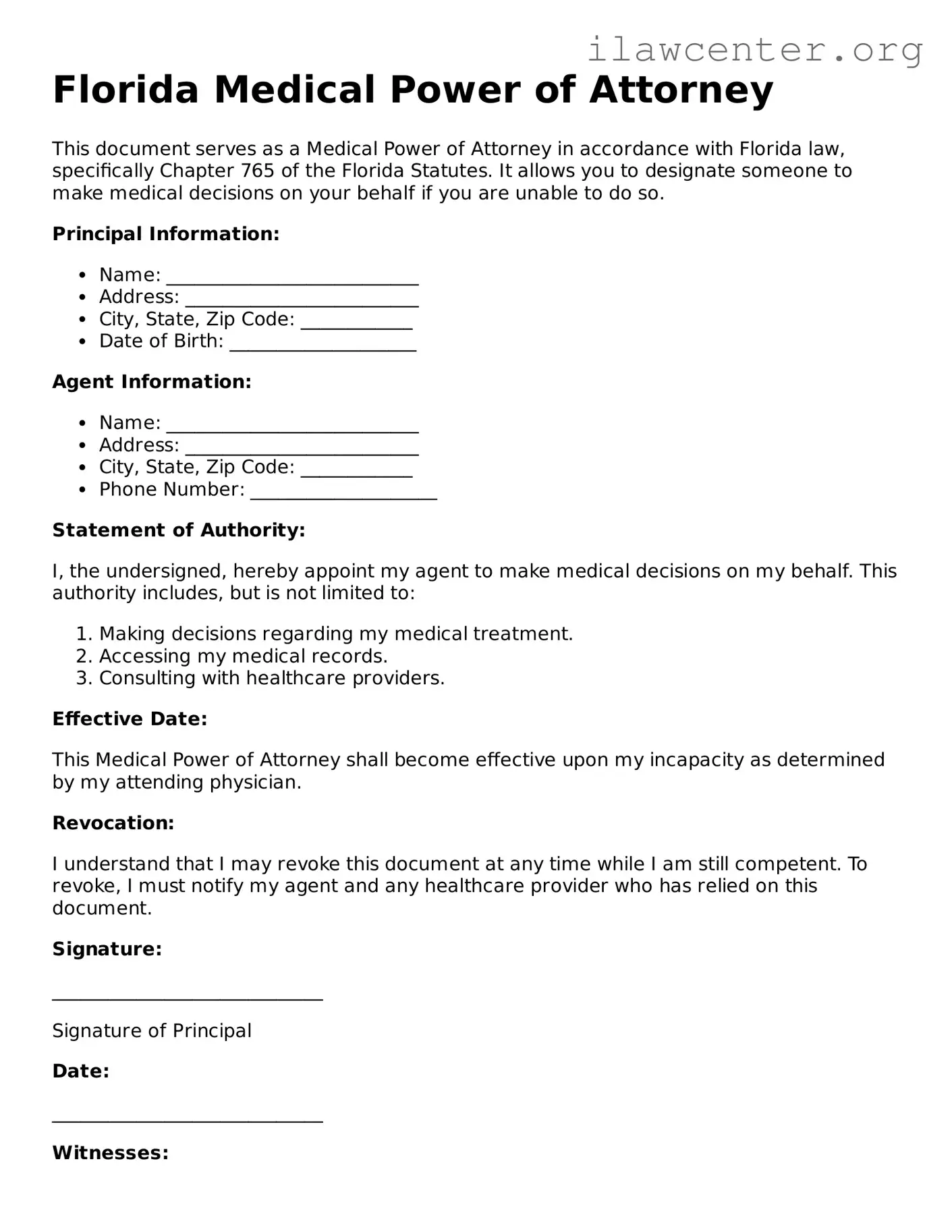
Florida Medical Power of Attorney

This document serves as a Medical Power of Attorney in accordance with Florida law, specifically Chapter 765 of the Florida Statutes. It allows you to designate someone to make medical decisions on your behalf if you are unable to do so.

Principal Information:

  • Name: ___________________________
  • Address: _________________________
  • City, State, Zip Code: ____________
  • Date of Birth: ____________________

Agent Information:

  • Name: ___________________________
  • Address: _________________________
  • City, State, Zip Code: ____________
  • Phone Number: ____________________

Statement of Authority:

I, the undersigned, hereby appoint my agent to make medical decisions on my behalf. This authority includes, but is not limited to:

  1. Making decisions regarding my medical treatment.
  2. Accessing my medical records.
  3. Consulting with healthcare providers.

Effective Date:

This Medical Power of Attorney shall become effective upon my incapacity as determined by my attending physician.

Revocation:

I understand that I may revoke this document at any time while I am still competent. To revoke, I must notify my agent and any healthcare provider who has relied on this document.

Signature:

_____________________________

Signature of Principal

Date:

_____________________________

Witnesses:

This document must be signed in the presence of two witnesses who are not related to the principal or the agent.

  • Witness 1: ______________________
  • Witness 2: ______________________

Notarization:

State of Florida, County of ________________

Subscribed and sworn to before me this ____ day of ___________, 20__.

_____________________________

Notary Public

PDF Form Characteristics

Fact Name Description
Definition A Florida Medical Power of Attorney allows an individual to designate another person to make healthcare decisions on their behalf if they become unable to do so.
Governing Law The Florida Medical Power of Attorney is governed by Chapter 765 of the Florida Statutes.
Requirements The form must be signed by the principal and witnessed by two individuals or notarized to be valid.
Durability This document remains effective even if the principal becomes incapacitated, ensuring that healthcare decisions can still be made.
Revocation The principal can revoke the Medical Power of Attorney at any time, provided they are of sound mind.

Instructions on Utilizing Florida Medical Power of Attorney

After obtaining the Florida Medical Power of Attorney form, it is important to complete it accurately to ensure it reflects the individual's wishes regarding medical decisions. Following the steps below will help in filling out the form correctly.

  1. Begin by entering the name of the person granting the power of attorney (the principal) at the top of the form.
  2. Provide the principal's address, including city, state, and zip code.
  3. Identify the designated agent by writing their full name in the designated area. This is the person who will make medical decisions on behalf of the principal.
  4. Include the agent's address, ensuring it is complete with city, state, and zip code.
  5. Specify any limitations or specific instructions regarding the agent's authority, if applicable. This can be done in the provided section of the form.
  6. Sign and date the form in the appropriate section. The principal must sign to validate the document.
  7. Have the signature witnessed by two individuals who are not related to the principal and who will not benefit from the principal's estate.
  8. Ensure that the witnesses also sign and provide their addresses on the form.

Once completed, the form should be stored in a safe place, and copies should be provided to the designated agent and any relevant healthcare providers. This ensures that the agent is prepared to act on the principal's behalf when necessary.

Important Facts about Florida Medical Power of Attorney

What is a Florida Medical Power of Attorney?

A Florida Medical Power of Attorney is a legal document that allows you to appoint someone to make healthcare decisions on your behalf if you become unable to do so. This ensures that your medical preferences are respected even if you cannot communicate them yourself.

Who can I appoint as my agent?

You can appoint any competent adult as your agent. This could be a family member, friend, or trusted advisor. It's important to choose someone who understands your values and wishes regarding medical treatment.

What types of decisions can my agent make?

Your agent can make a wide range of healthcare decisions, including choices about medical treatments, surgeries, and end-of-life care. They can also decide where you receive care and whether to accept or refuse specific medical procedures.

Do I need a lawyer to create a Medical Power of Attorney?

No, you do not need a lawyer to create a Medical Power of Attorney in Florida. However, it is advisable to seek legal advice to ensure that the document meets all legal requirements and accurately reflects your wishes.

How do I revoke or change my Medical Power of Attorney?

You can revoke or change your Medical Power of Attorney at any time, as long as you are mentally competent. To do this, you should create a new document that clearly states your intentions or formally revoke the previous one in writing.

Is a Medical Power of Attorney the same as a Living Will?

No, a Medical Power of Attorney and a Living Will are not the same. A Living Will outlines your wishes for medical treatment in specific situations, while a Medical Power of Attorney allows someone to make decisions on your behalf if you are unable to communicate.

Does my Medical Power of Attorney need to be notarized?

In Florida, a Medical Power of Attorney does not need to be notarized, but it must be signed by you and witnessed by two adults who are not related to you or entitled to any part of your estate. Notarization can add an extra layer of authenticity.

When does my Medical Power of Attorney become effective?

Your Medical Power of Attorney becomes effective when you are deemed unable to make your own healthcare decisions. This determination is usually made by a physician who assesses your mental competency.

Can I have more than one Medical Power of Attorney?

While you can technically have multiple Medical Powers of Attorney, it can lead to confusion. It’s best to appoint one primary agent and a backup in case the primary is unavailable.

What happens if I don’t have a Medical Power of Attorney?

If you do not have a Medical Power of Attorney and become incapacitated, healthcare providers may need to rely on state laws to determine who can make decisions for you. This can lead to delays and decisions that may not align with your personal wishes.

Common mistakes

Filling out a Florida Medical Power of Attorney form is an important step in ensuring that your healthcare decisions are made according to your wishes. However, many people make common mistakes that can lead to confusion or complications. One significant error is failing to choose the right agent. The selected agent should be someone you trust implicitly, as they will have the authority to make medical decisions on your behalf. Choosing someone without considering their willingness or ability to take on this responsibility can create issues later on.

Another mistake involves not being specific enough in the document. While the form allows for broad authority, it is crucial to outline any specific wishes or limitations you have regarding your medical care. If your preferences are vague or not clearly stated, your agent may struggle to make decisions that align with your values and desires.

Many individuals overlook the importance of having the form properly witnessed and notarized. Florida law requires that the Medical Power of Attorney be signed in the presence of two witnesses and a notary public. Failing to adhere to these requirements can render the document invalid, which means your agent would not have the authority to act on your behalf in a medical crisis.

Additionally, people often neglect to communicate their wishes with their chosen agent. It is not enough to simply fill out the form; discussing your values, preferences, and any specific medical treatments you do or do not want is essential. Without this conversation, your agent may face difficult decisions without a clear understanding of your wishes.

Finally, individuals sometimes forget to review and update their Medical Power of Attorney as circumstances change. Life events such as marriage, divorce, or the death of a previously chosen agent can necessitate changes to your document. Regularly reviewing and updating the form ensures that it remains relevant and accurately reflects your current wishes.

Documents used along the form

When considering a Florida Medical Power of Attorney, it is essential to understand that it often works in conjunction with various other forms and documents. Each of these documents serves a specific purpose, ensuring that your healthcare preferences and legal rights are clearly outlined and respected. Below is a list of commonly used forms that complement the Medical Power of Attorney.

  • Living Will: This document specifies your wishes regarding medical treatment in situations where you are unable to communicate your preferences, particularly in end-of-life scenarios.
  • Durable Power of Attorney: This form grants someone the authority to make financial decisions on your behalf, ensuring that your financial matters are handled according to your wishes.
  • Healthcare Surrogate Designation: Similar to a Medical Power of Attorney, this document allows you to appoint someone to make healthcare decisions for you when you are incapacitated.
  • Do Not Resuscitate (DNR) Order: This order communicates your preference regarding resuscitation efforts in the event of a medical emergency, allowing medical personnel to honor your wishes.
  • Organ Donation Consent: This document indicates your wishes regarding organ donation after your death, ensuring that your preferences are known and respected.
  • HIPAA Release Form: This form allows designated individuals access to your medical records, ensuring that they can make informed decisions regarding your care.
  • Advanced Healthcare Directive: This comprehensive document combines elements of a Living Will and a Medical Power of Attorney, outlining both your healthcare preferences and appointing a decision-maker.
  • Patient Advocate Designation: This form empowers someone to act on your behalf in healthcare situations, advocating for your treatment preferences and rights.
  • Medication Administration Record: This document is used by healthcare providers to track medications administered to you, ensuring that your treatment plan is followed accurately.
  • Emergency Contact Information: This simple form lists individuals to be contacted in case of a medical emergency, ensuring that your loved ones are informed promptly.

Understanding these documents and how they work together can provide peace of mind. It is crucial to ensure that your healthcare wishes are clearly articulated and legally documented, allowing your loved ones and healthcare providers to act in accordance with your preferences. Taking the time to prepare these forms can significantly ease the burden on your family during difficult times.

Similar forms

The Medical Power of Attorney (MPOA) form is an important legal document that allows individuals to designate someone to make healthcare decisions on their behalf. Several other documents serve similar purposes or complement the MPOA in ensuring that a person's healthcare wishes are respected. Below is a list of nine documents that share similarities with the MPOA:

  • Living Will: This document outlines specific medical treatments an individual wishes to receive or avoid in the event they become unable to communicate their preferences. It complements the MPOA by providing clear guidance to the appointed agent.
  • Durable Power of Attorney: Unlike the MPOA, which focuses solely on healthcare decisions, a Durable Power of Attorney allows an individual to appoint someone to handle a broader range of legal and financial matters, remaining effective even if the individual becomes incapacitated.
  • Healthcare Proxy: Similar to the MPOA, a healthcare proxy designates a person to make medical decisions on behalf of another. The terms may vary by state, but the intent remains the same: to ensure someone advocates for the patient’s wishes.
  • Do Not Resuscitate (DNR) Order: This document specifically instructs medical personnel not to perform CPR if the individual’s heart stops or they stop breathing. It is often used in conjunction with the MPOA to clarify end-of-life preferences.
  • Advance Directive: An advance directive is a broader term that encompasses both the MPOA and living wills. It serves as a comprehensive guide for healthcare providers regarding an individual’s wishes for medical treatment.
  • Organ Donation Consent: This document expresses an individual’s wishes regarding organ donation after death. It aligns with the MPOA in that both documents ensure personal choices regarding health and end-of-life care are respected.
  • Patient Advocate Designation: This form allows individuals to appoint a patient advocate who can make healthcare decisions and communicate with medical staff on their behalf, similar to the MPOA.
  • Mental Health Power of Attorney: This document specifically grants someone the authority to make decisions regarding mental health treatment, complementing the MPOA by addressing a specific aspect of healthcare.
  • Informed Consent Forms: These forms are used to obtain permission from patients before medical procedures. While not a decision-making document, they are part of the overall process of ensuring that patient autonomy is respected, similar to the MPOA.

Dos and Don'ts

When filling out the Florida Medical Power of Attorney form, it is crucial to ensure that the document accurately reflects your wishes and meets legal requirements. Here are six important do's and don'ts to consider:

  • Do choose a trusted individual as your agent. This person will make medical decisions on your behalf if you are unable to do so.
  • Do clearly outline your medical preferences. Specify your wishes regarding treatment options and end-of-life care.
  • Do sign the form in the presence of a notary public or witnesses as required by Florida law. This step is essential for the document's validity.
  • Do keep a copy of the completed form in a safe place and share it with your agent and family members.
  • Don't leave any sections blank. Incomplete forms may lead to confusion or legal issues later on.
  • Don't assume that verbal instructions will suffice. Written documentation is necessary to ensure your wishes are honored.

Misconceptions

Many people have misunderstandings about the Florida Medical Power of Attorney form. Here are eight common misconceptions:

  1. It only applies to end-of-life decisions.

    This form is not limited to end-of-life situations. It allows your designated agent to make medical decisions on your behalf whenever you are unable to do so, regardless of the circumstances.

  2. It is the same as a living will.

    A Medical Power of Attorney and a living will serve different purposes. A living will outlines your wishes regarding medical treatment in specific situations, while a Medical Power of Attorney designates someone to make decisions for you.

  3. Once signed, it cannot be changed.

    You can revoke or update your Medical Power of Attorney at any time, as long as you are mentally competent. This flexibility ensures your preferences can be kept current.

  4. Only lawyers can create this document.

    You do not need a lawyer to create a Medical Power of Attorney. While legal assistance can be helpful, individuals can complete the form themselves, provided they follow state guidelines.

  5. It is only valid in Florida.

    While this form is designed for use in Florida, many states recognize out-of-state Medical Powers of Attorney. However, it is advisable to check the specific laws in other states.

  6. My family will automatically make decisions for me.

    Without a Medical Power of Attorney, family members may face challenges in making medical decisions on your behalf. Designating an agent provides clarity and legal authority.

  7. It can be used for financial decisions.

    A Medical Power of Attorney is strictly for healthcare decisions. For financial matters, a separate Durable Power of Attorney is required.

  8. It is only necessary for elderly individuals.

    Anyone, regardless of age, can benefit from having a Medical Power of Attorney. Accidents or sudden illnesses can happen to anyone, making this document important for all adults.

Key takeaways

Filling out a Florida Medical Power of Attorney form is an important step in ensuring your healthcare decisions are honored when you cannot communicate them yourself. Here are some key takeaways to keep in mind:

  • Understand the Purpose: This document allows you to appoint someone you trust to make medical decisions on your behalf if you become incapacitated.
  • Choose Your Agent Wisely: Select a person who understands your values and wishes regarding medical treatment. This individual should be someone you trust to act in your best interest.
  • Be Specific: Clearly outline your preferences regarding medical treatments and interventions. The more specific you are, the better your agent can advocate for you.
  • Sign and Witness: Ensure that you sign the form in the presence of two witnesses. These witnesses cannot be your appointed agent or your immediate family members.
  • Keep Copies Accessible: After completing the form, make multiple copies and share them with your agent, healthcare providers, and family members to ensure they are aware of your wishes.

By following these guidelines, you can ensure that your medical preferences are respected and that your chosen agent is well-prepared to make decisions on your behalf.