Attorney-Verified  Motor Vehicle Power of Attorney Document for Florida

Attorney-Verified Motor Vehicle Power of Attorney Document for Florida

The Florida Motor Vehicle Power of Attorney form allows an individual to appoint someone else to handle vehicle-related matters on their behalf. This can include tasks like transferring ownership, registering a vehicle, or obtaining title documents. If you need to grant someone this authority, consider filling out the form by clicking the button below.

Article Guide

When it comes to managing vehicle-related matters in Florida, having the right legal documents in place can make all the difference. One essential tool for vehicle owners is the Florida Motor Vehicle Power of Attorney form. This document allows you to designate someone else to handle specific tasks related to your vehicle, such as registering, titling, or selling it on your behalf. By granting this power, you can ensure that your interests are represented, even if you cannot be present to manage these affairs yourself. The form is straightforward, requiring both your signature and that of the person you are appointing, known as the agent. Additionally, it’s important to note that the powers granted can be tailored to your needs, whether you want to give full authority or limit it to specific actions. Understanding the nuances of this form can help you navigate the often complex world of vehicle ownership with ease and confidence.

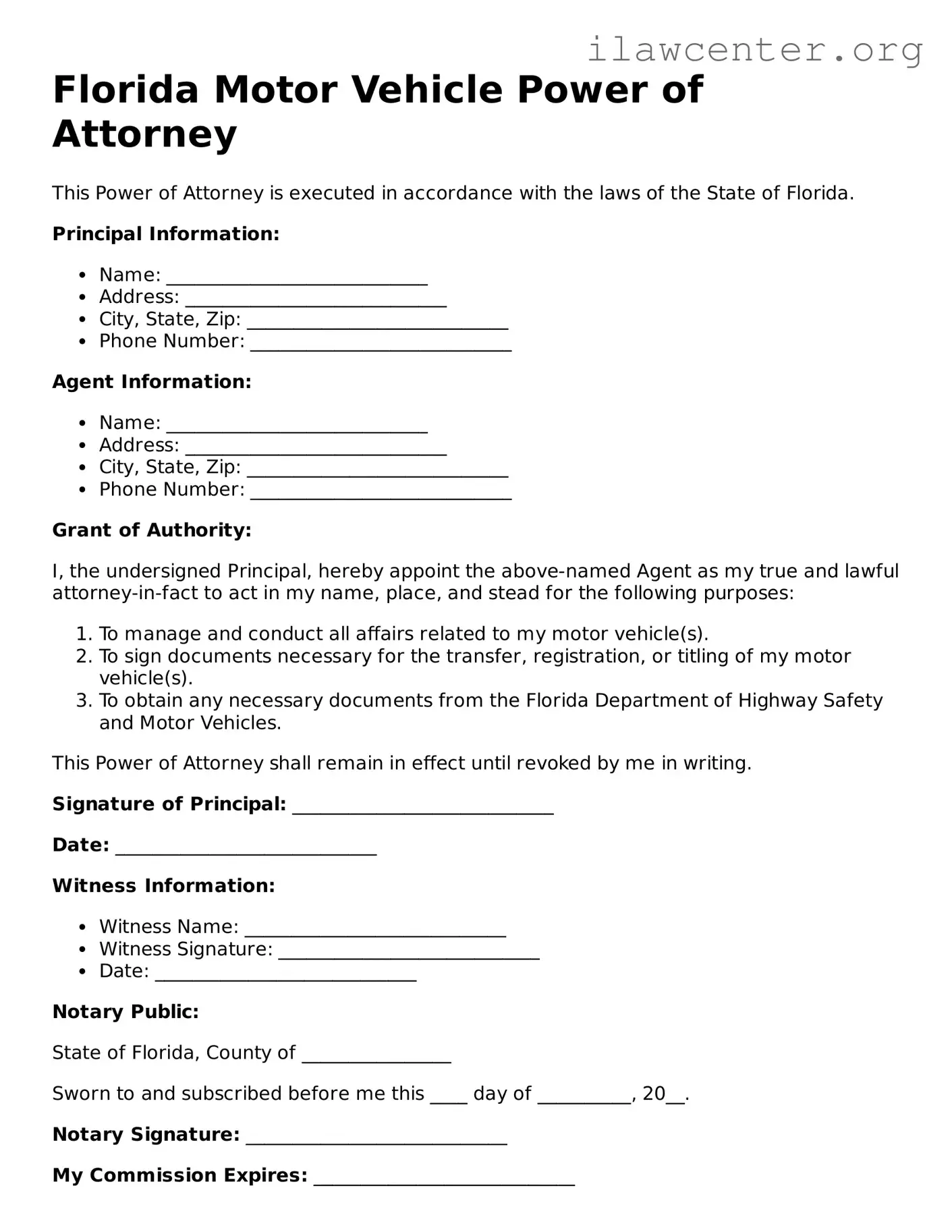
Florida Motor Vehicle Power of Attorney Preview

Florida Motor Vehicle Power of Attorney

This Power of Attorney is executed in accordance with the laws of the State of Florida.

Principal Information:

  • Name: ____________________________
  • Address: ____________________________
  • City, State, Zip: ____________________________
  • Phone Number: ____________________________

Agent Information:

  • Name: ____________________________
  • Address: ____________________________
  • City, State, Zip: ____________________________
  • Phone Number: ____________________________

Grant of Authority:

I, the undersigned Principal, hereby appoint the above-named Agent as my true and lawful attorney-in-fact to act in my name, place, and stead for the following purposes:

  1. To manage and conduct all affairs related to my motor vehicle(s).
  2. To sign documents necessary for the transfer, registration, or titling of my motor vehicle(s).
  3. To obtain any necessary documents from the Florida Department of Highway Safety and Motor Vehicles.

This Power of Attorney shall remain in effect until revoked by me in writing.

Signature of Principal: ____________________________

Date: ____________________________

Witness Information:

  • Witness Name: ____________________________
  • Witness Signature: ____________________________
  • Date: ____________________________

Notary Public:

State of Florida, County of ________________

Sworn to and subscribed before me this ____ day of __________, 20__.

Notary Signature: ____________________________

My Commission Expires: ____________________________

PDF Form Characteristics

Fact Name Details
Purpose The Florida Motor Vehicle Power of Attorney form allows an individual to designate another person to handle motor vehicle transactions on their behalf.
Governing Law This form is governed by Florida Statutes, specifically under Chapter 709, which covers powers of attorney.
Requirements The form must be signed by the principal (the person granting the authority) and may require notarization, depending on the transaction involved.
Usage Commonly used for tasks such as transferring title, registering vehicles, or dealing with the Department of Motor Vehicles.

Instructions on Utilizing Florida Motor Vehicle Power of Attorney

Filling out the Florida Motor Vehicle Power of Attorney form is a straightforward process. After completing the form, you will need to submit it to the appropriate authorities to ensure it is recognized. Here are the steps to guide you through filling out the form.

  1. Start with the title of the form at the top. Make sure it's labeled "Motor Vehicle Power of Attorney."
  2. Fill in the name of the principal, which is the person granting the power of attorney.
  3. Provide the principal's address. This should include the street address, city, state, and zip code.
  4. Enter the name of the agent, the person who will act on behalf of the principal.
  5. Include the agent's address, making sure to write the full street address, city, state, and zip code.
  6. Clearly describe the powers being granted to the agent. This may include selling, transferring, or registering a vehicle.
  7. Specify the vehicle information. Include the make, model, year, and vehicle identification number (VIN).
  8. Indicate the effective date of the power of attorney. This is when the document will become valid.
  9. Have the principal sign and date the form. Ensure that the signature matches the name provided at the top.
  10. Consider having the form notarized for added validity, if required.

Important Facts about Florida Motor Vehicle Power of Attorney

What is a Florida Motor Vehicle Power of Attorney form?

The Florida Motor Vehicle Power of Attorney form is a legal document that allows one person, known as the principal, to authorize another person, known as the agent, to act on their behalf regarding motor vehicle transactions. This can include tasks such as signing documents for vehicle registration, transferring ownership, or handling other related matters. It is particularly useful when the principal cannot be present to complete these transactions themselves.

Who can be designated as an agent in this form?

Any individual who is at least 18 years old and has the legal capacity to enter into contracts can be designated as an agent. This could be a family member, friend, or even a professional service. It is essential to choose someone trustworthy, as the agent will have significant authority over the principal's motor vehicle matters.

How long is the Florida Motor Vehicle Power of Attorney valid?

The validity of the Florida Motor Vehicle Power of Attorney can vary depending on the specific terms outlined in the document. Generally, it remains effective until the principal revokes it or until the specific purpose for which it was created has been fulfilled. It is advisable to review and update the document regularly to ensure it reflects the current wishes of the principal.

What should I do if I want to revoke the Power of Attorney?

If you wish to revoke the Florida Motor Vehicle Power of Attorney, you must do so in writing. It is recommended to create a formal revocation document that clearly states your intention to cancel the power granted to the agent. Once completed, provide a copy of the revocation to the agent and any institutions or entities that were relying on the original Power of Attorney. This ensures that there is no confusion regarding your decision.

Common mistakes

Filling out the Florida Motor Vehicle Power of Attorney form can be a straightforward process, but many individuals make common mistakes that can lead to complications. One frequent error is failing to provide accurate and complete information. It is crucial to ensure that all names, addresses, and identification numbers are correct. Inaccuracies can result in delays or even invalidate the document.

Another mistake often encountered is neglecting to sign the form properly. The principal, or the person granting authority, must sign the document in the designated area. Additionally, witnesses may be required depending on the specific circumstances. Omitting a signature or failing to have the necessary witnesses can render the form ineffective.

People also frequently overlook the importance of specifying the powers granted. The form should clearly outline what actions the agent can take on behalf of the principal. Vague language can lead to misunderstandings or disputes later on. It is essential to be precise and comprehensive in detailing the scope of authority granted.

Lastly, individuals sometimes forget to keep a copy of the completed form. After filling it out, it is wise to retain a signed copy for personal records. This practice ensures that both the principal and the agent have access to the document if questions arise. By avoiding these common mistakes, individuals can help ensure that their Power of Attorney is valid and effective.

Documents used along the form

When handling vehicle-related transactions in Florida, several forms and documents may accompany the Florida Motor Vehicle Power of Attorney. These documents help ensure that all necessary legal requirements are met. Below is a list of commonly used forms.

  • Florida Vehicle Registration Application: This form is used to register a vehicle in Florida. It provides details about the vehicle and the owner.
  • Bill of Sale: A bill of sale serves as proof of the sale of a vehicle. It includes information about the buyer, seller, and vehicle details.
  • Title Application: This application is necessary for obtaining a new title for a vehicle, especially if the original title is lost or damaged.
  • Notice of Sale: This document notifies the Florida Department of Highway Safety and Motor Vehicles that a vehicle has been sold. It helps protect the seller from future liabilities.
  • Affidavit of Heirship: Used when a vehicle is inherited, this affidavit establishes the rightful heir to the vehicle in the absence of a will.
  • Odometer Disclosure Statement: This statement is required for the transfer of ownership and verifies the vehicle's mileage at the time of sale.
  • Application for Duplicate Title: If a vehicle title is lost or stolen, this application is used to request a duplicate title from the state.
  • Vehicle Transfer Notification: This form notifies the state of a change in ownership, ensuring that the vehicle's registration is updated accordingly.

These documents work together to facilitate smooth vehicle transactions and ensure compliance with Florida laws. Properly completing and submitting these forms can help avoid potential legal issues in the future.

Similar forms

  • General Power of Attorney: This document grants broad authority to an agent to act on behalf of the principal in various matters, including financial and legal decisions. Like the Motor Vehicle Power of Attorney, it allows for the delegation of specific powers but covers a wider range of issues.
  • Durable Power of Attorney: Similar to the general version, this document remains effective even if the principal becomes incapacitated. It can include provisions for handling motor vehicle transactions, just like the Motor Vehicle Power of Attorney.
  • Limited Power of Attorney: This form restricts the agent’s authority to specific tasks or decisions. It may be used for a single transaction, such as selling a car, mirroring the focused nature of the Motor Vehicle Power of Attorney.
  • Health Care Power of Attorney: This document allows an agent to make medical decisions on behalf of the principal. While it pertains to health care, it shares the fundamental principle of designating authority to another person, akin to the Motor Vehicle Power of Attorney.
  • Real Estate Power of Attorney: This form permits an agent to manage real estate transactions for the principal. It is similar in that it grants specific powers to handle property matters, just as the Motor Vehicle Power of Attorney does for vehicles.
  • Financial Power of Attorney: This document gives an agent the authority to handle financial matters, such as banking and investments. It parallels the Motor Vehicle Power of Attorney in that both allow for the delegation of authority to manage specific types of assets.

Dos and Don'ts

When filling out the Florida Motor Vehicle Power of Attorney form, it is crucial to ensure accuracy and compliance with state requirements. Here are some important dos and don'ts to keep in mind:

  • Do provide accurate and complete information about both the principal and the agent.
  • Do sign the form in the presence of a notary public to ensure its validity.
  • Do keep a copy of the completed form for your records after submission.
  • Do check for any specific requirements or additional documents needed for your situation.
  • Don't leave any sections of the form blank; incomplete forms may be rejected.
  • Don't use outdated versions of the form; always download the latest version from official sources.
  • Don't assume that verbal agreements are sufficient; everything must be documented in the form.
  • Don't forget to review the form for errors before submission, as mistakes can lead to delays.

Misconceptions

When it comes to the Florida Motor Vehicle Power of Attorney form, several misconceptions can lead to confusion and potential issues. Understanding the facts can help ensure that you are making informed decisions. Here are four common misconceptions:

  1. Misconception 1: The form is only necessary for selling a vehicle.

    Many people believe that a Motor Vehicle Power of Attorney is only needed when selling a car. In reality, this form can be used for various purposes, including transferring ownership, registering a vehicle, or handling any other matters related to motor vehicles.

  2. Misconception 2: Anyone can act as an agent.

    Some individuals think that any person can serve as their agent on this form. However, the agent must be a competent adult and should ideally be someone you trust, as they will have the authority to make decisions on your behalf regarding your vehicle.

  3. Misconception 3: The form does not need to be notarized.

    Another common belief is that notarization is not required. In Florida, the Motor Vehicle Power of Attorney must be signed in the presence of a notary public to be considered valid. This step helps to ensure the authenticity of the document.

  4. Misconception 4: The form is permanent and cannot be revoked.

    Some people assume that once they complete and sign the form, it remains in effect indefinitely. In fact, you can revoke the Power of Attorney at any time, as long as you follow the proper procedures to do so. Keeping your documents updated is essential for your peace of mind.

By clarifying these misconceptions, you can navigate the process of using a Florida Motor Vehicle Power of Attorney with greater confidence and understanding.

Key takeaways

When filling out and using the Florida Motor Vehicle Power of Attorney form, it is essential to understand several key aspects. Below are important takeaways to consider:

  1. Purpose: The form allows an individual (the principal) to designate another person (the agent) to handle motor vehicle transactions on their behalf.
  2. Eligibility: Both the principal and the agent must be at least 18 years old. The agent should also be someone the principal trusts.
  3. Specificity: Clearly outline the powers granted to the agent. This may include buying, selling, or registering a vehicle.
  4. Duration: The power of attorney can be limited to a specific time frame or remain in effect until revoked by the principal.
  5. Signature Requirement: The principal must sign the form in the presence of a notary public to ensure its validity.
  6. Revocation: The principal has the right to revoke the power of attorney at any time, provided they do so in writing.
  7. Usage: The agent should present the completed form to relevant parties, such as the Department of Motor Vehicles (DMV), to perform the designated tasks.
  8. Record Keeping: It is advisable for the principal to keep a copy of the signed form for their records.
  9. Legal Advice: Consulting with a legal professional may be beneficial to ensure the form meets all requirements and adequately reflects the principal's wishes.