Attorney-Verified  Non-compete Agreement Document for Florida

Attorney-Verified Non-compete Agreement Document for Florida

A Florida Non-compete Agreement form is a legal document that restricts an employee from competing with their employer for a specified time after leaving the job. This agreement aims to protect the employer's business interests and confidential information. To ensure you understand your rights and obligations, consider filling out the form by clicking the button below.

Article Guide

In the competitive landscape of Florida's job market, employers often seek to protect their business interests through the use of non-compete agreements. These legal documents play a crucial role in defining the boundaries of employee conduct after leaving a company. A well-structured non-compete agreement form outlines essential components, including the duration of the restriction, geographic scope, and the specific activities that are prohibited. Employers must ensure that these agreements are reasonable and enforceable under Florida law, which requires consideration of factors such as the necessity of protecting legitimate business interests and the potential impact on an employee's ability to find work. Employees, on the other hand, should carefully review these agreements before signing, as they can significantly affect future employment opportunities. Understanding the nuances of the Florida Non-compete Agreement form is vital for both employers and employees to navigate the complexities of employment relationships and safeguard their respective interests.

Florida Non-compete Agreement Preview

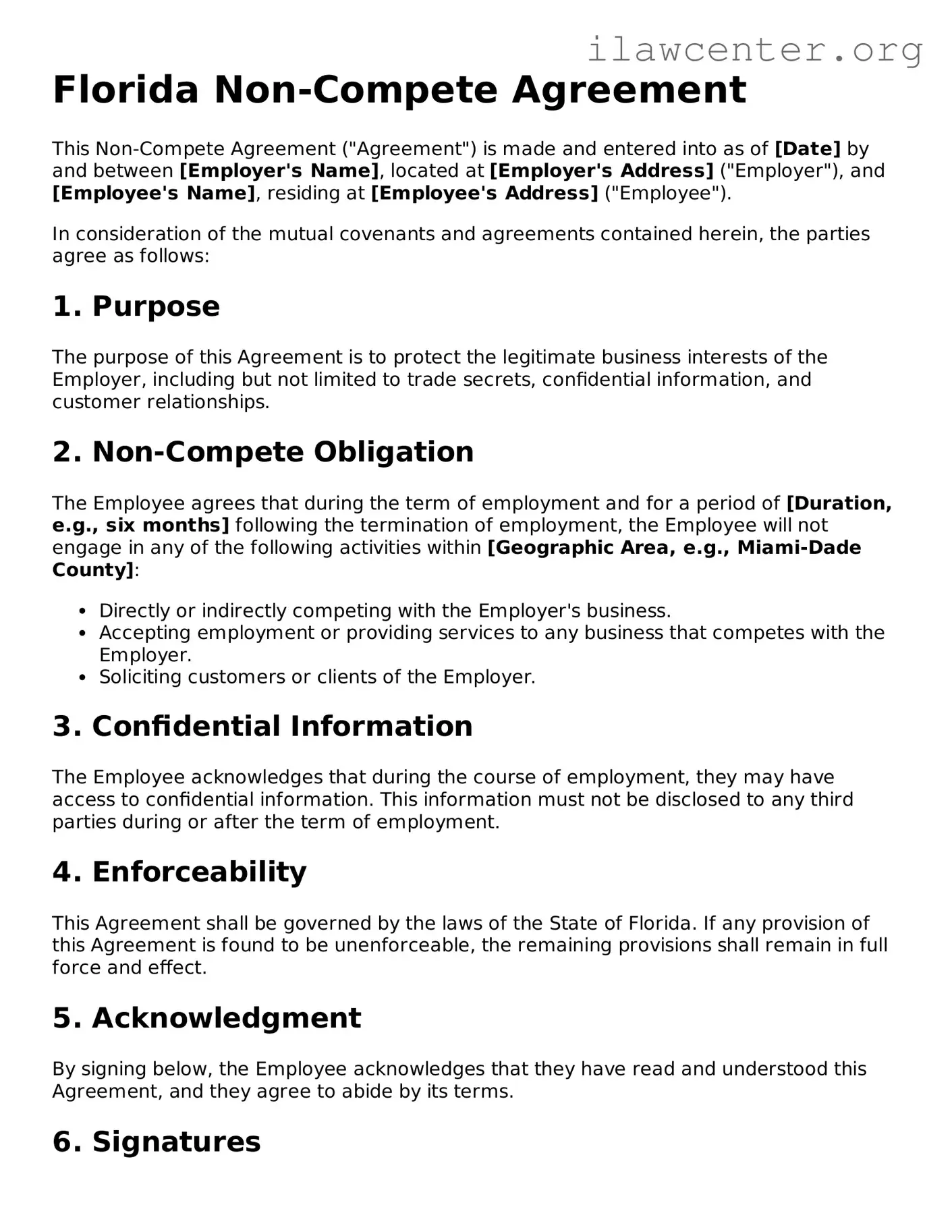
Florida Non-Compete Agreement

This Non-Compete Agreement ("Agreement") is made and entered into as of [Date] by and between [Employer's Name], located at [Employer's Address] ("Employer"), and [Employee's Name], residing at [Employee's Address] ("Employee").

In consideration of the mutual covenants and agreements contained herein, the parties agree as follows:

1. Purpose

The purpose of this Agreement is to protect the legitimate business interests of the Employer, including but not limited to trade secrets, confidential information, and customer relationships.

2. Non-Compete Obligation

The Employee agrees that during the term of employment and for a period of [Duration, e.g., six months] following the termination of employment, the Employee will not engage in any of the following activities within [Geographic Area, e.g., Miami-Dade County]:

  • Directly or indirectly competing with the Employer's business.
  • Accepting employment or providing services to any business that competes with the Employer.
  • Soliciting customers or clients of the Employer.

3. Confidential Information

The Employee acknowledges that during the course of employment, they may have access to confidential information. This information must not be disclosed to any third parties during or after the term of employment.

4. Enforceability

This Agreement shall be governed by the laws of the State of Florida. If any provision of this Agreement is found to be unenforceable, the remaining provisions shall remain in full force and effect.

5. Acknowledgment

By signing below, the Employee acknowledges that they have read and understood this Agreement, and they agree to abide by its terms.

6. Signatures

IN WITNESS WHEREOF, the parties hereto have executed this Non-Compete Agreement as of the date first above written.

______________________________
[Employer's Name]
Employer

______________________________
[Employee's Name]
Employee

PDF Form Characteristics

Fact Name Description
Definition A Florida Non-compete Agreement is a contract that restricts an individual's ability to work in a similar field after leaving a job.
Governing Law Florida Statutes, Chapter 542.335 governs non-compete agreements in the state.
Duration The duration of a non-compete clause must be reasonable, typically not exceeding two years.
Geographic Scope The agreement must specify a reasonable geographic area where the restrictions apply.
Consideration For a non-compete agreement to be enforceable, there must be adequate consideration, such as employment or access to confidential information.
Enforceability Florida courts will enforce a non-compete agreement if it is deemed reasonable in scope, duration, and geographic area.
Exceptions Non-compete agreements may not be enforced against certain professions, such as physicians and certain public employees.
Legal Action If a non-compete agreement is violated, the employer may seek injunctive relief or damages in court.

Instructions on Utilizing Florida Non-compete Agreement

Completing the Florida Non-compete Agreement form requires attention to detail and accurate information. Once the form is filled out correctly, it can be signed by both parties to establish the terms of the agreement.

  1. Obtain the Florida Non-compete Agreement form from a reliable source.
  2. Read through the entire form to understand its sections and requirements.
  3. Begin with the first section, which typically requires the names of the parties involved. Fill in the full legal names of the employer and employee.
  4. Proceed to the section outlining the scope of the non-compete agreement. Clearly define the nature of the business and the specific activities that are restricted.
  5. Specify the geographic area where the non-compete applies. This should be a reasonable distance relevant to the business.
  6. Indicate the duration of the non-compete period. This is the length of time the agreement will remain in effect after employment ends.
  7. Review any additional clauses or terms included in the form, ensuring they are applicable to your situation.
  8. Sign and date the form in the designated areas. Ensure that both parties sign the document.
  9. Make copies of the signed agreement for all parties involved for their records.

Important Facts about Florida Non-compete Agreement

What is a Florida Non-compete Agreement?

A Florida Non-compete Agreement is a legal contract between an employer and an employee. It restricts the employee from engaging in activities that compete with the employer’s business for a specified period and within a defined geographic area after leaving the company. This agreement aims to protect the employer's business interests, trade secrets, and customer relationships.

Who can use a Non-compete Agreement in Florida?

Any business owner or employer in Florida can utilize a Non-compete Agreement to safeguard their business interests. This includes corporations, partnerships, and sole proprietors. However, it is essential that the agreement is reasonable in scope and duration to be enforceable.

What are the key elements of a valid Non-compete Agreement?

For a Non-compete Agreement to be valid in Florida, it must include several critical elements: a legitimate business interest, reasonable geographic limitations, a defined duration of restriction, and clear terms outlining the prohibited activities. These components help ensure the agreement is enforceable in a court of law.

How long can a Non-compete Agreement last in Florida?

The duration of a Non-compete Agreement in Florida varies based on the nature of the business and the specific circumstances. Generally, agreements lasting up to two years are considered reasonable. However, the length must be justified based on the business interests being protected.

Can a Non-compete Agreement be enforced if I leave my job?

Yes, a Non-compete Agreement can be enforced if you leave your job, provided that the agreement is valid and reasonable. If you attempt to work for a competing business or start your own within the restricted timeframe and area, your former employer may take legal action against you.

What happens if I breach a Non-compete Agreement?

If you breach a Non-compete Agreement, your former employer may seek legal remedies. This could include seeking an injunction to prevent you from working for a competitor, as well as potential financial damages. It is crucial to understand the terms of the agreement to avoid such consequences.

Are there any exceptions to Non-compete Agreements in Florida?

Yes, certain exceptions may apply. For instance, if the agreement is deemed overly broad or unreasonable, a court may refuse to enforce it. Additionally, if an employee is terminated without cause, they may be exempt from the restrictions outlined in the agreement.

Can I negotiate the terms of a Non-compete Agreement?

Absolutely. Negotiating the terms of a Non-compete Agreement is common and often encouraged. Both parties should discuss the duration, geographic limitations, and scope of the agreement to ensure that it is fair and reasonable for all involved.

What should I do if I am asked to sign a Non-compete Agreement?

If you are asked to sign a Non-compete Agreement, take the time to read it carefully. Consider consulting with a legal professional to understand your rights and obligations fully. This step can help you make an informed decision about whether to sign the agreement.

Is it possible to void a Non-compete Agreement?

Yes, a Non-compete Agreement can potentially be voided if it does not meet the legal requirements or if it is found to be unreasonable. Courts may also invalidate agreements that impose undue hardship on employees or are contrary to public policy. Legal counsel can provide guidance on this matter.
Common mistakes

Filling out the Florida Non-compete Agreement form can be a daunting task, and many individuals make common mistakes that can have significant consequences. One frequent error is failing to clearly define the scope of the non-compete. It is crucial to specify the geographic area and the duration of the restriction. Without clear parameters, the agreement may be deemed unenforceable in court.

Another mistake involves overlooking the specific activities that are restricted. Individuals often assume that the terms are understood, but vague language can lead to confusion. Clearly outlining which activities are prohibited helps to avoid misunderstandings and ensures that both parties are on the same page.

Many people also neglect to consider the reasonableness of the agreement. Florida law requires that non-compete agreements be reasonable in terms of time, geography, and the business interests being protected. If the terms are too broad or overly restrictive, a court may invalidate the agreement. It is essential to strike a balance that protects the employer's interests while allowing the employee to pursue their career.

Additionally, failing to seek legal advice is a common pitfall. Individuals may feel confident in their understanding of the agreement, but consulting with a legal expert can provide valuable insights. A legal professional can help identify potential issues and ensure that the agreement complies with Florida law, ultimately protecting both parties.

Lastly, many people do not take the time to read the entire agreement before signing. This oversight can lead to unexpected obligations and restrictions. It is vital to thoroughly review the document and ask questions about any unclear terms. Taking the time to understand the implications of the agreement can prevent future disputes and ensure a smoother transition in employment.

Documents used along the form

When entering into a Florida Non-compete Agreement, several other documents and forms may accompany it to ensure clarity and legal protection for all parties involved. These documents can help define the terms of the agreement, outline responsibilities, and provide necessary disclosures. Below is a list of commonly used forms that often accompany a Non-compete Agreement in Florida.

  • Employment Agreement: This document outlines the terms of employment, including job responsibilities, compensation, and duration of employment. It often includes clauses about confidentiality and non-compete obligations.
  • Confidentiality Agreement: Also known as a Non-disclosure Agreement (NDA), this form protects sensitive information shared between the employer and employee during and after the employment period.
  • Non-solicitation Agreement: This agreement restricts an employee from soliciting clients or customers of the employer for a specified period after leaving the company.
  • Severance Agreement: This document outlines the terms under which an employee may receive severance pay upon termination, often including clauses that reinforce non-compete and confidentiality obligations.
  • Independent Contractor Agreement: For those who work as independent contractors, this agreement defines the terms of the working relationship and may include non-compete clauses relevant to the contractor's services.
  • Intellectual Property Assignment Agreement: This document ensures that any intellectual property created by an employee during their employment belongs to the employer, often linked to non-compete clauses.
  • Release of Claims: A release form can be used when an employee leaves a company, waiving their right to bring any claims against the employer, which may also reference non-compete obligations.
  • Job Offer Letter: This letter formally offers employment and may include references to the non-compete agreement, ensuring that the candidate understands the terms before accepting the position.
  • Termination Letter: When an employment relationship ends, this letter can outline the reasons for termination and reiterate any ongoing obligations under the non-compete agreement.

Understanding these documents can provide clarity and protect the interests of both employers and employees. When drafting or reviewing a Florida Non-compete Agreement, it is essential to consider how these forms interact and support the overall agreement, ensuring that all parties are on the same page regarding their rights and responsibilities.

Similar forms

A Non-compete Agreement is a legal document that restricts an individual from engaging in business activities that compete with their employer after leaving the company. This type of agreement shares similarities with several other legal documents. Here are eight documents that are akin to a Non-compete Agreement, along with a brief explanation of their similarities:

  • Non-disclosure Agreement (NDA): Like a Non-compete Agreement, an NDA protects sensitive information. While a Non-compete restricts future employment, an NDA prevents the sharing of confidential information obtained during employment.
  • Non-solicitation Agreement: This document restricts an individual from soliciting clients or employees from their former employer. Both agreements aim to protect business interests and maintain competitive advantages.
  • Employment Contract: An employment contract outlines the terms of employment, including duties, compensation, and restrictions. A Non-compete Agreement is often included as a clause within this broader contract.
  • Confidentiality Agreement: Similar to an NDA, a confidentiality agreement focuses on protecting proprietary information. Both documents serve to safeguard a company’s intellectual property and trade secrets.
  • Partnership Agreement: This document governs the relationship between business partners. It may include clauses similar to a Non-compete Agreement to prevent partners from starting competing businesses after separation.
  • Severance Agreement: Often provided upon termination, a severance agreement may include a Non-compete clause as a condition for receiving severance pay. Both agreements aim to clarify post-employment obligations.
  • Franchise Agreement: This document outlines the rights and responsibilities of the franchisor and franchisee. It may contain Non-compete provisions to protect the franchisor’s brand and business model.
  • License Agreement: A license agreement grants permission to use intellectual property. It may include restrictions similar to those found in a Non-compete Agreement to prevent the licensee from competing directly with the licensor.

Understanding these documents can provide clarity on how they function to protect business interests and maintain fair competition within various industries.

Dos and Don'ts

When filling out the Florida Non-compete Agreement form, it’s important to follow certain guidelines to ensure that the document is completed correctly. Here’s a list of what to do and what to avoid:

  • Do read the entire agreement carefully before signing.
  • Do consult with a legal professional if you have questions.
  • Do provide accurate and complete information.
  • Do understand the terms and conditions outlined in the agreement.
  • Do keep a copy of the signed agreement for your records.
  • Don't rush through the form; take your time to ensure accuracy.
  • Don't sign the agreement without fully understanding its implications.
  • Don't leave any sections blank unless instructed to do so.
  • Don't ignore any deadlines for submission or signing.

Misconceptions

Non-compete agreements are often misunderstood. Here are six common misconceptions about the Florida Non-compete Agreement form:

  1. Non-compete agreements are always enforceable.

    This is not true. In Florida, for a non-compete agreement to be enforceable, it must be reasonable in scope, duration, and geographic area. Courts may refuse to enforce overly restrictive agreements.

  2. All employees must sign a non-compete agreement.

    Not every employee is required to sign a non-compete agreement. Typically, these agreements are more common for employees in sensitive positions or those with access to trade secrets.

  3. Non-compete agreements are the same as non-disclosure agreements.

    While both types of agreements protect business interests, they serve different purposes. A non-disclosure agreement focuses on keeping confidential information private, whereas a non-compete agreement restricts an employee's ability to work in similar fields after leaving a job.

  4. Signing a non-compete means you can never work in your field again.

    This is a misconception. A non-compete agreement may limit where and for how long you can work in your field, but it does not completely ban you from your profession.

  5. Non-compete agreements can be enforced after termination of employment.

    In many cases, they can be enforced after termination, but the specifics depend on the terms of the agreement. It is essential to review the language used in the contract.

  6. All non-compete agreements are the same across Florida.

    This is incorrect. Non-compete agreements can vary widely in their terms and conditions. Each agreement is unique and should be tailored to the specific situation and needs of the business.

Key takeaways

When filling out and using the Florida Non-compete Agreement form, consider the following key takeaways:

  • Understand the Purpose: A non-compete agreement protects a business’s interests by preventing employees from working for competitors or starting similar businesses within a specified timeframe and geographic area.
  • Define the Scope: Clearly outline the activities that are restricted. This ensures that both parties understand what is prohibited.
  • Geographic Limitations: Specify the geographic area where the non-compete applies. This area should be reasonable and directly related to the business interests.
  • Duration: Determine a reasonable duration for the non-compete. Florida courts generally favor shorter timeframes.
  • Consideration: Provide something of value in exchange for the agreement, such as a job offer or access to confidential information.
  • Review State Laws: Familiarize yourself with Florida’s specific laws regarding non-compete agreements. Certain provisions may be unenforceable.
  • Consult a Lawyer: Before finalizing the agreement, seek legal advice to ensure that the document is enforceable and meets all legal requirements.