Attorney-Verified  Self-Proving Affidavit Document for Florida

Attorney-Verified Self-Proving Affidavit Document for Florida

The Florida Self-Proving Affidavit is a legal document that allows a testator's will to be validated without the need for witnesses to testify in court. This form simplifies the probate process, ensuring that the deceased's wishes are honored efficiently. To learn more about how to complete this essential document, fill out the form by clicking the button below.

Article Guide

The Florida Self-Proving Affidavit is a vital legal instrument designed to simplify the probate process for individuals creating a will. By incorporating this affidavit, testators can affirm the validity of their wills without requiring witnesses to testify in court. This form serves to streamline the administration of estates, ensuring that the decedent's wishes are honored while reducing the potential for disputes among heirs. The affidavit must be executed in conjunction with the will and requires the signatures of the testator and two witnesses, all of whom must affirm the document's authenticity. In addition to its practical benefits, the Self-Proving Affidavit also provides a layer of protection against challenges to the will's legitimacy, thereby offering peace of mind to both the testator and their loved ones. Understanding the nuances of this form is essential for anyone involved in estate planning or the management of a deceased person's affairs in Florida.

Florida Self-Proving Affidavit Preview

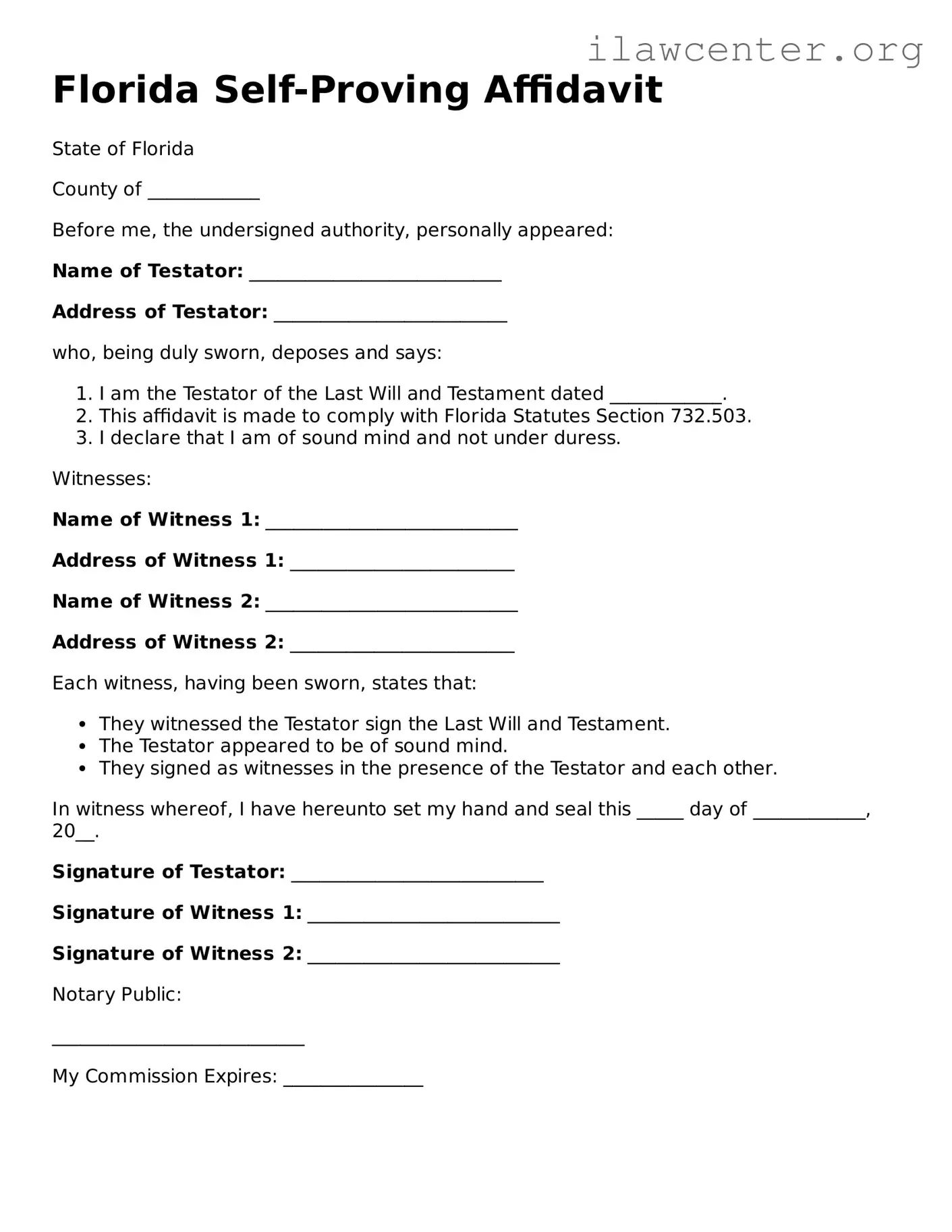
Florida Self-Proving Affidavit

State of Florida

County of ____________

Before me, the undersigned authority, personally appeared:

Name of Testator: ___________________________

Address of Testator: _________________________

who, being duly sworn, deposes and says:

  1. I am the Testator of the Last Will and Testament dated ____________.
  2. This affidavit is made to comply with Florida Statutes Section 732.503.
  3. I declare that I am of sound mind and not under duress.

Witnesses:

Name of Witness 1: ___________________________

Address of Witness 1: ________________________

Name of Witness 2: ___________________________

Address of Witness 2: ________________________

Each witness, having been sworn, states that:

  • They witnessed the Testator sign the Last Will and Testament.
  • The Testator appeared to be of sound mind.
  • They signed as witnesses in the presence of the Testator and each other.

In witness whereof, I have hereunto set my hand and seal this _____ day of ____________, 20__.

Signature of Testator: ___________________________

Signature of Witness 1: ___________________________

Signature of Witness 2: ___________________________

Notary Public:

___________________________

My Commission Expires: _______________

PDF Form Characteristics

Fact Name Details
Purpose The Florida Self-Proving Affidavit allows a testator's will to be validated without the need for witnesses to testify in court.
Governing Law This form is governed by Florida Statutes, Chapter 732.503.
Requirements The affidavit must be signed by the testator and two witnesses in the presence of a notary public.
Benefits Using this affidavit simplifies the probate process and can expedite the validation of the will.

Instructions on Utilizing Florida Self-Proving Affidavit

Completing the Florida Self-Proving Affidavit form is an important step in ensuring that your will is legally recognized and can be easily validated after your passing. This process involves gathering necessary information and carefully filling out the form. Follow the steps below to complete the affidavit accurately.

  1. Begin by obtaining the Florida Self-Proving Affidavit form. You can find this form online or through legal stationery stores.
  2. At the top of the form, write the name of the testator, the person who created the will.
  3. Next, include the date the will was signed. This is crucial for establishing the timeline of your estate planning.
  4. In the designated section, list the names of the witnesses. You will need at least two witnesses who were present when the will was signed.
  5. Each witness must sign the form in the appropriate space provided. Ensure they include their printed names and addresses for clarity.
  6. After the witnesses have signed, the testator must also sign the affidavit in the specified area.
  7. Finally, have the affidavit notarized. This step adds an extra layer of validation and ensures that the signatures are authentic.

Once the form is completed and notarized, it can be stored with your will. This will help streamline the probate process and provide clear evidence of your intentions regarding your estate.

Important Facts about Florida Self-Proving Affidavit

What is a Florida Self-Proving Affidavit?

A Florida Self-Proving Affidavit is a legal document that allows a will to be validated without the need for witnesses to testify in court. This affidavit is typically signed by the testator (the person who made the will) and two witnesses at the same time as the will. It simplifies the probate process, making it easier and quicker for the estate to be settled after the testator's passing.

Why should I use a Self-Proving Affidavit?

Using a Self-Proving Affidavit can save time and reduce complications during the probate process. When a will is self-proving, the court accepts it as valid without requiring the witnesses to appear and testify. This can help avoid potential disputes about the will's authenticity and streamline the administration of the estate.

How do I create a Self-Proving Affidavit in Florida?

To create a Self-Proving Affidavit, you must ensure that it is signed by the testator and two witnesses in the presence of a notary public. The affidavit should include a statement affirming that the testator was of sound mind and that the will was signed voluntarily. It is advisable to consult with an attorney to ensure that the affidavit meets all legal requirements.

Can I revoke a Self-Proving Affidavit?

Yes, a Self-Proving Affidavit can be revoked if the testator decides to change their will or create a new one. However, the revocation must be done in accordance with Florida law, which typically requires the testator to destroy the old will or create a new document that explicitly revokes the previous will. It is important to keep all documents organized to avoid confusion.

Is a Self-Proving Affidavit necessary for all wills in Florida?

No, a Self-Proving Affidavit is not required for all wills in Florida. While it can provide significant benefits, especially in simplifying the probate process, it is not mandatory. Individuals can choose to create a will without an affidavit, but doing so may lead to a longer and more complicated probate process.

Where can I find a Self-Proving Affidavit form?

Self-Proving Affidavit forms can typically be found online through legal websites, state government resources, or by consulting with an attorney. It is important to use a form that complies with Florida laws to ensure its validity. Always double-check that the form is up-to-date and meets the specific requirements for your situation.

Common mistakes

When individuals fill out the Florida Self-Proving Affidavit form, several common mistakes can lead to complications in the estate planning process. One significant error occurs when the testator, the person making the will, fails to sign the affidavit in the presence of witnesses. The law requires that the testator's signature be made in front of two witnesses who also need to sign the document. Omitting this step can render the affidavit invalid.

Another frequent mistake is neglecting to include the full names and addresses of both witnesses. The affidavit must clearly identify the witnesses to ensure their credibility and availability for any future legal proceedings. Failing to provide this information can create confusion and may complicate the validation of the will.

Additionally, individuals sometimes forget to date the affidavit. A date is crucial as it establishes when the affidavit was executed. Without a date, questions may arise regarding the timing of the will’s creation, potentially leading to disputes among heirs or beneficiaries.

Some people also mistakenly assume that the Self-Proving Affidavit can be completed after the will has been signed. In reality, the affidavit should be executed at the same time as the will to ensure that it meets all legal requirements. This oversight can jeopardize the self-proving status of the will.

Another common error involves the misunderstanding of the role of notaries. While a notary public can provide additional authentication, the Self-Proving Affidavit itself does not require notarization to be valid. However, some individuals mistakenly believe that notarization is mandatory, which can lead to unnecessary delays or additional costs.

Finally, individuals sometimes overlook the importance of reviewing the entire document before submission. Errors in any part of the affidavit can lead to complications. Ensuring that all sections are filled out correctly, with no missing information, is vital for the affidavit to hold up in court.

Documents used along the form

The Florida Self-Proving Affidavit is an important document that can simplify the probate process by affirming the validity of a will. Alongside this affidavit, several other forms and documents are commonly utilized to ensure the proper execution and administration of a will. Below is a list of these documents, each serving a distinct purpose in the estate planning and probate process.

  • Last Will and Testament: This document outlines how a person's assets and property will be distributed upon their death. It specifies beneficiaries and may appoint an executor to manage the estate.
  • Durable Power of Attorney: This form grants another individual the authority to make financial and legal decisions on behalf of the person, particularly if they become incapacitated.
  • Healthcare Surrogate Designation: This document allows an individual to appoint someone to make healthcare decisions on their behalf if they are unable to do so themselves.
  • Living Will: A living will expresses a person's wishes regarding medical treatment and end-of-life care. It guides healthcare providers and family members in making decisions when the individual cannot communicate their preferences.
  • Affidavit of Heirship: This document is often used to establish the identity of heirs and their rights to inherit property when a person dies without a will.
  • Notice of Administration: This notice informs interested parties about the probate proceedings of a deceased person's estate, providing them with essential details regarding the administration process.

These documents play a critical role in estate planning and probate, ensuring that individuals' wishes are honored and that their affairs are managed according to their preferences. Properly preparing and utilizing these forms can facilitate a smoother transition during what can be a challenging time for families and loved ones.

Similar forms

The Self-Proving Affidavit is a legal document that can simplify the probate process by affirming the validity of a will. Several other documents share similar purposes or functions. Here are eight documents that are comparable to the Self-Proving Affidavit:

  • Last Will and Testament: This is the primary document that outlines how a person's assets should be distributed after their death. Like the Self-Proving Affidavit, it requires signatures and can be contested if not properly executed.
  • Durable Power of Attorney: This document grants someone the authority to make financial or legal decisions on behalf of another person. It, too, must be signed and can be challenged if not properly executed.
  • Living Will: A Living Will expresses a person's wishes regarding medical treatment in case they become unable to communicate. Similar to the Self-Proving Affidavit, it serves to clarify intentions and can reduce disputes among family members.
  • Health Care Proxy: This document designates someone to make medical decisions for an individual if they are incapacitated. Like the Self-Proving Affidavit, it requires clear documentation of the individual's wishes.
  • Trust Agreement: A Trust Agreement outlines how a person's assets will be managed during their lifetime and after death. Both this document and the Self-Proving Affidavit aim to ensure that a person's wishes are followed.
  • Affidavit of Heirship: This affidavit is used to establish the heirs of a deceased person when there is no will. It shares the purpose of clarifying ownership and can expedite the transfer of assets.
  • Codicil: A Codicil is a document that amends an existing will. Like the Self-Proving Affidavit, it must be executed with the same formalities as a will to be valid.
  • Executor's Affidavit: This document is used by the executor of an estate to affirm their authority to act on behalf of the estate. It serves a similar function in confirming legitimacy and can help streamline the probate process.

Understanding these documents can help individuals navigate the complexities of estate planning and ensure that their wishes are respected. Each document plays a critical role in the legal landscape surrounding wills and estates.

Dos and Don'ts

When filling out the Florida Self-Proving Affidavit form, it's essential to follow certain guidelines to ensure the document is valid and effective. Here are seven key do's and don'ts to keep in mind:

  • Do ensure that the affidavit is signed in the presence of a notary public.
  • Do include all required information, such as the names of the testators and witnesses.
  • Do use clear and legible handwriting or type the information to avoid confusion.
  • Do keep a copy of the signed affidavit for your records.
  • Don't sign the affidavit before the notary arrives.
  • Don't forget to check for any state-specific requirements that may apply.
  • Don't leave any sections blank; ensure all fields are completed accurately.

By adhering to these guidelines, you can help ensure that your Self-Proving Affidavit is properly executed and will hold up in legal proceedings.

Misconceptions

Many individuals hold misconceptions about the Florida Self-Proving Affidavit form. Understanding the truth behind these misconceptions is essential for anyone involved in estate planning or will execution. Here are ten common misconceptions:

  1. The Self-Proving Affidavit is mandatory. Many believe that using this affidavit is required for a will to be valid in Florida. In reality, it is optional but can simplify the probate process.
  2. Only lawyers can create a Self-Proving Affidavit. While legal assistance is beneficial, individuals can draft this affidavit themselves as long as they follow the proper format and requirements.
  3. The affidavit must be signed in front of a notary public. Although notarization is a requirement, it is important to note that the affidavit must also be signed by the witnesses to the will.
  4. A Self-Proving Affidavit eliminates the need for witnesses. This is incorrect. The affidavit does not replace the need for witnesses when the will is executed; it merely provides proof of their signatures later on.
  5. All states have the same rules for Self-Proving Affidavits. This misconception overlooks the fact that laws vary by state. Florida has specific requirements that may differ from those in other jurisdictions.
  6. The Self-Proving Affidavit can be added to an existing will at any time. While it is possible to attach an affidavit to an existing will, it must be executed in accordance with Florida law to be valid.
  7. Self-Proving Affidavits are only for complex estates. This is not true. They can benefit any estate by streamlining the probate process, regardless of its complexity.
  8. If a will is contested, the Self-Proving Affidavit has no value. While a contested will may complicate matters, a Self-Proving Affidavit still serves as evidence of the will’s validity and the testator’s intent.
  9. Once signed, a Self-Proving Affidavit cannot be revoked. This is misleading. Just like a will, a Self-Proving Affidavit can be revoked or replaced by a new affidavit if the testator chooses.
  10. The Self-Proving Affidavit is only for individuals with substantial assets. This is a misconception. Anyone can benefit from the affidavit, regardless of the size of their estate.

Understanding these misconceptions helps individuals navigate the complexities of estate planning more effectively. The Florida Self-Proving Affidavit can be a powerful tool when used correctly.

Key takeaways

Filling out and using the Florida Self-Proving Affidavit form is an important step in ensuring that your will is recognized and accepted by the courts. Here are some key takeaways to keep in mind:

  1. Purpose of the Affidavit: The Self-Proving Affidavit serves to validate your will, making it easier for your executor to probate it without needing to locate witnesses.
  2. Signatures Required: Both the testator (the person making the will) and the witnesses must sign the affidavit in the presence of a notary public.
  3. Notarization: Having the affidavit notarized adds an extra layer of authenticity and legal recognition to the document.
  4. Timing: It is best to complete the Self-Proving Affidavit at the same time you sign your will to ensure all parties are present.
  5. State-Specific Requirements: Familiarize yourself with Florida’s specific requirements for a valid Self-Proving Affidavit to avoid any issues during probate.
  6. Retention: Keep the Self-Proving Affidavit with your will in a safe place, as it will be needed during the probate process.
  7. Revocation: If you create a new will, remember to revoke the previous one and consider completing a new Self-Proving Affidavit.
  8. Legal Assistance: If you have questions or concerns, consulting with an attorney can provide clarity and ensure compliance with the law.

By understanding these key points, you can navigate the process of creating a Self-Proving Affidavit with confidence.