Fmla Leave PDF Template

Fmla Leave PDF Template

The FMLA Leave Request Form is a document that employees use to formally request a leave of absence under the Family and Medical Leave Act (FMLA). This form must be completed and submitted to the Human Resource Office to initiate the leave process. For those needing to take time off for specific family or medical reasons, filling out this form is an essential step; click the button below to begin.

Article Guide

The FMLA Leave Request Form is an essential tool for employees seeking time off under the Family and Medical Leave Act. It streamlines the process of requesting leave for various personal and family-related reasons. Employees must fill out their name, department, and the dates for which they are requesting leave. The form allows for full-time leave requests, such as time off for the birth of a child, adoption, or caring for a family member with a serious health condition. Additionally, it accommodates requests for intermittent or reduced-schedule leave, enabling flexibility for those who may need to take leave sporadically. Employees can also indicate if they wish to substitute paid leave, such as vacation or sick hours, during their absence. Clear instructions guide users to provide necessary contact information for communication while on leave. Completing this form accurately is crucial, as it ensures that both the employee's needs and the employer's requirements are met, paving the way for a smooth leave process.

Fmla Leave Preview

© The Personnel Advisor 907
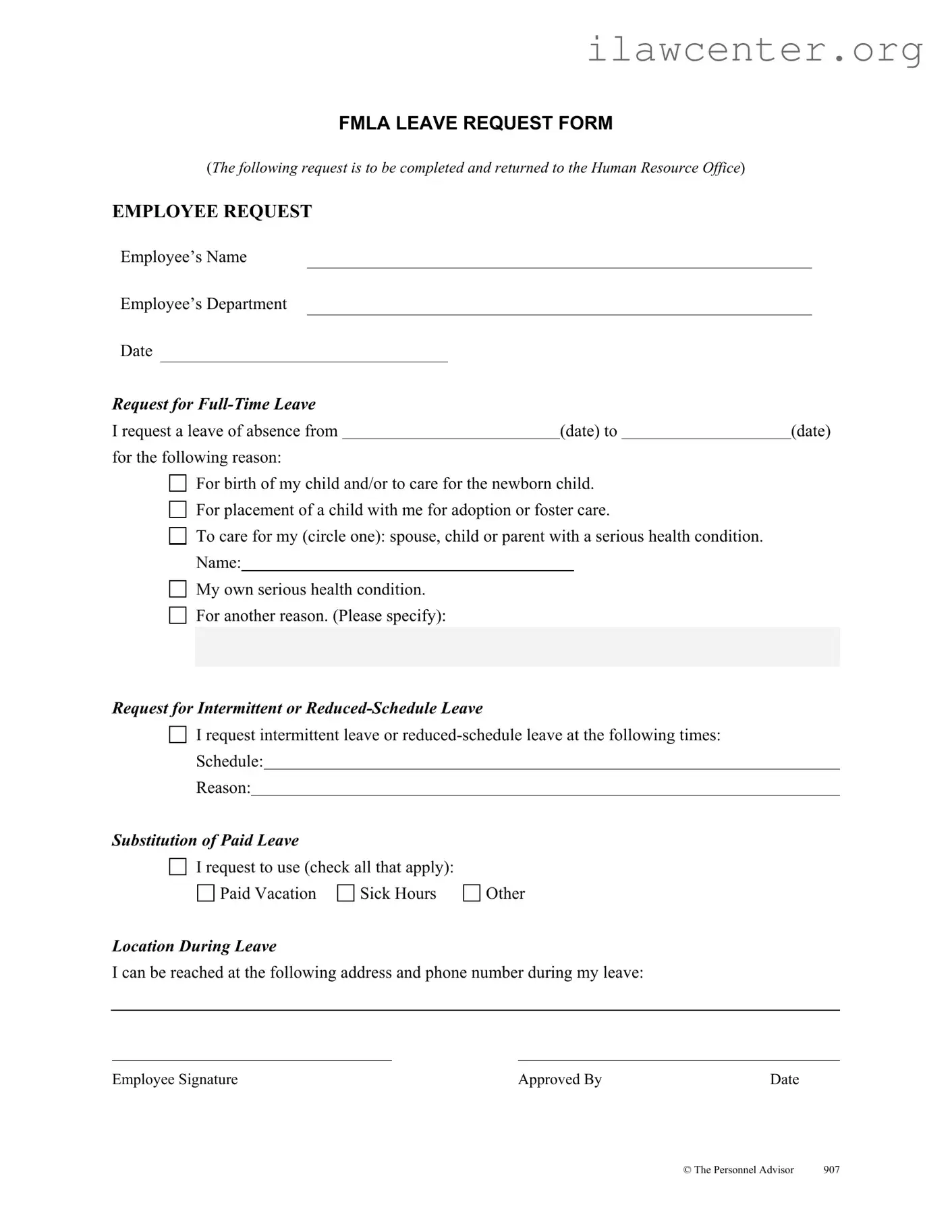
FMLA LEAVE REQUEST FORM
(The following request is to be completed and returned to the Human Resource Office)
EMPLOYEE REQUEST
Employee’s Name
Employee’s Department
Date
Request for Full-Time Leave
I request a leave of absence from
(date) to (date)
for the following reason:
For birth of my child and/or to care for the newborn child.
For placement of a child with me for adoption or foster care.
To care for my (circle one): spouse, child or parent with a serious health condition.
Name:
My own serious health condition.
For another reason. (Please specify):
Request for Intermittent or Reduced-Schedule Leave
I request intermittent leave or reduced-schedule leave at the following times:
Schedule:
Reason:
Substitution of Paid Leave
I request to use (check all that apply):
Paid Vacation Sick Hours Other
Location During Leave
I can be reached at the following address and phone number during my leave:
Employee Signature Approved By Date

File Properties

Fact Name Description
Purpose of FMLA Leave The Family and Medical Leave Act (FMLA) allows eligible employees to take unpaid leave for specific family and medical reasons, such as the birth of a child, adoption, or caring for a seriously ill family member.
Eligibility Requirements To qualify for FMLA leave, employees must have worked for their employer for at least 12 months and logged a minimum of 1,250 hours in the past year.
Intermittent Leave Option Employees can request intermittent or reduced-schedule leave, allowing them to take leave in smaller increments rather than all at once.
Paid Leave Substitution Employees may choose to use paid vacation, sick hours, or other paid leave during their FMLA leave, providing them with some income during their absence.
State-Specific Forms Some states have additional requirements or forms for FMLA leave, governed by state laws such as the California Family Rights Act (CFRA) or the New York Paid Family Leave (PFL) law.

Instructions on Utilizing Fmla Leave

After completing the FMLA Leave form, you will submit it to your Human Resource Office. They will review your request and get back to you with any necessary information or approvals.

  1. Fill in your Employee’s Name at the top of the form.
  2. Write your Employee’s Department next to your name.
  3. Enter the Date of your request.
  4. Indicate whether you are requesting Full-Time Leave or Intermittent or Reduced-Schedule Leave.
  5. If requesting full-time leave, specify the dates you will be absent.
  6. Choose the reason for your leave by checking the appropriate box. If it’s for another reason, write a brief explanation.
  7. If you are requesting intermittent leave, fill in the schedule and reason for the leave.
  8. Check all applicable boxes under Substitution of Paid Leave to indicate which types of paid leave you wish to use.
  9. Provide your contact information, including your address and phone number, where you can be reached during your leave.
  10. Sign the form to confirm your request.
  11. Leave space for the Approved By section and the Date of approval.

Important Facts about Fmla Leave

What is the FMLA Leave form used for?

The FMLA Leave form is a request for leave under the Family and Medical Leave Act (FMLA). It allows employees to formally apply for time off for specific family or medical reasons, such as the birth of a child, adoption, or caring for a family member with a serious health condition. Completing this form is essential to initiate the process and ensure that your rights under FMLA are protected.

How do I fill out the FMLA Leave form?

To fill out the FMLA Leave form, start by providing your name and department. Clearly indicate the dates you are requesting for your leave. Specify the reason for your leave by selecting from the options provided, such as caring for a newborn or addressing your own serious health condition. If you plan to take intermittent leave, include the schedule and reasons for those specific days. Finally, sign the form and submit it to your Human Resource Office for approval.

What should I do if my leave request is denied?

If your leave request is denied, you should first seek clarification from your HR department. Understand the reasons for the denial and whether any additional information is required. You may have the right to appeal the decision. Document all communications and consider discussing your situation with a legal advisor if you believe your FMLA rights are being violated.

Can I use paid leave during my FMLA leave?

Common mistakes

Filling out the FMLA Leave form can be a straightforward process, but there are common mistakes that can lead to delays or complications. Understanding these pitfalls is crucial for a smooth leave request. Here are eight mistakes to avoid.

One frequent error is failing to provide complete information. When filling out the employee's name, department, and dates of leave, every detail matters. Incomplete sections can lead to confusion and may result in a denial of the request. Always double-check that all required fields are filled out accurately.

Another mistake involves not specifying the reason for leave clearly. The form allows for various reasons, including caring for a newborn or dealing with a serious health condition. If the reason is vague or not clearly articulated, it may raise questions. Be specific about the circumstances to ensure that the request is understood.

Many individuals also overlook the importance of requesting the correct type of leave. The form offers options for full-time leave, intermittent leave, or reduced-schedule leave. Selecting the wrong type can complicate the approval process. Take time to consider which option best fits your situation.

Additionally, not checking the box for paid leave options can lead to missed benefits. Employees often forget to indicate if they want to use vacation or sick hours during their leave. This oversight can affect financial stability during the time off. Always review the paid leave section carefully.

Another common issue is not providing contact information. The form requests an address and phone number where the employee can be reached during their leave. Failing to include this information can hinder communication and delay the processing of the leave request. Make sure to provide accurate and up-to-date contact details.

Some employees may also forget to sign the form. An unsigned form is typically considered incomplete and will not be processed. It is essential to ensure that the signature is included before submission to avoid unnecessary delays.

Moreover, not following submission protocols can create additional complications. Each organization may have specific guidelines for how to submit the FMLA Leave form. Whether it’s through email, in person, or via a designated portal, adhering to these protocols is crucial for timely processing.

Lastly, neglecting to keep a copy of the submitted form can be detrimental. Having a record of the request is important for future reference. It can help clarify any misunderstandings or disputes that may arise later. Always keep a copy for personal records.

By being aware of these common mistakes, individuals can navigate the FMLA Leave form process more effectively. Taking the time to avoid these errors will contribute to a smoother experience when requesting leave.
Documents used along the form

When applying for leave under the Family and Medical Leave Act (FMLA), several other forms and documents may be necessary to support your request. These documents help clarify the reason for your leave and ensure compliance with the law. Below is a list of commonly used forms that accompany the FMLA Leave Request Form.

  • Medical Certification Form: This form is completed by a healthcare provider to confirm the serious health condition of the employee or their family member. It provides necessary details about the condition and the expected duration of the leave.
  • Notice of Eligibility and Rights & Responsibilities: Employers must provide this notice to employees who request FMLA leave. It outlines the employee's eligibility for leave and their rights and responsibilities under the FMLA.
  • Designation Notice: After reviewing the leave request, employers issue this notice to inform the employee whether their leave has been designated as FMLA leave. It includes the amount of leave counted against the employee's FMLA entitlement.
  • Return to Work Form: This form may be required for employees returning from FMLA leave. It usually includes a statement from a healthcare provider confirming that the employee is fit to return to work.
  • Intermittent Leave Request Form: If an employee needs to take leave in smaller increments rather than all at once, this form specifies the schedule and reasons for the intermittent leave.
  • Paid Leave Request Form: Employees may need to submit this form if they wish to use accrued paid leave (like vacation or sick days) during their FMLA leave.
  • Adoption/Foster Care Placement Form: This document is required when an employee is taking leave for the placement of a child for adoption or foster care. It may require details about the placement process.
  • Leave of Absence Policy Acknowledgment: Employees may need to sign this form to acknowledge their understanding of the employer's leave policies and procedures.
  • Family Medical History Form: In some cases, employers may request this form to understand the medical history of the employee's family, especially if the leave is for a family member's serious health condition.

Each of these documents plays a crucial role in the FMLA leave process. They ensure that both employees and employers understand their rights and responsibilities, making the process smoother for everyone involved.

Similar forms

The FMLA Leave form shares similarities with several other documents that relate to employee leave and benefits. Here are five such documents:

  • Medical Leave Request Form: This document is used by employees to formally request time off due to medical reasons. Like the FMLA Leave form, it requires details about the employee's health condition and the duration of the leave.
  • Short-Term Disability Claim Form: Employees fill out this form to claim benefits when they are unable to work due to a medical issue. Both forms require medical documentation and specify the time frame for the requested leave.
  • Parental Leave Application: This document is specifically for employees seeking leave for the birth or adoption of a child. Similar to the FMLA Leave form, it outlines the reason for leave and the expected duration.
  • Leave of Absence Request Form: This general form is used for various types of leave, including personal, medical, or family reasons. It also asks for the duration and reason for the leave, just like the FMLA Leave form.
  • Employee Benefits Enrollment Form: While not a leave request, this form is relevant as it often includes information about leave benefits. Both documents require employees to provide personal details and may involve similar approval processes.

Dos and Don'ts

When filling out the FMLA Leave form, it’s crucial to ensure accuracy and completeness. Here are six key actions to take and avoid:

  • Do provide your full name and department clearly.
  • Do specify the exact dates for your leave.
  • Do select the reason for your leave carefully, ensuring it aligns with FMLA guidelines.
  • Do indicate if you wish to use paid leave options and check all that apply.
  • Don't leave any sections blank; incomplete forms can delay your request.
  • Don't forget to sign and date the form before submission.

Following these guidelines can help streamline the process and ensure your leave request is processed without unnecessary delays.

Misconceptions

Many people have misunderstandings about the Family and Medical Leave Act (FMLA) Leave form. Here are four common misconceptions:

  • FMLA Leave is only for maternity leave. Many believe that FMLA leave is solely for childbirth. In reality, it covers a variety of situations, including caring for a newborn, adopting a child, or caring for a family member with a serious health condition.
  • Employees must take FMLA leave all at once. Some think that FMLA leave must be taken in one continuous block. However, the law allows for intermittent or reduced-schedule leave, which can be taken in smaller increments based on the employee's needs.
  • FMLA leave is paid leave. There is a misconception that FMLA leave is automatically paid. In fact, FMLA provides job protection but does not guarantee pay. Employees may choose to use their paid vacation or sick leave during their FMLA leave.
  • Only full-time employees can use FMLA leave. Some people believe that only full-time employees qualify for FMLA leave. This is not true. Part-time employees may also be eligible, provided they meet the required hours worked in the past year.

Understanding these points can help clarify the purpose and use of the FMLA Leave form. If you have questions about your specific situation, it is advisable to consult with your Human Resource office.

Key takeaways

When filling out the FMLA Leave Request Form, it's essential to keep several key points in mind. Here are some important takeaways:

  • Complete All Sections: Ensure every section of the form is filled out accurately, including your name, department, and dates of leave.
  • Specify the Reason for Leave: Clearly indicate the reason for your leave, whether it's for the birth of a child, adoption, or to care for a family member.
  • Intermittent Leave Options: If you need intermittent or reduced-schedule leave, specify the times and reasons in the designated section.
  • Paid Leave Substitution: Check all applicable boxes if you wish to use paid vacation or sick hours during your leave.
  • Contact Information: Provide a reliable address and phone number where you can be reached during your leave.
  • Signature Required: Don’t forget to sign the form. Your signature is necessary for the request to be processed.
  • Submit to HR: Return the completed form to your Human Resource Office promptly to avoid any delays.
  • Keep a Copy: Always retain a copy of the completed form for your records and future reference.

By following these guidelines, you can ensure that your FMLA leave request is processed smoothly and efficiently.