Four Column Chart PDF Template

Four Column Chart PDF Template

The Four Column Chart form is a structured tool designed to help individuals organize information by dividing it into four distinct categories. Each column allows for the input of specific details related to a chosen topic, facilitating clearer analysis and understanding. To begin using this form, please fill it out by clicking the button below.

Article Guide

The Four Column Chart form serves as a practical tool for organizing information in a structured manner. It encourages users to break down complex topics into manageable sections. Each column can be assigned a specific heading, allowing for clear categorization of details related to the chosen subject. The form typically includes space for a name and date, ensuring proper documentation and accountability. By using this format, individuals can effectively analyze and present information, making it easier to identify relationships and patterns. This method promotes clarity and enhances understanding, making it particularly useful in educational and professional settings. The Four Column Chart can be applied to various topics, such as project planning, data analysis, or brainstorming sessions, providing a versatile framework for effective communication and collaboration.

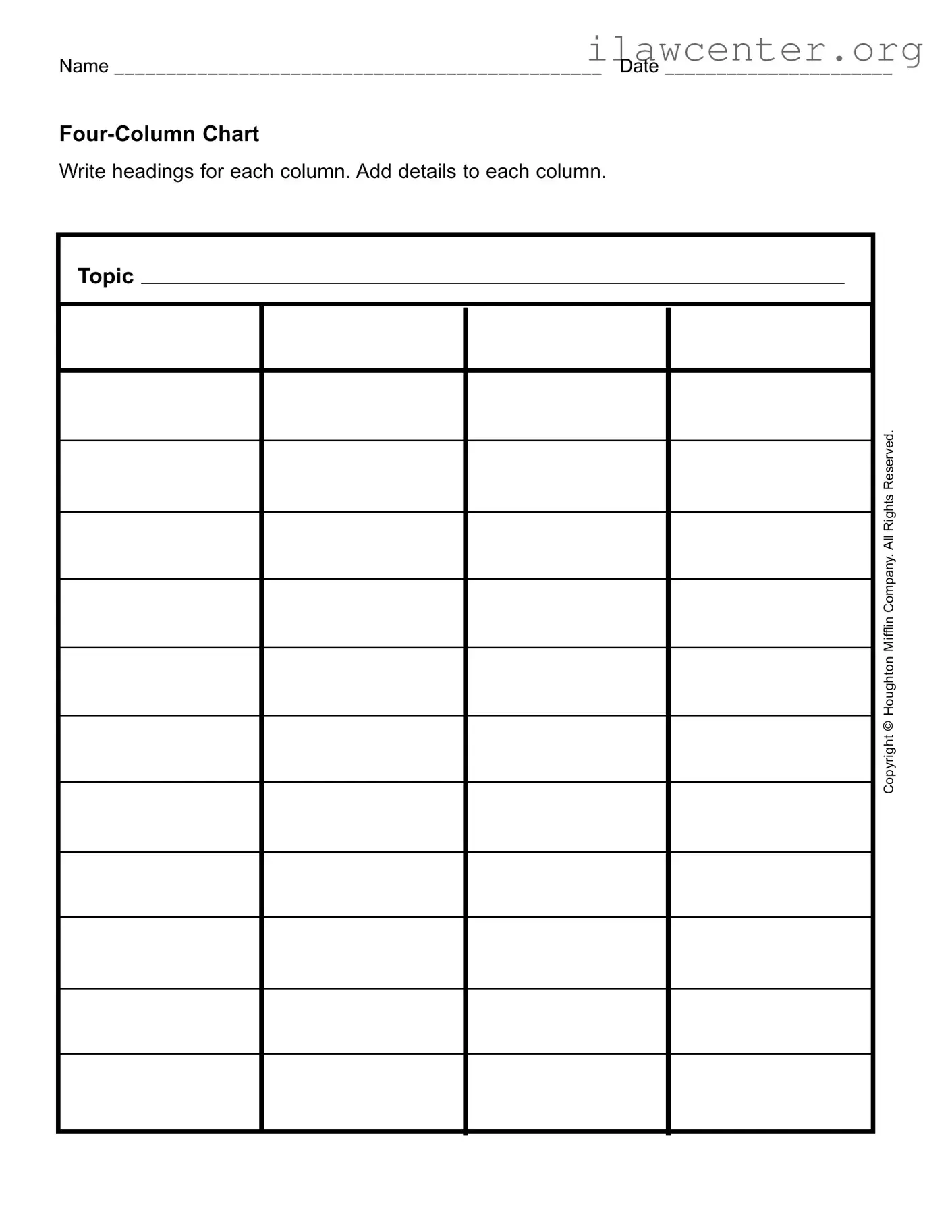
Four Column Chart Preview

Copyright © Houghton Mifflin Company. All Rights Reserved.
Topic
Name _______________________________________________ Date ______________________
Four-Column Chart
Write headings for each column. Add details to each column.

File Properties

Fact Name Description Governing Law Example
Structure The Four Column Chart typically consists of four distinct columns that allow for organized data presentation. Varies by state; often governed by local business regulations. Columns labeled as Topic, Details, Analysis, and Conclusion.
Purpose This format is used to compare and contrast different topics or ideas in a clear and concise manner. Varies by state; may be influenced by educational guidelines. Used in legal education to analyze case law.
Flexibility The chart can be adapted for various subjects beyond law, including business and social sciences. Varies by state; educational institutions may have specific requirements. Applicable in project management for tracking tasks.
Visual Aid It serves as a visual aid that enhances understanding and retention of information. Varies by state; local educational standards may apply. Helpful in presentations to summarize key points.
Collaboration The format encourages collaborative learning, allowing groups to fill in the chart together. Varies by state; collaborative educational practices may differ. Group projects in classrooms often utilize this format.

Instructions on Utilizing Four Column Chart

Filling out the Four Column Chart form involves organizing information into four distinct sections. By following these steps, you will create a clear and structured representation of the relevant details.

  1. Begin by writing your Name in the designated space at the top of the form.
  2. Next, enter the Date in the space provided.
  3. Identify the main topic for your chart. In this case, it is the Mifflin Company.
  4. Decide on the headings for each of the four columns. Write these headings at the top of each column.
  5. Fill in the details for each column based on the headings you created. Ensure that the information is relevant and organized.

After completing these steps, review your chart to ensure all information is accurately filled out and clearly presented.

Important Facts about Four Column Chart

What is the purpose of the Four Column Chart form?

The Four Column Chart form is designed to help individuals organize information systematically. It allows users to categorize details related to a specific topic, making it easier to analyze and understand complex information. This structure can be particularly useful in educational settings, project planning, or any situation where clarity is essential.

How do I fill out the Four Column Chart form?

To fill out the form, start by writing a clear heading for each of the four columns. These headings should reflect the categories of information you wish to organize. Next, add relevant details under each heading. The goal is to ensure that information is easily accessible and logically arranged, facilitating better comprehension and retention.

What types of topics are suitable for the Four Column Chart?

The Four Column Chart can be used for a wide range of topics. It is effective for summarizing research findings, comparing and contrasting ideas, or outlining the pros and cons of a decision. Whether it’s for academic purposes, business analysis, or personal projects, the chart can adapt to various subjects.

Can I use the Four Column Chart for group projects?

Absolutely! The Four Column Chart is an excellent tool for group projects. It encourages collaboration by allowing team members to contribute their insights in a structured manner. Each member can add their information to the chart, ensuring that all perspectives are considered and documented.

Is there a specific format I need to follow for the headings?

While there is no strict format for the headings, they should be concise and descriptive. Aim for clarity so that anyone reviewing the chart can quickly grasp the categories. It’s often helpful to use nouns or short phrases that directly relate to the content of each column.

How can the Four Column Chart enhance my learning?

The Four Column Chart promotes active engagement with the material. By organizing information visually, it aids in memory retention and comprehension. This method encourages critical thinking, as you must analyze the information to determine how best to categorize it.

Can I modify the Four Column Chart for my needs?

Yes, the Four Column Chart is flexible. You can adjust the number of columns or change the headings to suit your specific needs. If you find that four columns do not adequately capture your information, feel free to expand or condense the format as necessary.

What are some common mistakes to avoid when using the Four Column Chart?

One common mistake is using vague headings that do not accurately represent the content. Additionally, overcrowding the chart with too much information can lead to confusion. Strive for balance: provide enough detail to convey your message without overwhelming the reader.

Where can I find examples of completed Four Column Charts?

Examples of completed Four Column Charts can often be found in educational resources, online databases, or academic publications. Many educators also provide sample charts in their course materials. Reviewing these examples can give you a clearer understanding of how to effectively utilize the form.

Is there a digital version of the Four Column Chart form available?

Many educational platforms and software applications offer digital templates for the Four Column Chart. These versions allow for easy editing and sharing, making them convenient for collaborative projects. Check with your educational institution or online resources for available options.
Common mistakes

Filling out the Four Column Chart form can be straightforward, but many individuals make common mistakes that can lead to confusion or incomplete submissions. One frequent error is neglecting to provide a name and date at the top of the form. Without this essential information, it becomes difficult to track submissions or identify the author of the chart.

Another mistake often made is failing to write clear and concise headings for each column. Headings serve as a guide for what information should be included, and vague or generic headings can lead to misinterpretation of the data entered. It is crucial to ensure that each heading accurately reflects the content of the corresponding column.

People frequently overlook the importance of consistency in formatting. For example, using different font styles or sizes within the same column can create visual clutter. Maintaining a uniform appearance helps in understanding the information presented and makes the chart more professional.

Additionally, many individuals forget to include sufficient details in each column. A Four Column Chart is designed to organize information effectively. Skimping on details can lead to a lack of clarity. Each entry should be thorough enough to convey the intended message without overwhelming the reader.

Another common error is misaligning the information within the columns. Each piece of data should be placed in its respective column. Misalignment can cause confusion and make it difficult for others to interpret the chart accurately.

Some users fail to proofread their entries before submission. Spelling and grammatical errors can detract from the professionalism of the chart. Taking a moment to review the information can prevent misunderstandings and enhance clarity.

People sometimes ignore the overall structure of the chart. A well-organized chart with logical flow helps the reader follow the information easily. Ensure that the information progresses in a coherent manner, making it easier for the audience to understand the relationships between the columns.

Another mistake is not considering the audience. Tailoring the content to the intended readers can enhance the effectiveness of the chart. Understanding who will view the chart can help in selecting appropriate language and details.

Some individuals may also submit the form without double-checking for completeness. Each column should be filled out adequately. Leaving any column blank or partially filled can lead to incomplete data, which defeats the purpose of creating the chart.

Lastly, individuals may forget to save a copy of their completed form. Keeping a record of submissions is important for future reference. It is advisable to save a digital copy or make a photocopy of the completed chart for personal records.

Documents used along the form

The Four Column Chart form is a useful tool for organizing information in a structured manner. When completing this form, several other documents may complement it, enhancing clarity and providing additional context. Below is a list of commonly used forms and documents that often accompany the Four Column Chart.

  • Cover Letter: This document introduces the Four Column Chart. It provides a brief overview of its purpose and outlines the key points that will be addressed in the chart.
  • Data Collection Sheet: This sheet gathers raw data that will be analyzed and summarized in the Four Column Chart. It ensures that all relevant information is collected before chart completion.
  • Summary Report: A summary report synthesizes the findings presented in the Four Column Chart. It highlights major conclusions and recommendations based on the organized data.
  • Presentation Slides: These slides can be created to visually represent the information from the Four Column Chart. They are useful for sharing findings with an audience in a clear and engaging format.
  • Feedback Form: This document collects input from stakeholders regarding the information presented in the Four Column Chart. It helps to assess the effectiveness of the data organization and identify areas for improvement.
  • Action Plan: An action plan outlines the steps to be taken based on the analysis from the Four Column Chart. It details specific tasks, responsible parties, and timelines for implementation.

Using these documents in conjunction with the Four Column Chart can significantly improve the overall effectiveness of data presentation and decision-making processes. Each form plays a distinct role in ensuring that information is clear, actionable, and well-supported.

Similar forms

The Four Column Chart form is a useful tool for organizing information. It shares similarities with several other documents. Here are six documents that resemble the Four Column Chart form:

  • Spreadsheet: Like the Four Column Chart, a spreadsheet allows users to organize data into rows and columns. Each cell can contain specific information, making it easy to analyze and compare data.
  • Table: A table presents information in a structured format, similar to the Four Column Chart. Both utilize rows and columns to display data clearly, allowing for easy reference and organization.
  • Matrix: A matrix organizes data in a grid format, much like the Four Column Chart. It can help visualize relationships between different variables or categories, enhancing understanding.
  • Outline: An outline breaks down information into main points and subpoints. While the structure differs, both documents aim to organize thoughts and details systematically.
  • Mind Map: A mind map visually represents information and ideas. Although it uses a different format, both the mind map and Four Column Chart serve to organize complex information in an accessible way.
  • Checklist: A checklist allows users to track tasks or items systematically. While it typically involves a single column, both documents focus on organization and clarity in presenting information.

Dos and Don'ts

When filling out the Four Column Chart form, consider the following guidelines to ensure clarity and accuracy.

  • Do write clearly and legibly to avoid confusion.
  • Do use appropriate headings for each column to organize your information.
  • Do fill in all required fields completely to provide a full picture.
  • Do review your entries for spelling and grammatical errors before submission.
  • Don't leave any columns blank unless specified; incomplete forms may be rejected.
  • Don't use abbreviations or jargon that may not be understood by all readers.

Following these tips will help ensure that your Four Column Chart is effective and easy to understand.

Misconceptions

The Four Column Chart form is a useful tool, but several misconceptions exist about its purpose and functionality. Below is a list of common misunderstandings.

  • It is only for academic use. Many believe this form is exclusively for educational settings, but it can be applied in various contexts, including business and personal projects.
  • It requires extensive training to use. The form is straightforward and does not necessitate specialized training. Anyone can fill it out with basic information.
  • All four columns must be filled. While it is designed for four columns, users can choose to leave some columns blank if they are not relevant to their topic.
  • It is only for brainstorming. Although it can aid in brainstorming, the Four Column Chart is also effective for organizing information and analyzing data.
  • It is a rigid format. The structure of the chart is flexible. Users can adapt the headings and details to suit their needs.
  • It is not useful for group projects. This form can facilitate collaboration by providing a clear layout for team members to contribute their ideas and insights.
  • It must be printed out to be useful. The chart can be created digitally, allowing for easy edits and sharing among users.
  • Only one topic can be addressed at a time. Users can create multiple Four Column Charts to cover different topics simultaneously, enhancing their organizational capabilities.

Key takeaways

When using the Four Column Chart form, there are several important points to keep in mind. Here are four key takeaways:

  • Clear Headings: Start by writing clear and concise headings for each column. This will help organize your thoughts and make the information easier to understand.
  • Focus on Details: In each column, add relevant details that pertain to the topic. This ensures that your chart is informative and serves its purpose effectively.
  • Stay Organized: Keep your entries in each column organized and consistent. This will make it easier to compare information across the columns.
  • Review and Revise: After filling out the chart, take a moment to review your work. Make any necessary revisions to enhance clarity and accuracy.