Fillable General Photo Release Document

Fillable General Photo Release Document

A General Photo Release form is a legal document that allows individuals or organizations to obtain permission to use photographs of a person for various purposes, such as marketing or promotional materials. By signing this form, the individual grants rights to the photographer or organization to use their image without further compensation. If you need to ensure that your use of photographs is legally sound, consider filling out the form by clicking the button below.

Article Guide

The General Photo Release form is an important document that allows individuals and organizations to obtain permission to use photographs of people in various contexts. This form typically includes key elements such as the names of the parties involved, a description of the photos being used, and the specific purposes for which the images will be utilized. By signing this form, individuals grant permission for their likeness to be used in promotional materials, websites, social media, and other platforms. Additionally, the release often clarifies that no compensation will be provided for the use of the images, although some agreements may include provisions for payment. Understanding the nuances of this form can help protect the rights of both the photographer and the subjects, ensuring that everyone is aware of how the images will be used and what rights they are waiving. Overall, a General Photo Release form fosters clear communication and mutual respect between all parties involved in the photographic process.

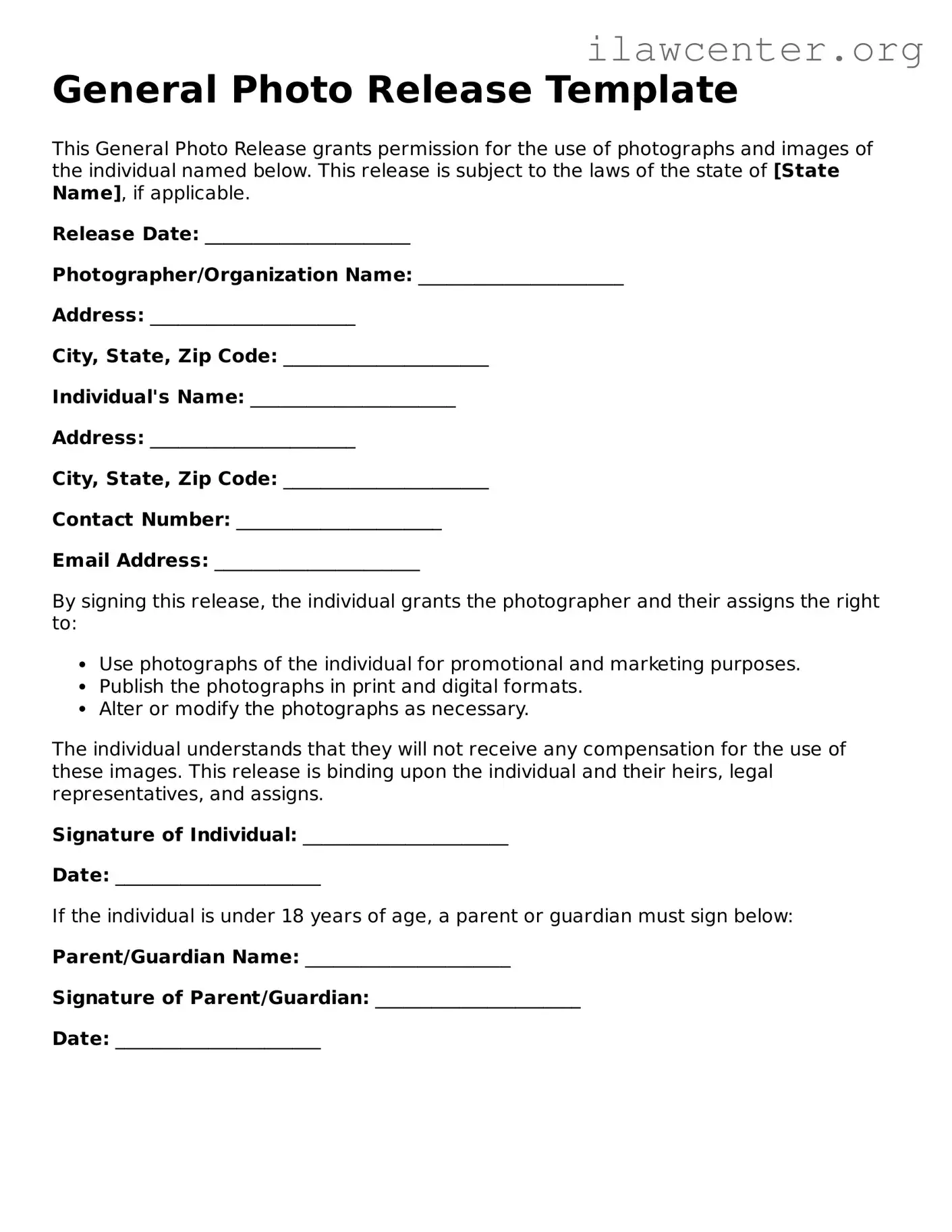
General Photo Release Preview

General Photo Release Template

This General Photo Release grants permission for the use of photographs and images of the individual named below. This release is subject to the laws of the state of [State Name], if applicable.

Release Date: ______________________

Photographer/Organization Name: ______________________

Address: ______________________

City, State, Zip Code: ______________________

Individual's Name: ______________________

Address: ______________________

City, State, Zip Code: ______________________

Contact Number: ______________________

Email Address: ______________________

By signing this release, the individual grants the photographer and their assigns the right to:

  • Use photographs of the individual for promotional and marketing purposes.
  • Publish the photographs in print and digital formats.
  • Alter or modify the photographs as necessary.

The individual understands that they will not receive any compensation for the use of these images. This release is binding upon the individual and their heirs, legal representatives, and assigns.

Signature of Individual: ______________________

Date: ______________________

If the individual is under 18 years of age, a parent or guardian must sign below:

Parent/Guardian Name: ______________________

Signature of Parent/Guardian: ______________________

Date: ______________________

PDF Form Characteristics

Fact Name Description
Purpose A General Photo Release form allows individuals to grant permission for their images to be used in various media, such as advertisements, websites, or publications.
Consent By signing the form, individuals provide their explicit consent for the use of their photographs, ensuring that their rights are respected.
Revocation Individuals may have the right to revoke their consent, but this typically does not apply retroactively to images already published.
Governing Law The governing law for the General Photo Release form can vary by state. For example, in California, the laws surrounding privacy and publicity rights are particularly relevant.
Age Requirement Minors usually require parental or guardian consent to sign a photo release form, ensuring that their rights are protected.
Scope of Use The form should clearly outline how the images will be used, whether for commercial purposes, educational materials, or social media.
Compensation Some releases may include compensation for the use of images, while others may be granted without any payment involved.
Duration The release may specify a duration for which the consent is valid, or it may be indefinite until revoked.
Legal Validity For the release to be legally valid, it must be signed voluntarily by the individual and should ideally be witnessed or notarized.

Instructions on Utilizing General Photo Release

Completing the General Photo Release form is a straightforward process that ensures clarity regarding the use of images. Once the form is filled out, it can be submitted to the appropriate party for processing. Below are the steps to guide you through the completion of the form.

  1. Begin by entering your full name in the designated field at the top of the form.
  2. Next, provide your contact information, including your email address and phone number.
  3. In the section labeled "Date," write the current date when you are filling out the form.
  4. Identify the purpose of the photo release by selecting the relevant option or writing a brief description.
  5. Sign your name in the signature box to indicate your consent.
  6. Finally, print your name below the signature line for clarity.

After completing these steps, review the form to ensure all information is accurate before submission.

Important Facts about General Photo Release

What is a General Photo Release form?

A General Photo Release form is a legal document that grants permission to use an individual's likeness in photographs or videos. This form is often used by photographers, businesses, or organizations to ensure that they have the right to publish or distribute images featuring a person without facing legal repercussions.

Who needs to sign a General Photo Release form?

Anyone whose image or likeness will be used in a photograph or video should sign a General Photo Release form. This includes models, participants in events, or anyone appearing in the background of an image. It is essential to obtain consent to avoid potential legal issues related to privacy rights.

When should a General Photo Release form be used?

A General Photo Release form should be used whenever a photographer or organization intends to use images for commercial purposes, such as marketing, advertising, or promotional materials. It is also advisable to use the form for personal projects that may be shared publicly.

What information is typically included in a General Photo Release form?

Common elements of a General Photo Release form include the name of the individual granting permission, a description of the images being used, the intended use of the images, and a statement affirming that the individual understands their rights. It may also include a section for signatures and dates.

Is a General Photo Release form legally binding?

Yes, a properly executed General Photo Release form is legally binding. However, its enforceability can depend on the jurisdiction and specific circumstances. It is advisable to ensure that the form is clear, concise, and free of ambiguity to minimize the risk of disputes.

Can a General Photo Release form be revoked?

In general, a General Photo Release form can be revoked, but the specifics depend on the terms outlined in the document. If the release includes a time limit or specific conditions, it is important to adhere to those stipulations. Once images are published, revoking consent may not prevent further use, especially if the images have been widely distributed.

What happens if someone refuses to sign a General Photo Release form?

If an individual refuses to sign a General Photo Release form, the photographer or organization should respect their decision. It is advisable to avoid using images of individuals who have not provided consent. This helps to maintain ethical standards and avoid potential legal issues.

Are there any exceptions to using a General Photo Release form?

Yes, certain exceptions exist. For example, images taken in public spaces where individuals do not have a reasonable expectation of privacy may not require a release. However, it is always best practice to obtain consent to mitigate any risks associated with privacy rights.

Where can I obtain a General Photo Release form?

General Photo Release forms can be obtained from various sources, including legal document websites, photography associations, or by consulting a legal professional. Many templates are available online that can be customized to fit specific needs.
Common mistakes

Filling out a General Photo Release form can seem straightforward, but many people make common mistakes that can lead to confusion later on. One frequent error is not providing complete information. When you leave out details such as your name or contact information, it can create problems in the future. Always double-check that all required fields are filled out completely.

Another common mistake is failing to read the entire form carefully. Many individuals skim through the document, missing important sections that outline rights and responsibilities. Understanding what you are signing is crucial. Take the time to read everything, so you know what permissions you are granting.

Some people neglect to specify the purpose of the photo use. The form should clearly state how the photos will be used, whether for marketing, social media, or other purposes. This clarity protects both the photographer and the subject. Without this specification, misunderstandings can arise later.

Additionally, not signing and dating the form is a mistake that can invalidate the release. A signature is essential to show that you agree to the terms. Always ensure that you sign and date the document before submitting it.

Another error involves not keeping a copy of the signed release. After you fill out the form, make sure to keep a copy for your records. This way, you have proof of the agreement should any questions arise in the future.

Lastly, some individuals forget to discuss the release with the photographer or organization involved. Open communication can prevent misunderstandings. It’s important to clarify any questions or concerns before finalizing the form.

Documents used along the form

The General Photo Release form is commonly used to obtain permission for the use of photographs in various contexts. Along with this form, several other documents may be relevant depending on the situation. Below is a list of additional forms and documents that are often utilized in conjunction with a General Photo Release form.

  • Model Release Form: This document is used to obtain consent from individuals who are featured in photographs or videos, allowing their likeness to be used for commercial purposes.
  • Property Release Form: When a photo includes private property, this form secures permission from the property owner to use images of their property for commercial or promotional purposes.
  • Copyright Assignment Agreement: This document transfers ownership of the copyright of an image from the creator to another party, often used when hiring photographers for specific projects.
  • Photography Contract: A contract between a photographer and a client that outlines the terms of service, including payment, deliverables, and rights to the images produced.
  • Consent Form for Minors: This form is specifically designed to obtain permission from a parent or guardian when photographing minors, ensuring that legal consent is obtained.
  • Usage License Agreement: This agreement specifies how and where the images can be used, detailing the rights granted to the user while protecting the interests of the photographer.

These documents help ensure that all parties involved understand their rights and responsibilities regarding the use of photographs. Proper documentation can prevent misunderstandings and legal issues in the future.

Similar forms

  • Model Release Form: This document grants permission for the use of an individual's likeness in photographs or videos. Like the General Photo Release, it ensures that the subject understands how their image will be used, often for commercial purposes.
  • Property Release Form: This form allows a photographer to use images of private property. Similar to the General Photo Release, it secures the rights needed to publish or sell images that include someone else's property.
  • Video Release Form: This document is used to obtain consent for the use of an individual's likeness in video recordings. It shares similarities with the General Photo Release in that it outlines how the footage may be utilized, ensuring that the subject is informed and agrees to the terms.
  • Event Release Form: Often used during public events, this form allows photographers to capture and use images of attendees. It is akin to the General Photo Release as it informs individuals that their image may be used for promotional purposes, thus protecting the photographer legally.

Dos and Don'ts

When filling out the General Photo Release form, it is important to follow certain guidelines to ensure clarity and compliance. Here are five things to do and avoid:

  • Do read the entire form carefully before signing.
  • Do provide accurate information about yourself and the photos.
  • Do ask questions if any part of the form is unclear.
  • Do keep a copy of the signed form for your records.
  • Do sign and date the form where indicated.
  • Don't leave any required fields blank.
  • Don't sign the form under pressure or without understanding it.
  • Don't provide false information, as it may lead to legal issues.
  • Don't forget to check the expiration date of the release.
  • Don't assume verbal agreements are sufficient; always get it in writing.

Misconceptions

Misconceptions about the General Photo Release form can lead to confusion and misunderstandings. Here are seven common misconceptions, along with clarifications for each.

  1. Everyone needs to sign a General Photo Release.

    Not everyone needs to sign this form. It is typically required when a person's likeness will be used for commercial purposes, such as advertising or promotional materials.

  2. Signing the form means you lose all rights to your image.

    This is not accurate. While the form allows the photographer or company to use the image, it does not transfer ownership of the image or eliminate the subject's rights entirely.

  3. The form is only necessary for professional photographers.

    Amateurs and hobbyists may also need a General Photo Release if they plan to use the images commercially. The form applies regardless of the photographer's experience level.

  4. Once signed, the release cannot be revoked.

    In some cases, individuals may have the right to revoke the release, particularly if it was signed under duress or without full understanding of its implications. Legal advice may be needed in such situations.

  5. All General Photo Releases are the same.

    This is misleading. While many releases share common elements, they can vary significantly based on jurisdiction, intended use, and specific terms outlined by the photographer or organization.

  6. Children cannot be photographed without a release.

    While it is essential to obtain a release for children, it must be signed by a parent or legal guardian. This ensures that the rights of the minor are protected.

  7. Once the release is signed, the subject will never be notified of usage.

    While the form allows for usage, many photographers and companies maintain good practices by informing subjects about how and where their images will be used, fostering transparency.

Key takeaways

  • Always obtain consent before taking or using someone's photograph. This shows respect for their privacy and rights.

  • The General Photo Release form is a legal document that grants permission to use a person's image for specific purposes, such as marketing or promotional materials.

  • Make sure to clearly specify the intended use of the photographs. This helps avoid misunderstandings later on.

  • Individuals signing the release should be of legal age. If they are minors, a parent or guardian must provide consent.

  • Consider including a clause about compensation. Some individuals may expect payment for the use of their image.

  • Review the form carefully before signing. Ensure that all terms are understood and agreeable to both parties.

  • Keep a copy of the signed release form for your records. This can be crucial if any disputes arise in the future.

  • Be aware that the release may not cover all potential uses of the image. Clarifying the scope of the release can help prevent issues.

  • Remember that the release can be revoked. If someone changes their mind, they have the right to withdraw their consent.