Fillable General Release and Waiver Document

Fillable General Release and Waiver Document

The General Release and Waiver form is a legal document that allows individuals to relinquish their right to pursue claims against another party. By signing this form, you acknowledge and accept the risks involved and agree not to hold the other party liable for any injuries or damages. To ensure your protection, consider filling out the form by clicking the button below.

Article Guide

The General Release and Waiver form serves as a crucial legal document that individuals use to relinquish their rights to pursue claims against another party. This form is often utilized in various contexts, such as settling disputes, engaging in recreational activities, or entering contractual agreements. By signing this document, individuals acknowledge the inherent risks involved and agree not to hold the other party liable for any potential injuries or damages that may arise. Key components of the form typically include a clear statement of the parties involved, a detailed description of the activities or circumstances covered, and an affirmation that the signer understands the implications of the release. Moreover, it may outline any exceptions or limitations to the waiver, ensuring that both parties have a mutual understanding of their rights and responsibilities. Overall, the General Release and Waiver form is an essential tool for managing risk and fostering clarity in various personal and professional interactions.

General Release and Waiver Preview

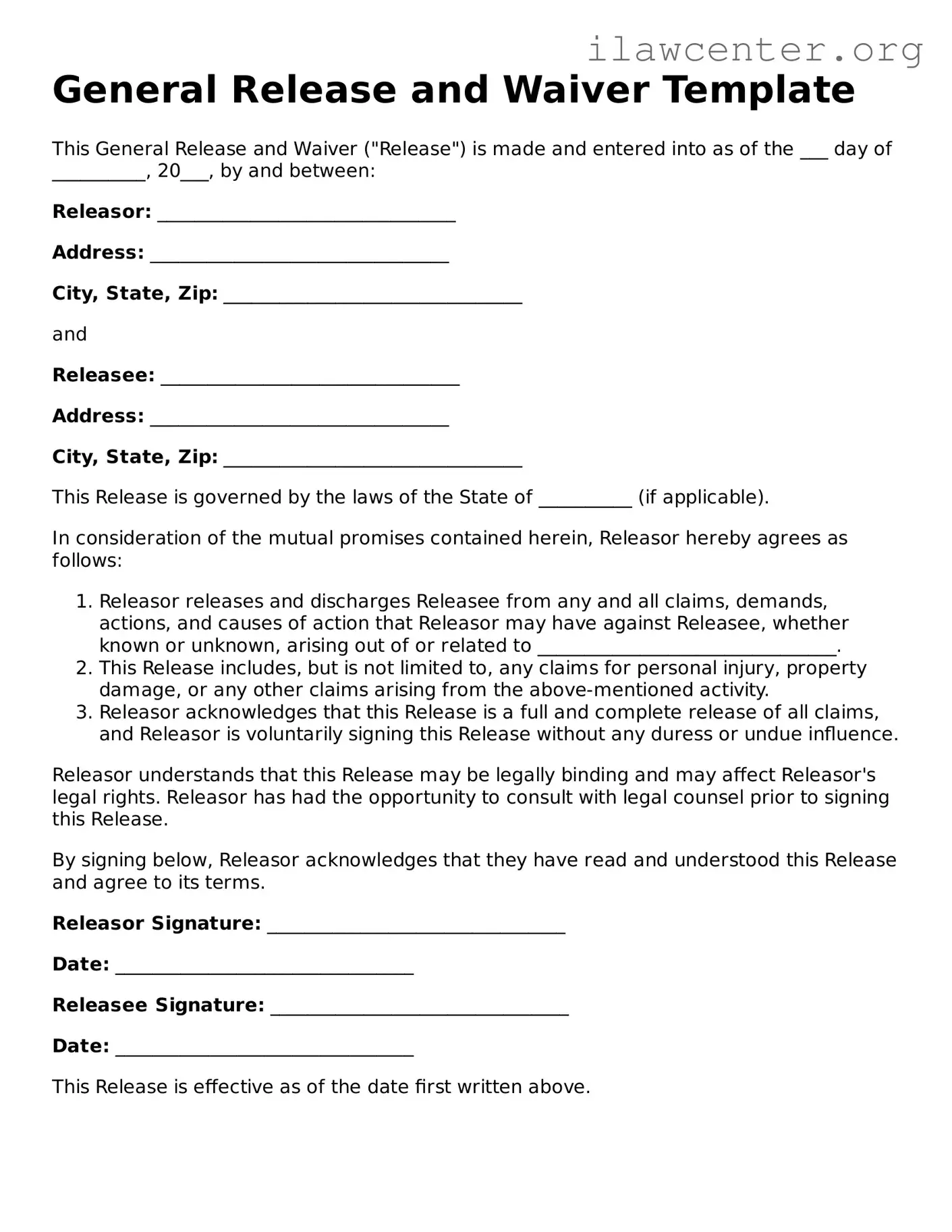
General Release and Waiver Template

This General Release and Waiver ("Release") is made and entered into as of the ___ day of __________, 20___, by and between:

Releasor: ________________________________

Address: ________________________________

City, State, Zip: ________________________________

and

Releasee: ________________________________

Address: ________________________________

City, State, Zip: ________________________________

This Release is governed by the laws of the State of __________ (if applicable).

In consideration of the mutual promises contained herein, Releasor hereby agrees as follows:

  1. Releasor releases and discharges Releasee from any and all claims, demands, actions, and causes of action that Releasor may have against Releasee, whether known or unknown, arising out of or related to ________________________________.
  2. This Release includes, but is not limited to, any claims for personal injury, property damage, or any other claims arising from the above-mentioned activity.
  3. Releasor acknowledges that this Release is a full and complete release of all claims, and Releasor is voluntarily signing this Release without any duress or undue influence.

Releasor understands that this Release may be legally binding and may affect Releasor's legal rights. Releasor has had the opportunity to consult with legal counsel prior to signing this Release.

By signing below, Releasor acknowledges that they have read and understood this Release and agree to its terms.

Releasor Signature: ________________________________

Date: ________________________________

Releasee Signature: ________________________________

Date: ________________________________

This Release is effective as of the date first written above.

PDF Form Characteristics

Fact Name Description
Purpose The General Release and Waiver form is designed to protect an individual or organization from future claims or liabilities arising from specific activities or events.
Voluntary Agreement Signing this form indicates that the signer is voluntarily waiving their rights to pursue legal action related to the specified matters.
State-Specific Variations Different states may have specific requirements or language for the General Release and Waiver form. For example, in California, the governing law is Civil Code Section 1542.
Consideration For the waiver to be valid, there usually needs to be some form of consideration, meaning that something of value is exchanged.
Legal Advice It is often recommended that individuals seek legal advice before signing the form to fully understand the implications of waiving their rights.

Instructions on Utilizing General Release and Waiver

Filling out the General Release and Waiver form is straightforward. Follow these steps carefully to ensure that all necessary information is provided correctly. Once you complete the form, you will be ready to submit it as required.

  1. Read the form carefully. Make sure you understand all sections before filling it out.
  2. Provide your personal information. Fill in your name, address, phone number, and email address in the designated areas.
  3. Specify the date. Write the date on which you are completing the form.
  4. Detail the activity or event. Clearly describe the activity or event for which you are waiving rights.
  5. Sign the form. Add your signature in the appropriate section to indicate your agreement.
  6. Print your name. Write your name below your signature to ensure clarity.
  7. Provide a witness signature. If required, have a witness sign the form in the designated area.
  8. Submit the form. Follow the instructions provided for submitting the completed form.

Important Facts about General Release and Waiver

What is a General Release and Waiver form?

A General Release and Waiver form is a legal document that allows one party to release another from liability for certain actions or events. By signing this form, an individual agrees not to hold the other party responsible for any claims, damages, or injuries that may arise in the future. It is often used in situations where one party wants to ensure that they cannot be sued for any potential issues related to an activity or event.

When should I use a General Release and Waiver form?

This form is typically used in various contexts, such as sports events, recreational activities, or any situation where there is a risk of injury. For example, if you are participating in a community sports league, the organizers may ask you to sign a General Release and Waiver form to protect themselves from liability. It is also useful in business transactions where one party wants to mitigate risks associated with a particular agreement.

What are the key components of a General Release and Waiver form?

A well-drafted General Release and Waiver form should include several important elements. First, it should clearly identify the parties involved. Next, it should specify the activities or events covered by the release. The language should be clear and unambiguous, outlining the scope of the waiver. Additionally, it should include a statement indicating that the signer understands the risks involved and voluntarily agrees to waive their rights to any future claims.

Can I revoke my consent after signing the form?

Once you sign a General Release and Waiver form, it is generally considered binding. However, some jurisdictions may allow individuals to revoke their consent within a certain timeframe, particularly if they can demonstrate that they were coerced or did not fully understand the implications of their signature. It is important to read the form carefully and consider the consequences before signing.

What happens if I get injured despite signing the form?

If you are injured after signing a General Release and Waiver form, your ability to seek compensation may be limited. The purpose of the form is to protect the other party from liability. However, there are exceptions. If the injury was caused by gross negligence or intentional misconduct, the release may not be enforceable. Each case is unique, and it is advisable to consult with a legal professional if you find yourself in this situation.

Is a General Release and Waiver form enforceable in court?

In most cases, a properly drafted General Release and Waiver form is enforceable in court. Courts generally uphold these agreements as long as they are clear, voluntary, and do not violate public policy. However, enforceability can depend on various factors, including the specific circumstances surrounding the signing of the form and the jurisdiction in which it is being enforced. Always ensure that the form complies with local laws to maximize its effectiveness.
Common mistakes

Filling out a General Release and Waiver form can be straightforward, but many individuals make common mistakes that can lead to complications. One frequent error is not reading the entire document before signing. This form often contains important terms and conditions that affect rights and responsibilities. Skimming the text may lead to misunderstandings about what is being agreed to.

Another mistake is failing to provide accurate personal information. Incorrect names, addresses, or contact details can cause issues later on, especially if the release needs to be enforced. It is essential to ensure that all information is current and correct to avoid potential disputes.

Some individuals overlook the importance of understanding the scope of the release. A General Release and Waiver typically covers various claims, including those not yet known. Not recognizing the full extent of what is being waived can result in unintended consequences. It is crucial to comprehend what rights are being given up.

Additionally, people often forget to date the form. A missing date can create ambiguity about when the release was executed, which may complicate its validity. Properly dating the document helps establish a clear timeline for all parties involved.

Another common error is not having witnesses or notary public acknowledgment when required. Some jurisdictions may require additional verification for the release to be enforceable. Neglecting this step can render the waiver ineffective, leading to potential legal challenges.

Many individuals also fail to retain a copy of the signed form. Keeping a personal record is vital for future reference. Without a copy, individuals may struggle to prove that they signed the waiver, should any disputes arise later.

People sometimes rush through the signing process without fully understanding the implications. This haste can lead to regrets down the line, especially if unforeseen circumstances occur. Taking the time to reflect on the decision is essential.

Finally, misunderstanding the legal language can lead to confusion. While the form may seem straightforward, certain phrases may carry specific legal meanings. Seeking clarification or assistance can prevent misinterpretations that could affect the release's enforceability.

Documents used along the form

A General Release and Waiver form is an important document that helps protect parties from future claims. However, it often works best in conjunction with other forms and documents. Here are a few commonly used ones:

  • Indemnity Agreement: This document outlines the responsibilities of one party to compensate another for any losses or damages. It ensures that if one party faces a claim, the other will cover the costs.
  • Confidentiality Agreement: Also known as a non-disclosure agreement, this form ensures that sensitive information shared between parties remains private. It’s crucial for protecting trade secrets and proprietary information.
  • Release of Liability Form: Similar to the General Release and Waiver, this form specifically releases one party from liability for certain actions or events. It’s often used in situations involving physical activities or events.
  • Consent Form: This document gives permission for one party to take specific actions, such as using a person’s likeness or information. It’s essential for ensuring that all parties are on the same page regarding consent.

Using these documents alongside the General Release and Waiver can provide a comprehensive approach to risk management. Always ensure that all parties understand the terms before signing any agreements.

Similar forms

  • Release of Liability Form: This document releases one party from liability for any injuries or damages that may occur during a specific activity. Like the General Release and Waiver, it protects the party from future claims related to those activities.
  • Indemnity Agreement: An indemnity agreement obligates one party to compensate another for certain damages or losses. Similar to the General Release and Waiver, it shifts the risk of loss from one party to another.
  • Settlement Agreement: This document resolves disputes between parties, often involving compensation. It shares similarities with the General Release and Waiver in that both documents prevent further claims regarding the same issue.
  • Confidentiality Agreement: A confidentiality agreement ensures that sensitive information remains private. While its primary focus is on information protection, it often includes clauses that release parties from future claims related to the disclosed information, akin to the General Release and Waiver.
  • Disclaimer: A disclaimer informs participants of potential risks associated with an activity or service. It serves a similar purpose as the General Release and Waiver by limiting liability for the provider in case of accidents or injuries.

Dos and Don'ts

Filling out a General Release and Waiver form can seem daunting, but following some straightforward guidelines can make the process smoother. Here’s a list of things you should and shouldn’t do:

  • Do read the entire form carefully before filling it out.
  • Do provide accurate and complete information.
  • Do sign and date the form where required.
  • Do keep a copy of the completed form for your records.
  • Do consult a legal professional if you have questions about the form.
  • Don't rush through the form; take your time to ensure accuracy.
  • Don't leave any sections blank unless instructed to do so.
  • Don't sign the form if you do not fully understand its implications.
  • Don't forget to check for any specific requirements related to your situation.

Misconceptions

Understanding the General Release and Waiver form is essential for anyone considering signing it. Unfortunately, several misconceptions can lead to confusion. Here are seven common misunderstandings:

  1. It completely absolves the other party of all responsibility. Many believe that signing a release means the other party can never be held accountable. In reality, it typically only limits liability for specific claims or incidents.
  2. It is only for physical injuries. While often associated with personal injury cases, a General Release can apply to various situations, including property damage and other types of claims.
  3. You cannot negotiate the terms. Some think that once a release is presented, it’s a take-it-or-leave-it situation. However, terms can often be negotiated before signing.
  4. It is the same as a contract. Although both are legal documents, a release focuses on relinquishing claims, while a contract establishes obligations and rights between parties.
  5. Signing it means you can never pursue legal action again. This is misleading. A General Release may prevent you from pursuing specific claims, but it does not necessarily bar all future legal actions.
  6. It only protects the party offering the release. In many cases, it can also provide benefits to the signer by clarifying expectations and reducing potential legal disputes.
  7. It is a standard form that applies universally. Each General Release is unique and tailored to specific situations. It’s important to read and understand the terms of each document before signing.

Being informed about these misconceptions can help you make better decisions when dealing with a General Release and Waiver form. Always consider seeking legal advice if you have questions or concerns.

Key takeaways

Filling out and using a General Release and Waiver form is an important step in protecting yourself legally. Here are some key takeaways to consider:

  • Understand the Purpose: This form is designed to release one party from liability for certain actions or events.
  • Read Carefully: Always read the entire document before signing. Know what rights you are giving up.
  • Be Specific: Clearly state the activities or situations covered by the waiver to avoid confusion later.
  • Consult a Lawyer: If you have any doubts or concerns, seek legal advice to ensure your interests are protected.
  • Check for State Laws: Different states have varying laws regarding waivers. Make sure your form complies with local regulations.
  • Use Clear Language: Avoid complex legal terms. The form should be understandable to anyone signing it.
  • Keep a Copy: After signing, retain a copy of the form for your records. This can be important for future reference.
  • Consider Age Factors: If minors are involved, ensure a parent or guardian signs on their behalf, as they cannot waive their own rights.