Attorney-Verified  Affidavit of Correction Document for Georgia

Attorney-Verified Affidavit of Correction Document for Georgia

The Georgia Affidavit of Correction form is a legal document used to correct errors in public records, such as property deeds or other official filings. This form allows individuals to clarify or amend information that may have been inaccurately recorded. To ensure your records are accurate, consider filling out the form by clicking the button below.

Article Guide

The Georgia Affidavit of Correction form serves as a vital tool for individuals seeking to amend errors in recorded documents, ensuring that public records accurately reflect the intended information. This form is commonly utilized in situations involving inaccuracies in property deeds, legal documents, or other official filings. By submitting this affidavit, a person can clarify details such as names, dates, or descriptions that may have been misrepresented or incorrectly recorded. The process typically involves providing a sworn statement that outlines the specific corrections needed, along with supporting documentation if necessary. This helps to maintain the integrity of public records and can prevent potential legal disputes arising from misinformation. Understanding the requirements and proper usage of the Affidavit of Correction is crucial for anyone looking to rectify mistakes in their official documents in Georgia.

Georgia Affidavit of Correction Preview

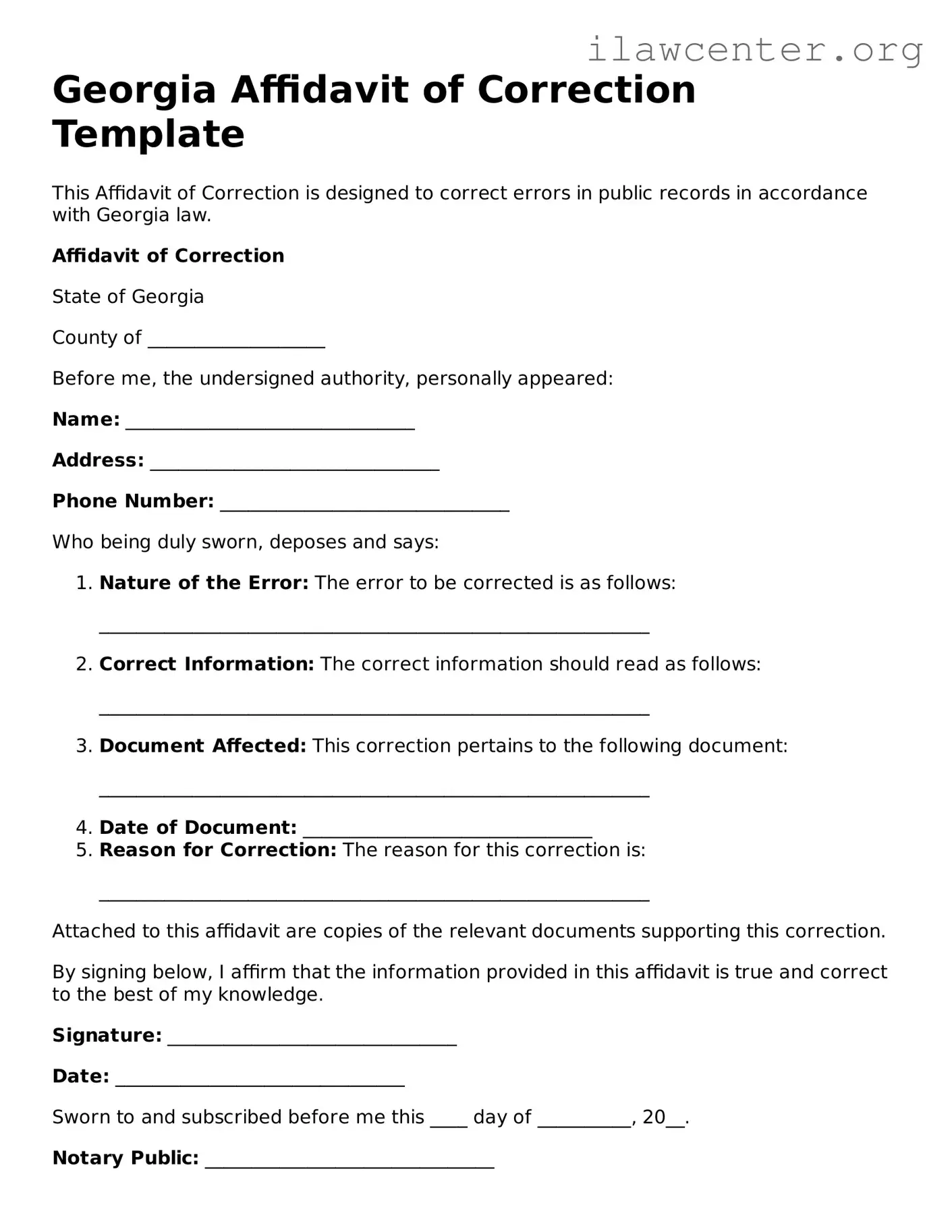
Georgia Affidavit of Correction Template

This Affidavit of Correction is designed to correct errors in public records in accordance with Georgia law.

Affidavit of Correction

State of Georgia

County of ___________________

Before me, the undersigned authority, personally appeared:

Name: _______________________________

Address: _______________________________

Phone Number: _______________________________

Who being duly sworn, deposes and says:

  1. Nature of the Error: The error to be corrected is as follows:
  2. ___________________________________________________________

  3. Correct Information: The correct information should read as follows:
  4. ___________________________________________________________

  5. Document Affected: This correction pertains to the following document:
  6. ___________________________________________________________

  7. Date of Document: _______________________________
  8. Reason for Correction: The reason for this correction is:
  9. ___________________________________________________________

Attached to this affidavit are copies of the relevant documents supporting this correction.

By signing below, I affirm that the information provided in this affidavit is true and correct to the best of my knowledge.

Signature: _______________________________

Date: _______________________________

Sworn to and subscribed before me this ____ day of __________, 20__.

Notary Public: _______________________________

My Commission Expires: _______________________________

PDF Form Characteristics

Fact Name Details
Purpose The Georgia Affidavit of Correction is used to correct errors in public records, such as deeds or other legal documents.
Governing Law This form is governed by Georgia law, specifically O.C.G.A. § 15-6-67.
Who Can File Any party who is affected by the error can file the affidavit, including property owners or their representatives.
Common Errors Common corrections include misspellings, incorrect legal descriptions, or wrong names.
Filing Process The completed affidavit must be filed with the appropriate county clerk's office where the original document was recorded.
Required Information The affidavit should include the original document details, the nature of the error, and the corrected information.
Effect of Filing Once filed, the correction is officially recognized, and the public record will reflect the accurate information.

Instructions on Utilizing Georgia Affidavit of Correction

Once you have the Georgia Affidavit of Correction form ready, you will need to fill it out carefully. Each section requires specific information, and accuracy is crucial. After completing the form, you will need to submit it to the appropriate office for processing.

  1. Begin by entering your name and contact information at the top of the form.
  2. Provide the date on which the affidavit is being completed.
  3. Clearly state the original document's details that you are correcting. This may include the title, date, and any identifying numbers.
  4. Explain the specific error that needs correction. Be concise and clear.
  5. Detail the correct information that should replace the erroneous data.
  6. Sign the affidavit in the designated area. Make sure to date your signature.
  7. If required, have the affidavit notarized. This step may vary based on the specific requirements of the office you are submitting to.
  8. Make copies of the completed affidavit for your records before submission.
  9. Submit the affidavit to the appropriate office, ensuring you follow any additional instructions provided.

Important Facts about Georgia Affidavit of Correction

What is a Georgia Affidavit of Correction?

The Georgia Affidavit of Correction is a legal document used to correct clerical errors or mistakes in public records. This form helps ensure that the official records accurately reflect the intended information, whether it's related to property deeds, marriage licenses, or other important documents.

Who can file an Affidavit of Correction in Georgia?

Any individual or entity that is directly affected by the error can file this affidavit. This includes property owners, business owners, or anyone whose name or details are incorrectly recorded in a public document.

What types of errors can be corrected with this affidavit?

This affidavit can be used to correct typographical errors, misspellings, incorrect dates, or other minor mistakes that do not alter the fundamental nature of the document. However, significant changes, such as altering ownership or changing terms, typically require different legal processes.

How do I complete the Affidavit of Correction?

To complete the form, start by clearly identifying the document that contains the error. Then, provide the correct information and explain the nature of the error. It’s essential to be accurate and thorough to avoid any further complications. Make sure to sign the affidavit in the presence of a notary public.

Do I need a lawyer to file an Affidavit of Correction?

While you are not required to hire a lawyer to file this affidavit, consulting one can be beneficial, especially if you are unsure about the process or the implications of the corrections. A legal professional can provide guidance tailored to your specific situation.

Where do I file the Affidavit of Correction?

You should file the completed affidavit with the same office where the original document is recorded. This could be the county clerk's office, the probate court, or another relevant agency, depending on the type of document being corrected.

Is there a fee to file the Affidavit of Correction?

Yes, there may be a filing fee associated with submitting the Affidavit of Correction. The amount can vary by county and type of document, so it's a good idea to check with the local office where you plan to file for the exact fee structure.

How long does it take to process an Affidavit of Correction?

The processing time can vary based on the office handling the affidavit and their current workload. Generally, it can take anywhere from a few days to a few weeks. If you need the correction made urgently, consider contacting the office directly for more information.

What happens after I file the Affidavit of Correction?

Once filed, the affidavit becomes part of the public record. The office will update the original document to reflect the corrections made. It’s wise to keep a copy of the affidavit for your records and to verify that the corrections have been made as intended.
Common mistakes

Filling out the Georgia Affidavit of Correction form can seem straightforward, but many individuals make common mistakes that can lead to complications. One frequent error is failing to provide accurate personal information. It's crucial to ensure that names, addresses, and other identifying details are correct. A simple typo can cause delays or even invalidate the correction.

Another common mistake is neglecting to sign the form. While it may seem obvious, many individuals overlook this step. Without a signature, the affidavit lacks authenticity and may not be accepted by the relevant authorities. Always double-check that all required signatures are present before submitting.

Some people forget to include the necessary supporting documentation. The Affidavit of Correction often requires additional papers to validate the correction being made. Missing these documents can lead to rejection of the application. Therefore, it's wise to review the form’s requirements carefully.

Additionally, individuals sometimes use outdated versions of the form. The state may update its forms periodically, and using an old version can result in the submission being denied. Always ensure you are using the most current form available on the official Georgia state website.

Another mistake involves incorrect notarization. The affidavit typically requires notarization to be legally binding. If the notary fails to sign or stamp the document properly, it could render the affidavit ineffective. It’s essential to verify that the notarization is complete and accurate.

People also often overlook the importance of clarity in their explanations. The affidavit should clearly state the nature of the correction. Vague language can lead to misunderstandings or further complications down the line. Providing a clear, concise explanation can help ensure that the correction is processed smoothly.

Some individuals fail to check for consistency across documents. If the information on the Affidavit of Correction does not match other official documents, such as birth certificates or marriage licenses, it can create confusion. Consistency is key in legal matters, so it's vital to cross-reference details.

Another mistake involves submitting the form to the wrong office. Each type of correction may need to be filed with a specific department or agency. Researching the appropriate destination for the form is essential to avoid unnecessary delays.

People sometimes underestimate the timeline for processing the affidavit. Many assume that corrections will be made immediately, but this is often not the case. Understanding the expected processing time can help manage expectations and reduce frustration.

Finally, individuals may neglect to keep copies of the submitted form and any accompanying documents. Retaining a copy is important for personal records and can be invaluable if any issues arise later. Always make sure to keep a complete set of documents for your records.

Documents used along the form

The Georgia Affidavit of Correction form is often used to correct errors in public records. When filing this form, it may be beneficial to also include other supporting documents to ensure clarity and compliance. Below are four commonly used forms and documents that accompany the Affidavit of Correction.

  • Certificate of Correction: This document is used to officially acknowledge and rectify errors in previously filed documents, such as corporate filings. It serves as an official record of the correction made.
  • Notarized Statement: A notarized statement may be required to validate the identity of the individual making the correction. This document ensures that the correction is made by the rightful party and adds an extra layer of authenticity.
  • Supporting Documentation: This can include any relevant documents that substantiate the need for correction. Examples might include previous versions of the document, identification, or any other proof that supports the claim of error.
  • Cover Letter: A cover letter can accompany the Affidavit of Correction and other documents. It should outline the purpose of the submission and provide a summary of the corrections being made, making it easier for the reviewing agency to understand the context.

Including these additional documents can help streamline the correction process and ensure that all necessary information is provided to the reviewing authority. Being thorough and organized can facilitate a smoother resolution to any discrepancies in public records.

Similar forms

The Affidavit of Correction is a legal document used to correct errors in official records. Several other documents serve similar purposes in various contexts. Here’s a list of eight documents that share similarities with the Affidavit of Correction:

  • Correction Deed: This document is used to correct errors in a property deed. Just like the Affidavit of Correction, it clarifies the intent of the parties involved and ensures the accuracy of property records.
  • Certificate of Correction: Often filed with state agencies, this certificate amends previously filed documents to rectify mistakes. It serves a similar function by ensuring that public records reflect accurate information.
  • Amendment: An amendment modifies an existing contract or agreement. Like an Affidavit of Correction, it aims to clarify terms and correct inaccuracies to prevent future disputes.
  • Erratum: This document is issued to correct errors in published materials, such as books or articles. It addresses mistakes in a formal way, similar to how an Affidavit of Correction addresses inaccuracies in legal records.
  • Notarized Statement: A notarized statement can serve to clarify or correct information in various contexts. It provides a sworn account that can support corrections, akin to the purpose of an Affidavit of Correction.
  • Change of Name Document: This document is used to legally change a person's name. It functions similarly by officially documenting a change and ensuring that records reflect the current name.
  • Release of Liability: This document can correct or clarify responsibilities in agreements. It serves to ensure that all parties understand their obligations, much like how an Affidavit of Correction clarifies errors in legal documents.
  • Power of Attorney Revocation: This document cancels a previously granted power of attorney. It ensures that all parties are aware of the change, similar to how an Affidavit of Correction updates official records.

Each of these documents plays a crucial role in maintaining accurate and reliable records, just as the Affidavit of Correction does in its specific context.

Dos and Don'ts

When filling out the Georgia Affidavit of Correction form, it's essential to approach the process with care. Here are some important dos and don'ts to keep in mind:

  • Do read the instructions carefully before starting.
  • Do provide accurate and complete information.
  • Do sign and date the form where required.
  • Do double-check for any spelling or typographical errors.
  • Don't leave any required fields blank.
  • Don't use white-out or any correction fluid on the form.
  • Don't submit the form without making a copy for your records.
  • Don't forget to verify the submission deadline.

By following these guidelines, you can help ensure that your Affidavit of Correction is processed smoothly and efficiently.

Misconceptions

Understanding the Georgia Affidavit of Correction form is crucial for anyone looking to amend a public record. However, several misconceptions can lead to confusion. Here are nine common misunderstandings:

  1. The form can only be used for minor errors.

    This is not true. The Affidavit of Correction can address a variety of mistakes, including those related to names, dates, and other significant details.

  2. Only attorneys can file an Affidavit of Correction.

    In Georgia, individuals have the right to file this form without needing an attorney, although legal advice may still be beneficial.

  3. The form is only applicable to real estate documents.

    This is a misconception. While it is commonly used in real estate, it can also correct errors in other types of public records.

  4. Once filed, the correction is permanent and cannot be changed.

    While the correction is intended to be permanent, it is possible to file additional affidavits if further corrections are needed.

  5. There is a specific deadline for filing the affidavit.

    No specific deadline exists for filing an Affidavit of Correction in Georgia, but timely filing is recommended to avoid complications.

  6. The affidavit must be notarized to be valid.

    While notarization is often recommended, it is not a strict requirement for the affidavit to be considered valid.

  7. Filing the affidavit guarantees that the correction will be accepted.

    Acceptance of the correction is at the discretion of the relevant authority. They may require additional documentation or clarification.

  8. All errors can be corrected using this form.

    Not all types of errors are eligible for correction through this affidavit. Some issues may require different legal processes.

  9. There is a fee associated with filing the affidavit.

    In most cases, there is no fee for filing an Affidavit of Correction, but it is wise to check with the local office for any potential charges.

Being aware of these misconceptions can help individuals navigate the process more effectively and ensure that their public records are accurate.

Key takeaways

When filling out and using the Georgia Affidavit of Correction form, keep the following key takeaways in mind:

  • The affidavit is used to correct errors in public records, such as property deeds or other legal documents.
  • Accurate information is crucial; ensure all details match the original documents to avoid further complications.
  • The form must be signed in the presence of a notary public to validate the corrections.
  • Submit the completed affidavit to the appropriate county office where the original document was recorded.
  • There may be a filing fee associated with submitting the affidavit, so check with the local office for specific costs.