Attorney-Verified  Affidavit of Residency Document for Georgia

Attorney-Verified Affidavit of Residency Document for Georgia

The Georgia Affidavit of Residency form is a legal document that verifies an individual's residence in the state of Georgia. This form is often required for various purposes, such as enrolling a child in school or applying for certain benefits. To ensure a smooth process, it's important to fill out this form accurately.

Ready to get started? Fill out the form by clicking the button below.

Article Guide

The Georgia Affidavit of Residency form serves as a crucial document for individuals who need to verify their residence within the state. This form is often required for various purposes, including enrollment in public schools, obtaining a driver's license, or accessing certain government services. It typically includes sections where the affiant must provide personal information, such as their name, address, and the duration of their residency. Additionally, the form may require the signature of a witness or notary public to validate the information provided. By completing this affidavit, individuals affirm their residency status, which can facilitate access to essential services and benefits. Understanding the requirements and implications of this form is vital for residents navigating administrative processes in Georgia.

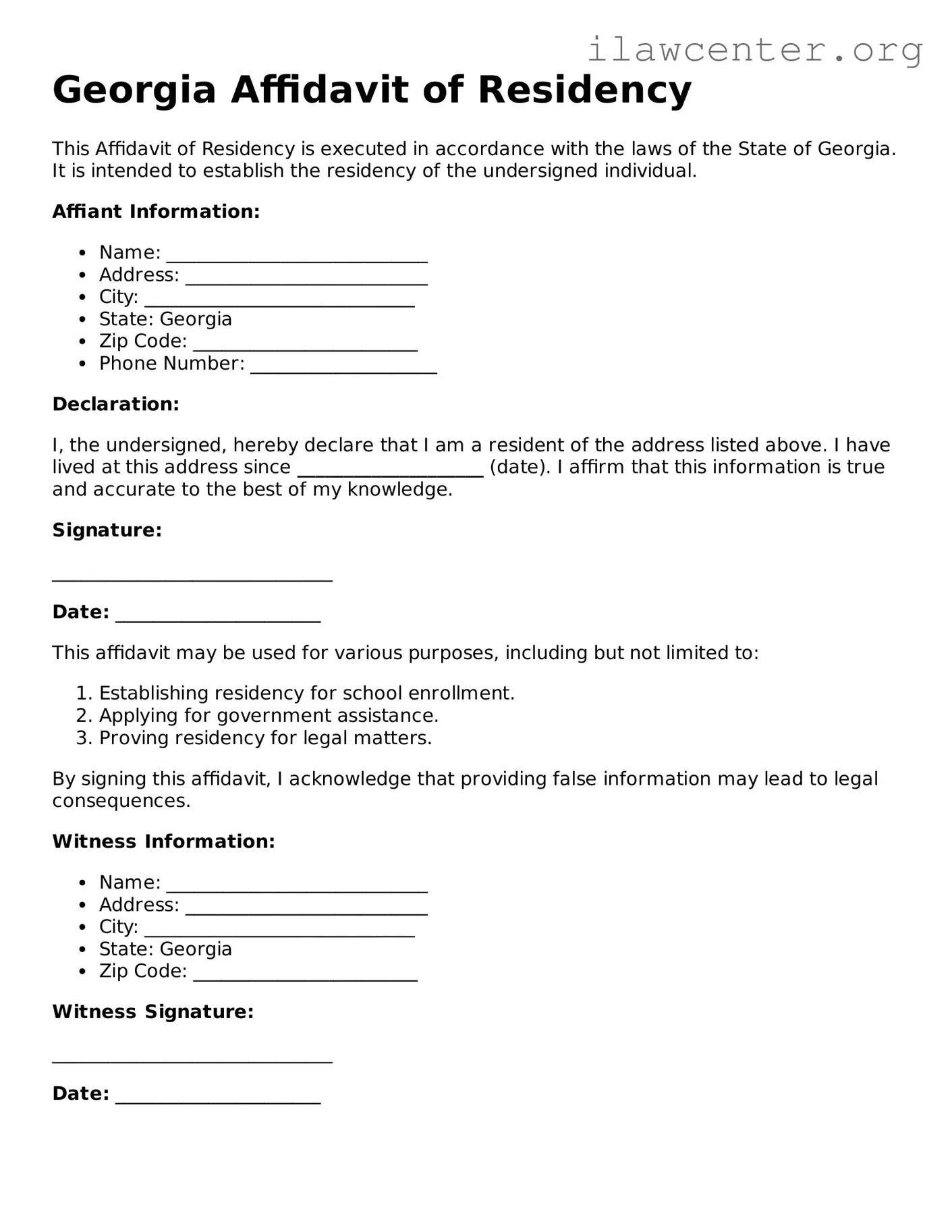
Georgia Affidavit of Residency Preview

Georgia Affidavit of Residency

This Affidavit of Residency is executed in accordance with the laws of the State of Georgia. It is intended to establish the residency of the undersigned individual.

Affiant Information:

  • Name: ____________________________
  • Address: __________________________
  • City: _____________________________
  • State: Georgia
  • Zip Code: ________________________
  • Phone Number: ____________________

Declaration:

I, the undersigned, hereby declare that I am a resident of the address listed above. I have lived at this address since ____________________ (date). I affirm that this information is true and accurate to the best of my knowledge.

Signature:

______________________________

Date: ______________________

This affidavit may be used for various purposes, including but not limited to:

  1. Establishing residency for school enrollment.
  2. Applying for government assistance.
  3. Proving residency for legal matters.

By signing this affidavit, I acknowledge that providing false information may lead to legal consequences.

Witness Information:

  • Name: ____________________________
  • Address: __________________________
  • City: _____________________________
  • State: Georgia
  • Zip Code: ________________________

Witness Signature:

______________________________

Date: ______________________

PDF Form Characteristics

Fact Name Description
Purpose The Georgia Affidavit of Residency form is used to verify a person's residency status in Georgia.
Governing Law This form is governed by Georgia state law, specifically O.C.G.A. § 15-11-30.
Who Uses It Individuals, often parents or guardians, use this form to establish residency for school enrollment or other legal purposes.
Required Information The form typically requires the individual's name, address, and a statement affirming residency.
Signature Requirement The affidavit must be signed in the presence of a notary public to be considered valid.
Filing Locations This form can be submitted to schools, courts, or other relevant institutions that require proof of residency.
Validity Period The affidavit remains valid as long as the residency status remains unchanged; however, updates may be required for different purposes.
Consequences of False Information Providing false information on the affidavit can result in legal penalties, including fines or loss of residency status.

Instructions on Utilizing Georgia Affidavit of Residency

Once you have the Georgia Affidavit of Residency form in hand, it's time to fill it out carefully. This form is essential for confirming where you live, and accuracy is key. Follow the steps below to ensure that you complete it correctly.

  1. Begin by entering your full name at the top of the form.
  2. Provide your current residential address. Make sure to include the street number, street name, city, and zip code.
  3. Next, indicate the length of time you have lived at this address. Be specific about the month and year.
  4. In the designated section, list any previous addresses if applicable. Include the same details as your current address.
  5. Sign the form in the space provided, affirming that the information you provided is true and accurate.
  6. Date your signature to confirm when you completed the form.
  7. Finally, if required, have the form notarized by a licensed notary public to validate your affidavit.

Once you have filled out the form and ensured all information is accurate, you can submit it to the appropriate authority as directed. Keep a copy for your records.

Important Facts about Georgia Affidavit of Residency

What is the Georgia Affidavit of Residency form?

The Georgia Affidavit of Residency form is a legal document used to verify an individual's residency in the state of Georgia. It is often required for various purposes, such as enrolling a child in school, obtaining a driver's license, or applying for public assistance. The form typically includes information about the individual’s address and may require a signature from a witness or notary to confirm its authenticity.

Who needs to complete the Affidavit of Residency form?

This form is generally needed by individuals who must prove their residency in Georgia for legal or administrative reasons. Common scenarios include parents enrolling their children in public schools, individuals applying for government benefits, or residents seeking to register to vote. Anyone who needs to establish their residence in Georgia may be required to fill out this form.

How do I obtain the Georgia Affidavit of Residency form?

The Georgia Affidavit of Residency form can typically be obtained from various sources, including the Georgia Department of Driver Services, local school districts, or government offices. Additionally, the form may be available online through official state or local government websites. It is advisable to ensure that the most current version of the form is being used.

What information is required on the form?

The form generally requires personal information such as the individual's name, current address, and the duration of residency at that address. Some versions of the form may also ask for additional details, such as the names of household members or the reason for needing the affidavit. It is important to provide accurate and truthful information to avoid any legal complications.

Is the Affidavit of Residency form notarized?

In many cases, the Affidavit of Residency form must be notarized to ensure its validity. Notarization involves a notary public witnessing the signing of the document and confirming the identity of the signer. This step adds a layer of authenticity and may be required by the entity requesting the affidavit.

What happens if the information on the form is false?

Providing false information on the Georgia Affidavit of Residency form can lead to serious consequences. Legal repercussions may include fines, criminal charges, or denial of services such as school enrollment or public assistance. It is crucial to complete the form honestly and accurately to avoid potential legal issues.

Can the Affidavit of Residency form be used for multiple purposes?

Yes, the Georgia Affidavit of Residency form can often be utilized for various purposes, such as enrolling children in school, applying for a driver's license, or verifying residency for government benefits. However, it is important to check if the specific agency or institution has particular requirements or versions of the form that need to be completed.

How long is the Affidavit of Residency form valid?

The validity of the Affidavit of Residency form can vary based on the purpose for which it is being used. Some agencies may require a new affidavit to be submitted annually or whenever there is a change in residency. It is advisable to consult with the specific agency or institution to determine their requirements regarding the validity period of the form.
Common mistakes

Completing the Georgia Affidavit of Residency form can be straightforward, but mistakes can lead to delays or complications. One common error is failing to provide accurate personal information. It’s crucial to ensure that names, addresses, and other identifying details are correct. Even a small typo can create confusion and may require resubmission of the form.

Another frequent mistake is not signing the affidavit. The form requires a signature to validate the information provided. Omitting this step can result in the form being considered incomplete. Always double-check that you have signed where necessary before submitting.

Many people overlook the importance of including the date on the affidavit. The date serves as a reference point for when the information was attested to. Without it, the affidavit may not be accepted, as it lacks the necessary context.

Providing insufficient proof of residency is another common pitfall. The affidavit often requires supporting documents to confirm your residency. This could include utility bills, lease agreements, or bank statements. Ensure that the documents are current and clearly display your name and address.

Some individuals neglect to have the affidavit notarized when required. Notarization adds an extra layer of authenticity, and in some cases, it is a mandatory step. If the form indicates that notarization is necessary, be sure to follow through.

Another mistake is not reading the instructions carefully. Each affidavit may have specific requirements that vary by situation. Taking the time to thoroughly review the guidelines can help avoid misunderstandings and ensure that all necessary information is included.

Additionally, failing to keep a copy of the submitted affidavit can create issues down the line. Having a personal record allows you to reference the information if questions arise later. It’s a simple step that can save time and frustration.

Finally, some individuals rush through the process without reviewing their completed form. Taking a moment to go over the entire affidavit can help catch any errors or omissions. This final check can make a significant difference in ensuring that the form is accepted without delay.

Documents used along the form

The Georgia Affidavit of Residency form is often used in various situations requiring proof of residency. Several other documents may accompany this form to provide additional verification or fulfill specific requirements. Below is a list of commonly used forms and documents that complement the Affidavit of Residency.

  • Utility Bill: A recent utility bill, such as electricity, water, or gas, can serve as proof of residency, showing the individual's name and address.
  • Lease Agreement: A signed lease agreement between a tenant and landlord confirms the individual's right to reside at a specific address.
  • Bank Statement: A bank statement displaying the individual's name and address can provide further evidence of residency.
  • Government-Issued ID: A driver's license or state ID with the current address can help establish residency when presented alongside the affidavit.
  • Voter Registration Card: A voter registration card indicating the individual's address can serve as a valid proof of residency.
  • Tax Documents: Recent tax documents that list the individual's address can support claims of residency.
  • Employment Records: Documents from an employer that show the individual's name and address can also be useful.
  • School Enrollment Records: For students, records from the school that include the student's address can help verify residency.
  • Affidavit of Support: This document can be used when someone is sponsoring another person, confirming their residency status.

When compiling these documents, ensure they are recent and clearly display the individual's name and address. This will enhance the credibility of the residency claim and facilitate smoother processing of related applications.

Similar forms

The Affidavit of Residency form is a vital document often used to confirm an individual's residence. It shares similarities with several other legal documents. Here is a list of nine documents that are comparable to the Affidavit of Residency, along with an explanation of how they are alike:

  • Lease Agreement: This document outlines the terms of renting a property. Like the Affidavit of Residency, it serves as proof of residence by detailing the tenant's address and duration of stay.
  • Utility Bill: A recent utility bill can verify a person's address. It is similar to the Affidavit of Residency in that it provides evidence of where an individual lives.
  • Voter Registration Card: This card indicates where a person is registered to vote. It is akin to the Affidavit of Residency, as both confirm an individual's address for legal and civic purposes.
  • Bank Statement: A bank statement often contains the account holder's address. This document is similar to the Affidavit of Residency in that it can be used to substantiate one's residence.
  • Government-Issued ID: A driver's license or state ID lists the holder's address. Like the Affidavit of Residency, it is an official document that proves where a person resides.
  • Employment Records: These records may include the employee's address. They are comparable to the Affidavit of Residency, as they can be used to confirm where someone lives for employment verification.
  • Mortgage Statement: This document provides details about a home loan and includes the property address. It functions similarly to the Affidavit of Residency by confirming ownership and residence.
  • School Enrollment Records: These records show where a child is enrolled and often include the family’s address. They align with the Affidavit of Residency by establishing a connection to a specific residence.
  • Insurance Policy Documents: Homeowners or renters insurance documents list the insured address. They are similar to the Affidavit of Residency in that they provide proof of residence for coverage purposes.

Each of these documents plays a role in affirming an individual's residence, serving various purposes in legal, financial, and civic contexts. Understanding their similarities can help in navigating residency verification processes more effectively.

Dos and Don'ts

When filling out the Georgia Affidavit of Residency form, it is essential to adhere to specific guidelines to ensure accuracy and compliance. Here are four important do's and don'ts to consider:

  • Do: Provide accurate and complete information. Double-check all entries for correctness.
  • Do: Sign and date the form in the designated areas. An unsigned affidavit may be deemed invalid.
  • Do: Use clear and legible handwriting or type the information if possible. Clarity is crucial for processing.
  • Do: Keep a copy of the completed form for your records. This can be useful for future reference.
  • Don't: Leave any required fields blank. Incomplete forms may delay processing.
  • Don't: Use white-out or other correction methods on the form. Errors should be crossed out neatly and corrected.
  • Don't: Submit the form without verifying that all information is current and relevant. Outdated information can lead to complications.
  • Don't: Forget to check the submission deadline. Timeliness is essential for compliance with residency requirements.

Misconceptions

When it comes to the Georgia Affidavit of Residency form, several misconceptions can lead to confusion. Understanding these common misunderstandings can help ensure that individuals complete the form correctly and efficiently. Here are four prevalent misconceptions:

  1. It's only for students.

    Many people believe that the Affidavit of Residency is solely for students who need to prove their residency for school enrollment. In reality, this form can be used by anyone who needs to establish their residency in Georgia for various purposes, including voting, obtaining a driver's license, or other legal matters.

  2. Notarization is optional.

    Some assume that notarizing the Affidavit of Residency is not necessary. However, to ensure the document is legally binding, it typically must be signed in the presence of a notary public. This step adds an extra layer of authenticity to the affidavit.

  3. It can be filled out quickly without any documentation.

    While the form may seem straightforward, it's important to gather the required documentation beforehand. Applicants often need to provide proof of residency, such as utility bills or lease agreements, to support their claims. Rushing through the process without this documentation can lead to delays or rejections.

  4. Once submitted, the affidavit cannot be changed.

    Another misconception is that once the Affidavit of Residency is submitted, it cannot be altered. In fact, if there are any changes to your residency status or personal information, you can submit a new affidavit. Keeping your information current is crucial for maintaining compliance with legal requirements.

By clarifying these misconceptions, individuals can approach the Georgia Affidavit of Residency with a better understanding, ensuring that they complete it accurately and in accordance with the law.

Key takeaways

When filling out and utilizing the Georgia Affidavit of Residency form, there are several important aspects to keep in mind. Below are key takeaways that can help ensure the process goes smoothly.

  • Understand the Purpose: The Affidavit of Residency is primarily used to verify an individual’s residency status in Georgia, often required for school enrollment or other official purposes.
  • Gather Necessary Information: Before starting the form, collect all relevant information, including your current address, the length of time you have lived there, and any supporting documents that may be required.
  • Complete All Sections: Ensure that every section of the form is filled out completely. Incomplete forms can lead to delays or rejection.
  • Provide Accurate Details: Accuracy is crucial. Double-check all information for errors, as incorrect details can complicate your residency verification.
  • Sign in the Presence of a Notary: The affidavit must be signed in front of a notary public. This adds a layer of authenticity and ensures that the document is legally binding.
  • Keep Copies: After completing and notarizing the affidavit, make copies for your records. This can be useful if you need to reference the document in the future.
  • Submit to the Appropriate Authority: Finally, submit the completed affidavit to the institution or agency that requested it. Be aware of any deadlines to ensure timely processing.

By following these guidelines, individuals can navigate the process of completing the Georgia Affidavit of Residency with greater ease and confidence.