Attorney-Verified  Bill of Sale Document for Georgia

Attorney-Verified Bill of Sale Document for Georgia

The Georgia Bill of Sale form is a legal document used to record the transfer of ownership of personal property from one party to another. This form serves as proof of the transaction and outlines important details such as the description of the item, the sale price, and the signatures of both the buyer and seller. To ensure a smooth transfer of ownership, it is essential to complete this form accurately.

Ready to fill out the Georgia Bill of Sale form? Click the button below to get started.

Article Guide

When engaging in the sale or transfer of personal property in Georgia, a Bill of Sale serves as an essential document to formalize the transaction. This form not only provides a clear record of the agreement between the buyer and seller but also outlines critical details such as the names and addresses of both parties, a description of the item being sold, and the purchase price. In Georgia, a Bill of Sale can be particularly important for items like vehicles, boats, or firearms, as it may be required for registration or title transfer. Additionally, this document can help protect both parties by clarifying the terms of the sale and confirming that the seller has the right to sell the item. By properly completing a Bill of Sale, individuals can ensure that their transaction is legally recognized and can avoid potential disputes in the future. Understanding the key components of this form is crucial for anyone looking to engage in a sale, as it lays the groundwork for a smooth and transparent exchange.

Georgia Bill of Sale Preview

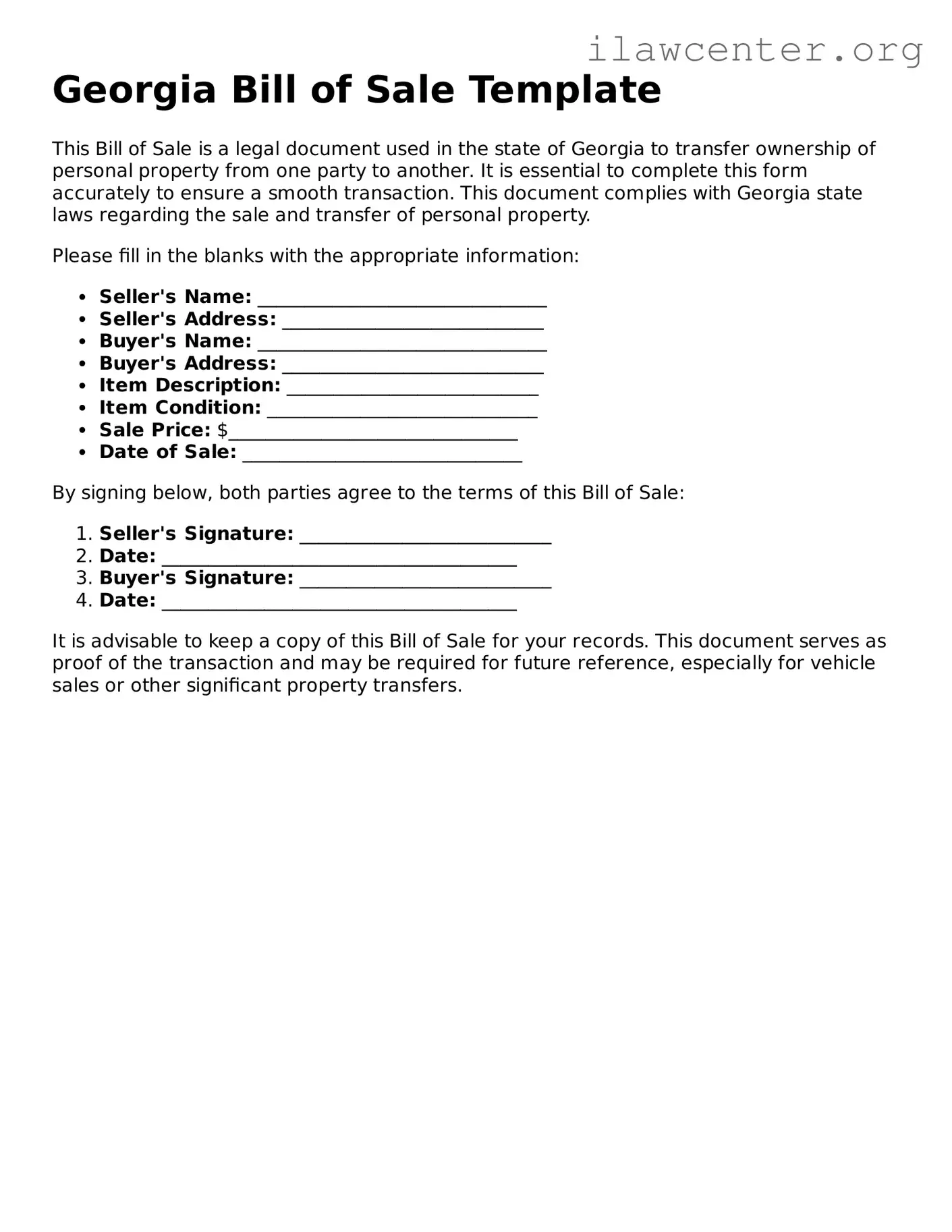
Georgia Bill of Sale Template

This Bill of Sale is a legal document used in the state of Georgia to transfer ownership of personal property from one party to another. It is essential to complete this form accurately to ensure a smooth transaction. This document complies with Georgia state laws regarding the sale and transfer of personal property.

Please fill in the blanks with the appropriate information:

  • Seller's Name: _______________________________
  • Seller's Address: ____________________________
  • Buyer's Name: _______________________________
  • Buyer's Address: ____________________________
  • Item Description: ___________________________
  • Item Condition: _____________________________
  • Sale Price: $_______________________________
  • Date of Sale: ______________________________

By signing below, both parties agree to the terms of this Bill of Sale:

  1. Seller's Signature: ___________________________
  2. Date: ______________________________________
  3. Buyer's Signature: ___________________________
  4. Date: ______________________________________

It is advisable to keep a copy of this Bill of Sale for your records. This document serves as proof of the transaction and may be required for future reference, especially for vehicle sales or other significant property transfers.

PDF Form Characteristics

Fact Name Details
Purpose The Georgia Bill of Sale form is used to document the transfer of ownership of personal property from one party to another.
Governing Law The form is governed by Georgia state law, specifically O.C.G.A. § 11-2-101 et seq.
Types of Property This form can be used for various types of personal property, including vehicles, boats, and equipment.
Notarization Notarization is not required for a Bill of Sale in Georgia, but it can provide additional legal protection.
Buyer's Information The form requires the buyer's full name and address to ensure proper identification.
Seller's Information Seller's full name and address must also be included to confirm ownership and responsibility.
Consideration The Bill of Sale should state the amount paid for the property, which is referred to as "consideration."
Record Keeping Both parties should keep a copy of the Bill of Sale for their records, as it serves as proof of the transaction.

Instructions on Utilizing Georgia Bill of Sale

After obtaining the Georgia Bill of Sale form, you will need to provide specific information to ensure that the document is complete and accurate. This form is essential for recording the transfer of ownership of a vehicle or personal property. Follow these steps to fill it out correctly.

  1. Begin by entering the date of the transaction at the top of the form.
  2. Next, provide the full name and address of the seller. This identifies the person transferring the item.
  3. Then, enter the full name and address of the buyer. This identifies the person receiving the item.
  4. Fill in the description of the item being sold. Include details such as make, model, year, and VIN for vehicles.
  5. Specify the sale price of the item. This should reflect the agreed amount between the seller and buyer.
  6. If applicable, include any warranties or conditions of the sale. This clarifies any promises made by the seller.
  7. Both the seller and buyer must sign and date the form at the designated areas. Signatures confirm that both parties agree to the terms outlined.

Once you have completed the form, ensure that both parties keep a copy for their records. This documentation is important for future reference and may be required for vehicle registration or other legal purposes.

Important Facts about Georgia Bill of Sale

What is a Georgia Bill of Sale?

A Georgia Bill of Sale is a legal document that serves as a receipt for the transfer of ownership of personal property from one party to another. This document provides proof of the transaction and outlines the details of the sale, including the items being sold, the sale price, and the identities of both the buyer and seller.

When do I need a Bill of Sale in Georgia?

A Bill of Sale is typically needed when selling or purchasing personal property such as vehicles, boats, trailers, or other tangible items. While it may not be legally required for every transaction, having a Bill of Sale can protect both parties by providing a written record of the agreement.

What information should be included in a Georgia Bill of Sale?

Essential details to include in a Georgia Bill of Sale are the names and addresses of both the buyer and seller, a description of the item being sold, the sale price, the date of the transaction, and any warranties or conditions related to the sale. It is also advisable to include the signatures of both parties to validate the document.

Is a Bill of Sale required for vehicle sales in Georgia?

Yes, a Bill of Sale is required when selling or buying a vehicle in Georgia. This document is necessary for the buyer to register the vehicle in their name. The Georgia Department of Revenue provides a specific form for vehicle sales that must be completed and submitted along with other required documents.

Can I create my own Bill of Sale in Georgia?

Absolutely. You can create your own Bill of Sale as long as it includes all the necessary information. Many templates are available online, or you can draft one from scratch. Just ensure that it meets the requirements set forth by Georgia law and includes all relevant details of the transaction.

Do I need to have my Bill of Sale notarized?

Notarization is not a requirement for a Bill of Sale in Georgia, but it is highly recommended. Having the document notarized can provide an additional layer of authenticity and may help prevent disputes in the future.

What if the item sold has a lien on it?

If the item being sold has a lien, it is crucial to disclose this information in the Bill of Sale. The seller must ensure that the lien is satisfied or that the buyer is aware of the lien before completing the sale. This protects the buyer from potential legal issues regarding ownership.

How long should I keep a copy of the Bill of Sale?

It is advisable to keep a copy of the Bill of Sale for at least three to five years after the transaction. This period allows for any potential disputes or issues that may arise regarding the sale. Both the buyer and seller should retain their copies for their records.

Where can I find a Bill of Sale template for Georgia?

Templates for a Georgia Bill of Sale can be found on various legal websites, state government pages, and office supply stores. It is important to choose a template that is specifically designed for Georgia to ensure compliance with state laws.
Common mistakes

Filling out the Georgia Bill of Sale form can seem straightforward, but many individuals make common mistakes that can lead to complications down the line. One frequent error is failing to provide accurate information about the buyer and seller. Each party's full name, address, and contact information should be clearly stated. Omitting even one detail can create confusion and hinder future transactions.

Another mistake involves neglecting to include a thorough description of the item being sold. It is essential to specify the make, model, year, and Vehicle Identification Number (VIN) for vehicles. For other items, detailed descriptions help establish the item’s condition and value. Incomplete descriptions can lead to disputes over what was actually sold.

Many people also overlook the importance of signing the document. Both the buyer and seller must sign the Bill of Sale to validate the transaction. Without signatures, the document may not hold up in court, should any issues arise later. It’s a simple step, but one that is often forgotten in the rush to complete the transaction.

Additionally, failing to date the Bill of Sale can create problems. The date signifies when the transaction took place, which is critical for record-keeping and any future legal matters. A lack of a date can lead to disputes regarding ownership and responsibilities.

Some individuals mistakenly assume that a Bill of Sale is only necessary for high-value items. However, even low-value transactions benefit from having a written record. This document serves as proof of ownership and can be crucial if there are any claims or disputes in the future.

Another common error is not providing a clear method of payment. Whether the buyer pays in cash, check, or through another method, specifying this in the Bill of Sale helps clarify the terms of the transaction. Ambiguity in payment terms can lead to misunderstandings and potential legal issues.

People often forget to check local laws regarding Bill of Sale requirements. Each state has its own regulations, and Georgia is no exception. Being unaware of specific requirements can lead to an invalid or unenforceable document.

Moreover, failing to keep copies of the Bill of Sale can be a significant oversight. Both parties should retain a copy for their records. This can be particularly important if there are any disputes or if the buyer needs to register the item with a government agency.

Some individuals mistakenly believe that a Bill of Sale is a substitute for a title transfer, especially in vehicle sales. While it documents the sale, it does not replace the need for a proper title transfer. Ensuring that the title is also transferred is vital to avoid future ownership issues.

Lastly, not consulting with a legal expert when in doubt can lead to errors. While filling out the Bill of Sale may seem simple, having a professional review the document can prevent costly mistakes. Seeking guidance ensures that all necessary elements are included and that the document meets legal standards.

Documents used along the form

When completing a transaction in Georgia, especially for the sale of personal property, several forms and documents may accompany the Bill of Sale. Each document serves a unique purpose, ensuring that the transaction is clear and legally binding. Here’s a list of common forms you might encounter.

  • Title Transfer Form: This document is essential for transferring ownership of a vehicle. It includes information about the buyer, seller, and the vehicle itself.
  • Vehicle Registration Application: If the item sold is a vehicle, this form is necessary for registering the vehicle in the new owner's name with the Georgia Department of Revenue.
  • Odometer Disclosure Statement: Required for vehicle sales, this statement verifies the mileage on the vehicle at the time of sale to prevent fraud.
  • Affidavit of Ownership: This document asserts that the seller is the rightful owner of the property being sold, providing additional proof of ownership.
  • Sales Tax Form: This form is used to report and pay any applicable sales tax on the transaction, ensuring compliance with state tax laws.
  • Purchase Agreement: A more detailed document that outlines the terms of the sale, including price, payment methods, and any warranties or guarantees.
  • Inspection Report: Often used for vehicles, this report details the condition of the item being sold, giving buyers assurance about their purchase.
  • Power of Attorney: If the seller cannot be present for the transaction, this document allows someone else to act on their behalf, facilitating the sale.
  • Notarized Statement: Sometimes, a notarized document is required to validate the authenticity of the signatures on the Bill of Sale or other related documents.

Having these documents ready can streamline the sales process and help avoid potential disputes in the future. Always ensure that you understand each form's purpose and keep copies for your records.

Similar forms

The Bill of Sale is a crucial document in the transfer of ownership for personal property. Several other documents share similarities with the Bill of Sale, serving as instruments of proof in various transactions. Below are five documents that are comparable to the Bill of Sale:

  • Purchase Agreement: This document outlines the terms and conditions of a sale between a buyer and a seller. Like a Bill of Sale, it serves as evidence of the transaction and specifies details such as the purchase price and item description.
  • Title Transfer Document: Often used in vehicle sales, this document officially transfers ownership from the seller to the buyer. It contains similar information as a Bill of Sale, including identification of the parties and a description of the item being sold.
  • Lease Agreement: While primarily used for renting property, a lease agreement can include terms for eventual purchase. It outlines the responsibilities of both parties and can function similarly to a Bill of Sale when ownership is transferred at the end of the lease term.
  • Warranty Deed: This document is used in real estate transactions to transfer property ownership. Like a Bill of Sale, it provides a record of the transfer and includes details about the property and the parties involved.
  • Receipts: Though simpler in form, receipts serve as proof of purchase. They document the transaction and can include information about the item sold, making them similar to a Bill of Sale in terms of providing evidence of ownership transfer.

Dos and Don'ts

When filling out the Georgia Bill of Sale form, there are important considerations to keep in mind. Below is a list of things you should and shouldn't do to ensure the process goes smoothly.

  • Do provide accurate information about the buyer and seller.
  • Do include a detailed description of the item being sold.
  • Do specify the sale price clearly.
  • Do sign and date the form before submitting it.
  • Don't leave any sections blank; fill out all required fields.
  • Don't use vague language when describing the item.
  • Don't forget to keep a copy of the completed Bill of Sale for your records.

Following these guidelines can help prevent misunderstandings and ensure a smooth transaction. Clarity and accuracy are key in any sales agreement.

Misconceptions

The Georgia Bill of Sale form is an important document for transferring ownership of personal property. However, there are several misconceptions surrounding its use and requirements. Below are six common misconceptions:

  • 1. A Bill of Sale is only needed for vehicles. Many people believe that a Bill of Sale is only required when selling or buying a car. In reality, it is also necessary for other personal property transactions, such as boats, trailers, and even furniture.
  • 2. A Bill of Sale must be notarized. While having a Bill of Sale notarized can add an extra layer of authenticity, it is not a legal requirement in Georgia. A simple signed document between the buyer and seller is usually sufficient.
  • 3. The Bill of Sale needs to be filed with the state. Some individuals think that the Bill of Sale must be submitted to a state office. In Georgia, this is not necessary. The document is primarily for the parties involved and does not require state filing.
  • 4. A verbal agreement is just as good as a Bill of Sale. Relying on a verbal agreement can lead to misunderstandings and disputes. A written Bill of Sale provides clear evidence of the transaction and protects both parties.
  • 5. You cannot use a Bill of Sale for gifts. Some believe that a Bill of Sale can only be used for sales. However, it can also document the transfer of ownership for gifts, ensuring that the recipient has proof of ownership.
  • 6. A Bill of Sale is only necessary for high-value items. Many people think that only expensive items require a Bill of Sale. In fact, it is wise to use a Bill of Sale for any significant transaction, regardless of the item's value, to ensure clarity and protection.

Understanding these misconceptions can help individuals navigate property transactions more effectively and ensure that their rights are protected.

Key takeaways

When it comes to buying or selling personal property in Georgia, a Bill of Sale is an essential document. Here are some key takeaways to keep in mind:

  1. Understanding the Purpose: A Bill of Sale serves as a legal record of the transaction between the buyer and seller, proving ownership transfer.
  2. Basic Information Required: Include the names and addresses of both the buyer and seller, along with the date of the transaction.
  3. Description of the Item: Clearly describe the item being sold. This includes details like make, model, year, and VIN for vehicles.
  4. Purchase Price: State the agreed-upon price for the item. This is crucial for both parties and for any future reference.
  5. As-Is Clause: If applicable, include an "as-is" clause to indicate that the buyer accepts the item in its current condition.
  6. Signatures: Both the buyer and seller must sign the Bill of Sale. This signifies agreement to the terms outlined in the document.
  7. Witness or Notary: While not always required, having a witness or notarization can add an extra layer of legitimacy to the document.
  8. Record Keeping: Keep a copy of the Bill of Sale for your records. This can be useful for future reference or in case of disputes.
  9. State-Specific Requirements: Be aware of any additional requirements specific to Georgia, such as local regulations or taxes.
  10. Use for Various Transactions: A Bill of Sale can be used for more than just vehicles; it applies to boats, trailers, and even personal items like furniture.

Filling out and using a Georgia Bill of Sale can seem daunting, but by following these key points, you can ensure a smooth transaction. Always double-check the information before finalizing the document to avoid any potential issues down the line.