Attorney-Verified  Commercial Lease Agreement Document for Georgia

Attorney-Verified Commercial Lease Agreement Document for Georgia

A Georgia Commercial Lease Agreement is a legal document that outlines the terms and conditions between a landlord and a tenant for renting commercial property in Georgia. This agreement details important aspects such as rent payment, lease duration, and responsibilities of both parties. To get started, fill out the form by clicking the button below.

Article Guide

When entering into a business venture, securing the right space is often one of the most critical decisions an entrepreneur will make. In Georgia, the Commercial Lease Agreement form plays a vital role in this process, outlining the terms and conditions that govern the rental of commercial property. This document typically includes essential details such as the lease duration, rental amount, and payment schedule, ensuring that both landlords and tenants have a clear understanding of their obligations. Additionally, it addresses important aspects like maintenance responsibilities, permissible uses of the property, and renewal options. By providing a structured framework, the agreement helps mitigate potential disputes and fosters a professional relationship between the parties involved. Understanding the nuances of this form is crucial for anyone looking to lease commercial space in Georgia, as it serves as the foundation for a successful business operation.

Georgia Commercial Lease Agreement Preview

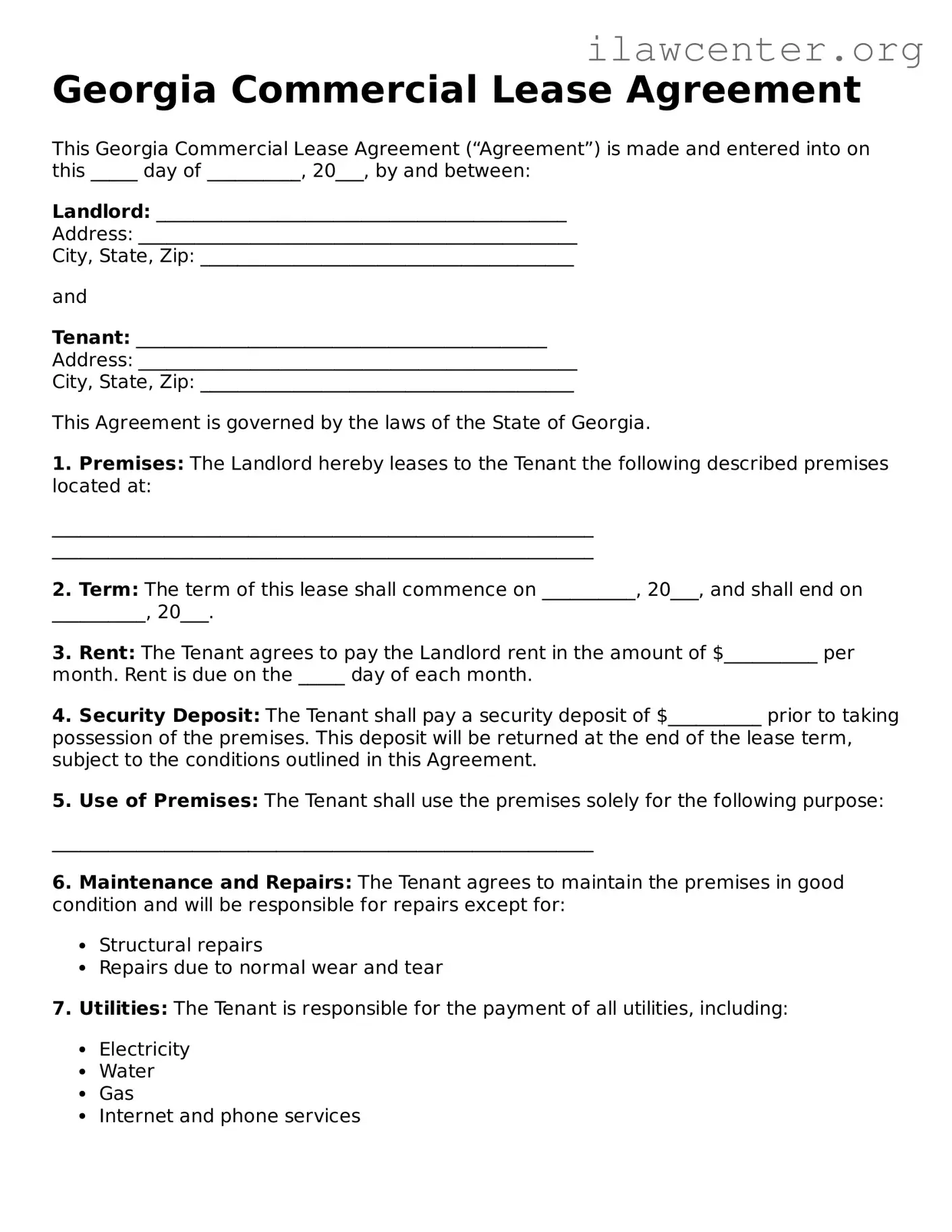
Georgia Commercial Lease Agreement

This Georgia Commercial Lease Agreement (“Agreement”) is made and entered into on this _____ day of __________, 20___, by and between:

Landlord: ____________________________________________
Address: _______________________________________________
City, State, Zip: ________________________________________

and

Tenant: ____________________________________________
Address: _______________________________________________
City, State, Zip: ________________________________________

This Agreement is governed by the laws of the State of Georgia.

1. Premises: The Landlord hereby leases to the Tenant the following described premises located at:

__________________________________________________________
__________________________________________________________

2. Term: The term of this lease shall commence on __________, 20___, and shall end on __________, 20___.

3. Rent: The Tenant agrees to pay the Landlord rent in the amount of $__________ per month. Rent is due on the _____ day of each month.

4. Security Deposit: The Tenant shall pay a security deposit of $__________ prior to taking possession of the premises. This deposit will be returned at the end of the lease term, subject to the conditions outlined in this Agreement.

5. Use of Premises: The Tenant shall use the premises solely for the following purpose:

__________________________________________________________

6. Maintenance and Repairs: The Tenant agrees to maintain the premises in good condition and will be responsible for repairs except for:

  • Structural repairs
  • Repairs due to normal wear and tear

7. Utilities: The Tenant is responsible for the payment of all utilities, including:

  • Electricity
  • Water
  • Gas
  • Internet and phone services

8. Alterations: The Tenant must obtain written consent from the Landlord before making any alterations to the premises.

9. Termination: This Agreement may be terminated by either party with a written notice of _____ days prior to the intended termination date.

10. Governing Law: This Agreement shall be governed by and construed in accordance with the laws of the State of Georgia.

IN WITNESS WHEREOF, the parties hereto have executed this Georgia Commercial Lease Agreement as of the date first above written.

Landlord Signature: _______________________________ Date: ________________

Tenant Signature: ________________________________ Date: ________________

PDF Form Characteristics

Fact Name Description
Governing Law The Georgia Commercial Lease Agreement is governed by the laws of the State of Georgia.
Purpose This form is used for renting commercial property, such as office space or retail locations.
Parties Involved The agreement typically involves a landlord (lessor) and a tenant (lessee).
Lease Term The lease term can vary, often ranging from one year to multiple years.
Rent Payment The form specifies the amount of rent, payment due dates, and accepted payment methods.
Security Deposit A security deposit may be required to cover potential damages or unpaid rent.
Maintenance Responsibilities The agreement outlines who is responsible for maintenance and repairs of the property.
Termination Clause There is usually a clause that details how either party can terminate the lease early.

Instructions on Utilizing Georgia Commercial Lease Agreement

When preparing to fill out the Georgia Commercial Lease Agreement form, it is essential to gather all necessary information about the property, the parties involved, and the terms of the lease. This preparation will help ensure a smooth completion of the form and assist in avoiding any potential misunderstandings later on.

  1. Begin by entering the date on which the lease agreement is being executed at the top of the form.
  2. Identify the landlord by providing their full name and address in the designated fields.
  3. Next, enter the tenant's full name and address. Ensure that this information is accurate to avoid issues in the future.
  4. Fill in the property address, including any suite or unit numbers, to clearly specify the location being leased.
  5. Indicate the lease term by specifying the start date and end date of the lease period.
  6. State the monthly rent amount that the tenant agrees to pay, along with any details regarding payment methods or due dates.
  7. Provide information regarding security deposits, including the amount and conditions for its return.
  8. Outline any utilities and services that will be provided, specifying who is responsible for payment.
  9. Include any maintenance responsibilities for both the landlord and tenant, ensuring clarity on who handles repairs and upkeep.
  10. Detail any options to renew the lease, if applicable, including terms and conditions for renewal.
  11. Sign and date the agreement at the bottom of the form, ensuring that both parties have provided their signatures.

Important Facts about Georgia Commercial Lease Agreement

What is a Georgia Commercial Lease Agreement?

A Georgia Commercial Lease Agreement is a legal document that outlines the terms and conditions under which a landlord rents commercial property to a tenant. It covers important details like rent amount, lease duration, and responsibilities of both parties.

Who needs a Commercial Lease Agreement?

Any business or individual looking to rent commercial space in Georgia should use a Commercial Lease Agreement. This includes retail stores, offices, warehouses, and other business facilities. It protects both the landlord and the tenant by clearly defining their rights and obligations.

What key terms should be included in the agreement?

Essential terms include the lease duration, rental amount, payment schedule, security deposit requirements, maintenance responsibilities, and any restrictions on property use. It’s important to be thorough to avoid misunderstandings later on.

How long does a typical commercial lease last?

Commercial leases can vary widely in duration. They often range from one year to several years, depending on the needs of the tenant and the landlord’s preferences. Longer leases may offer more stability, while shorter leases can provide flexibility.

Can the lease be modified after it’s signed?

Yes, a lease can be modified, but both parties must agree to any changes. Modifications should be documented in writing and signed by both the landlord and tenant to ensure clarity and avoid disputes.

What happens if the tenant wants to break the lease early?

If a tenant needs to break the lease early, they should refer to the agreement for any early termination clauses. Often, tenants may need to pay a penalty or continue paying rent until a new tenant is found.

Is a security deposit required?

Most landlords require a security deposit. This deposit protects the landlord against potential damages or unpaid rent. The amount is typically negotiable but often equals one month’s rent.

What should I do if there’s a dispute?

If a dispute arises, the first step is to review the lease agreement for any relevant clauses. Open communication can often resolve issues. If that doesn’t work, mediation or legal action may be necessary, depending on the situation.

Can I sublease the commercial property?

Subleasing is often allowed, but it usually requires the landlord’s approval. The lease agreement should specify whether subleasing is permitted and under what conditions. Always get written consent to avoid any complications.

Common mistakes

Filling out the Georgia Commercial Lease Agreement can be a straightforward process, but several common mistakes can lead to confusion or legal issues. One frequent error is failing to include all necessary parties in the agreement. It’s essential to list both the landlord and tenant correctly. Omitting a party or using incorrect names can create problems down the line.

Another mistake often made is not specifying the lease term. The agreement should clearly state the duration of the lease, including start and end dates. If this information is vague or missing, it can lead to misunderstandings regarding the rental period.

People sometimes overlook the importance of detailing the rental amount and payment terms. The lease should specify how much rent is due, when it is due, and the method of payment. Failing to include this information can result in disputes over rent payments.

Additionally, tenants may neglect to read the fine print regarding maintenance responsibilities. The lease should outline who is responsible for repairs and maintenance of the property. If this section is unclear or ignored, it could lead to unexpected costs for either party.

Another common oversight is not addressing the renewal options. If the lease includes options for renewal, these terms should be explicitly stated. This helps both the landlord and tenant understand their rights and obligations at the end of the lease term.

Lastly, many people fail to seek legal advice before signing the lease. A commercial lease can be complex, and understanding all the terms is crucial. Consulting with a legal professional can help clarify any confusing sections and ensure that all parties are protected.

Documents used along the form

When entering into a commercial lease agreement in Georgia, several additional forms and documents may be necessary to ensure a smooth transaction. Each of these documents serves a specific purpose and can help clarify the responsibilities and expectations of both parties involved.

  • Letter of Intent: This document outlines the preliminary terms and conditions of the lease agreement before it is finalized. It serves as a roadmap for negotiations and can help both parties understand their intentions.
  • Guaranty Agreement: A guaranty agreement is often required to provide additional security for the landlord. It involves a third party agreeing to take responsibility for the lease obligations if the tenant fails to meet them.
  • Estoppel Certificate: This document confirms the current status of the lease and the tenant's obligations. It is typically requested by lenders or potential buyers to ensure there are no disputes regarding the lease terms.
  • Subordination, Non-Disturbance, and Attornment Agreement (SNDA): This agreement protects the tenant's rights in the event the property is sold or foreclosed. It ensures that the tenant can continue to occupy the space under the same terms.
  • Maintenance and Repair Agreement: This document specifies the responsibilities of both the landlord and tenant regarding property maintenance and repairs. It helps prevent misunderstandings and ensures that both parties are clear about their obligations.

Utilizing these documents alongside the Georgia Commercial Lease Agreement can help establish a solid foundation for the landlord-tenant relationship. Clarity in these agreements fosters trust and can lead to a more successful leasing experience.

Similar forms

  • Residential Lease Agreement: Similar to a Commercial Lease Agreement, this document outlines the terms and conditions under which a tenant rents a residential property from a landlord. Both agreements specify rent amounts, duration, and responsibilities for maintenance. However, the Residential Lease is tailored for living spaces, while the Commercial Lease is focused on business use.

  • Sublease Agreement: This document allows a tenant to rent out their leased space to another party. Like the Commercial Lease, it includes details about rent, duration, and obligations. However, the Sublease Agreement is typically used when the original tenant needs to vacate the space temporarily, and it must align with the terms of the original lease.

  • Letter of Intent (LOI): An LOI is often used in commercial real estate transactions to outline the preliminary terms of a lease before a formal agreement is drafted. It shares similarities with the Commercial Lease Agreement in that both documents establish the intent to lease and include key terms such as rent and duration. However, the LOI is generally non-binding and serves as a starting point for negotiations.

  • Commercial Purchase Agreement: This document is used when a buyer intends to purchase commercial property. While it differs from a lease in that it involves ownership transfer, both agreements detail terms such as price, contingencies, and responsibilities of the parties involved. The Commercial Purchase Agreement often includes lease provisions if the property is currently leased.

Dos and Don'ts

When filling out the Georgia Commercial Lease Agreement form, it is essential to approach the process with care. Here are six important things to consider:

  • Do read the entire lease agreement thoroughly. Understanding all terms and conditions is crucial before signing.
  • Do ensure all parties involved are clearly identified. This includes the landlord, tenant, and any additional parties.
  • Do specify the lease term. Clearly state the start and end dates of the lease to avoid confusion later.
  • Do include all necessary details about the property. Describe the leased space accurately, including square footage and specific uses.
  • Don't leave any blanks in the agreement. Every section should be completed to prevent misunderstandings.
  • Don't rush the process. Take your time to review and understand each section before finalizing the agreement.

Misconceptions

Understanding the Georgia Commercial Lease Agreement form is essential for both landlords and tenants. However, several misconceptions can lead to confusion. Here are ten common misconceptions:

  1. All commercial leases are the same. Many believe that all commercial leases follow a standard format. In reality, each lease can be customized to fit the specific needs of the parties involved.
  2. Only landlords can negotiate lease terms. Tenants often think they have no power in negotiations. However, tenants can and should negotiate terms to ensure they meet their business needs.
  3. Security deposits are non-refundable. Some assume that all security deposits are lost if the lease is terminated. In fact, many leases outline conditions under which deposits can be refunded.
  4. Lease agreements are only for long-term commitments. Many people believe that commercial leases must be for several years. However, short-term leases are also available and can be beneficial for certain businesses.
  5. All expenses are included in the lease. There is a common misconception that all costs associated with the property are covered in the lease. In reality, tenants may be responsible for additional expenses such as maintenance and utilities.
  6. Verbal agreements are sufficient. Some individuals think that a verbal agreement is enough to secure a lease. However, having a written contract is crucial for legal protection and clarity.
  7. Landlords can enter the property at any time. Many tenants believe that landlords have unrestricted access to the leased space. In fact, landlords must provide notice and have valid reasons for entering the property.
  8. Termination clauses are unnecessary. Some may think that termination clauses are not important. However, these clauses are essential for outlining the process and conditions for ending the lease.
  9. Commercial leases cannot be modified. There is a belief that once a lease is signed, it cannot be changed. However, leases can often be amended if both parties agree to the modifications.
  10. Legal advice is not needed. Some tenants and landlords feel that they can navigate the lease process without legal assistance. In reality, consulting with a legal professional can help avoid costly mistakes.

By addressing these misconceptions, both landlords and tenants can approach the leasing process with greater confidence and understanding.

Key takeaways

When it comes to filling out and using the Georgia Commercial Lease Agreement form, there are several important points to keep in mind. Understanding these key takeaways can help ensure a smooth leasing process for both landlords and tenants.

  • Understand the Basics: Familiarize yourself with the essential components of a commercial lease, including terms, conditions, and obligations.
  • Specify the Lease Term: Clearly state the duration of the lease. This includes the start and end dates, as well as any options for renewal.
  • Define the Rent Amount: Clearly outline the rent amount, payment schedule, and any potential increases over time.
  • Identify the Property: Provide a detailed description of the leased premises, including the address and any specific areas included in the lease.
  • Include Maintenance Responsibilities: Specify who is responsible for maintenance and repairs. This can help prevent disputes later on.
  • Review Use Clauses: Clearly define how the space can be used. This is crucial for ensuring that both parties understand the intended purpose of the property.
  • Address Termination Conditions: Outline the conditions under which the lease can be terminated. This includes notice periods and any penalties for early termination.
  • Consult Legal Advice: It’s wise to have a legal professional review the lease agreement before signing. This can help identify potential issues and protect your interests.
  • Keep Copies: After signing, both parties should retain copies of the lease agreement. This ensures that everyone has access to the terms agreed upon.

By keeping these key points in mind, you can navigate the complexities of the Georgia Commercial Lease Agreement with greater confidence. A well-prepared lease can lead to a successful and mutually beneficial relationship between landlords and tenants.