Attorney-Verified  Divorce Settlement Agreement Document for Georgia

Attorney-Verified Divorce Settlement Agreement Document for Georgia

The Georgia Divorce Settlement Agreement form is a legal document that outlines the terms agreed upon by both parties during a divorce. This form serves to clarify issues such as property division, child custody, and support arrangements, ensuring that both individuals have a mutual understanding of their responsibilities. To begin the process of finalizing your divorce, consider filling out the form by clicking the button below.

Article Guide

When navigating the complexities of divorce in Georgia, a Divorce Settlement Agreement form plays a crucial role in outlining the terms of the separation between spouses. This document addresses key aspects such as the division of property, spousal support, and child custody arrangements, ensuring that both parties have a clear understanding of their rights and responsibilities. It serves as a binding contract that can help prevent future disputes by detailing how assets and debts will be divided. Furthermore, the agreement can specify visitation schedules and child support obligations, providing a framework for co-parenting. By carefully drafting this form, individuals can create a fair and equitable resolution that reflects their unique circumstances, promoting a smoother transition into the next chapter of their lives.

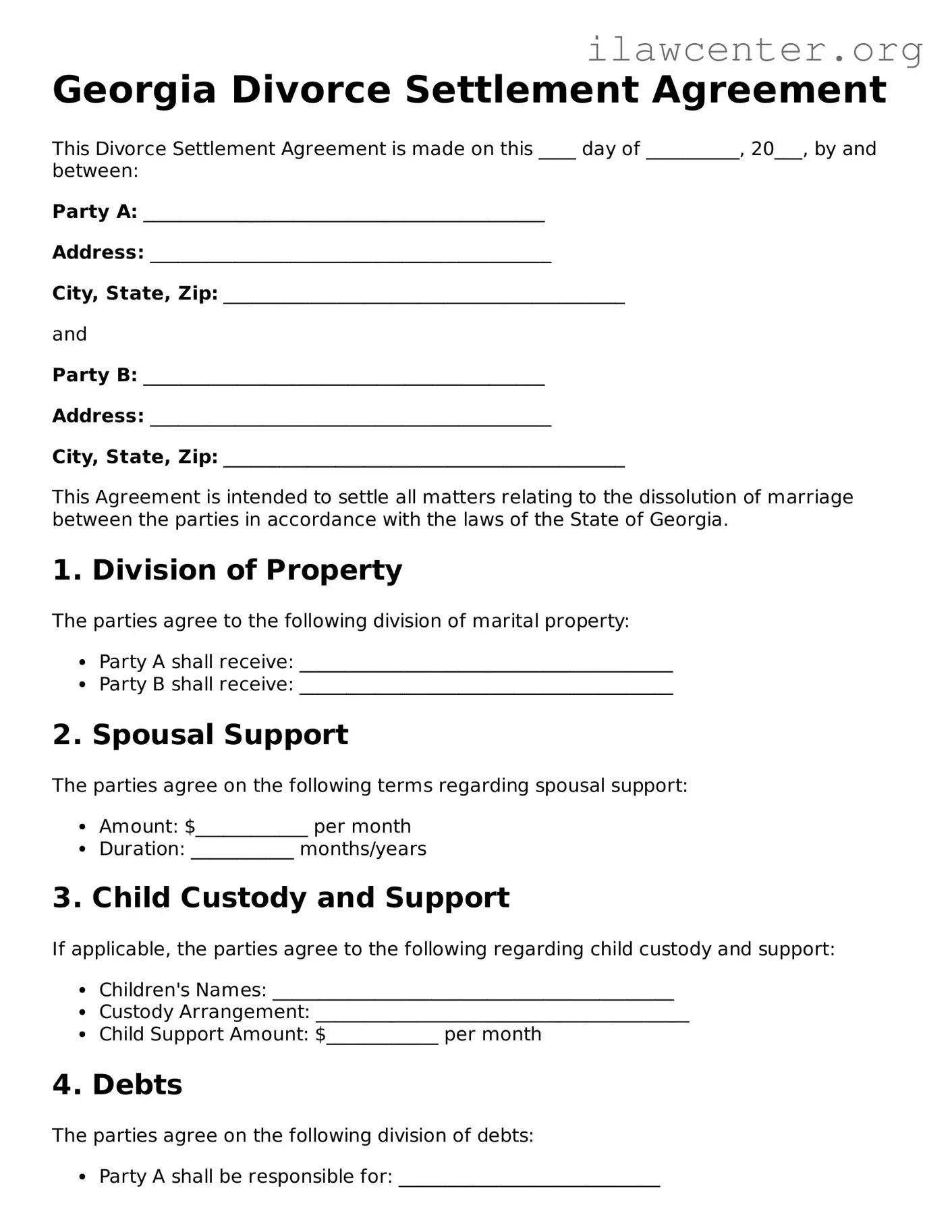
Georgia Divorce Settlement Agreement Preview

Georgia Divorce Settlement Agreement

This Divorce Settlement Agreement is made on this ____ day of __________, 20___, by and between:

Party A: ___________________________________________

Address: ___________________________________________

City, State, Zip: ___________________________________________

and

Party B: ___________________________________________

Address: ___________________________________________

City, State, Zip: ___________________________________________

This Agreement is intended to settle all matters relating to the dissolution of marriage between the parties in accordance with the laws of the State of Georgia.

1. Division of Property

The parties agree to the following division of marital property:

  • Party A shall receive: ________________________________________
  • Party B shall receive: ________________________________________

2. Spousal Support

The parties agree on the following terms regarding spousal support:

  • Amount: $____________ per month
  • Duration: ___________ months/years

3. Child Custody and Support

If applicable, the parties agree to the following regarding child custody and support:

  • Children's Names: ___________________________________________
  • Custody Arrangement: ________________________________________
  • Child Support Amount: $____________ per month

4. Debts

The parties agree on the following division of debts:

  • Party A shall be responsible for: ____________________________
  • Party B shall be responsible for: ____________________________

5. Miscellaneous

Other agreements include:

  • ___________________________________________
  • ___________________________________________

By signing below, both parties acknowledge that they have read and understood this Agreement and voluntarily agree to its terms.

Party A Signature: _______________________________ Date: ____________

Party B Signature: _______________________________ Date: ____________

Witness Signature: _______________________________ Date: ____________

PDF Form Characteristics

Fact Name Description
Purpose The Georgia Divorce Settlement Agreement form is used to outline the terms of a divorce settlement between spouses, covering issues such as property division, alimony, and child custody.
Governing Law This form is governed by the laws of the State of Georgia, specifically under Title 19, Chapter 5 of the Official Code of Georgia Annotated (OCGA).
Requirements Both parties must voluntarily agree to the terms laid out in the form, and it must be signed in the presence of a notary public to ensure its validity.
Filing After completion, the signed agreement must be filed with the court as part of the divorce proceedings, allowing the judge to review and approve the terms.

Instructions on Utilizing Georgia Divorce Settlement Agreement

Once you have the Georgia Divorce Settlement Agreement form in hand, it’s time to fill it out carefully. This form is essential for outlining the terms of your divorce, including asset division, child custody, and support arrangements. Follow the steps below to ensure you complete the form accurately.

  1. Begin by entering your full name and the name of your spouse at the top of the form.
  2. Provide your current addresses, including city, state, and zip code.
  3. Fill in the date of your marriage and the date of separation.
  4. List any children from the marriage, including their names and birth dates.
  5. Detail the terms of child custody, including physical and legal custody arrangements.
  6. Outline the child support obligations, specifying the amount and frequency of payments.
  7. Describe how marital property will be divided, including real estate, bank accounts, and personal property.
  8. Indicate any spousal support arrangements, including the amount and duration of payments.
  9. Sign and date the form at the bottom, ensuring both spouses do the same.
  10. Make copies of the completed form for your records before submitting it to the court.

After completing the form, review it for accuracy and completeness. Once satisfied, you can proceed to file it with the appropriate court. This step is crucial in finalizing the divorce process.

Important Facts about Georgia Divorce Settlement Agreement

What is a Divorce Settlement Agreement in Georgia?

A Divorce Settlement Agreement is a legal document that outlines the terms of a divorce between spouses. It covers important issues such as property division, child custody, child support, and spousal support. This agreement is crucial for ensuring both parties understand their rights and responsibilities after the divorce is finalized.

Do I need a lawyer to create a Divorce Settlement Agreement?

While it is not legally required to have a lawyer, it is highly recommended. A lawyer can help ensure that the agreement is fair and complies with Georgia law. They can also provide guidance on what to include and how to protect your interests.

How do I fill out the Divorce Settlement Agreement form?

Filling out the form requires careful attention to detail. Begin by clearly stating both parties' names and contact information. Next, address key issues such as asset division, debts, and any arrangements for children. Be thorough and specific to avoid misunderstandings later on.

Can I modify the Divorce Settlement Agreement after it is signed?

Yes, modifications can be made, but both parties must agree to the changes. It’s best to document any modifications in writing and, if possible, have them reviewed by a lawyer. This helps ensure that the new terms are enforceable.

What happens if one party doesn’t follow the agreement?

If one party fails to comply with the terms of the Divorce Settlement Agreement, the other party can seek enforcement through the court. This may involve filing a motion for contempt or seeking a modification of the agreement. Courts take these matters seriously, especially when children are involved.

Is the Divorce Settlement Agreement legally binding?

Yes, once signed by both parties and approved by the court, the Divorce Settlement Agreement becomes legally binding. This means that both parties must adhere to the terms outlined in the agreement. Failure to do so can lead to legal consequences.

How long does it take to finalize a Divorce Settlement Agreement?

The timeline can vary widely based on the complexity of the issues and whether both parties agree on the terms. If both parties are cooperative, it can take a few weeks. However, if there are disputes, it may take several months or longer to reach a resolution.

What if my spouse and I can’t agree on the terms?

If an agreement cannot be reached, mediation may be a helpful option. A neutral third party can assist in negotiating the terms. If mediation fails, the case may need to go to court, where a judge will make the final decisions on contested issues.

Where do I submit the Divorce Settlement Agreement?

The completed Divorce Settlement Agreement must be submitted to the appropriate court in Georgia. This is typically the county where either spouse resides. It’s important to file the agreement along with any other required divorce documents to ensure everything is processed correctly.

Can I use a template for the Divorce Settlement Agreement?

Using a template can be a good starting point, but it’s essential to customize it to fit your specific situation. Generic templates may not cover all necessary details or comply with Georgia law. Consulting with a lawyer can help ensure that your agreement is comprehensive and legally sound.
Common mistakes

Filling out the Georgia Divorce Settlement Agreement form can be a daunting task, and many individuals make common mistakes that can lead to complications later on. One prevalent mistake is failing to provide complete and accurate information. Each section of the form requires specific details, and omitting information can result in delays or even rejection of the agreement. It is crucial to double-check all entries to ensure that nothing is missing.

Another frequent error involves misunderstanding the terms used in the form. Legal terminology can be confusing, and misinterpreting these terms may lead to unintended consequences. For instance, individuals might not fully grasp the implications of "equitable distribution," which could affect how assets are divided. Seeking clarification on terms before filling out the form can prevent misunderstandings.

Many people also neglect to consider the tax implications of their settlement. For example, spousal support may have tax consequences that affect both parties. Failing to account for these factors can lead to financial surprises down the line. It is wise to consult with a financial advisor or tax professional to understand how the settlement may impact one's finances.

Additionally, some individuals may rush through the form without thoroughly reviewing the entire document. This haste can lead to errors, such as incorrect figures or misplaced signatures. Taking the time to carefully read through the agreement before submitting it can help catch mistakes that might otherwise go unnoticed.

Another common mistake is not including all relevant assets and debts. People may overlook certain items, thinking they are insignificant, but even small assets can have a bearing on the overall settlement. Listing everything ensures that both parties have a clear understanding of what is being divided.

In some cases, individuals might forget to address child custody and support arrangements. These elements are critical components of the divorce settlement and must be clearly outlined to avoid future disputes. Not specifying these arrangements can lead to confusion and conflict after the divorce is finalized.

Moreover, individuals sometimes fail to have the agreement notarized or witnessed, which can undermine its enforceability. A signature alone may not suffice; having the document properly executed adds an extra layer of legitimacy and can prevent challenges in the future.

Lastly, not seeking legal advice can be a significant oversight. While it may seem cost-effective to navigate the process independently, having a legal professional review the agreement can provide peace of mind. They can identify potential pitfalls and ensure that the agreement complies with Georgia laws, ultimately protecting one's interests.

Documents used along the form

When navigating a divorce in Georgia, having the right forms and documents is essential for a smooth process. Along with the Georgia Divorce Settlement Agreement, several other documents can help clarify terms and ensure everything is properly addressed. Below is a list of commonly used forms that may accompany your Divorce Settlement Agreement.

  • Petition for Divorce: This is the initial document filed with the court to start the divorce process. It outlines the reasons for the divorce and the relief sought.
  • Financial Affidavit: A detailed statement of your financial situation, including income, expenses, assets, and debts. This document helps the court understand your financial needs and obligations.
  • Child Custody Agreement: If children are involved, this document outlines the custody arrangements, including physical and legal custody, visitation rights, and decision-making responsibilities.
  • Child Support Worksheet: A form that calculates the amount of child support one parent may owe to the other based on income and expenses. This ensures that the financial needs of the children are met.
  • Property Settlement Agreement: This document details how marital property and debts will be divided between the spouses, ensuring clarity and fairness in the division of assets.
  • Temporary Orders: If immediate decisions need to be made regarding custody, support, or property during the divorce proceedings, this document requests temporary relief until a final decision is reached.
  • Final Judgment and Decree of Divorce: This is the official court order that finalizes the divorce, outlining all decisions made regarding property, custody, and support.
  • Notice of Hearing: A document that informs all parties involved about the date and time of court hearings related to the divorce, ensuring everyone has the opportunity to attend and present their case.

Having these documents ready can streamline the divorce process and help ensure that all important aspects are addressed. It’s always wise to consult with a legal professional to make sure everything is completed correctly and to protect your rights throughout this challenging time.

Similar forms

  • Separation Agreement: This document outlines the terms under which a couple will live apart. It addresses similar issues such as property division, child custody, and support, much like a Divorce Settlement Agreement.

  • Child Custody Agreement: Focused specifically on the arrangements for children, this agreement details custody and visitation rights, paralleling the child-related aspects of a Divorce Settlement Agreement.

  • Property Settlement Agreement: This form specifically deals with the division of marital assets and debts. Like a Divorce Settlement Agreement, it aims to clarify how property will be divided between the parties.

  • Marital Settlement Agreement: This document encompasses the overall terms of a divorce, including support and custody arrangements, similar to a Divorce Settlement Agreement but often used in uncontested divorces.

  • Spousal Support Agreement: This form focuses solely on financial support between spouses after separation or divorce. It shares the financial component found in a Divorce Settlement Agreement.

  • Child Support Agreement: This outlines the financial responsibilities of each parent towards their children. It resembles the support provisions of a Divorce Settlement Agreement.

  • Postnuptial Agreement: Created after marriage, this document details the distribution of assets and responsibilities. It serves a similar purpose to a Divorce Settlement Agreement in terms of asset division.

  • Prenuptial Agreement: Established before marriage, this agreement addresses asset distribution and spousal support, much like a Divorce Settlement Agreement, but is created to prevent disputes in the event of a divorce.

  • Modification Agreement: This document is used to change existing agreements, such as custody or support arrangements, reflecting the evolving needs of the family, similar to how a Divorce Settlement Agreement may be adjusted post-divorce.

  • Affidavit of Support: This form is often used in immigration cases but can also relate to financial support obligations. It connects to the support aspects of a Divorce Settlement Agreement.

Dos and Don'ts

When filling out the Georgia Divorce Settlement Agreement form, it's essential to approach the process with care. Here’s a list of things you should and shouldn’t do to ensure everything goes smoothly.

  • Do read the entire form carefully before starting. Understanding what is required will help you provide accurate information.
  • Do provide complete and truthful information. Omitting details can lead to complications later.
  • Do consult with a legal expert if you have questions. Getting professional advice can clarify complex issues.
  • Do keep copies of all documents. Having a record is crucial for your personal files and future reference.
  • Don't rush through the form. Taking your time can prevent mistakes that might delay the process.
  • Don't use vague language. Be specific in your responses to avoid confusion.
  • Don't ignore deadlines. Submitting the form on time is vital to avoid unnecessary delays in your divorce proceedings.
  • Don't forget to sign and date the form. An unsigned document is not valid and can cause issues down the line.

Misconceptions

Understanding the nuances of a Divorce Settlement Agreement form in Georgia is essential for anyone navigating the divorce process. Several misconceptions can lead to confusion and potential legal pitfalls. Below is a list of common misconceptions along with clarifications.

  • Misconception 1: The Divorce Settlement Agreement is the same as the final divorce decree.
  • This is not true. The Divorce Settlement Agreement outlines the terms of the divorce, such as asset division and child custody, but it must be approved by the court to become legally binding.

  • Misconception 2: A Divorce Settlement Agreement can be created without legal assistance.
  • While it is possible to draft an agreement independently, having legal guidance ensures that all necessary terms are included and comply with state laws, reducing the risk of future disputes.

  • Misconception 3: The agreement is permanent and cannot be changed.
  • In fact, if circumstances change significantly, such as a job loss or relocation, either party can petition the court to modify the agreement.

  • Misconception 4: Both parties must agree on every term for the agreement to be valid.
  • While mutual agreement is ideal, a court can still enforce certain terms if one party does not agree, especially regarding child support and custody.

  • Misconception 5: The Divorce Settlement Agreement only addresses financial matters.
  • This is misleading. The agreement can also cover child custody, visitation rights, and other personal matters, making it a comprehensive document.

  • Misconception 6: Once signed, the Divorce Settlement Agreement is final and cannot be revisited.
  • Although the agreement is binding once approved by the court, parties can seek to modify it through legal channels if necessary.

Key takeaways

When filling out and using the Georgia Divorce Settlement Agreement form, it is essential to understand several key aspects to ensure clarity and compliance. Below are important takeaways to consider:

  • Complete all sections: Ensure every section of the form is filled out accurately. Missing information can lead to delays in the divorce process.
  • Be clear and specific: Use clear language when describing terms of the agreement. Ambiguity can result in misunderstandings later.
  • Consider legal implications: Understand that the agreement is a legally binding document. Seek legal advice if needed to ensure your rights are protected.
  • Include all relevant details: Address all aspects of the divorce, including child custody, division of assets, and spousal support.
  • Review and revise: Take time to review the agreement thoroughly before signing. Make necessary revisions to ensure it reflects your intentions.
  • Sign in front of a notary: Notarization is often required. This adds an extra layer of authenticity to the document.
  • File with the court: After completion, submit the signed agreement to the appropriate court. This finalizes the divorce process.
  • Keep copies: Retain copies of the signed agreement for your records. This will be useful for future reference.