Attorney-Verified  Do Not Resuscitate Order Document for Georgia

Attorney-Verified Do Not Resuscitate Order Document for Georgia

A Georgia Do Not Resuscitate (DNR) Order form is a legal document that allows individuals to refuse resuscitation in the event of a medical emergency. This form provides clear instructions to healthcare providers about a person's wishes regarding life-sustaining treatment. Understanding how to properly fill out and utilize this form is crucial for ensuring that your healthcare preferences are respected.

Ready to take control of your healthcare decisions? Fill out the DNR Order form by clicking the button below.

Article Guide

In the realm of healthcare, understanding patient autonomy and end-of-life decisions is crucial. The Georgia Do Not Resuscitate (DNR) Order form serves as a vital tool for individuals who wish to make their preferences known regarding resuscitation efforts in the event of a medical emergency. This legally recognized document allows patients to express their desire not to receive cardiopulmonary resuscitation (CPR) or other life-sustaining treatments if their heart stops beating or they stop breathing. The form must be completed and signed by a physician, ensuring that it reflects informed medical advice. Additionally, it requires the patient’s signature or that of a legally authorized representative, which underscores the importance of informed consent in healthcare decisions. By providing clear instructions to medical personnel, the DNR Order aims to honor the wishes of patients while also facilitating communication among healthcare providers, patients, and families. In a society that values individual rights and personal choices, understanding the nuances of the Georgia DNR Order form is essential for anyone considering their end-of-life care options.

Georgia Do Not Resuscitate Order Preview

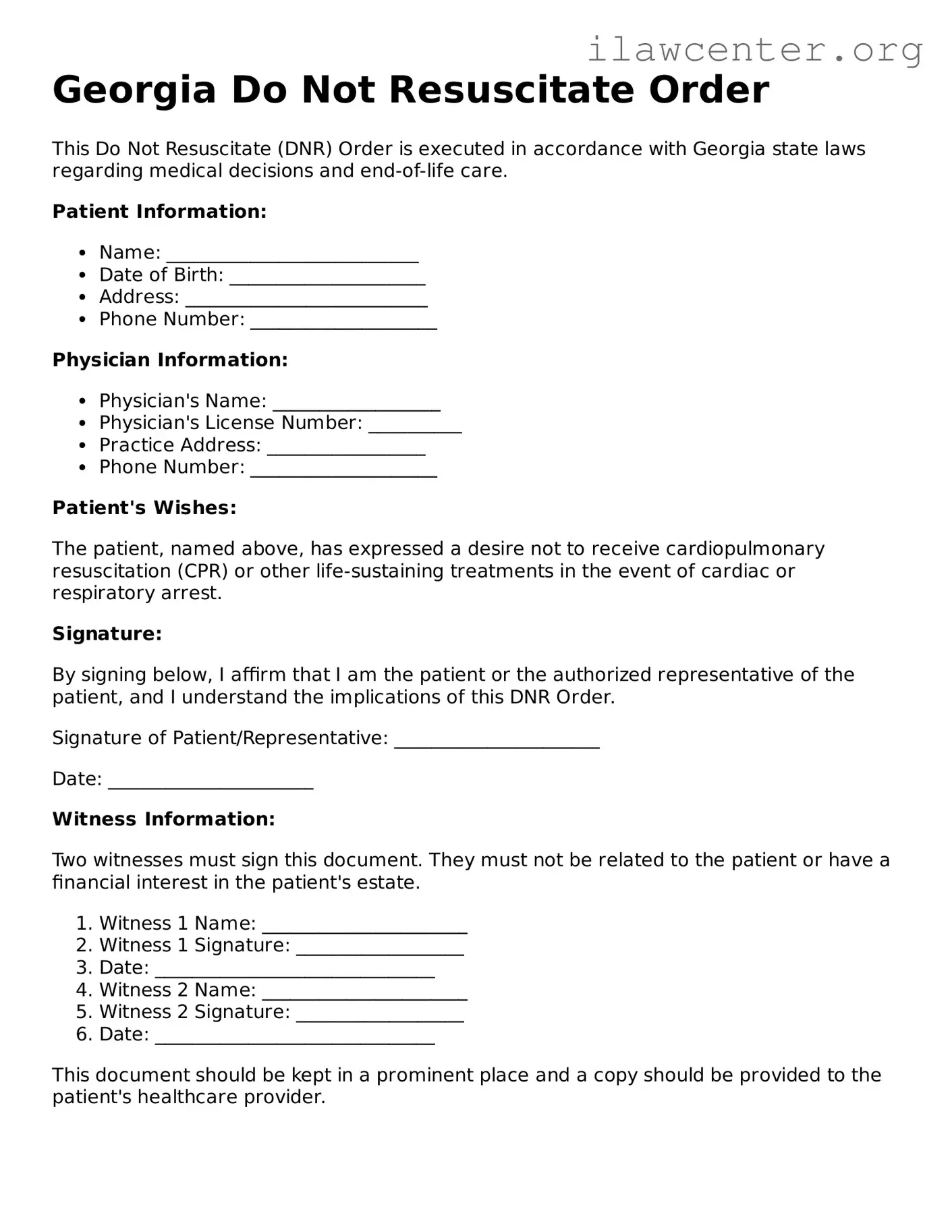
Georgia Do Not Resuscitate Order

This Do Not Resuscitate (DNR) Order is executed in accordance with Georgia state laws regarding medical decisions and end-of-life care.

Patient Information:

  • Name: ___________________________
  • Date of Birth: _____________________
  • Address: __________________________
  • Phone Number: ____________________

Physician Information:

  • Physician's Name: __________________
  • Physician's License Number: __________
  • Practice Address: _________________
  • Phone Number: ____________________

Patient's Wishes:

The patient, named above, has expressed a desire not to receive cardiopulmonary resuscitation (CPR) or other life-sustaining treatments in the event of cardiac or respiratory arrest.

Signature:

By signing below, I affirm that I am the patient or the authorized representative of the patient, and I understand the implications of this DNR Order.

Signature of Patient/Representative: ______________________

Date: ______________________

Witness Information:

Two witnesses must sign this document. They must not be related to the patient or have a financial interest in the patient's estate.

  1. Witness 1 Name: ______________________
  2. Witness 1 Signature: __________________
  3. Date: ______________________________
  4. Witness 2 Name: ______________________
  5. Witness 2 Signature: __________________
  6. Date: ______________________________

This document should be kept in a prominent place and a copy should be provided to the patient's healthcare provider.

PDF Form Characteristics

Fact Name Details
Definition A Do Not Resuscitate (DNR) Order in Georgia is a legal document that instructs medical personnel not to perform cardiopulmonary resuscitation (CPR) if a patient's heart stops or if they stop breathing.
Governing Law The Georgia DNR Order is governed by O.C.G.A. § 31-39, which outlines the requirements and procedures for creating and recognizing DNR orders within the state.
Eligibility Any adult who is of sound mind can complete a DNR order in Georgia. Additionally, a parent or legal guardian can execute a DNR order on behalf of a minor.
Form Availability The Georgia DNR Order form is available through various healthcare providers and can also be downloaded from the Georgia Department of Public Health website.

Instructions on Utilizing Georgia Do Not Resuscitate Order

Filling out the Georgia Do Not Resuscitate Order form is an important step in expressing your healthcare preferences. This document will guide you through the necessary steps to ensure your wishes are clearly communicated.

  1. Obtain the Georgia Do Not Resuscitate Order form. You can find this form online or request it from your healthcare provider.
  2. Read the instructions carefully to understand the requirements and implications of the form.
  3. Fill in your personal information, including your full name, date of birth, and address. Make sure this information is accurate.
  4. Designate a healthcare agent if desired. This person will be responsible for making decisions on your behalf if you are unable to do so.
  5. Sign and date the form. Your signature is essential for the document to be valid.
  6. Have the form witnessed by two individuals who are not related to you and who will not benefit from your estate. They must also sign the form.
  7. Make copies of the completed form. Keep one for your records and provide copies to your healthcare provider and designated healthcare agent.

Once you have completed the form, it’s essential to discuss your wishes with your healthcare provider and loved ones. This ensures everyone is aware of your preferences and can act accordingly when needed.

Important Facts about Georgia Do Not Resuscitate Order

What is a Do Not Resuscitate (DNR) Order in Georgia?

A Do Not Resuscitate Order is a medical order that informs healthcare providers not to perform cardiopulmonary resuscitation (CPR) if a patient’s heart stops beating or if they stop breathing. In Georgia, this order must be documented on a specific DNR form to be valid in medical settings.

Who can request a DNR Order in Georgia?

In Georgia, a DNR Order can be requested by a patient who is at least 18 years old and has the capacity to make medical decisions. If the patient is unable to make decisions, a legally authorized representative, such as a family member or legal guardian, may request the order on their behalf.

How does one obtain a DNR Order form in Georgia?

The DNR Order form can be obtained from various sources, including healthcare providers, hospitals, or the Georgia Department of Public Health. It is important to ensure that the form is the official state version to meet legal requirements.

What information is required on the DNR Order form?

The DNR Order form requires specific information, including the patient’s name, date of birth, and a statement indicating that the patient does not wish to receive CPR. Additionally, it must be signed by the patient or their authorized representative and a physician.

Is a DNR Order valid in all healthcare settings in Georgia?

Yes, a properly completed and signed DNR Order is valid in all healthcare settings in Georgia, including hospitals, nursing homes, and emergency medical services. It must be presented to healthcare providers to be honored.

Can a DNR Order be revoked?

Yes, a DNR Order can be revoked at any time by the patient or their authorized representative. To revoke the order, the patient should inform their healthcare provider and may need to complete a revocation form or destroy the original DNR form.

What happens if a DNR Order is not available during a medical emergency?

If a DNR Order is not available during a medical emergency, healthcare providers are required to perform CPR and other life-saving measures. It is crucial to keep the DNR form accessible and inform family members and caregivers about its existence.

Are there any legal protections for healthcare providers regarding DNR Orders?

Yes, healthcare providers in Georgia are protected from legal liability when they comply with a valid DNR Order. They must act in accordance with the order to avoid legal repercussions, provided that the order is properly executed and presented.

Can a DNR Order be used in conjunction with other advance directives?

Yes, a DNR Order can be used alongside other advance directives, such as a living will or a healthcare power of attorney. These documents can work together to provide comprehensive guidance on a patient’s medical preferences and end-of-life care.
Common mistakes

Filling out a Do Not Resuscitate (DNR) Order form in Georgia is a critical task that requires careful attention. Mistakes can lead to confusion or unintended medical actions. One common error is not having the form signed by a physician. In Georgia, a doctor’s signature is necessary for the DNR order to be valid. Without it, healthcare providers may not honor the wishes expressed in the document.

Another mistake is failing to clearly identify the patient. It’s essential to include the full name and date of birth on the form. Omitting this information can lead to misunderstandings, especially in emergency situations. Additionally, people sometimes forget to date the form. A DNR order should be dated to ensure it reflects the most current wishes of the patient.

Some individuals also overlook the importance of discussing the DNR order with family members. Not having these conversations can create confusion and conflict among loved ones during critical moments. It’s advisable to communicate openly about the decision and ensure everyone understands the patient’s wishes.

Another frequent mistake is using an outdated form. The Georgia DNR Order form may change over time, so it’s important to use the most recent version. Using an old form could lead to issues with its acceptance by medical personnel.

People may also neglect to make copies of the completed DNR order. Having multiple copies ensures that healthcare providers, family members, and emergency responders have access to the document when needed. This can be crucial in ensuring that the patient’s wishes are honored.

Lastly, some individuals may not review the DNR order regularly. Life circumstances and health conditions can change, and it’s important to revisit the order to ensure it still aligns with the patient’s current wishes. Regularly reviewing the form can help avoid any discrepancies in the future.

Documents used along the form

When considering end-of-life care and medical decisions, several documents complement the Georgia Do Not Resuscitate (DNR) Order form. Each of these forms serves a specific purpose and can help ensure that an individual's wishes are respected. Below is a list of important documents that may be used alongside the DNR Order.

  • Advance Directive for Health Care: This document outlines an individual's preferences for medical treatment and appoints a healthcare agent to make decisions on their behalf if they become unable to do so.
  • Living Will: A living will specifies the types of medical treatment a person wishes to receive or avoid in situations where they are terminally ill or permanently unconscious.
  • Durable Power of Attorney for Health Care: This form designates a trusted person to make healthcare decisions for someone if they are unable to communicate their wishes.
  • Physician Orders for Life-Sustaining Treatment (POLST): POLST is a medical order that reflects a patient's wishes regarding life-sustaining treatment and is intended for individuals with serious illnesses.
  • Do Not Intubate (DNI) Order: This order specifies that a patient should not be placed on a ventilator or receive mechanical breathing assistance in the event of respiratory failure.
  • Organ Donation Registration: This document allows individuals to express their wishes regarding organ donation after death, ensuring their intentions are honored.
  • Emergency Medical Services (EMS) DNR Order: This form is specifically for emergency medical personnel, indicating that resuscitation should not be attempted in case of cardiac arrest.
  • Medical History and Medication List: Keeping an updated list of medical history and current medications can help healthcare providers make informed decisions aligned with a patient’s wishes.
  • Funeral Planning Documents: These documents outline preferences for funeral arrangements, including burial or cremation, and can ease the burden on family members during a difficult time.

Each of these documents plays a crucial role in ensuring that healthcare providers and family members understand and respect an individual's wishes regarding medical treatment and end-of-life care. It is essential to keep these documents accessible and updated to facilitate timely decision-making when necessary.

Similar forms

  • Living Will: A living will outlines a person's wishes regarding medical treatment in situations where they can no longer communicate their preferences. Like a Do Not Resuscitate Order, it helps ensure that healthcare providers respect the individual's desires about end-of-life care.
  • Health Care Proxy: This document designates a specific person to make medical decisions on behalf of someone who is unable to do so. Similar to a DNR, it empowers individuals to have their treatment preferences honored through a trusted representative.
  • Advance Directive: An advance directive combines elements of a living will and a health care proxy. It provides instructions for medical care and appoints a decision-maker, ensuring that a person’s wishes are followed when they are incapacitated.
  • POLST (Physician Orders for Life-Sustaining Treatment): A POLST form translates a patient’s treatment preferences into medical orders. Like a DNR, it is designed for individuals with serious health conditions, ensuring that their choices are respected in emergency situations.
  • Durable Power of Attorney for Health Care: This document allows someone to make health care decisions on behalf of another person, similar to a health care proxy. It ensures that a trusted individual can advocate for the patient's wishes, including decisions related to resuscitation and life support.

Dos and Don'ts

When filling out the Georgia Do Not Resuscitate Order form, it is essential to follow specific guidelines to ensure your wishes are accurately documented. Here are ten important dos and don'ts to consider:

  • Do ensure that you are of sound mind when completing the form.
  • Do discuss your decision with your healthcare provider and loved ones.
  • Do clearly indicate your wishes regarding resuscitation.
  • Do sign and date the form in the presence of a witness.
  • Do keep copies of the signed form for your medical records.
  • Don't use ambiguous language that could lead to confusion.
  • Don't forget to update the form if your wishes change.
  • Don't leave the form unsigned or undated.
  • Don't assume that verbal instructions will be honored without documentation.
  • Don't overlook the importance of informing emergency contacts about your DNR status.

By adhering to these guidelines, you can ensure that your Do Not Resuscitate Order accurately reflects your wishes and is respected by healthcare providers.

Misconceptions

Many people have misunderstandings about the Georgia Do Not Resuscitate (DNR) Order form. Here are five common misconceptions:

  • A DNR order means you will not receive any medical treatment. This is not true. A DNR order specifically applies to resuscitation efforts in the event of cardiac arrest. Patients can still receive other medical treatments and interventions as needed.
  • Only terminally ill patients can have a DNR order. This misconception overlooks that anyone can request a DNR order, regardless of their health status. It is a personal choice based on individual values and preferences.
  • A DNR order is only valid in a hospital setting. This is incorrect. In Georgia, a DNR order is valid in various settings, including at home or in long-term care facilities. It must be properly documented and recognized by healthcare providers.
  • You cannot change or revoke a DNR order once it is signed. This is a misunderstanding. Individuals have the right to change or revoke their DNR order at any time. It is important to communicate any changes to healthcare providers and ensure that updated documents are in place.
  • Having a DNR order means you are giving up on life. Many believe that a DNR order indicates a desire to stop fighting for life. In reality, it reflects a personal decision about the type of medical interventions one wants during a critical situation. It can be a thoughtful choice based on quality of life considerations.

Key takeaways

When considering a Do Not Resuscitate (DNR) Order in Georgia, it's important to understand the key aspects of the form and its implications. Here are some essential takeaways:

  • Understanding the Purpose: A DNR Order is a legal document that informs medical personnel not to perform cardiopulmonary resuscitation (CPR) in the event of cardiac arrest.
  • Eligibility: Typically, DNR Orders are intended for individuals with serious health conditions or those who are nearing the end of life.
  • Filling Out the Form: The form must be completed accurately and signed by the patient or their legal representative, along with a physician's signature.
  • Communication is Key: Discuss your wishes with family members and healthcare providers to ensure everyone understands your decisions regarding resuscitation.
  • Review and Update: Regularly review your DNR Order to ensure it reflects your current health status and wishes, especially if your situation changes.

By keeping these points in mind, you can make informed decisions about your healthcare preferences and ensure that your wishes are respected in critical situations.