Attorney-Verified  Durable Power of Attorney Document for Georgia

Attorney-Verified Durable Power of Attorney Document for Georgia

A Durable Power of Attorney form in Georgia allows an individual to designate someone else to manage their financial and legal affairs when they are unable to do so themselves. This important document ensures that your wishes are respected and that your responsibilities are handled by a trusted person. To take the next step, fill out the form by clicking the button below.

Article Guide

The Georgia Durable Power of Attorney form is a crucial legal document that allows individuals to appoint someone they trust to make decisions on their behalf, especially in situations where they may become incapacitated. This form empowers the designated agent to handle financial matters, manage real estate transactions, and make healthcare decisions, ensuring that the principal's wishes are honored even when they cannot communicate them. It is important to understand that this document remains effective even if the principal becomes mentally or physically unable to manage their affairs. Additionally, the form must be signed and notarized to be legally binding, providing a clear framework for the agent's authority. By preparing this document, individuals can gain peace of mind, knowing that their interests will be protected and that their chosen representative will act in accordance with their desires. Understanding the nuances of the Georgia Durable Power of Attorney is essential for anyone looking to secure their future and safeguard their financial and medical decisions.

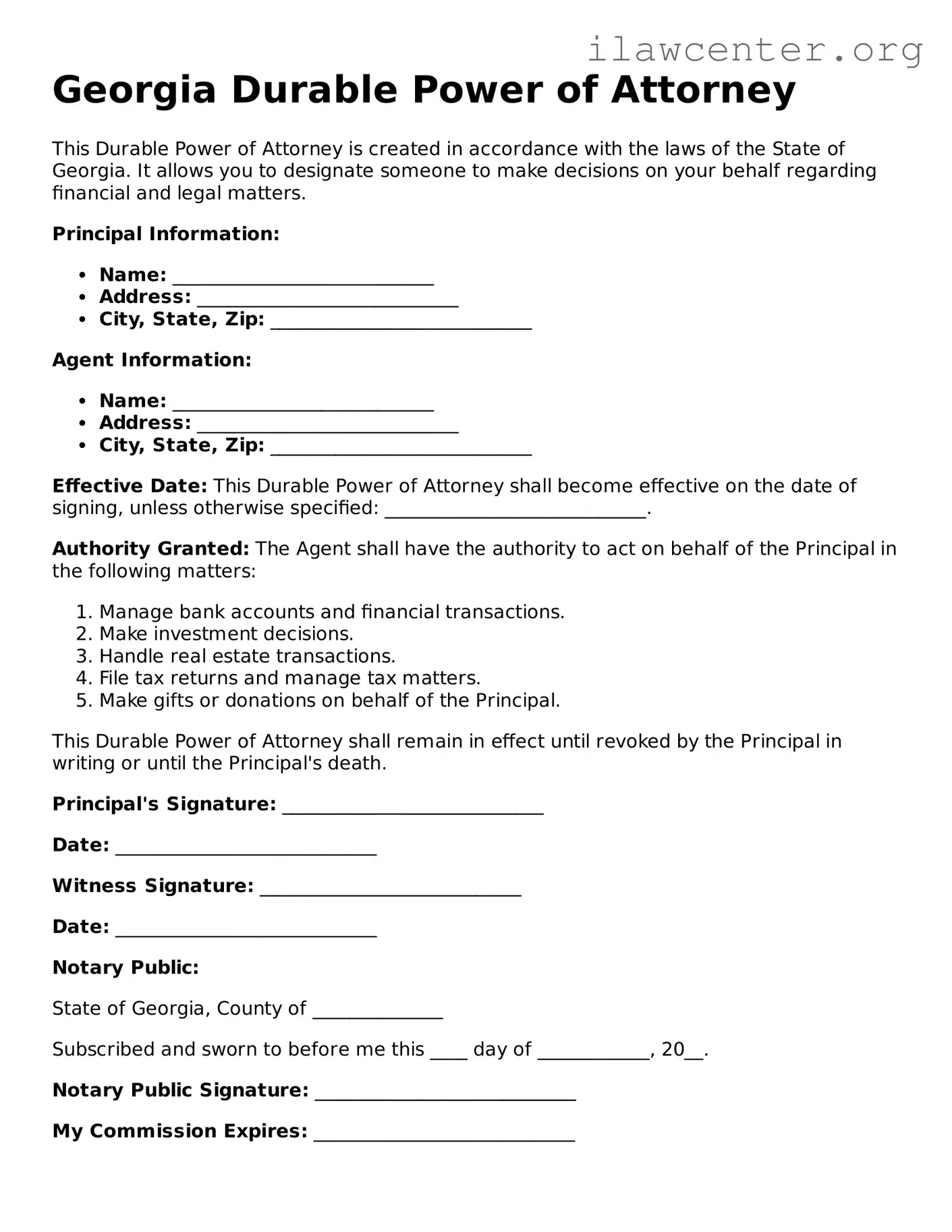
Georgia Durable Power of Attorney Preview

Georgia Durable Power of Attorney

This Durable Power of Attorney is created in accordance with the laws of the State of Georgia. It allows you to designate someone to make decisions on your behalf regarding financial and legal matters.

Principal Information:

  • Name: ____________________________
  • Address: ____________________________
  • City, State, Zip: ____________________________

Agent Information:

  • Name: ____________________________
  • Address: ____________________________
  • City, State, Zip: ____________________________

Effective Date: This Durable Power of Attorney shall become effective on the date of signing, unless otherwise specified: ____________________________.

Authority Granted: The Agent shall have the authority to act on behalf of the Principal in the following matters:

  1. Manage bank accounts and financial transactions.
  2. Make investment decisions.
  3. Handle real estate transactions.
  4. File tax returns and manage tax matters.
  5. Make gifts or donations on behalf of the Principal.

This Durable Power of Attorney shall remain in effect until revoked by the Principal in writing or until the Principal's death.

Principal's Signature: ____________________________

Date: ____________________________

Witness Signature: ____________________________

Date: ____________________________

Notary Public:

State of Georgia, County of ______________

Subscribed and sworn to before me this ____ day of ____________, 20__.

Notary Public Signature: ____________________________

My Commission Expires: ____________________________

PDF Form Characteristics

Fact Name Description
Definition A Georgia Durable Power of Attorney allows an individual to appoint someone to make financial decisions on their behalf.
Durability This document remains effective even if the principal becomes incapacitated.
Governing Law The form is governed by Georgia Code Title 10, Chapter 6B.
Agent Authority The agent can manage financial matters, including banking, real estate, and investments.
Revocation The principal can revoke the Durable Power of Attorney at any time, as long as they are competent.
Notarization While notarization is not required, it is recommended for added validity.
Execution Requirements The form must be signed by the principal and witnessed by two individuals or notarized.

Instructions on Utilizing Georgia Durable Power of Attorney

Filling out the Georgia Durable Power of Attorney form is a straightforward process. Once completed, this form allows you to designate someone to act on your behalf in financial matters. Follow these steps carefully to ensure the form is filled out correctly.

  1. Obtain a copy of the Georgia Durable Power of Attorney form. This can be found online or at legal supply stores.
  2. Begin by entering your name and address at the top of the form. This identifies you as the principal.
  3. Next, provide the name and address of the person you are appointing as your agent. This person will have the authority to act on your behalf.
  4. Specify the powers you are granting to your agent. You may choose to give them broad authority or limit their powers to specific tasks.
  5. Include any special instructions you want your agent to follow. This might include conditions or limitations on their authority.
  6. Sign and date the form in the designated area. Your signature must be in the presence of a notary public.
  7. Have the form notarized. The notary will verify your identity and witness your signature.
  8. Make copies of the completed and notarized form. Keep one for your records and provide copies to your agent and any relevant institutions.

Important Facts about Georgia Durable Power of Attorney

What is a Durable Power of Attorney in Georgia?

A Durable Power of Attorney is a legal document that allows one person, known as the principal, to designate another person, known as the agent, to make decisions on their behalf. This authority remains effective even if the principal becomes incapacitated, ensuring that their affairs can continue to be managed without interruption.

What decisions can an agent make under a Durable Power of Attorney?

The agent can make a wide range of decisions, including but not limited to managing financial accounts, paying bills, handling real estate transactions, and making healthcare decisions if specified. The scope of authority can be tailored to the principal's preferences, allowing for specific limitations or broader powers as needed.

How is a Durable Power of Attorney executed in Georgia?

To execute a Durable Power of Attorney in Georgia, the principal must sign the document in the presence of a notary public. It is advisable to have witnesses present as well, though Georgia law does not require witnesses for the document to be valid. Proper execution ensures that the document is legally binding and recognized by financial institutions and healthcare providers.

Can a Durable Power of Attorney be revoked?

Yes, a Durable Power of Attorney can be revoked at any time as long as the principal is mentally competent. The revocation must be in writing and should be communicated to the agent and any relevant third parties, such as banks or healthcare providers, to prevent any confusion regarding the authority of the agent.

What happens if the principal becomes incapacitated?

If the principal becomes incapacitated, the Durable Power of Attorney remains in effect. This is a key feature that distinguishes it from a regular Power of Attorney, which typically becomes void if the principal loses capacity. The agent can then step in to manage the principal's affairs as outlined in the document.

Is there a specific form required for a Durable Power of Attorney in Georgia?

While there is no official state form required, Georgia law does provide guidelines for creating a Durable Power of Attorney. It is important to ensure that the document complies with these guidelines to be legally effective. Many individuals choose to use templates or consult with an attorney to ensure compliance.

Can I appoint multiple agents in my Durable Power of Attorney?

Yes, a principal can appoint multiple agents in a Durable Power of Attorney. They can specify whether the agents must act jointly or if they can act independently. It is important to clearly outline the roles and responsibilities of each agent to avoid potential conflicts or confusion.

What are the limitations of a Durable Power of Attorney?

While a Durable Power of Attorney grants significant authority to the agent, there are limitations. For instance, an agent cannot make decisions that are contrary to the principal's wishes, nor can they make decisions regarding the principal's own medical treatment unless explicitly granted that authority in the document. Additionally, agents must act in the best interest of the principal.

Do I need an attorney to create a Durable Power of Attorney?

While it is not legally required to have an attorney draft a Durable Power of Attorney, consulting with one is highly recommended. An attorney can provide guidance on the specific needs of the principal, ensure that the document complies with Georgia law, and help address any complex issues that may arise.

How can I ensure my Durable Power of Attorney is recognized by third parties?

To ensure that a Durable Power of Attorney is recognized by banks, healthcare providers, and other institutions, it is advisable to provide them with a copy of the document. Additionally, some institutions may have their own forms or requirements, so it is beneficial to inquire about their specific policies to facilitate smooth transactions.
Common mistakes

Filling out a Durable Power of Attorney (DPOA) form in Georgia can be a straightforward process, but many individuals make common mistakes that can lead to complications. One frequent error is not clearly identifying the principal. The principal is the person granting authority, and it’s crucial to provide their full name and address. Omitting this information can create confusion about who is granting the power.

Another mistake involves selecting the wrong agent. The agent is the person who will act on behalf of the principal. It’s important to choose someone trustworthy and capable. Sometimes, individuals select an agent without considering their ability to handle financial matters or make decisions in stressful situations.

Many people also overlook the importance of specifying the powers granted to the agent. The DPOA form allows for a range of powers, from managing bank accounts to making healthcare decisions. Failing to specify these powers can lead to misunderstandings about what the agent can or cannot do.

Additionally, some individuals forget to sign the document in the presence of a notary public. In Georgia, a DPOA must be notarized to be valid. Without a proper signature and notarization, the document may not hold up in legal situations.

Another common error is neglecting to date the form. A DPOA should include the date it was signed to establish its validity. If the date is missing, questions may arise regarding when the authority was granted.

People often assume that a DPOA remains effective indefinitely. However, if the principal becomes incapacitated, it’s essential to ensure the document includes provisions that allow it to remain in effect. Failing to clarify this can lead to complications when the principal needs assistance.

Some individuals also forget to provide copies of the DPOA to relevant parties. It’s advisable to share copies with the agent, financial institutions, and healthcare providers. Without these copies, the agent may face challenges when trying to act on behalf of the principal.

Moreover, many people do not review the DPOA regularly. Life circumstances change, and it’s vital to update the document to reflect any new relationships or changes in the principal’s wishes. Ignoring this can lead to outdated information being used in critical situations.

Finally, some individuals fail to consider the implications of their choices. Granting broad powers can be risky if the agent does not act in the principal’s best interests. It’s essential to think carefully about the extent of authority given and to communicate these wishes clearly.

By avoiding these common mistakes, individuals can ensure that their Durable Power of Attorney is effective and serves their needs when it matters most.

Documents used along the form

A Durable Power of Attorney (DPOA) is a vital document that allows an individual to designate someone else to make financial or healthcare decisions on their behalf. Along with the DPOA, there are several other forms and documents that can be beneficial in managing personal affairs. Below is a list of commonly used documents that complement the Durable Power of Attorney in Georgia.

  • Advance Directive for Health Care: This document outlines an individual's healthcare preferences and appoints a healthcare agent to make medical decisions if the individual becomes incapacitated.
  • Living Will: A living will specifies the types of medical treatment an individual wishes to receive or avoid in situations where they cannot communicate their wishes.
  • HIPAA Release Form: This form allows individuals to authorize specific people to access their medical records and health information, ensuring their privacy is maintained while allowing trusted individuals to stay informed.
  • Financial Power of Attorney: Similar to a Durable Power of Attorney, this document grants authority to someone to manage financial matters, but it may not remain effective if the principal becomes incapacitated.
  • Will: A will is a legal document that outlines how a person's assets and affairs should be handled after their death, including the appointment of an executor to oversee the estate.
  • Trust Document: A trust is an arrangement where one party holds property for the benefit of another. This document details how the trust will be managed and distributed.
  • Property Deed: This document transfers ownership of real estate from one party to another and may be necessary if property is involved in the DPOA.
  • Guardianship Petition: If a person is unable to manage their own affairs, a guardianship petition can be filed to appoint someone to make decisions on their behalf.
  • Beneficiary Designation Forms: These forms allow individuals to specify who will receive benefits from accounts such as life insurance, retirement plans, and bank accounts upon their death.
  • Affidavit of Identity: This document can help verify a person's identity and may be required in various legal situations, including the execution of the DPOA.

Understanding these documents and their purposes can significantly aid individuals in making informed decisions about their legal and financial matters. Proper planning ensures that personal wishes are respected and that trusted individuals are empowered to act when necessary.

Similar forms

The Durable Power of Attorney (DPOA) form is a legal document that grants an individual the authority to make decisions on behalf of another person. Several other documents serve similar purposes, allowing for the delegation of authority or decision-making capabilities. Below are six documents that share similarities with the Durable Power of Attorney:

  • General Power of Attorney: This document provides broad authority to an agent to act on behalf of the principal. Unlike the DPOA, it may not remain effective if the principal becomes incapacitated.
  • Healthcare Power of Attorney: This specific form allows an agent to make medical decisions for the principal if they are unable to do so themselves. It focuses solely on health-related matters.
  • Living Will: A living will outlines an individual’s preferences regarding medical treatment in situations where they cannot communicate their wishes. While it does not appoint an agent, it guides decision-makers.
  • Financial Power of Attorney: This document grants authority specifically for financial matters. It allows an agent to manage the principal's financial affairs, similar to a DPOA but may not include healthcare decisions.
  • Advance Healthcare Directive: This combines a living will and a healthcare power of attorney, specifying medical preferences and appointing an agent for healthcare decisions.
  • Trust Agreement: A trust agreement allows a trustee to manage assets for the benefit of beneficiaries. While it serves a different primary purpose, it involves delegation of authority regarding financial matters.

Dos and Don'ts

When filling out the Georgia Durable Power of Attorney form, it’s crucial to approach the task with care. This document grants someone the authority to make decisions on your behalf if you become unable to do so. Here are some important do's and don'ts to keep in mind:

  • Do clearly identify the person you are appointing as your agent. Make sure they understand their responsibilities.
  • Do specify the powers you are granting. Be as detailed as possible to avoid confusion later.
  • Do sign the document in front of a notary public. This adds a layer of authenticity and helps ensure your wishes are respected.
  • Do keep a copy of the signed document in a safe place. Share copies with your agent and trusted family members.
  • Don't rush through the form. Take your time to ensure all information is accurate and complete.
  • Don't forget to review the document periodically. Life changes, and so might your preferences regarding who you want to make decisions for you.

By following these guidelines, you can help ensure that your Durable Power of Attorney reflects your wishes and provides peace of mind for you and your loved ones.

Misconceptions

Understanding the Georgia Durable Power of Attorney (DPOA) form is crucial for effective estate planning. However, several misconceptions can lead to confusion. Here are four common misconceptions:

  1. Misconception 1: The DPOA is only for financial decisions.

    This is not true. While the DPOA often covers financial matters, it can also include health care decisions if specified. You can grant your agent the authority to make medical decisions on your behalf, making it a versatile tool.

  2. Misconception 2: A DPOA is only valid while the principal is alive.

    Actually, a Durable Power of Attorney remains effective even if the principal becomes incapacitated. This is what makes it "durable." It ensures that your chosen agent can act on your behalf when you cannot.

  3. Misconception 3: You cannot revoke a DPOA once it is created.

    This is incorrect. A DPOA can be revoked at any time, as long as the principal is mentally competent. A written notice of revocation should be provided to the agent and any relevant institutions to ensure clarity.

  4. Misconception 4: All DPOAs are the same across states.

    This is a common misunderstanding. Each state, including Georgia, has its own laws and requirements for a Durable Power of Attorney. It’s essential to use the correct form and follow state-specific guidelines to ensure its validity.

Key takeaways

Filling out and utilizing a Durable Power of Attorney (DPOA) in Georgia is a significant step in ensuring that your financial and healthcare decisions are managed according to your wishes. Here are some key takeaways to keep in mind:

  • Choose a trusted agent: Selecting someone you trust implicitly is crucial. This person will have the authority to make decisions on your behalf, so consider their judgment and reliability.
  • Specify powers clearly: The DPOA should clearly outline the powers granted to your agent. Be specific about financial matters, healthcare decisions, and any limitations you wish to impose.
  • Consider timing: A Durable Power of Attorney becomes effective immediately upon signing unless you specify otherwise. Think about when you want the powers to begin, especially if you are concerned about future incapacity.
  • Review and update regularly: Life circumstances change, and so may your preferences. Regularly review your DPOA to ensure it reflects your current wishes and the dynamics of your relationships.