Attorney-Verified  Firearm Bill of Sale Document for Georgia

Attorney-Verified Firearm Bill of Sale Document for Georgia

A Georgia Firearm Bill of Sale form is a legal document that records the sale or transfer of a firearm between two parties. This form serves as proof of the transaction and can help protect both the buyer and seller in case of future disputes. To ensure a smooth transfer, fill out the form by clicking the button below.

Article Guide

The Georgia Firearm Bill of Sale form serves as a crucial document in the private sale or transfer of firearms within the state. This form outlines essential details such as the identities of the buyer and seller, including their names, addresses, and driver's license numbers, ensuring that both parties are clearly identified. Additionally, the form requires a description of the firearm being sold, including its make, model, caliber, and serial number, which helps to establish the specific item being transferred. By documenting the transaction, the form provides a legal record that can be referenced in the future, offering protection to both the buyer and seller. It is important to note that while Georgia does not mandate the use of a Bill of Sale for private sales, having this document can help mitigate potential disputes and serve as proof of ownership. Furthermore, the form encourages responsible firearm ownership by promoting transparency in transactions, aligning with state regulations. Understanding the significance of this form is essential for anyone engaging in the sale or purchase of firearms in Georgia.

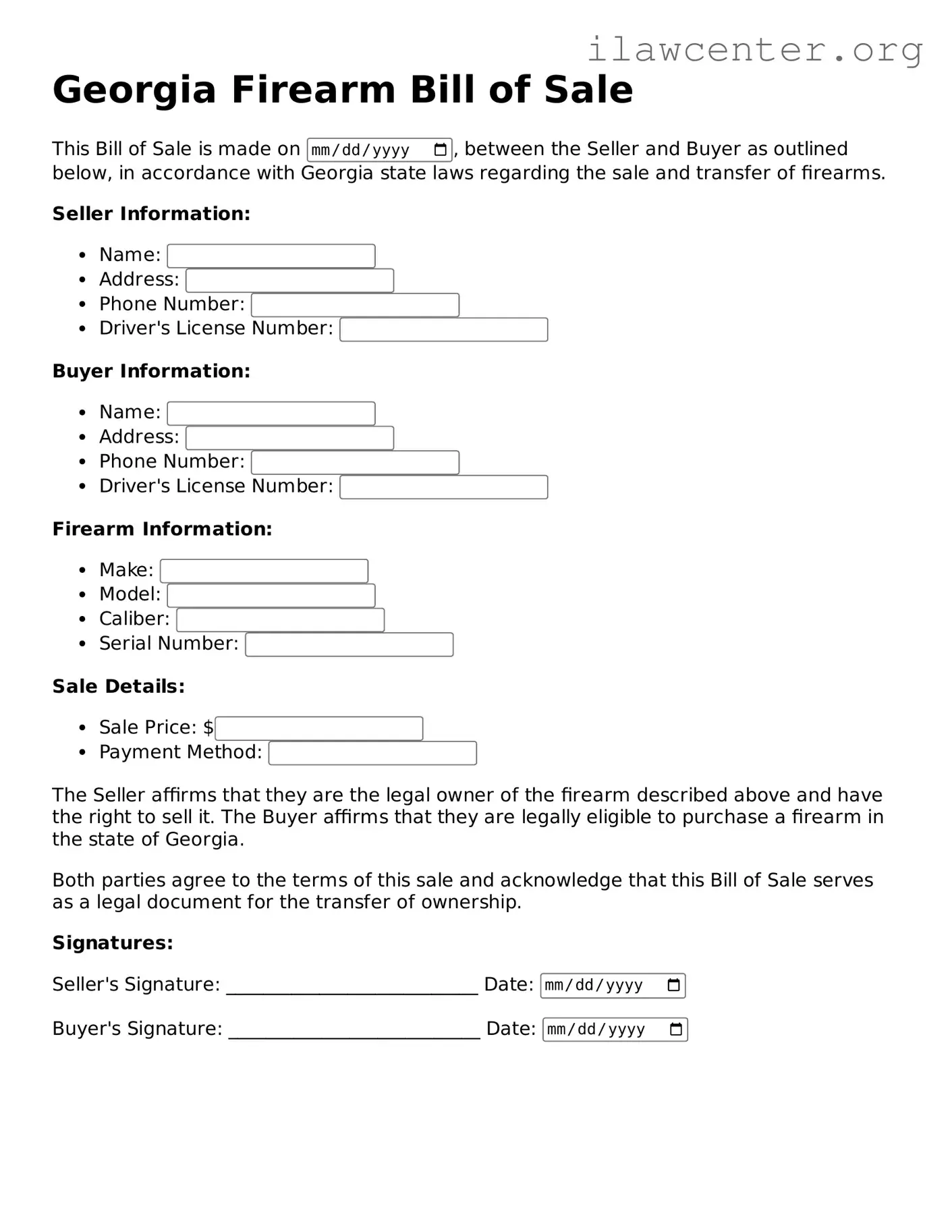
Georgia Firearm Bill of Sale Preview

Georgia Firearm Bill of Sale

This Bill of Sale is made on , between the Seller and Buyer as outlined below, in accordance with Georgia state laws regarding the sale and transfer of firearms.

Seller Information:

  • Name:
  • Address:
  • Phone Number:
  • Driver's License Number:

Buyer Information:

  • Name:
  • Address:
  • Phone Number:
  • Driver's License Number:

Firearm Information:

  • Make:
  • Model:
  • Caliber:
  • Serial Number:

Sale Details:

  • Sale Price: $
  • Payment Method:

The Seller affirms that they are the legal owner of the firearm described above and have the right to sell it. The Buyer affirms that they are legally eligible to purchase a firearm in the state of Georgia.

Both parties agree to the terms of this sale and acknowledge that this Bill of Sale serves as a legal document for the transfer of ownership.

Signatures:

Seller's Signature: ___________________________ Date:

Buyer's Signature: ___________________________ Date:

PDF Form Characteristics

Fact Name Description
Purpose The Georgia Firearm Bill of Sale form is used to document the sale or transfer of a firearm between private parties.
Legal Requirement While a bill of sale is not legally required in Georgia, it is highly recommended for proof of ownership and transaction details.
Governing Law The form is governed by Georgia state laws, specifically O.C.G.A. § 16-11-131.
Parties Involved The form includes spaces for the seller's and buyer's names, addresses, and signatures.
Firearm Details It requires detailed information about the firearm, including make, model, caliber, and serial number.
Notarization Notarization is not mandatory for the bill of sale in Georgia, but it can add an extra layer of authenticity.
Record Keeping Both parties should keep a copy of the completed bill of sale for their records, in case of future disputes.
Age Requirement Buyers must be at least 18 years old to purchase a firearm in Georgia.
Background Checks Private sales do not require background checks, but sellers should be cautious and verify the buyer's eligibility.
Additional Documentation It is advisable to include additional identification, such as a driver's license, to confirm the buyer's identity.

Instructions on Utilizing Georgia Firearm Bill of Sale

Filling out the Georgia Firearm Bill of Sale form is a straightforward process. After completing the form, both the buyer and seller will have a record of the transaction, which can help protect their interests.

  1. Obtain the Georgia Firearm Bill of Sale form. This can be found online or at a local gun shop.
  2. Fill in the date of the transaction at the top of the form.
  3. Provide the seller's full name and address in the designated sections.
  4. Enter the buyer's full name and address in the appropriate fields.
  5. Describe the firearm being sold. Include details such as the make, model, caliber, and serial number.
  6. Indicate the sale price of the firearm.
  7. Both parties should sign and date the form at the bottom. Ensure that both signatures are clear and legible.
  8. Make copies of the completed form for both the buyer and the seller for their records.

Important Facts about Georgia Firearm Bill of Sale

What is a Firearm Bill of Sale in Georgia?

A Firearm Bill of Sale in Georgia is a legal document that records the sale or transfer of a firearm from one individual to another. This document serves as proof of the transaction and includes essential details such as the names of the buyer and seller, the description of the firearm, and the date of the sale. While not required by law, having a bill of sale can help protect both parties in the event of future disputes.

Is a Firearm Bill of Sale required in Georgia?

No, Georgia does not require a bill of sale for private firearm transactions. However, it is highly recommended to create one. A bill of sale can provide legal protection and clear documentation of ownership, which can be beneficial for both the buyer and the seller.

What information should be included in a Firearm Bill of Sale?

A comprehensive Firearm Bill of Sale should include the following information: the names and addresses of both the buyer and seller, the date of the transaction, a detailed description of the firearm (including make, model, caliber, and serial number), and the sale price. Both parties should sign the document to validate the transaction.

Can I sell a firearm to someone out of state using a Bill of Sale?

Selling a firearm to someone out of state involves additional regulations. While a Bill of Sale can document the transaction, federal law requires that the sale be conducted through a licensed dealer if the buyer is in another state. This ensures compliance with federal and state laws regarding firearm sales.

What if the buyer is not a resident of Georgia?

If the buyer is not a resident of Georgia, it is crucial to understand both federal and state laws governing firearm sales. Federal law mandates that firearms must be transferred through a licensed dealer if the buyer resides in a different state. A Bill of Sale alone does not suffice for such transactions.

How can I ensure the buyer is legally allowed to purchase a firearm?

To ensure the buyer is legally permitted to purchase a firearm, you can ask them to provide valid identification and verify that they are not prohibited from owning a firearm under federal or state law. While a Bill of Sale does not guarantee the buyer’s eligibility, it is wise to conduct due diligence before completing the sale.

What should I do if I sell a firearm and it is later used in a crime?

If you sell a firearm and it is later involved in a crime, having a Bill of Sale can help establish that you are no longer the owner. It is important to keep a copy of the bill for your records. Additionally, you may want to report the sale to local law enforcement to further protect yourself.

Where can I obtain a Firearm Bill of Sale form?

Firearm Bill of Sale forms can be found online through various legal resources, gun advocacy organizations, or local firearm dealers. Many websites offer free templates that you can customize to fit your specific transaction. Ensure that the form you choose complies with Georgia laws and includes all necessary information.
Common mistakes

When filling out the Georgia Firearm Bill of Sale form, individuals often overlook important details that can lead to complications. One common mistake is failing to include the correct identification information. Both the buyer and seller must provide their full names, addresses, and valid identification numbers. Omitting even one piece of this information can render the document incomplete, which may cause issues later on.

Another frequent error involves inaccuracies in the firearm description. The form requires specific details about the firearm, such as the make, model, caliber, and serial number. If any of this information is incorrect or missing, it can create confusion regarding ownership and legality. Ensuring that these details are accurate is crucial for a valid transaction.

Additionally, many individuals neglect to sign the form. Both parties must sign the Bill of Sale to validate the transaction. Without these signatures, the document lacks legal standing, which can lead to disputes over ownership. Always double-check that both the buyer and seller have signed the form before finalizing the sale.

Finally, some people fail to keep a copy of the completed form. It is essential for both the buyer and seller to retain a copy for their records. This documentation serves as proof of the transaction and can be invaluable in case of future disputes or legal inquiries. Keeping a copy ensures that both parties have access to the same information, reducing the likelihood of misunderstandings.

Documents used along the form

When engaging in the purchase or sale of a firearm in Georgia, several other forms and documents may be useful alongside the Firearm Bill of Sale. Each of these documents serves a specific purpose and helps ensure that the transaction is conducted legally and smoothly. Below is a list of some commonly used forms and documents.

  • Background Check Consent Form: This form is necessary for conducting a background check on the buyer. It ensures that the seller complies with federal and state laws regarding firearm sales.
  • Georgia Weapons Carry License: This license allows individuals to carry a concealed firearm. A seller may request to see this license to verify that the buyer is legally permitted to own a firearm.
  • Firearm Registration Form: While Georgia does not require firearm registration, some sellers may choose to document the sale for personal records. This form can include details about the firearm and the buyer.
  • Affidavit of Firearm Transfer: This document can serve as a sworn statement confirming the transfer of ownership from the seller to the buyer. It provides additional legal protection for both parties.
  • Identification Documents: Buyers should present a valid form of identification, such as a driver’s license or state ID. This helps confirm the identity of the buyer and their eligibility to purchase a firearm.
  • Receipt of Sale: A simple receipt can be created to document the transaction. It should include the date of sale, details of the firearm, and the names of both the buyer and seller.
  • Warranty of Firearm: If the seller offers any warranty on the firearm, this document outlines the terms and conditions. It helps clarify the seller's responsibilities regarding the firearm's condition.
  • Transfer of Ownership Form: This form may be used to formally document the transfer of ownership. It can help avoid disputes regarding ownership in the future.
  • Gun Safety Agreement: This document outlines safety practices and responsibilities for firearm ownership. It can serve as a reminder of the importance of safe handling and storage.
  • Local Ordinance Compliance Form: Depending on the locality, some areas may have specific regulations regarding firearm sales. This form can ensure that both parties are aware of and comply with local laws.

Using these documents can enhance the safety and legality of firearm transactions. They help protect both the buyer and seller by ensuring that all necessary information is recorded and that the transaction adheres to applicable laws. Always consider consulting with a legal professional for guidance tailored to your specific situation.

Similar forms

  • Vehicle Bill of Sale: This document serves as proof of transfer of ownership for a vehicle. It includes details about the buyer, seller, and the vehicle itself, similar to how a Firearm Bill of Sale outlines the firearm and the parties involved in the sale.
  • Boat Bill of Sale: Like the Firearm Bill of Sale, this form is used to document the sale of a boat. It includes information about the boat, the seller, and the buyer, ensuring that ownership is legally transferred.
  • Real Estate Purchase Agreement: This document outlines the terms of a real estate transaction. It details the parties involved, the property description, and the agreed-upon price, similar to the specifics found in a Firearm Bill of Sale.
  • Personal Property Bill of Sale: This form is used for the sale of personal items, such as furniture or electronics. It records the details of the item and the transaction, much like a Firearm Bill of Sale does for firearms.
  • Equipment Bill of Sale: This document is used when transferring ownership of equipment, such as machinery or tools. It includes the same essential elements as a Firearm Bill of Sale, ensuring a clear record of the transaction.

Dos and Don'ts

When completing the Georgia Firearm Bill of Sale form, there are several important steps to follow. Here’s a list of things you should and shouldn't do to ensure the process goes smoothly.

  • Do provide accurate information about the firearm, including make, model, and serial number.
  • Do include your full name and contact information, as well as the buyer's details.
  • Do sign and date the form to make it legally binding.
  • Do keep a copy of the completed bill of sale for your records.
  • Don't leave any fields blank; ensure all required information is filled out.
  • Don't attempt to sell a firearm that you do not legally own or have the right to sell.

By following these guidelines, you can ensure that the transaction is both lawful and clear for both parties involved.

Misconceptions

Understanding the Georgia Firearm Bill of Sale form is essential for anyone involved in the buying or selling of firearms in the state. However, several misconceptions can lead to confusion. Here are ten common misconceptions explained:

  1. It is not necessary to have a Bill of Sale for private firearm sales. Many believe that a Bill of Sale is optional for private transactions. In Georgia, while not legally required, it is highly recommended to protect both parties involved.
  2. Only licensed dealers can provide a Bill of Sale. This is incorrect. Individuals can create and sign their own Bill of Sale for private sales, ensuring it includes necessary details about the firearm and the transaction.
  3. The Bill of Sale must be notarized. While notarization adds a layer of authenticity, it is not a legal requirement for a Bill of Sale in Georgia. However, having it notarized can help in case of future disputes.
  4. All firearm transactions require a background check. In Georgia, private sales do not require background checks. Only sales conducted through licensed dealers mandate this process.
  5. Once a Bill of Sale is signed, the transaction is final and cannot be reversed. While a Bill of Sale indicates a completed transaction, it does not prevent either party from pursuing legal remedies if issues arise, such as misrepresentation.
  6. There is a specific form that must be used for the Bill of Sale. There is no official state form. Individuals can create their own document, provided it includes essential details about the firearm and the transaction.
  7. Both parties must be Georgia residents to complete a Bill of Sale. This is not true. Non-residents can legally purchase firearms in Georgia, as long as they comply with their home state’s laws.
  8. All types of firearms can be sold using the same Bill of Sale. While a Bill of Sale can be used for various firearms, specific regulations apply to certain types, like machine guns or silencers, which may require additional documentation.
  9. Once a Bill of Sale is created, it cannot be amended. This is a misconception. A Bill of Sale can be amended if both parties agree to the changes and sign the updated document.
  10. The Bill of Sale protects the seller from all liability. While it provides some protection, it does not absolve the seller of all responsibility, especially if the firearm is used in a crime or if the seller misrepresented the firearm's condition.

Being informed about these misconceptions can help ensure a smooth and legal transaction when buying or selling firearms in Georgia. Always consider consulting with a legal expert if you have specific questions or concerns.

Key takeaways

The Georgia Firearm Bill of Sale form is an important document for individuals involved in the sale or transfer of firearms. Here are key takeaways regarding its use and completion:

  1. Identification of Parties: The form requires the full names and addresses of both the buyer and the seller. Accurate information is essential.
  2. Description of Firearm: A detailed description of the firearm must be included. This includes the make, model, caliber, and serial number.
  3. Condition of Firearm: The seller should indicate the condition of the firearm, whether it is new, used, or refurbished. This helps clarify expectations.
  4. Purchase Price: The agreed-upon purchase price should be clearly stated. This is necessary for both parties to understand the financial terms of the sale.
  5. Signatures Required: Both the buyer and seller must sign the document. This signifies that both parties agree to the terms outlined in the bill of sale.
  6. Legal Compliance: Ensure that the sale complies with all federal and state laws regarding firearm transfers. This is crucial to avoid legal issues.
  7. Record Keeping: Both parties should keep a copy of the completed bill of sale for their records. This serves as proof of the transaction.
  8. Notarization: While notarization is not required, it is recommended for added legal protection. A notary can verify the identities of the parties involved.

Understanding these key points can facilitate a smooth transaction when using the Georgia Firearm Bill of Sale form.