Attorney-Verified  Gift Deed Document for Georgia

Attorney-Verified Gift Deed Document for Georgia

A Georgia Gift Deed form is a legal document used to transfer ownership of property from one individual to another without any exchange of money. This form ensures that the transfer is recognized by the state and provides a clear record of the gift. If you're ready to make a gift of property, fill out the form by clicking the button below.

Article Guide

The Georgia Gift Deed form serves as an important legal document that facilitates the transfer of property from one individual to another without any exchange of money. This form is particularly useful for those who wish to give real estate or personal property as a gift, ensuring that the transaction is documented and legally binding. Key aspects of the form include the identification of the donor (the person giving the gift) and the recipient (the person receiving the gift), a clear description of the property involved, and the signatures of both parties. Additionally, the form may require notarization to validate the transaction. Understanding the nuances of the Georgia Gift Deed form is crucial for anyone looking to make a property transfer as a gift, as it helps to avoid potential disputes and ensures compliance with state laws. By completing this form accurately, individuals can provide a meaningful gift while also protecting their legal interests.

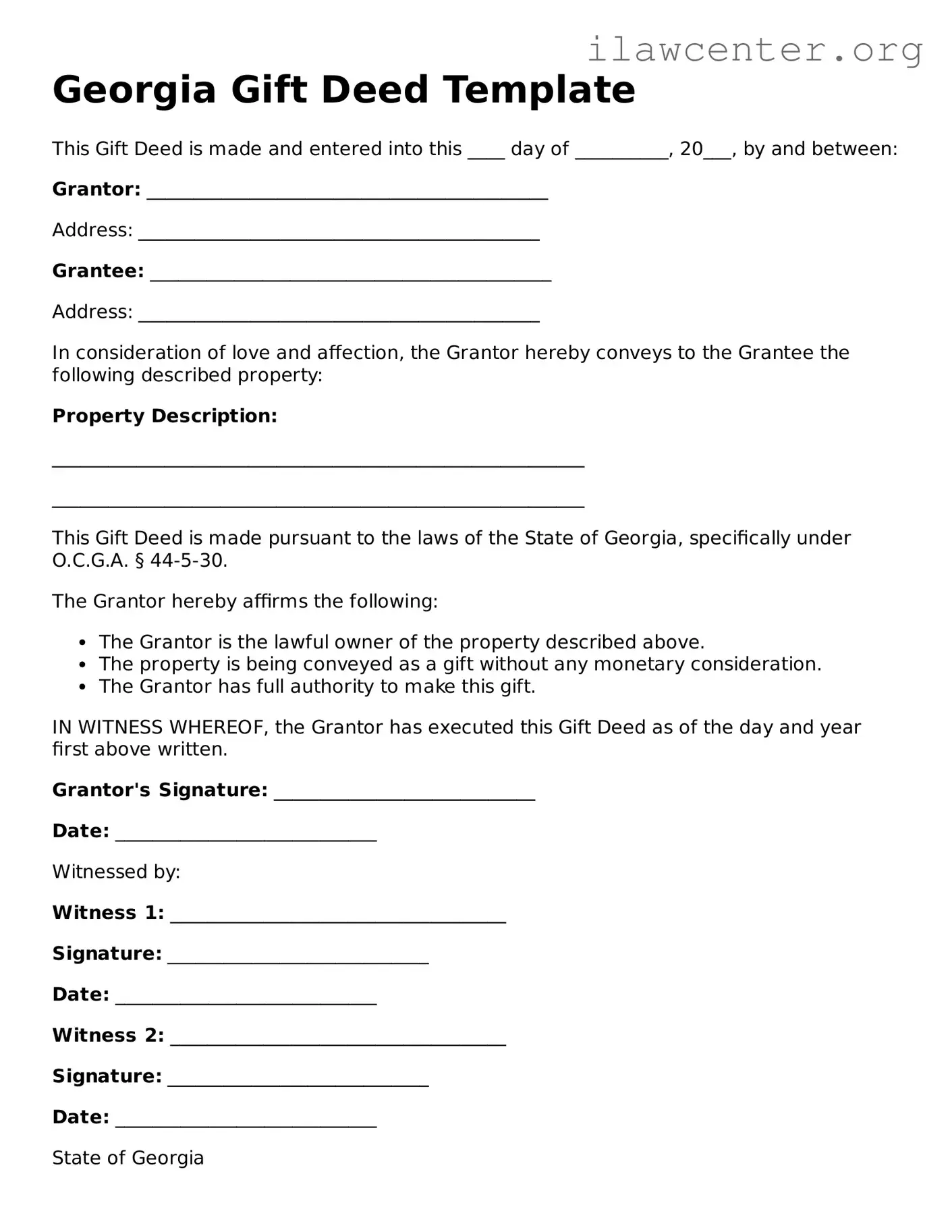
Georgia Gift Deed Preview

Georgia Gift Deed Template

This Gift Deed is made and entered into this ____ day of __________, 20___, by and between:

Grantor: ___________________________________________

Address: ___________________________________________

Grantee: ___________________________________________

Address: ___________________________________________

In consideration of love and affection, the Grantor hereby conveys to the Grantee the following described property:

Property Description:

_________________________________________________________

_________________________________________________________

This Gift Deed is made pursuant to the laws of the State of Georgia, specifically under O.C.G.A. § 44-5-30.

The Grantor hereby affirms the following:

  • The Grantor is the lawful owner of the property described above.
  • The property is being conveyed as a gift without any monetary consideration.
  • The Grantor has full authority to make this gift.

IN WITNESS WHEREOF, the Grantor has executed this Gift Deed as of the day and year first above written.

Grantor's Signature: ____________________________

Date: ____________________________

Witnessed by:

Witness 1: ____________________________________

Signature: ____________________________

Date: ____________________________

Witness 2: ____________________________________

Signature: ____________________________

Date: ____________________________

State of Georgia

County of ______________________

On this ____ day of __________, 20___, before me, a Notary Public, personally appeared ____________________________, known to me to be the person whose name is subscribed to the within instrument, and acknowledged that he/she executed the same for the purposes therein contained.

Notary Public: ____________________________

My Commission Expires: ____________________________

PDF Form Characteristics

Fact Name Description
Definition A Georgia Gift Deed is a legal document used to transfer property ownership without monetary exchange.
Governing Law The Georgia Gift Deed is governed by Title 44, Chapter 5 of the Official Code of Georgia Annotated (OCGA).
Parties Involved The document involves a donor (the giver) and a donee (the recipient).
Consideration Unlike traditional deeds, a Gift Deed does not require monetary consideration to be valid.
Witness Requirement Two witnesses are required to sign the Gift Deed for it to be legally binding.
Notarization The Gift Deed must be notarized to ensure authenticity and prevent fraud.
Tax Implications Gift Deeds may have tax implications for both the donor and the donee, including potential gift taxes.
Recordation It is advisable to record the Gift Deed with the county clerk’s office to provide public notice of the transfer.
Revocation Once executed, a Gift Deed generally cannot be revoked unless specific conditions are met.
Legal Advice Consulting with a legal professional is recommended to ensure compliance with state laws and regulations.

Instructions on Utilizing Georgia Gift Deed

Filling out the Georgia Gift Deed form is a straightforward process. Once completed, the form will need to be signed and filed with the appropriate county office to ensure the transfer of property is legally recognized.

  1. Begin by downloading the Georgia Gift Deed form from a reliable source or obtain a hard copy from your local county office.
  2. In the first section, enter the name and address of the grantor (the person giving the gift).
  3. Next, provide the name and address of the grantee (the person receiving the gift).
  4. Clearly describe the property being transferred. Include details such as the address, parcel number, and any other identifying information.
  5. Indicate the date of the gift.
  6. In the designated area, both the grantor and grantee should sign the form. Make sure to include the date of each signature.
  7. If required, have the form notarized. This step may be necessary to validate the signatures.
  8. Finally, submit the completed form to the appropriate county office for recording. Check with your local office for any filing fees or additional requirements.

Important Facts about Georgia Gift Deed

What is a Georgia Gift Deed?

A Georgia Gift Deed is a legal document used to transfer property from one individual to another without any exchange of money. It is often used when a property owner wishes to give their property to a family member or friend as a gift. The deed outlines the details of the property and the parties involved in the transfer.

What information is required to complete a Gift Deed?

To complete a Gift Deed in Georgia, you will need the names and addresses of both the donor (the person giving the gift) and the recipient (the person receiving the gift). You must also include a legal description of the property being transferred, which can typically be found on the current deed or property tax records.

Do I need to have the Gift Deed notarized?

Yes, a Gift Deed must be signed in the presence of a notary public in Georgia. The notary will verify the identities of the parties involved and witness the signing of the document. This step is essential to ensure the deed is legally valid.

Are there any tax implications when using a Gift Deed?

Yes, there may be tax implications associated with gifting property. The donor may be subject to federal gift tax if the value of the gift exceeds the annual exclusion limit set by the IRS. It is advisable to consult a tax professional to understand any potential tax consequences before proceeding with a Gift Deed.

How do I record a Gift Deed in Georgia?

To record a Gift Deed in Georgia, you must file the signed and notarized document with the county clerk's office where the property is located. There may be a recording fee, and it is important to ensure that the deed is properly recorded to protect the rights of the recipient.

Can a Gift Deed be revoked or changed after it is executed?

Once a Gift Deed is executed and recorded, it is generally considered final and cannot be revoked. However, if the donor retains certain rights or interests in the property, it may be possible to modify the arrangement. Legal advice should be sought if there is a need to change the terms of the gift.

What if the donor has outstanding debts?

If the donor has outstanding debts, creditors may be able to claim against the property, even after it has been transferred via a Gift Deed. It is essential to consider the financial situation of the donor before proceeding with the gift, as this could affect the recipient's ownership rights.

Common mistakes

When completing the Georgia Gift Deed form, one common mistake is failing to provide accurate property descriptions. The form requires a clear and detailed description of the property being gifted. Without this information, the deed may be considered invalid. Ensure that the address, lot number, and any other relevant details are correct to avoid complications.

Another frequent error involves not including the correct names of the grantor and grantee. Both parties must be clearly identified on the form. If names are misspelled or incomplete, it can lead to legal disputes later on. Double-check the spelling and ensure that the full legal names are used.

People often overlook the requirement for signatures. Both the grantor and grantee must sign the Gift Deed for it to be legally binding. If either party neglects to sign, the deed will not be valid. It is crucial to verify that all necessary signatures are present before submitting the document.

Lastly, many individuals forget to have the deed notarized. In Georgia, a Gift Deed must be notarized to be enforceable. Skipping this step can render the deed ineffective. Make sure to find a notary public and complete this important requirement to ensure the transfer of property is legally recognized.

Documents used along the form

A Georgia Gift Deed form is a vital document for transferring property without any exchange of money. However, several other forms and documents often accompany it to ensure a smooth and legally sound transaction. Below are some of the commonly used forms in conjunction with a Gift Deed in Georgia.

  • Quitclaim Deed: This document transfers any interest the grantor has in the property to the grantee, without guaranteeing that the title is clear. It’s often used when the transfer is between family members.
  • Warranty Deed: Unlike a quitclaim deed, this document guarantees that the grantor holds clear title to the property and has the right to transfer it. It provides more security to the grantee.
  • Affidavit of Value: This is a sworn statement that declares the fair market value of the property being gifted. It may be required for tax purposes.
  • Property Tax Exemption Application: If the gifted property qualifies for a homestead exemption or other tax benefits, this application can help the new owner claim those benefits.
  • Gift Tax Return (Form 709): This IRS form is necessary if the value of the gift exceeds the annual exclusion limit. It helps report the gift for tax purposes.
  • Title Insurance Policy: While not always required, obtaining title insurance can protect the new owner against potential issues with the title that may arise after the transfer.
  • Closing Statement: This document outlines the financial details of the transaction, including any closing costs, and is typically prepared at the time of the property transfer.

In summary, when executing a Gift Deed in Georgia, consider these additional documents to ensure that the transfer is comprehensive and legally binding. Each document plays a crucial role in protecting both the giver and the recipient throughout the process.

Similar forms

  • Will: A will outlines how a person's assets will be distributed after their death. Like a gift deed, it transfers ownership, but it takes effect only upon death rather than immediately.
  • Trust Agreement: A trust agreement allows a person to transfer assets to a trustee for the benefit of others. Similar to a gift deed, it involves the transfer of property, but a trust can be more complex and may have ongoing management.
  • Sales Agreement: A sales agreement details the terms of a sale, including price and conditions. While a gift deed transfers property without payment, both documents formalize the transfer of ownership.
  • Lease Agreement: A lease agreement allows one party to use another's property for a specified time in exchange for rent. Though it does not transfer ownership, it shares the intent of defining the terms of property use.
  • Quitclaim Deed: A quitclaim deed transfers whatever interest a person has in a property without guaranteeing that interest. Like a gift deed, it is a method of transferring property, but it may not provide the same level of assurance about ownership.
  • Deed of Trust: A deed of trust secures a loan with real estate. It involves the transfer of property rights to a trustee until the loan is repaid, similar to how a gift deed transfers ownership outright.
  • Power of Attorney: A power of attorney allows one person to act on behalf of another. While it does not transfer property, it enables someone to manage another's assets, similar to how a gift deed facilitates the transfer of ownership.

Dos and Don'ts

When filling out the Georgia Gift Deed form, it is essential to follow specific guidelines to ensure the document is valid and accurately reflects your intentions. Here are eight important dos and don'ts to consider:

  • Do provide complete and accurate information about both the donor and the recipient.
  • Do include a clear description of the property being gifted.
  • Do ensure that the deed is signed in the presence of a notary public.
  • Do check for any local requirements that may apply to the transfer of property.
  • Don't leave any sections of the form blank; incomplete forms can lead to delays or rejection.
  • Don't forget to include the date of the transfer; this is crucial for record-keeping.
  • Don't use vague language when describing the property; clarity is key.
  • Don't overlook the need for proper witnesses if required by local laws.

By adhering to these guidelines, you can help ensure that your Georgia Gift Deed is executed properly and legally binding.

Misconceptions

Understanding the Georgia Gift Deed form is essential for anyone considering transferring property as a gift. However, several misconceptions can cloud the process. Here are eight common misunderstandings:

  1. Gift Deeds are the same as sales contracts.

    Many people believe that a gift deed functions like a sales contract. In reality, a gift deed involves no exchange of money or consideration, while a sales contract requires a purchase price.

  2. Gift Deeds are only for family members.

    Some think that gift deeds can only be executed between family members. However, anyone can gift property to another person, regardless of their relationship.

  3. A gift deed must be notarized.

    While notarization is highly recommended to validate the document, it is not a legal requirement in Georgia. The deed can still be effective without a notary, though it may complicate matters later.

  4. Gift Deeds are irrevocable.

    Another misconception is that once a gift deed is executed, it cannot be undone. In some circumstances, a donor may have the ability to revoke the gift, particularly if certain conditions are met.

  5. There are no tax implications for gift deeds.

    People often believe that gifting property incurs no tax consequences. However, the IRS imposes gift taxes on transfers above a certain value, so it’s important to be aware of potential tax liabilities.

  6. All types of property can be gifted.

    While many types of property can be transferred via a gift deed, some assets, like certain financial accounts, may require different documentation or processes.

  7. Gift deeds are only necessary for large gifts.

    Some individuals think that gift deeds are only relevant for significant transfers of property. In fact, even smaller gifts can benefit from a formal deed to ensure clarity and legal protection.

  8. Once a gift deed is signed, the donor loses all rights to the property.

    This belief can be misleading. In certain cases, the donor may retain specific rights or conditions related to the property, depending on how the deed is structured.

By addressing these misconceptions, individuals can better navigate the complexities of property transfers in Georgia and make informed decisions regarding gift deeds.

Key takeaways

Filling out and using the Georgia Gift Deed form can be a straightforward process, but it is important to understand the key elements involved. Here are some essential takeaways to consider:

  • Purpose: A Gift Deed is used to transfer property ownership without any exchange of money. It is a legal way to give property as a gift.
  • Eligibility: Anyone can give a gift of property, but the giver must be the legal owner of the property being gifted.
  • Form Requirements: The Gift Deed must be in writing and signed by the giver. It should clearly identify the property and the recipient.
  • Consideration: Unlike other property transfers, a Gift Deed does not require consideration, meaning the recipient does not pay for the property.
  • Witnesses: In Georgia, the Gift Deed must be signed in the presence of a notary public to be legally valid.
  • Recording: After signing, the Gift Deed should be recorded with the county clerk's office where the property is located. This ensures public notice of the transfer.
  • Tax Implications: Gifting property may have tax implications for both the giver and the recipient. It is advisable to consult a tax professional.
  • Revocation: Once a Gift Deed is executed and recorded, it cannot be revoked without the consent of the recipient.
  • Legal Advice: While the process can be simple, seeking legal advice can help ensure all requirements are met and prevent future disputes.

Understanding these key points can help make the process of filling out and using the Georgia Gift Deed form smoother and more effective.