Attorney-Verified  Hold Harmless Agreement Document for Georgia

Attorney-Verified Hold Harmless Agreement Document for Georgia

The Georgia Hold Harmless Agreement form is a legal document designed to protect one party from liability for any injuries or damages that may occur during a specific event or activity. This agreement is commonly used in various contexts, such as rentals, events, and construction projects, to ensure that one party does not hold the other responsible for unforeseen incidents. For those looking to safeguard their interests, filling out this form is essential; click the button below to get started.

Article Guide

The Georgia Hold Harmless Agreement form serves as a vital legal tool for individuals and organizations looking to mitigate liability risks associated with various activities. This agreement outlines the responsibilities of parties involved, ensuring that one party agrees to protect the other from potential legal claims or damages arising from specific events or actions. Typically utilized in contexts such as property rentals, events, and construction projects, the form emphasizes the importance of clear communication and mutual understanding between the parties. By signing this document, individuals can clarify their intentions and expectations, fostering a safer environment for all involved. Additionally, the agreement often includes provisions detailing the scope of liability, indemnification clauses, and any limitations on coverage, which are crucial for safeguarding interests. Understanding the nuances of this form can empower individuals and organizations to navigate potential risks effectively, making it an essential component of responsible planning and execution in various scenarios.

Georgia Hold Harmless Agreement Preview

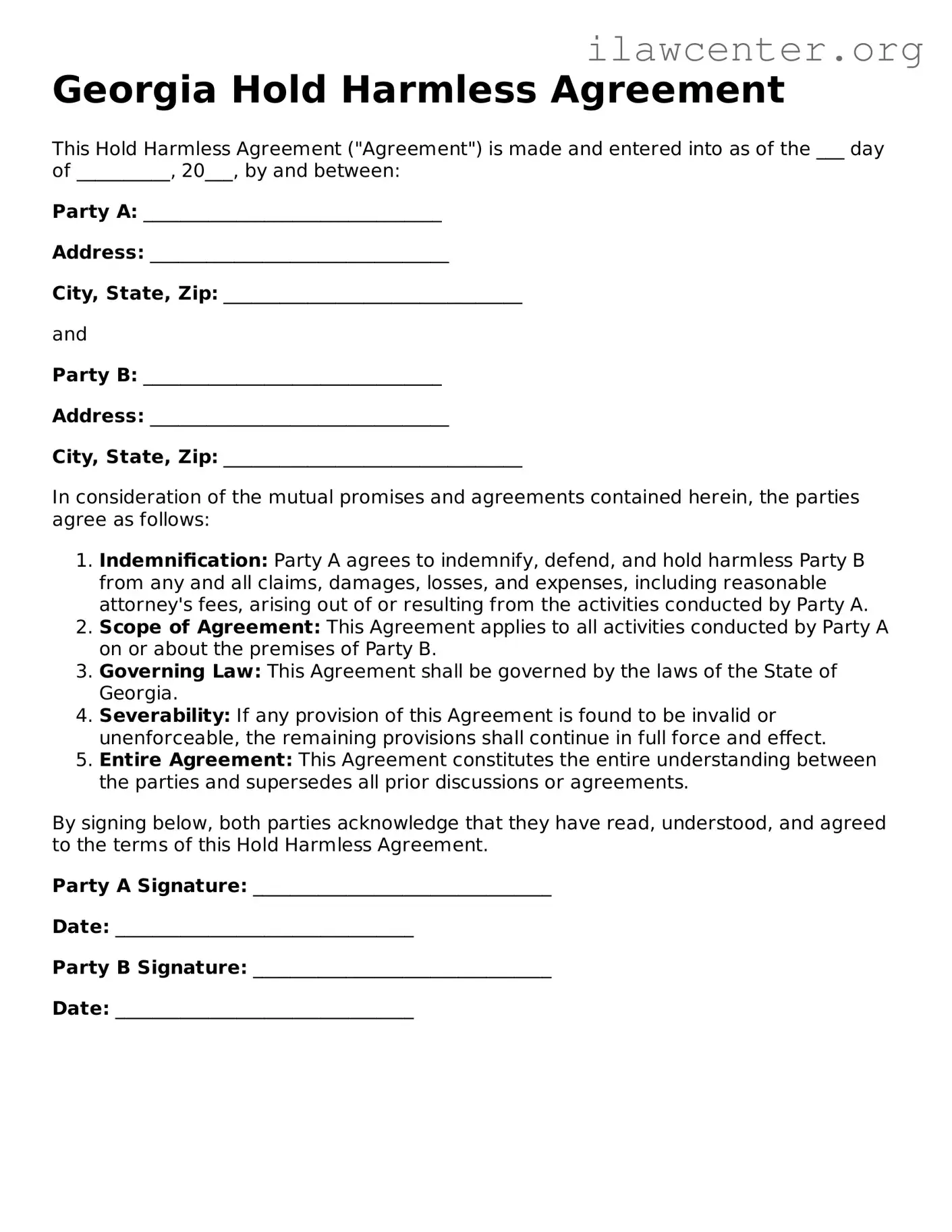
Georgia Hold Harmless Agreement

This Hold Harmless Agreement ("Agreement") is made and entered into as of the ___ day of __________, 20___, by and between:

Party A: ________________________________

Address: ________________________________

City, State, Zip: ________________________________

and

Party B: ________________________________

Address: ________________________________

City, State, Zip: ________________________________

In consideration of the mutual promises and agreements contained herein, the parties agree as follows:

  1. Indemnification: Party A agrees to indemnify, defend, and hold harmless Party B from any and all claims, damages, losses, and expenses, including reasonable attorney's fees, arising out of or resulting from the activities conducted by Party A.
  2. Scope of Agreement: This Agreement applies to all activities conducted by Party A on or about the premises of Party B.
  3. Governing Law: This Agreement shall be governed by the laws of the State of Georgia.
  4. Severability: If any provision of this Agreement is found to be invalid or unenforceable, the remaining provisions shall continue in full force and effect.
  5. Entire Agreement: This Agreement constitutes the entire understanding between the parties and supersedes all prior discussions or agreements.

By signing below, both parties acknowledge that they have read, understood, and agreed to the terms of this Hold Harmless Agreement.

Party A Signature: ________________________________

Date: ________________________________

Party B Signature: ________________________________

Date: ________________________________

PDF Form Characteristics

Fact Name Description
Purpose The Georgia Hold Harmless Agreement is designed to protect one party from liability for damages or injuries that may occur during a specific event or activity.
Governing Law This agreement is governed by the laws of the State of Georgia, ensuring that any disputes will be resolved under Georgia law.
Parties Involved Typically, the agreement involves at least two parties: the indemnitor (the party agreeing to hold harmless) and the indemnitee (the party being protected).
Enforceability For the agreement to be enforceable, it must be clear, specific, and voluntarily signed by all parties involved.

Instructions on Utilizing Georgia Hold Harmless Agreement

Once you have the Georgia Hold Harmless Agreement form in front of you, it’s time to get started. Carefully follow the steps below to ensure that you fill out the form correctly. Taking your time will help avoid any mistakes that could cause delays.

  1. Begin by entering the date at the top of the form. This helps establish when the agreement is being made.
  2. Next, fill in your name and contact information. This identifies who is entering the agreement.
  3. Provide the name and contact information of the other party involved in the agreement. This ensures that both parties are clearly identified.
  4. In the designated section, describe the activity or event that the agreement pertains to. Be specific to avoid any misunderstandings later on.
  5. Read through the terms of the agreement carefully. Make sure you understand what you are agreeing to.
  6. Sign the form where indicated. Your signature confirms your acceptance of the terms outlined in the agreement.
  7. Date your signature to indicate when you signed the agreement.
  8. If required, have the other party sign the form as well. This step is crucial for mutual agreement.
  9. Finally, keep a copy of the completed form for your records. This will be helpful in case you need to reference it in the future.

After completing these steps, you’ll have a properly filled-out Hold Harmless Agreement. Make sure to review the form one last time before considering it finalized. It’s always good practice to double-check your work!

Important Facts about Georgia Hold Harmless Agreement

What is a Georgia Hold Harmless Agreement?

A Georgia Hold Harmless Agreement is a legal document designed to protect one party from liability for certain risks associated with a specific activity or event. Typically used in contracts, this agreement ensures that if one party is injured or suffers damages during the activity, the other party will not be held responsible. This type of agreement is common in various situations, such as rentals, events, or construction projects, where one party may face potential legal claims from the other party or third parties.

Who typically uses a Hold Harmless Agreement in Georgia?

Various individuals and organizations utilize Hold Harmless Agreements in Georgia. Common users include property owners, event organizers, contractors, and businesses that provide services. For example, a property owner may require a tenant to sign this agreement before renting out a space for an event. Similarly, a contractor may ask subcontractors to sign it before starting work on a project, ensuring that they are not liable for any accidents that occur during the job.

What are the key components of a Hold Harmless Agreement?

While the specific contents can vary, a typical Hold Harmless Agreement includes several essential components. First, it identifies the parties involved, clearly stating who is being protected and who is assuming the risk. Second, it outlines the scope of the activities covered by the agreement. Third, it includes a clause that specifies the extent of liability that is being waived. Finally, the agreement often requires signatures from both parties to indicate their acceptance of the terms.

Are there any limitations to a Hold Harmless Agreement in Georgia?

Yes, there are limitations. While these agreements can provide significant protection, they cannot shield a party from liability for gross negligence or willful misconduct. Courts in Georgia may not enforce a Hold Harmless Agreement if it is deemed overly broad or unconscionable. It's crucial to ensure that the agreement is fair and reasonable, outlining specific risks rather than attempting to waive all responsibility.

How can I create a Hold Harmless Agreement in Georgia?

Creating a Hold Harmless Agreement in Georgia can be straightforward. You can start by drafting a document that includes all the necessary components mentioned earlier. It's advisable to use clear and concise language to avoid confusion. While templates are available online, consider consulting with a legal professional to ensure the agreement meets all legal requirements and adequately protects your interests. This step can help you avoid potential pitfalls down the road.

Common mistakes

When filling out the Georgia Hold Harmless Agreement form, individuals often overlook key details that can lead to complications. One common mistake is failing to provide complete and accurate information. It is essential to include all relevant parties' names, addresses, and contact information. Missing or incorrect details can render the agreement unenforceable.

Another frequent error is neglecting to specify the scope of the agreement. The form should clearly outline the activities or events for which the parties are agreeing to hold each other harmless. Vague language can create confusion and may not protect the parties as intended.

People also tend to skip the section that addresses the duration of the agreement. Without a specified time frame, the agreement may be interpreted as ongoing indefinitely, which could lead to unintended liabilities. Setting a clear start and end date is crucial for both parties' understanding.

Additionally, some individuals forget to include a clause about indemnification. This clause is vital as it outlines who will cover costs in the event of a claim. Omitting this information can leave one party vulnerable to unexpected expenses.

Another mistake is not having the agreement reviewed by legal counsel. While it may seem straightforward, legal documents can be complex. Consulting with a lawyer can help ensure that the agreement complies with Georgia law and adequately protects all parties involved.

Many people also fail to sign and date the agreement properly. A signature is essential for validating the document, and without it, the agreement may not hold up in court. It's important to ensure that all parties sign the form in the appropriate places.

Moreover, individuals sometimes overlook the need for witnesses or notarization. Depending on the circumstances, having a witness or a notary public can add an extra layer of legitimacy to the agreement. This step is especially important if the agreement is likely to be contested later.

People may also forget to keep copies of the signed agreement. After completing the form, it’s crucial to distribute copies to all parties involved. Without documentation, proving the terms of the agreement can become challenging if a dispute arises.

Finally, some individuals do not take the time to read the entire agreement before signing. Understanding the terms is essential to avoid any surprises later on. Taking a moment to review the document can prevent misunderstandings and ensure that everyone is on the same page.

Documents used along the form

When engaging in activities that require a Georgia Hold Harmless Agreement, several other forms and documents may be necessary to ensure clarity and protection for all parties involved. These documents help outline responsibilities, permissions, and liabilities associated with specific activities or events.

  • Liability Waiver: This document is designed to protect an organization from legal claims by participants. It informs individuals of the risks involved in an activity and requires them to acknowledge and accept those risks before participating.
  • Indemnity Agreement: This agreement outlines the responsibilities of one party to compensate another for any losses or damages incurred. It often complements the Hold Harmless Agreement by specifying who is responsible for what in case of an incident.
  • Insurance Certificate: An insurance certificate serves as proof that a party has the necessary insurance coverage for specific activities. This document is often required to ensure that adequate financial protection is in place in case of accidents or damages.
  • Event Permit: For certain activities, especially public events, obtaining an event permit is crucial. This document grants permission from local authorities to hold the event and ensures compliance with local laws and regulations.

Using these documents in conjunction with the Georgia Hold Harmless Agreement can provide a comprehensive framework for managing risk and liability. Proper documentation is essential for protecting all parties involved and ensuring smooth operations.

Similar forms

A Hold Harmless Agreement is a legal document that protects one party from liability for certain actions or events. There are several other documents that serve similar purposes. Here are four of them:

  • Indemnity Agreement: This document also involves one party agreeing to compensate another for any losses or damages. It focuses on protecting against claims made by third parties, similar to how a Hold Harmless Agreement operates.
  • Liability Waiver: A Liability Waiver is often used in activities where there is a risk of injury. Participants agree not to hold the organization responsible for any accidents, mirroring the protective intent of a Hold Harmless Agreement.
  • Release of Liability: This document releases one party from any future claims or lawsuits. Like the Hold Harmless Agreement, it aims to prevent one party from being held accountable for certain risks or actions.
  • Contractual Disclaimer: A Contractual Disclaimer states that a party does not accept responsibility for specific issues. This document, much like a Hold Harmless Agreement, limits liability and clarifies the extent of responsibility.

Dos and Don'ts

When filling out the Georgia Hold Harmless Agreement form, it is important to approach the task with care. Below are five key actions to take and avoid:

  • Do read the entire agreement carefully before filling it out. Understanding the terms is crucial.
  • Do provide accurate and complete information. Inaccuracies can lead to complications.
  • Do consult with a legal professional if you have questions. They can provide valuable guidance.
  • Don't rush through the form. Take your time to ensure everything is correct.
  • Don't leave any sections blank unless instructed. Missing information can invalidate the agreement.

Misconceptions

The Georgia Hold Harmless Agreement form is often misunderstood. Here are six common misconceptions about this legal document:

  1. It completely protects against all liability.

    Many believe that signing a Hold Harmless Agreement means they cannot be held liable for any damages. In reality, it typically only protects against claims arising from specific actions or situations outlined in the agreement.

  2. It is only for businesses.

    While businesses frequently use these agreements, individuals can also utilize them. For instance, someone hosting a private event may ask attendees to sign a Hold Harmless Agreement.

  3. It eliminates the need for insurance.

    Some people think that signing this agreement negates the necessity for insurance coverage. However, insurance is still essential as it provides financial protection that a Hold Harmless Agreement cannot fully substitute.

  4. It is legally binding in all situations.

    This form may not be enforceable in every circumstance. Courts can invalidate a Hold Harmless Agreement if it is deemed unconscionable or if it violates public policy.

  5. It is a one-size-fits-all document.

    Many assume that a standard template will suffice for any situation. However, the specifics of each agreement should be tailored to fit the unique circumstances of the parties involved.

  6. Signing means you cannot sue.

    Some individuals mistakenly believe that signing this agreement forfeits their right to pursue legal action. In reality, while it may limit claims, it does not eliminate the right to sue altogether.

Key takeaways

When dealing with a Georgia Hold Harmless Agreement, understanding its implications and proper usage is essential. Here are some key takeaways to consider:

  • Purpose of the Agreement: This form is designed to protect one party from liability for damages or injuries that may occur during a specified activity or event.
  • Clear Language: Ensure that the agreement is written in clear, understandable terms. Ambiguity can lead to misunderstandings and potential legal issues.
  • Signatures Matter: All parties involved must sign the agreement. This demonstrates mutual consent and understanding of the terms outlined.
  • Consult Legal Counsel: Before finalizing the agreement, it’s wise to consult with a legal professional. They can provide guidance tailored to your specific situation and ensure compliance with Georgia law.

By keeping these points in mind, you can navigate the Hold Harmless Agreement with greater confidence and clarity.