Attorney-Verified  Homeschool Letter of Intent Document for Georgia

Attorney-Verified Homeschool Letter of Intent Document for Georgia

The Georgia Homeschool Letter of Intent is a formal document that parents must submit to notify the state of their intention to homeschool their children. This essential form ensures compliance with Georgia's educational regulations and helps establish a clear educational plan for your family. To get started on your homeschooling journey, fill out the form by clicking the button below.

Article Guide

In Georgia, parents who choose to homeschool their children must submit a Homeschool Letter of Intent to the local school district. This form serves as an official notification of the family's decision to educate their child at home. The submission of the letter is a critical step in complying with state regulations regarding homeschooling. It typically requires basic information such as the names and ages of the children being homeschooled, the address of the family, and a declaration of intent to provide a home-based education. Additionally, the letter may include details about the educational curriculum planned for the year. Parents must ensure that the letter is submitted within 30 days of beginning the homeschooling process or within 30 days of the start of the school year. Failure to submit this form can lead to complications in the homeschooling journey, making it essential for families to understand the requirements and deadlines associated with the Homeschool Letter of Intent.

Georgia Homeschool Letter of Intent Preview

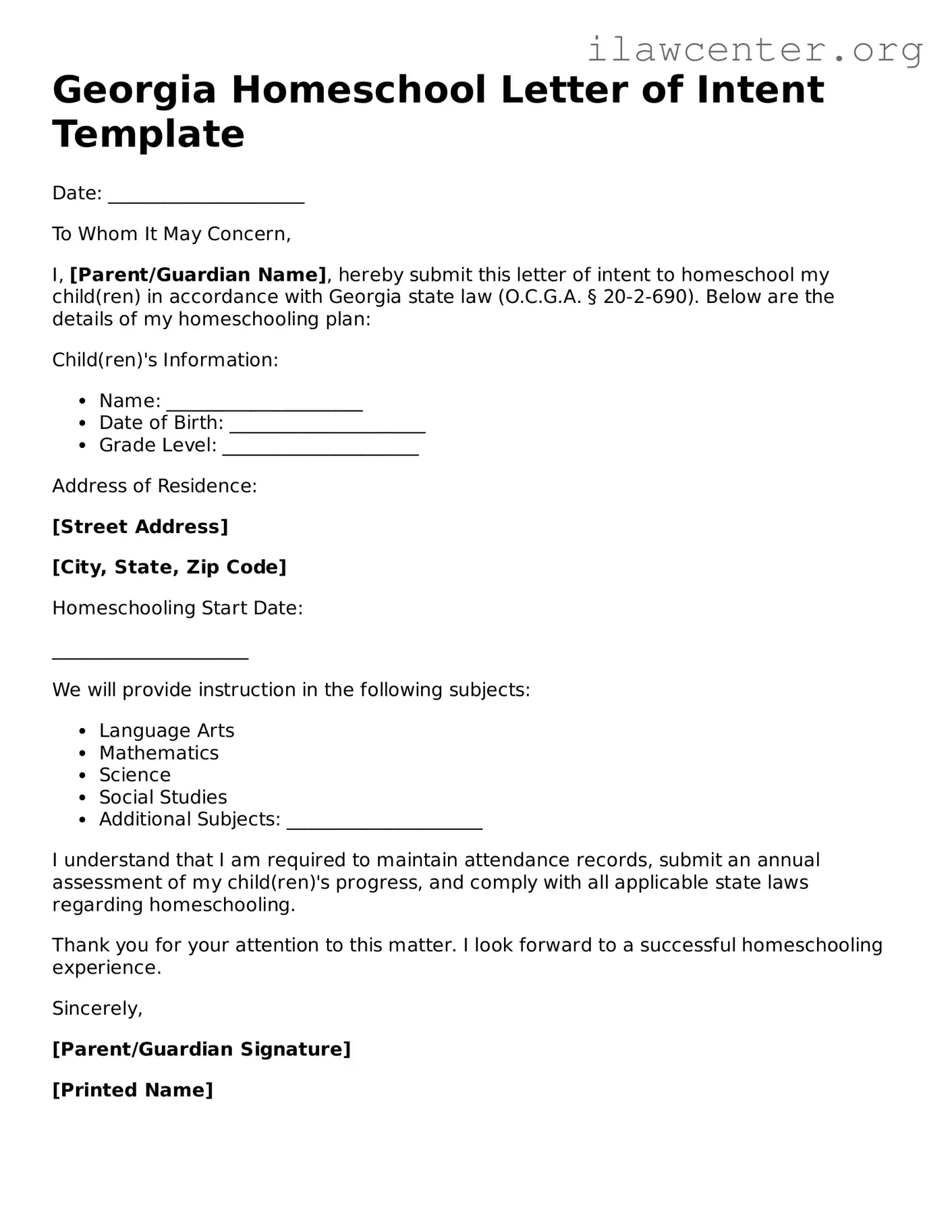
Georgia Homeschool Letter of Intent Template

Date: _____________________

To Whom It May Concern,

I, [Parent/Guardian Name], hereby submit this letter of intent to homeschool my child(ren) in accordance with Georgia state law (O.C.G.A. § 20-2-690). Below are the details of my homeschooling plan:

Child(ren)'s Information:

  • Name: _____________________
  • Date of Birth: _____________________
  • Grade Level: _____________________

Address of Residence:

[Street Address]

[City, State, Zip Code]

Homeschooling Start Date:

_____________________

We will provide instruction in the following subjects:

  • Language Arts
  • Mathematics
  • Science
  • Social Studies
  • Additional Subjects: _____________________

I understand that I am required to maintain attendance records, submit an annual assessment of my child(ren)'s progress, and comply with all applicable state laws regarding homeschooling.

Thank you for your attention to this matter. I look forward to a successful homeschooling experience.

Sincerely,

[Parent/Guardian Signature]

[Printed Name]

PDF Form Characteristics

Fact Name Description
Purpose The Georgia Homeschool Letter of Intent is used to formally notify the state that a parent or guardian intends to homeschool their child.
Governing Law This form is governed by Georgia law, specifically O.C.G.A. § 20-2-690.1.
Submission Deadline Parents must submit the Letter of Intent within 30 days of beginning homeschooling.
Age Requirement The form must be submitted for children between the ages of 6 and 16 who are being homeschooled.
Annual Submission The Letter of Intent is required only once, but parents must keep records of their homeschooling activities annually.
Content Requirements The form should include the names and ages of the children being homeschooled and the address of the homeschooling location.
Notification Method Parents can submit the Letter of Intent via mail or in person to their local school district.
Record Keeping While the form itself is a one-time requirement, parents must maintain educational records, including attendance and curriculum used.

Instructions on Utilizing Georgia Homeschool Letter of Intent

After completing the Georgia Homeschool Letter of Intent form, you will need to submit it to your local school district. This step is crucial in ensuring that your homeschooling journey is recognized by the state. Make sure to keep a copy for your records.

  1. Obtain the Georgia Homeschool Letter of Intent form from your local school district's website or office.
  2. Fill in your name and contact information in the designated fields.
  3. Provide the names and ages of the children you intend to homeschool.
  4. Indicate the address where the homeschooling will take place.
  5. Specify the educational curriculum you plan to use for your homeschooling program.
  6. Sign and date the form to certify that the information provided is accurate.
  7. Make a copy of the completed form for your records.
  8. Submit the form to your local school district office, either in person or by mail.

Important Facts about Georgia Homeschool Letter of Intent

What is the Georgia Homeschool Letter of Intent?

The Georgia Homeschool Letter of Intent is a formal document that parents or guardians must submit to declare their intention to homeschool their children. This letter serves as an official notification to the local school district, ensuring that the educational needs of the child are being met outside of the traditional school setting.

Who needs to file the Letter of Intent?

Any parent or guardian who wishes to homeschool their child in Georgia must file the Letter of Intent. This includes families with children who are currently enrolled in public or private schools, as well as those who have not yet started formal education. It is essential to submit this letter for each child you plan to homeschool.

When should I submit the Letter of Intent?

The Letter of Intent should be submitted within 30 days of beginning your homeschool program. If you are withdrawing your child from a traditional school, it is advisable to file the letter as soon as possible to avoid any potential issues with the school district. Timeliness is key to ensuring compliance with state regulations.

What information is required in the Letter of Intent?

The Letter of Intent typically requires basic information such as the names and ages of the children being homeschooled, the address of the homeschooling family, and the signature of the parent or guardian. Some districts may have specific requirements, so it’s wise to check with your local school district for any additional information they may need.

Is there a specific format for the Letter of Intent?

While there is no official state form for the Letter of Intent, it must be written in a clear and concise manner. Many families choose to use a simple template that includes all necessary information. Keeping it straightforward will help ensure that the document is processed without unnecessary delays.

What happens after I submit the Letter of Intent?

Once you submit the Letter of Intent, your local school district will acknowledge receipt. They may contact you for further information or clarification, but generally, no further action is required on your part. It is important to keep a copy of the letter for your records, as it serves as proof of your intent to homeschool.

What are the consequences of not filing the Letter of Intent?

Failing to file the Letter of Intent can lead to legal complications. The state of Georgia requires this notification to ensure that children receive an appropriate education. If the letter is not submitted, you may face inquiries from the school district, and it could potentially affect your child’s educational status. It is crucial to adhere to this requirement to avoid any unnecessary issues.
Common mistakes

When filling out the Georgia Homeschool Letter of Intent form, many families encounter common mistakes that can lead to delays or complications. One frequent error is failing to provide complete and accurate information. The form requires specific details about the student and the parent or guardian. Omitting any required information can result in the form being rejected or returned for corrections.

Another mistake is not submitting the form within the designated timeframe. Georgia law mandates that the Letter of Intent must be filed within 30 days of beginning homeschooling. Some families may overlook this deadline, which can lead to unnecessary stress and legal complications. It is essential to mark the calendar and ensure timely submission.

People often misinterpret the requirements for educational materials. The form does not ask for a detailed curriculum plan, but some individuals mistakenly include extensive descriptions of their educational approach. This can make the form unnecessarily lengthy and complicated. Keeping the information straightforward and focused on the essentials is advisable.

Finally, many individuals fail to keep a copy of the submitted Letter of Intent. This document serves as proof of intent to homeschool and may be needed for future reference. Without a copy, families might struggle to verify their compliance with state regulations. It is wise to maintain organized records of all homeschooling documents.

Documents used along the form

When families choose to homeschool in Georgia, they often need to complete several forms and documents to ensure compliance with state regulations. While the Homeschool Letter of Intent is a key component, there are other important documents that can facilitate the homeschooling process.

  • Homeschool Curriculum Plan: This document outlines the educational materials and methods that will be used throughout the school year. It helps parents stay organized and provides a clear structure for their children’s learning.
  • Attendance Records: Keeping track of daily attendance is essential. This document shows the number of days of instruction and can be helpful for both parents and state authorities to verify compliance with educational requirements.
  • Progress Reports: Regular assessments of a child's academic progress can be documented through progress reports. These reports can highlight achievements and areas needing improvement, providing a comprehensive view of the student’s educational journey.
  • Standardized Test Results: In Georgia, homeschooled students are required to take standardized tests at certain intervals. Keeping a record of these results can demonstrate academic proficiency and is often required for high school students seeking to transition to public or private schools.
  • Portfolio of Student Work: A collection of a student’s work, including assignments, projects, and tests, can serve as a portfolio. This document showcases the child’s learning and growth over the school year and can be a valuable resource for assessments or evaluations.

By preparing these documents alongside the Homeschool Letter of Intent, families can create a comprehensive framework for their homeschooling experience. This not only helps in meeting legal requirements but also supports the educational journey of the student.

Similar forms

The Homeschool Letter of Intent form serves as a crucial document for families choosing to educate their children at home. It is similar to several other documents used in educational settings. Below is a list of ten documents that share similarities with the Homeschool Letter of Intent form, along with explanations of how they are alike.

  • Enrollment Form: Like the Homeschool Letter of Intent, an enrollment form is submitted to an educational authority to officially register a child for a specific educational program, ensuring compliance with state requirements.
  • Withdrawal Form: This document is used when a parent decides to withdraw a child from a traditional school. It, too, serves as a formal notice to the school district and outlines the intent to pursue alternative education, similar to the purpose of the Letter of Intent.
  • Curriculum Plan: A curriculum plan outlines the educational materials and subjects a child will study at home. It complements the Homeschool Letter of Intent by providing details on how the educational needs will be met.
  • Attendance Record: Keeping track of a child’s attendance is essential in homeschooling. An attendance record, like the Letter of Intent, serves as documentation that the child is receiving education and meets state requirements.
  • Progress Report: Similar to the Homeschool Letter of Intent, a progress report provides updates on a child’s academic achievements and areas for improvement, helping to keep educational authorities informed.
  • Education Plan: An education plan outlines the goals and objectives for a child’s learning. This document is akin to the Homeschool Letter of Intent, as both are focused on the educational pathway chosen by the family.
  • Special Education Plan: For children with special needs, a special education plan details the accommodations and modifications required. This document shares the purpose of ensuring that a child’s educational needs are formally recognized, similar to the intent expressed in the Letter of Intent.
  • Transcript: A transcript provides a record of a student’s courses and grades. While it is typically used for high school students, it serves a similar function in documenting educational progress, much like the Homeschool Letter of Intent.
  • Affidavit of Intent: In some states, an affidavit of intent is a legal document affirming a parent’s decision to homeschool. This document is similar to the Homeschool Letter of Intent in its function of declaring the educational choice.
  • Notification Letter: A notification letter is often sent to the school district to inform them of a homeschooling decision. Like the Homeschool Letter of Intent, it serves as a formal communication of educational intent.

Each of these documents plays a significant role in the educational journey of a child being homeschooled. They provide necessary information to educational authorities and ensure that families comply with state regulations.

Dos and Don'ts

When filling out the Georgia Homeschool Letter of Intent form, it is crucial to adhere to certain guidelines to ensure a smooth process. Here are four things you should and shouldn't do:

  • Do ensure accuracy: Double-check all information for correctness, including names, addresses, and dates.
  • Do submit on time: Make sure to send your letter of intent within the required timeframe to comply with state regulations.
  • Don't forget to include all required information: Missing details can lead to delays or rejection of your application.
  • Don't use informal language: Maintain a professional tone throughout the document to reflect seriousness and commitment.

Misconceptions

There are several misconceptions about the Georgia Homeschool Letter of Intent form that can lead to confusion for families considering homeschooling. Understanding these misconceptions can help clarify the process and ensure that families meet their educational goals.

  • Misconception 1: The Letter of Intent is a complex legal document.
  • In reality, the form is straightforward and requires only basic information about the student and the homeschooling parent. It is designed to be user-friendly.

  • Misconception 2: You must submit the Letter of Intent before you start homeschooling.
  • While it is recommended to submit the form before the school year begins, you can still file it at any time during the year if you decide to homeschool mid-year.

  • Misconception 3: You need to provide a detailed curriculum plan with the Letter of Intent.
  • The form does not require a detailed curriculum. Simply stating that you will provide an educational program is sufficient.

  • Misconception 4: The Letter of Intent must be notarized.
  • This is not true. The form does not need to be notarized; signing it is enough to validate your intent to homeschool.

  • Misconception 5: You can only homeschool your children if you have a teaching degree.
  • In Georgia, parents do not need a teaching degree to homeschool their children. Any parent or guardian can choose to educate their child at home.

  • Misconception 6: Once you submit the Letter of Intent, you cannot change your mind about homeschooling.
  • Submitting the form does not lock you into homeschooling. You can choose to return your child to public or private school at any time.

Key takeaways

Filling out and using the Georgia Homeschool Letter of Intent form is an important step for parents who wish to educate their children at home. Here are some key takeaways to keep in mind:

  • The form must be submitted to the local school district by the annual deadline, typically within 30 days of beginning your homeschool program.
  • It is essential to provide accurate information about the child, including their name, age, and grade level.
  • Parents must indicate their choice of curriculum or educational approach, although detailed descriptions are not required.
  • Once submitted, keep a copy of the Letter of Intent for your records. This serves as proof of your intent to homeschool.
  • Be aware that the form does not require approval from the school district; submission is sufficient.
  • Updating the form is necessary if there are any changes, such as moving to a new district or changes in educational plans.
  • Remember to familiarize yourself with state laws regarding homeschooling to ensure compliance with all requirements.

By following these key points, you can navigate the process of submitting the Georgia Homeschool Letter of Intent with confidence.