Attorney-Verified  Independent Contractor Agreement Document for Georgia

Attorney-Verified Independent Contractor Agreement Document for Georgia

The Georgia Independent Contractor Agreement is a crucial document that outlines the terms and conditions between a business and an independent contractor. This agreement helps clarify the relationship, ensuring both parties understand their rights and responsibilities. To get started, fill out the form by clicking the button below.

Article Guide

In the state of Georgia, the Independent Contractor Agreement form serves as a vital tool for establishing a clear understanding between businesses and independent contractors. This document outlines the terms of engagement, detailing the scope of work, payment terms, and deadlines. It clarifies the nature of the relationship, emphasizing that the contractor operates independently rather than as an employee. Key elements often included are the responsibilities of each party, confidentiality clauses, and provisions for termination. By addressing these aspects, the agreement helps protect both parties and ensures that expectations are aligned from the outset. Understanding this form is essential for anyone looking to navigate the complexities of freelance work or contract-based employment in Georgia.

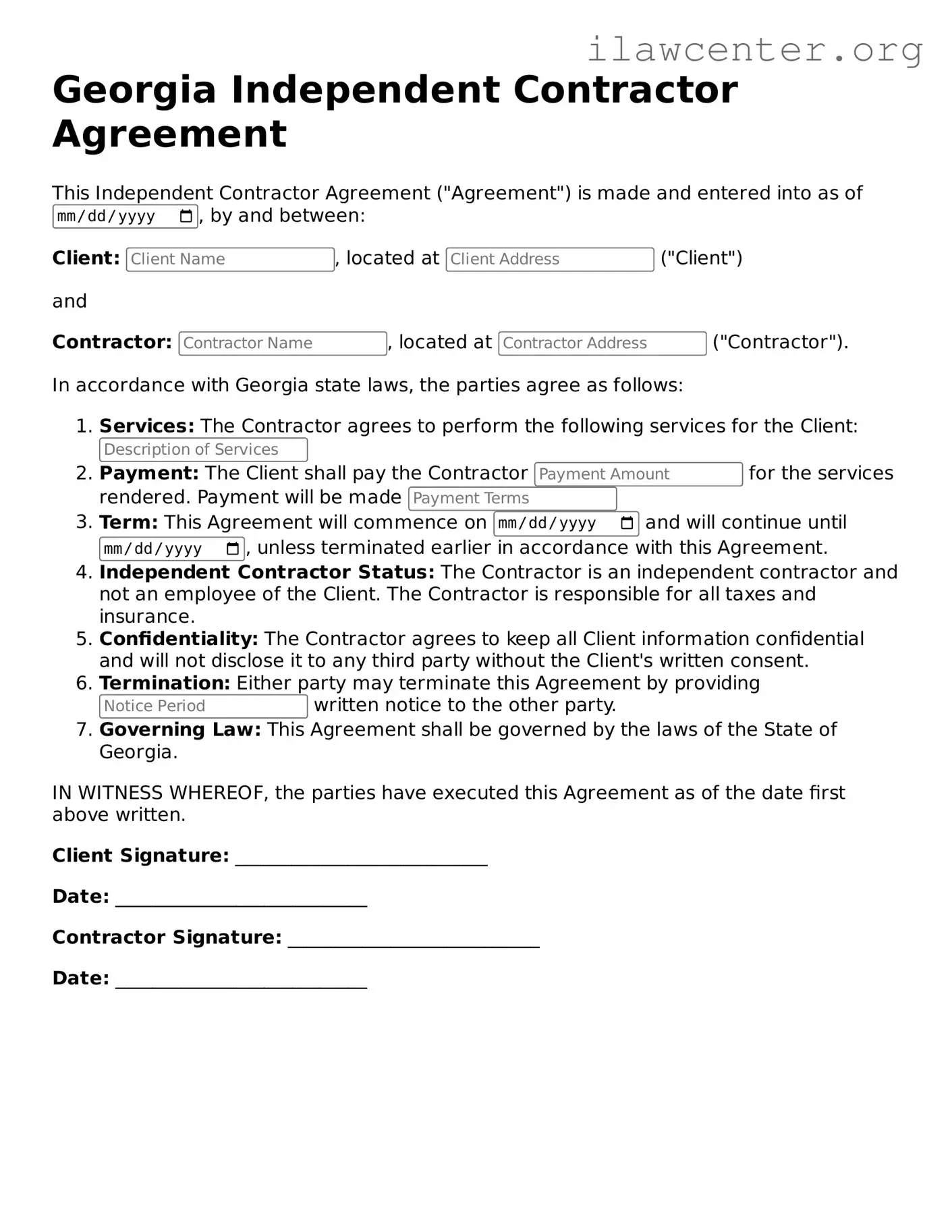
Georgia Independent Contractor Agreement Preview

Georgia Independent Contractor Agreement

This Independent Contractor Agreement ("Agreement") is made and entered into as of , by and between:

Client: , located at ("Client")

and

Contractor: , located at ("Contractor").

In accordance with Georgia state laws, the parties agree as follows:

  1. Services: The Contractor agrees to perform the following services for the Client:
  2. Payment: The Client shall pay the Contractor for the services rendered. Payment will be made
  3. Term: This Agreement will commence on and will continue until , unless terminated earlier in accordance with this Agreement.
  4. Independent Contractor Status: The Contractor is an independent contractor and not an employee of the Client. The Contractor is responsible for all taxes and insurance.
  5. Confidentiality: The Contractor agrees to keep all Client information confidential and will not disclose it to any third party without the Client's written consent.
  6. Termination: Either party may terminate this Agreement by providing written notice to the other party.
  7. Governing Law: This Agreement shall be governed by the laws of the State of Georgia.

IN WITNESS WHEREOF, the parties have executed this Agreement as of the date first above written.

Client Signature: ___________________________

Date: ___________________________

Contractor Signature: ___________________________

Date: ___________________________

PDF Form Characteristics

Fact Name Description
Definition The Georgia Independent Contractor Agreement is a legal document that outlines the terms and conditions between a business and an independent contractor.
Governing Law This agreement is governed by the laws of the State of Georgia, ensuring compliance with state regulations.
Key Components Essential elements include the scope of work, payment terms, and duration of the agreement, which help clarify expectations for both parties.
Liability Protection By using this agreement, businesses can limit their liability, as independent contractors are generally responsible for their own taxes and insurance.
Termination Clauses The agreement can include termination clauses, allowing either party to end the contract under specified conditions, providing flexibility in the working relationship.

Instructions on Utilizing Georgia Independent Contractor Agreement

Filling out the Georgia Independent Contractor Agreement form is an important step in establishing a clear understanding between a contractor and a client. Completing this form accurately ensures that both parties are on the same page regarding their roles, responsibilities, and expectations. Below are the steps to guide you through the process.

  1. Begin by downloading the Georgia Independent Contractor Agreement form from a reliable source.
  2. Read the entire form carefully to understand what information is required.
  3. In the first section, enter the name and address of the contractor. Make sure to include any relevant business name if applicable.
  4. Next, provide the name and address of the client or company hiring the contractor.
  5. Specify the date on which the agreement is being signed.
  6. In the designated area, outline the specific services the contractor will provide. Be as detailed as possible.
  7. Indicate the payment terms, including the amount, method, and schedule of payments.
  8. Fill in the duration of the agreement, noting the start and end dates if applicable.
  9. Review any additional terms or conditions included in the form. Adjust them as necessary to fit your agreement.
  10. Both parties should sign and date the form at the end to indicate their agreement.
  11. Make copies of the signed agreement for both the contractor and the client for their records.

Once you have completed these steps, you will have a signed agreement that clarifies the working relationship between the contractor and the client. This document serves as a reference point for both parties throughout the duration of the project.

Important Facts about Georgia Independent Contractor Agreement

What is a Georgia Independent Contractor Agreement?

A Georgia Independent Contractor Agreement is a legal document that outlines the terms and conditions between a business and an independent contractor. It specifies the nature of the work, payment terms, and the responsibilities of both parties. This agreement helps to clarify the relationship and protect the interests of both the contractor and the hiring entity.

Why is an Independent Contractor Agreement important?

This agreement is important because it establishes clear expectations for the work to be performed. It helps to prevent misunderstandings and disputes by detailing the scope of work, deadlines, and compensation. Additionally, it serves as a legal record of the agreement between the contractor and the business.

Who should use a Georgia Independent Contractor Agreement?

Any business or individual hiring an independent contractor in Georgia should use this agreement. This includes freelancers, consultants, and other self-employed individuals who provide services. It is essential for both parties to have a clear understanding of their rights and obligations.

What key elements should be included in the agreement?

The agreement should include several key elements: the names and contact information of both parties, a description of the services to be provided, payment terms, deadlines, confidentiality clauses, and termination conditions. Including these details helps to ensure that both parties are on the same page.

How does the payment structure work in an Independent Contractor Agreement?

The payment structure can vary based on the agreement. It may include hourly rates, fixed fees, or commission-based payments. The agreement should specify how and when payments will be made, such as upon completion of the work or at regular intervals. Clear payment terms help to avoid disputes later on.

Can the agreement be modified after it is signed?

Yes, the agreement can be modified after it is signed, but both parties must agree to the changes. It is advisable to document any modifications in writing and have both parties sign the updated agreement. This ensures that all changes are clear and legally binding.

What happens if one party breaches the agreement?

If one party breaches the agreement, the other party may seek remedies as outlined in the contract. This could include monetary damages or specific performance, depending on the terms of the agreement. It is essential to include a dispute resolution clause to outline how conflicts will be handled.

Is an Independent Contractor Agreement legally binding?

Yes, an Independent Contractor Agreement is legally binding if it meets the necessary legal requirements. Both parties must voluntarily agree to the terms, and the agreement should not contain any illegal provisions. It is recommended to have the agreement reviewed by a legal professional to ensure its validity.

Do I need a lawyer to create an Independent Contractor Agreement?

While it is not legally required to have a lawyer draft the agreement, it is advisable to seek legal assistance. A lawyer can help ensure that the agreement complies with Georgia laws and adequately protects your interests. This can be especially important for more complex arrangements.

Where can I find a template for a Georgia Independent Contractor Agreement?

Templates for a Georgia Independent Contractor Agreement can be found online through legal websites or templates services. It is important to choose a reputable source and customize the template to fit the specific needs of the parties involved. Always review the final document to ensure it meets all legal requirements.
Common mistakes

Filling out the Georgia Independent Contractor Agreement form can be a straightforward process, but there are common mistakes that individuals often make. Understanding these pitfalls can help ensure that the agreement is completed accurately and effectively. One frequent error is failing to provide complete contact information. It is essential to include not only the names of both parties but also their addresses, phone numbers, and email addresses. Incomplete contact details can lead to confusion and difficulties in communication.

Another common mistake involves misclassifying the nature of the work. It's crucial to clearly define the scope of services to avoid any ambiguity. When the description is vague or overly broad, it can create misunderstandings later on. Both parties should have a clear understanding of the specific tasks and responsibilities involved in the agreement. This clarity helps prevent disputes and ensures that expectations are aligned.

People also often overlook the importance of including payment terms. This section should specify how much the contractor will be paid, when payments will be made, and the method of payment. Without clear payment terms, misunderstandings can arise regarding compensation, leading to frustration and potential conflicts. It is advisable to be as detailed as possible to protect both parties' interests.

Additionally, many individuals neglect to address the issue of liability and insurance. It is essential to clarify who is responsible for any potential damages or injuries that may occur during the course of the work. Including a clause that outlines liability can protect both the contractor and the client. This step is vital in ensuring that both parties understand their responsibilities and liabilities.

Finally, a common mistake is failing to sign and date the agreement. Even if the form is filled out correctly, it is not legally binding without signatures. Both parties must sign and date the document to confirm their acceptance of the terms. This final step is crucial for the enforceability of the agreement, ensuring that both parties are committed to the terms laid out in the contract.

Documents used along the form

The Georgia Independent Contractor Agreement is a crucial document for establishing the terms of the working relationship between a contractor and a client. To ensure a comprehensive understanding of the arrangement, several other forms and documents are often utilized alongside this agreement. Here is a list of related documents that may be beneficial in this context.

  • W-9 Form: This form is used by the contractor to provide their taxpayer identification number to the client. It is essential for tax reporting purposes.
  • Invoice Template: An invoice is issued by the contractor to request payment for services rendered. It typically includes details about the work completed, payment terms, and due dates.
  • Scope of Work Document: This document outlines the specific tasks and responsibilities of the contractor. It clarifies expectations and helps prevent misunderstandings.
  • Confidentiality Agreement: Also known as a non-disclosure agreement (NDA), this document protects sensitive information shared between the contractor and the client during the course of their work.
  • Non-Compete Agreement: This agreement restricts the contractor from engaging in similar work with competitors for a specified period after the contract ends, safeguarding the client’s business interests.
  • Payment Agreement: This document details the payment structure, including rates, payment schedule, and any bonuses or penalties associated with performance.
  • Termination Notice: A formal notice that outlines the process for ending the contractor-client relationship, including any required notice period and conditions for termination.
  • Insurance Certificate: This document provides proof of insurance coverage, which may be required by the client to protect against potential liabilities arising from the contractor's work.

Incorporating these documents alongside the Georgia Independent Contractor Agreement can help create a clear and structured framework for the working relationship. Each document serves a specific purpose, contributing to a smoother collaboration and reducing the risk of disputes.

Similar forms

  • Consulting Agreement: This document outlines the terms under which a consultant provides services to a client. Similar to an Independent Contractor Agreement, it specifies the scope of work, payment terms, and duration of the engagement.
  • Service Agreement: A service agreement details the relationship between a service provider and a client. Like the Independent Contractor Agreement, it defines the services to be provided, compensation, and responsibilities of each party.
  • Freelance Agreement: This type of agreement is tailored for freelancers, covering the specifics of the work to be completed, payment structure, and deadlines. It shares similarities with the Independent Contractor Agreement in terms of defining the working relationship.
  • Non-Disclosure Agreement (NDA): While primarily focused on confidentiality, an NDA can accompany an Independent Contractor Agreement to protect sensitive information. Both documents work together to establish trust and security in a business relationship.
  • Partnership Agreement: This document governs the relationship between business partners. Although it involves a different structure than an Independent Contractor Agreement, both establish roles, responsibilities, and the sharing of profits or losses.
  • Employment Agreement: Although this document is typically used for employees, it shares some common elements with the Independent Contractor Agreement, such as job responsibilities and compensation. The key difference lies in the classification of the worker.
  • Joint Venture Agreement: This agreement outlines the terms under which two or more parties collaborate on a specific project. Similar to an Independent Contractor Agreement, it details the contributions and obligations of each party involved.
  • Letter of Agreement: A letter of agreement serves as a simpler, often less formal version of an Independent Contractor Agreement. It outlines the basic terms of the working relationship, including services, payment, and duration, but may not include as much detail.

Dos and Don'ts

When filling out the Georgia Independent Contractor Agreement form, it is important to be thorough and accurate. Here are some essential dos and don'ts to keep in mind:

  • Do read the entire agreement carefully before filling it out.
  • Do provide accurate personal and business information.
  • Do clearly define the scope of work to avoid misunderstandings.
  • Do specify the payment terms, including rates and deadlines.
  • Do include any necessary licenses or permits required for your work.
  • Don't leave any sections blank; fill in all required fields.
  • Don't use vague language that could lead to confusion.
  • Don't ignore the termination clause; understand how to end the agreement if needed.
  • Don't sign the agreement until you fully understand its terms.

Misconceptions

Misconceptions about the Georgia Independent Contractor Agreement form can lead to confusion for both contractors and businesses. Here are ten common misunderstandings:

  1. Independent contractors are the same as employees. Many people think that independent contractors have the same rights and protections as employees. This is not true. Independent contractors operate under different rules and do not receive benefits like health insurance or retirement plans from the hiring company.
  2. All contracts need to be in writing. While it’s a good practice to have a written agreement, not all contracts must be in writing to be enforceable. However, having a written agreement helps clarify expectations and responsibilities.
  3. Independent contractors can work for multiple clients. Some believe that independent contractors can only work for one client at a time. In reality, they can work for multiple clients simultaneously, as long as it does not violate any terms of their contracts.
  4. Independent contractors cannot be terminated. There is a misconception that independent contractors cannot be fired. While they are not employees, they can be terminated according to the terms of the contract or if the work is not satisfactory.
  5. Independent contractors are not responsible for their taxes. Some individuals think that independent contractors do not need to pay taxes. In fact, they are responsible for their own taxes, including self-employment taxes.
  6. All independent contractor agreements are the same. Many assume that all independent contractor agreements are identical. Each agreement can vary significantly based on the nature of the work, the parties involved, and specific terms negotiated.
  7. Independent contractors have no legal protections. A common belief is that independent contractors have no legal rights. They do have rights, including the right to be paid for their work and to pursue legal action if the terms of the contract are violated.
  8. Verbal agreements are sufficient. Some people think that a verbal agreement is enough for independent contractor arrangements. While verbal agreements can be enforceable, they can lead to misunderstandings and disputes without written documentation.
  9. Independent contractors must provide their own tools and equipment. While many independent contractors do supply their own tools, this is not a requirement in every case. The terms of the contract should specify who is responsible for providing necessary equipment.
  10. Independent contractors do not need liability insurance. There is a misconception that independent contractors are not required to carry liability insurance. Depending on the nature of the work, having insurance may be necessary to protect against potential claims.

Understanding these misconceptions can help both independent contractors and businesses navigate their agreements more effectively.

Key takeaways

When filling out and using the Georgia Independent Contractor Agreement form, keep these key takeaways in mind:

  • Ensure that all parties involved are clearly identified. This includes the contractor and the hiring entity.
  • Clearly outline the scope of work. Specify the tasks and responsibilities expected from the contractor.
  • Include payment terms. State how much the contractor will be paid and when payments will be made.
  • Define the duration of the agreement. Specify the start and end dates or conditions for termination.
  • Address confidentiality and non-disclosure. Protect sensitive information that may be shared during the project.
  • Review local laws and regulations. Ensure compliance with Georgia's specific requirements for independent contractors.

Taking these steps can help create a clear and effective agreement, minimizing misunderstandings and protecting both parties' interests.