Attorney-Verified  Loan Agreement Document for Georgia

Attorney-Verified Loan Agreement Document for Georgia

The Georgia Loan Agreement form is a legally binding document that outlines the terms and conditions of a loan between a borrower and a lender. This essential agreement helps protect both parties by clearly defining their rights and responsibilities. To ensure a smooth borrowing experience, consider filling out the form by clicking the button below.

Article Guide

The Georgia Loan Agreement form serves as a crucial document for individuals and businesses seeking to formalize a loan transaction in the state. This form outlines the terms and conditions of the loan, including the principal amount, interest rate, repayment schedule, and any collateral involved. It ensures that both the lender and borrower have a clear understanding of their rights and obligations. Additionally, the agreement may specify default terms, late fees, and the governing law, providing legal clarity in case of disputes. By utilizing this standardized form, parties can minimize misunderstandings and protect their interests throughout the lending process.

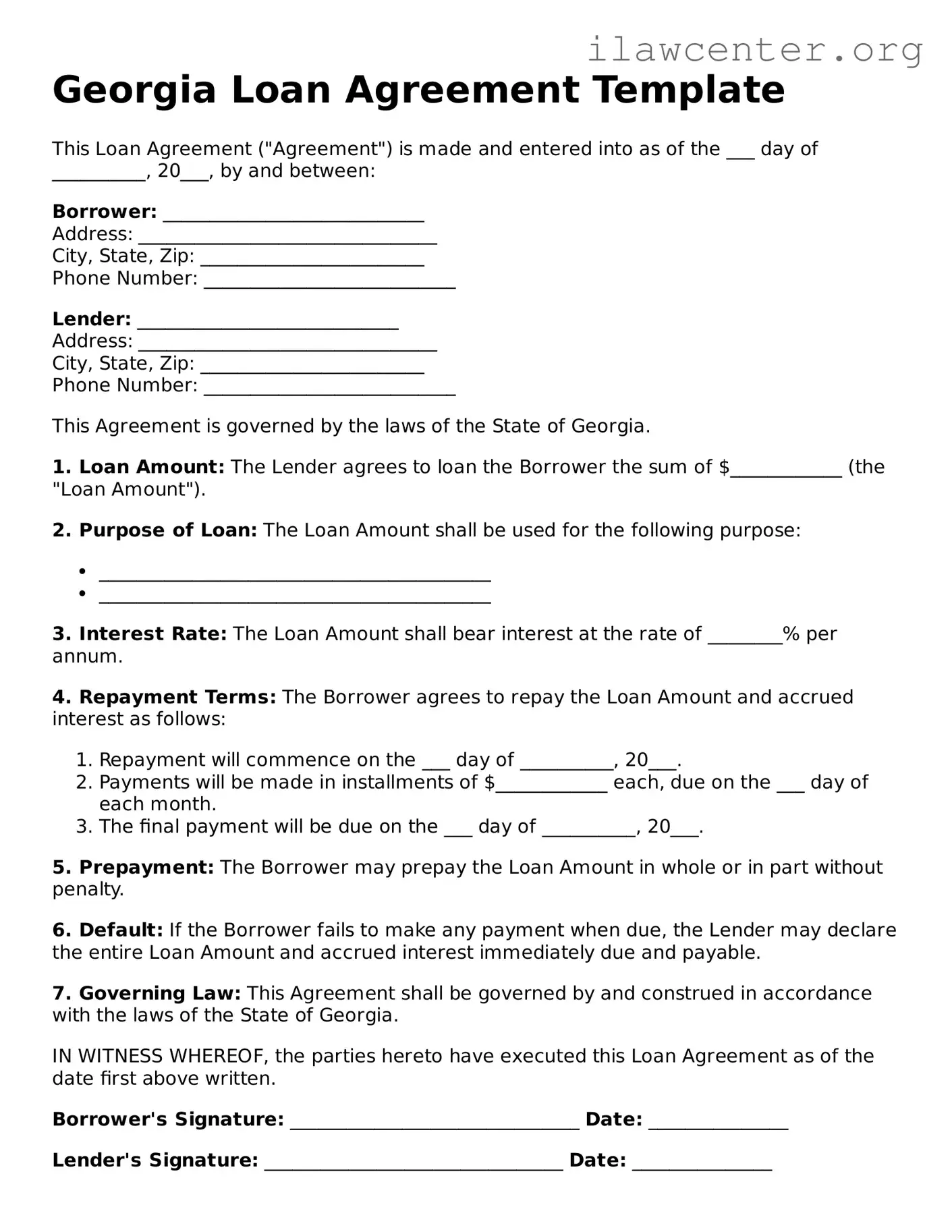
Georgia Loan Agreement Preview

Georgia Loan Agreement Template

This Loan Agreement ("Agreement") is made and entered into as of the ___ day of __________, 20___, by and between:

Borrower: ____________________________
Address: ________________________________
City, State, Zip: ________________________
Phone Number: ___________________________

Lender: ____________________________
Address: ________________________________
City, State, Zip: ________________________
Phone Number: ___________________________

This Agreement is governed by the laws of the State of Georgia.

1. Loan Amount: The Lender agrees to loan the Borrower the sum of $____________ (the "Loan Amount").

2. Purpose of Loan: The Loan Amount shall be used for the following purpose:

  • __________________________________________
  • __________________________________________

3. Interest Rate: The Loan Amount shall bear interest at the rate of ________% per annum.

4. Repayment Terms: The Borrower agrees to repay the Loan Amount and accrued interest as follows:

  1. Repayment will commence on the ___ day of __________, 20___.
  2. Payments will be made in installments of $____________ each, due on the ___ day of each month.
  3. The final payment will be due on the ___ day of __________, 20___.

5. Prepayment: The Borrower may prepay the Loan Amount in whole or in part without penalty.

6. Default: If the Borrower fails to make any payment when due, the Lender may declare the entire Loan Amount and accrued interest immediately due and payable.

7. Governing Law: This Agreement shall be governed by and construed in accordance with the laws of the State of Georgia.

IN WITNESS WHEREOF, the parties hereto have executed this Loan Agreement as of the date first above written.

Borrower's Signature: _______________________________ Date: _______________

Lender's Signature: ________________________________ Date: _______________
PDF Form Characteristics

Fact Name Description
Governing Law The Georgia Loan Agreement is governed by the laws of the State of Georgia.
Purpose This form is used to outline the terms and conditions of a loan between a lender and a borrower.
Parties Involved The agreement typically includes the lender, who provides the funds, and the borrower, who receives the funds.
Loan Amount The specific amount of money being loaned must be clearly stated in the agreement.
Repayment Terms Details regarding the repayment schedule, including interest rates and due dates, are included in the form.
Signatures Both parties must sign the agreement to make it legally binding, indicating their acceptance of the terms.

Instructions on Utilizing Georgia Loan Agreement

Filling out the Georgia Loan Agreement form is a straightforward process. Once you have completed the form, you will be ready to proceed with the next steps in your loan process.

  1. Begin by gathering all necessary information, including personal details and loan specifics.
  2. Write your full name in the designated field.
  3. Provide your current address, including city, state, and zip code.
  4. Fill in your phone number and email address for contact purposes.
  5. Indicate the loan amount you are requesting.
  6. Specify the purpose of the loan in the appropriate section.
  7. Review the terms and conditions outlined in the agreement.
  8. Sign and date the form at the bottom.
  9. Make a copy of the completed form for your records.
  10. Submit the form to the appropriate lender or financial institution.

Important Facts about Georgia Loan Agreement

What is a Georgia Loan Agreement form?

A Georgia Loan Agreement form is a legal document that outlines the terms and conditions of a loan between a lender and a borrower within the state of Georgia. This form typically includes essential details such as the loan amount, interest rate, repayment schedule, and any collateral involved. By clearly defining these terms, both parties can have a mutual understanding of their obligations, reducing the risk of disputes in the future.

Who should use a Georgia Loan Agreement form?

This form is beneficial for anyone involved in lending or borrowing money in Georgia. Individuals, businesses, or organizations that plan to lend money or take out a loan can utilize this agreement. It serves as a formal record of the transaction, ensuring that all parties are on the same page regarding the terms. Whether you’re a friend lending money or a business providing a loan, having a written agreement is a wise choice.

What are the key components of a Georgia Loan Agreement form?

Several crucial elements should be included in a Georgia Loan Agreement. These typically encompass the names and contact information of both the lender and borrower, the total loan amount, the interest rate, the repayment schedule, and any late fees or penalties for missed payments. Additionally, it may outline the consequences of defaulting on the loan and any collateral that secures the loan. Including these details helps protect the interests of both parties.

Is it necessary to have a lawyer review the Georgia Loan Agreement form?

Common mistakes

Filling out the Georgia Loan Agreement form can be a straightforward process, but there are common mistakes that individuals often make. One frequent error is failing to provide accurate personal information. This includes names, addresses, and contact details. It is crucial to double-check that all information is correct, as discrepancies can lead to delays or complications.

Another mistake is neglecting to read the terms and conditions thoroughly. Many people skim through the document without fully understanding the obligations and responsibilities they are agreeing to. This oversight can result in unexpected fees or penalties down the line.

Some individuals forget to include all required signatures. A loan agreement typically requires signatures from all parties involved. Omitting a signature can render the agreement invalid, causing significant issues for both the lender and the borrower.

Additionally, failing to specify the loan amount clearly is a common pitfall. The loan amount should be clearly stated in both numbers and words. If there is any ambiguity, it could lead to misunderstandings about the terms of the loan.

Another mistake is not providing a repayment schedule. Borrowers should outline how and when they plan to repay the loan. Without a clear repayment plan, lenders may be hesitant to approve the loan.

Some people overlook the importance of including collateral information when required. If the loan is secured, details about the collateral must be provided. Not including this information can lead to complications in the approval process.

Moreover, individuals sometimes fail to disclose their financial status accurately. Providing false or incomplete financial information can jeopardize the loan approval process and lead to legal issues.

Finally, many individuals forget to keep a copy of the completed agreement for their records. Retaining a copy is essential for future reference and can protect both parties if any disputes arise. Always make sure to have a signed copy on hand.

Documents used along the form

When entering into a loan agreement in Georgia, several additional forms and documents may be required to ensure clarity and compliance. These documents help define the terms of the loan, protect the interests of both parties, and facilitate the borrowing process.

  • Promissory Note: This document outlines the borrower's promise to repay the loan. It includes details such as the loan amount, interest rate, repayment schedule, and any penalties for late payments.
  • Loan Application: A formal request for a loan, this application collects essential information about the borrower, including financial history, income, and creditworthiness.
  • Credit Report Authorization: This document grants permission for the lender to access the borrower's credit report, helping assess their creditworthiness and financial stability.
  • Security Agreement: If the loan is secured, this agreement details the collateral backing the loan. It specifies what the lender can claim if the borrower defaults.
  • Disclosure Statement: This document provides borrowers with important information about the loan terms, including fees, interest rates, and other costs associated with the loan.
  • Guaranty Agreement: In cases where a third party guarantees the loan, this agreement outlines their commitment to repay the loan if the borrower defaults.
  • Amortization Schedule: This schedule breaks down each payment into principal and interest components, providing a clear view of how the loan balance decreases over time.
  • Loan Closing Statement: This document summarizes the final terms of the loan, including all fees and charges, and is typically reviewed and signed at the closing of the loan transaction.

Each of these documents plays a crucial role in the loan process. By understanding their purpose, borrowers and lenders can navigate the complexities of loan agreements more effectively, ensuring a smoother transaction and clearer communication throughout the lending process.

Similar forms

The Loan Agreement form shares similarities with several other financial and legal documents. Each document serves a unique purpose but often contains overlapping elements related to terms, obligations, and conditions. Below are seven documents that are similar to a Loan Agreement:

  • Promissory Note: This document outlines a borrower's promise to repay a loan. Like a Loan Agreement, it specifies the amount borrowed, interest rate, and repayment schedule.
  • Mortgage Agreement: When securing a loan with real estate, a Mortgage Agreement is used. It details the loan terms and the property being used as collateral, similar to how a Loan Agreement outlines the loan specifics.
  • Credit Agreement: This document governs the terms of credit extended to a borrower. It includes interest rates, fees, and repayment terms, paralleling the details found in a Loan Agreement.
  • Lease Agreement: While primarily for rental arrangements, a Lease Agreement can resemble a Loan Agreement in that it includes payment terms and obligations, particularly if a lease includes financing for equipment or property.
  • Personal Loan Agreement: This is a specific type of Loan Agreement for personal loans. It clearly defines the loan amount, interest rate, and repayment terms, much like a standard Loan Agreement.
  • Business Loan Agreement: Tailored for business financing, this document outlines loan terms for business purposes. It includes similar elements such as payment schedules and interest rates, akin to a Loan Agreement.
  • Debt Settlement Agreement: This document outlines the terms under which a debtor agrees to pay a reduced amount to settle a debt. It shares similarities with a Loan Agreement in that it defines repayment terms and obligations, though it often involves negotiation and compromise.

Understanding these similarities can help in navigating the complexities of financial agreements. Each document, while distinct, plays a role in the broader landscape of borrowing and lending.

Dos and Don'ts

When filling out the Georgia Loan Agreement form, it's crucial to approach the task with care. Here are some essential dos and don'ts to ensure the process goes smoothly.

  • Do read the entire agreement carefully before filling it out. Understanding the terms is vital.
  • Do provide accurate and truthful information. Inaccuracies can lead to complications later.
  • Do double-check your calculations, especially if the agreement involves interest rates or payment amounts.
  • Do sign and date the form in the appropriate places. An unsigned agreement may not be enforceable.
  • Do keep a copy of the completed form for your records. This will be important for future reference.
  • Don't rush through the form. Taking your time can prevent mistakes.
  • Don't leave any required fields blank. Missing information can delay processing.
  • Don't use abbreviations or shorthand. Clarity is key in legal documents.
  • Don't forget to review the agreement with a trusted advisor if needed. Their insights can be invaluable.
  • Don't ignore deadlines. Timeliness is crucial in loan agreements to avoid penalties.

By adhering to these guidelines, you can help ensure that your Georgia Loan Agreement form is completed correctly and efficiently.

Misconceptions

Understanding the Georgia Loan Agreement form can be tricky, especially with various misconceptions floating around. Here are ten common misunderstandings, along with clarifications to help you navigate this important document.

  1. All loan agreements are the same. Many people believe that all loan agreements follow a standard format. In reality, each agreement can vary significantly based on the lender, the type of loan, and the specific terms negotiated.
  2. You don't need to read the agreement. Some individuals assume that they can sign a loan agreement without reading it. This is a risky approach. Understanding the terms and conditions is crucial to avoid future disputes.
  3. Only the lender benefits from the agreement. It’s a common belief that loan agreements only serve the lender’s interests. However, these agreements also protect borrowers by outlining their rights and responsibilities.
  4. Verbal agreements are sufficient. Some people think that a verbal agreement with a lender is enough. In Georgia, having a written loan agreement is essential for legal enforceability and clarity.
  5. Loan agreements are only for large amounts. Many believe that loan agreements are only necessary for significant loans. In truth, even small loans should be documented to ensure all parties understand the terms.
  6. You cannot negotiate terms. There’s a misconception that loan terms are set in stone. In fact, borrowers often have the opportunity to negotiate terms like interest rates and repayment schedules.
  7. Once signed, you cannot change anything. Some think that once a loan agreement is signed, it cannot be altered. While changes can be challenging, amendments are possible if both parties agree.
  8. Loan agreements are only for individuals. Many assume that only individuals need loan agreements. However, businesses and organizations also require these documents to formalize loans.
  9. All fees and costs are disclosed upfront. It’s a common misunderstanding that all fees associated with a loan will be clearly outlined in the agreement. Borrowers should always ask for a full disclosure of all costs before signing.
  10. Loan agreements are not legally binding. Some people believe that loan agreements lack legal weight. In reality, these documents are legally binding contracts that can be enforced in court.

By addressing these misconceptions, borrowers can approach the Georgia Loan Agreement form with greater confidence and understanding. Always take the time to read and comprehend the details of any loan agreement before signing.

Key takeaways

When utilizing the Georgia Loan Agreement form, it is essential to understand its components and requirements. Here are some key takeaways to consider:

  • Understand the Purpose: The Loan Agreement serves as a formal document outlining the terms of a loan between a lender and a borrower.
  • Identify the Parties: Clearly state the names and addresses of both the lender and the borrower to avoid any confusion.
  • Detail the Loan Amount: Specify the exact amount being borrowed, as well as any applicable interest rates.
  • Set the Repayment Terms: Include information about the repayment schedule, such as the frequency of payments and the due date.
  • Include Default Provisions: Outline what constitutes a default and the consequences that will follow if the borrower fails to meet the obligations.
  • Consider Legal Requirements: Ensure compliance with Georgia state laws regarding loan agreements, which may include specific disclosures or terms.
  • Seek Legal Advice: It is advisable for both parties to consult with legal professionals to ensure that the agreement is fair and enforceable.

By keeping these points in mind, individuals can better navigate the process of filling out and using the Georgia Loan Agreement form effectively.