Attorney-Verified  Non-compete Agreement Document for Georgia

Attorney-Verified Non-compete Agreement Document for Georgia

A Georgia Non-compete Agreement form is a legal document that restricts an employee's ability to engage in business activities that compete with their employer after leaving the company. This form helps protect the employer's business interests and confidential information. To ensure your rights are safeguarded, consider filling out the form by clicking the button below.

Article Guide

In the ever-evolving landscape of employment law, non-compete agreements have become a significant topic of discussion, particularly in Georgia. These agreements serve as a tool for employers to protect their business interests by restricting employees from working with competitors or starting similar businesses after leaving a job. The Georgia Non-compete Agreement form outlines essential components that both parties must consider. It typically includes the duration of the restriction, the geographical area in which the employee cannot compete, and the specific activities that are prohibited. Additionally, the form must be reasonable in scope to be enforceable, which means it should balance the employer's need for protection with the employee's right to work. Clarity is vital; ambiguous language can lead to disputes and make enforcement difficult. Understanding these aspects is crucial for both employers and employees to navigate their rights and obligations effectively.

Georgia Non-compete Agreement Preview

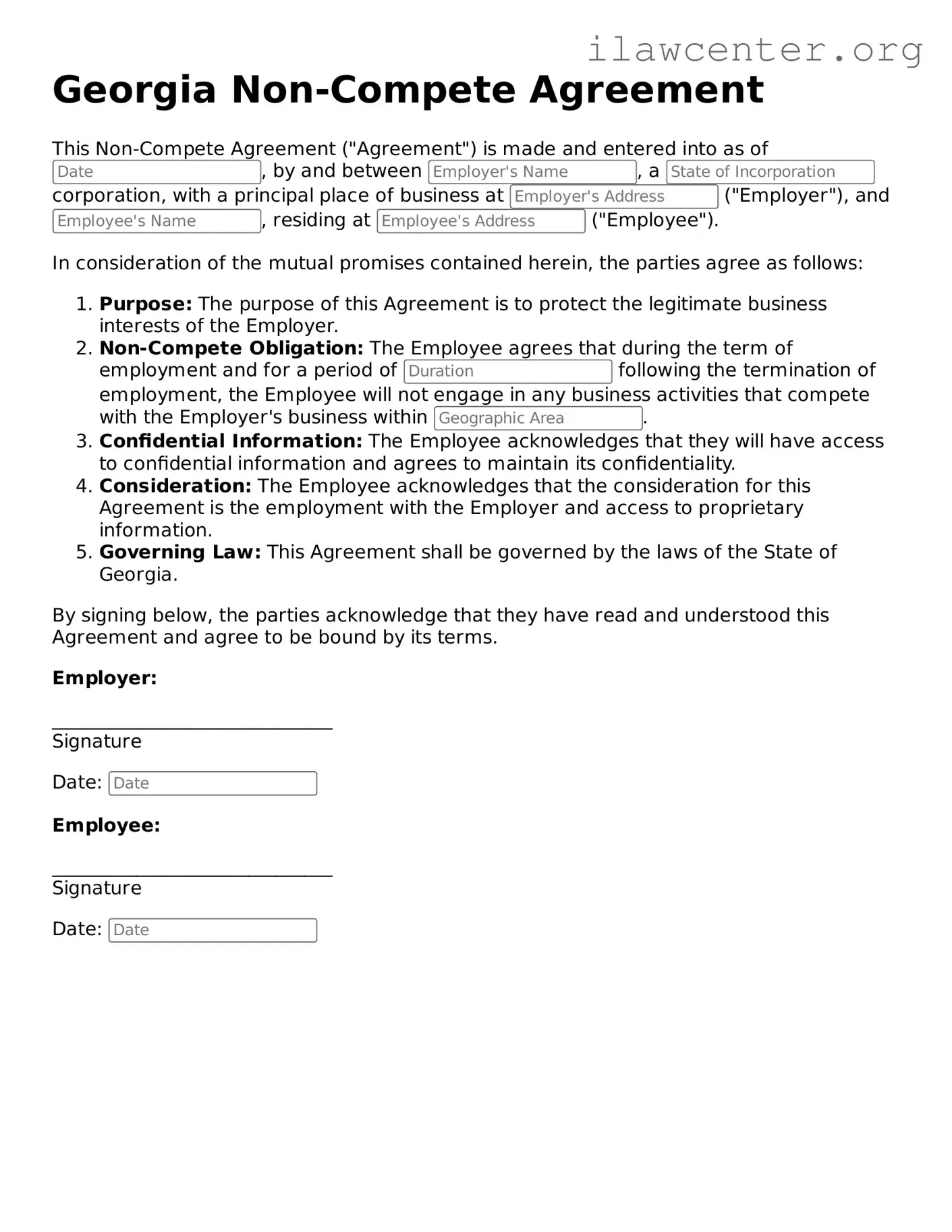
Georgia Non-Compete Agreement

This Non-Compete Agreement ("Agreement") is made and entered into as of , by and between , a corporation, with a principal place of business at ("Employer"), and , residing at ("Employee").

In consideration of the mutual promises contained herein, the parties agree as follows:

  1. Purpose: The purpose of this Agreement is to protect the legitimate business interests of the Employer.
  2. Non-Compete Obligation: The Employee agrees that during the term of employment and for a period of following the termination of employment, the Employee will not engage in any business activities that compete with the Employer's business within .
  3. Confidential Information: The Employee acknowledges that they will have access to confidential information and agrees to maintain its confidentiality.
  4. Consideration: The Employee acknowledges that the consideration for this Agreement is the employment with the Employer and access to proprietary information.
  5. Governing Law: This Agreement shall be governed by the laws of the State of Georgia.

By signing below, the parties acknowledge that they have read and understood this Agreement and agree to be bound by its terms.

Employer:

______________________________
Signature

Date:

Employee:

______________________________
Signature

Date:

PDF Form Characteristics

Fact Name Description
Governing Law The Georgia Non-compete Agreement is governed by Georgia state law, specifically O.C.G.A. § 13-8-50 et seq.
Enforceability Non-compete agreements in Georgia are enforceable if they are reasonable in scope, duration, and geographic area.
Duration Limit Georgia law allows non-compete agreements to last up to two years from the date of termination of employment.
Geographic Limit The agreement must specify a reasonable geographic area where the restrictions apply.
Consideration For a non-compete agreement to be valid, there must be adequate consideration, such as employment or a promotion.
Blue Pencil Rule Georgia courts may modify overly broad non-compete agreements to make them enforceable, a practice known as the "blue pencil" rule.
Exceptions Certain professionals, such as physicians and attorneys, may face additional restrictions on non-compete agreements.
Employee Rights Employees have the right to seek legal counsel before signing a non-compete agreement to understand its implications.

Instructions on Utilizing Georgia Non-compete Agreement

After obtaining the Georgia Non-compete Agreement form, you will need to provide specific information to ensure it is properly filled out. This document requires details about the parties involved, the nature of the agreement, and the terms of the non-compete. Follow the steps below to complete the form accurately.

  1. Identify the parties: Write the full legal names of both the employer and the employee. Ensure that the spelling is correct and that you include any relevant titles.
  2. Define the scope: Clearly outline the nature of the business and the specific services or products involved. This section should provide enough detail to clarify the context of the non-compete.
  3. Set the geographical area: Indicate the geographical limits where the non-compete applies. Be specific about the regions or locations that are included.
  4. Specify the duration: Determine and write the length of time the non-compete will be effective. This could range from several months to a few years.
  5. Include any exceptions: If there are any exceptions to the non-compete clause, such as specific circumstances under which the employee may work for a competitor, list them clearly.
  6. Sign and date: Both parties must sign the agreement. Ensure that the signatures are dated and that any witnesses or notaries required by Georgia law are present.

Once you have completed these steps, review the entire document for accuracy and clarity. It’s crucial to keep a copy for your records and provide one to the other party involved in the agreement.

Important Facts about Georgia Non-compete Agreement

What is a Non-compete Agreement in Georgia?

A Non-compete Agreement is a contract that restricts an employee from working for competitors or starting a competing business for a certain period after leaving their job. In Georgia, these agreements are generally enforceable if they are reasonable in scope, duration, and geographic area.

What are the requirements for a Non-compete Agreement to be enforceable in Georgia?

For a Non-compete Agreement to be enforceable, it must be in writing and signed by the employee. Additionally, it should protect legitimate business interests, such as trade secrets, customer relationships, or specialized training. The restrictions imposed must be reasonable in terms of time and geographic area.

How long can a Non-compete Agreement last in Georgia?

The duration of a Non-compete Agreement can vary, but it typically should not exceed two years. Courts in Georgia often assess whether the length of time is reasonable based on the nature of the business and the employee's role.

Can a Non-compete Agreement prevent me from working in my field entirely?

No, a Non-compete Agreement cannot completely bar you from working in your field. It can only restrict you from working for specific competitors or in certain areas. The agreement must allow you to pursue your career without undue hardship.

What happens if I violate a Non-compete Agreement?

If you violate a Non-compete Agreement, your former employer may seek legal action against you. This could result in a court issuing an injunction to stop you from working for a competitor or potentially awarding damages to the employer for any losses incurred due to the violation.

Can I negotiate the terms of a Non-compete Agreement?

Yes, you can negotiate the terms of a Non-compete Agreement before signing it. It is advisable to discuss any concerns with your employer. Modifications may include adjusting the duration, geographic scope, or specific restrictions to make the agreement more reasonable.

What should I do if I have questions about a Non-compete Agreement?

If you have questions about a Non-compete Agreement, it is best to consult with a legal professional who specializes in employment law. They can provide guidance specific to your situation and help you understand your rights and obligations under the agreement.

Common mistakes

Filling out the Georgia Non-compete Agreement form can be challenging. Many individuals make common mistakes that can lead to complications later on. Understanding these errors can help ensure that the agreement is completed correctly and serves its intended purpose.

One frequent mistake is failing to clearly define the scope of the non-compete clause. It is essential to specify the geographic area and the duration of the restriction. Without these details, the agreement may be deemed too broad or unenforceable.

Another common error is neglecting to include consideration. In legal terms, consideration refers to something of value exchanged between the parties. If this is omitted, the agreement may lack enforceability. Ensure that both parties understand what they are giving and receiving.

Many people also forget to review their state's specific laws regarding non-compete agreements. Georgia has unique regulations that govern these contracts. Failing to adhere to these laws can render the agreement invalid.

Additionally, some individuals overlook the importance of mutuality in the agreement. A one-sided non-compete can lead to issues if only one party is bound by the terms. It is crucial to ensure that both parties are equally obligated under the agreement.

Another mistake is using vague language. Ambiguities can create confusion and potential legal disputes. Clear and precise wording is necessary to avoid misinterpretation of the terms.

Many individuals also fail to seek legal advice before signing. Consulting with a legal professional can provide valuable insights and help identify any potential issues. This step can save time and resources in the long run.

Lastly, some people rush through the process without fully understanding the implications of the agreement. It is vital to take the time to read and comprehend each clause. Understanding the long-term effects can prevent regret later.

Documents used along the form

When entering into a Georgia Non-compete Agreement, several other forms and documents may be necessary to support the agreement. These documents help clarify terms, protect interests, and ensure compliance with legal requirements. Below is a list of common forms that are often used alongside a Non-compete Agreement in Georgia.

  • Confidentiality Agreement: This document ensures that sensitive information shared between parties remains protected. It outlines what constitutes confidential information and the obligations of each party to keep it secure.
  • Employment Agreement: This is a contract between an employer and an employee that outlines the terms of employment, including job responsibilities, compensation, and duration of employment.
  • Non-disclosure Agreement (NDA): Similar to a confidentiality agreement, an NDA specifically prevents the sharing of proprietary information. It is often used when sensitive data is exchanged during business discussions.
  • Severance Agreement: This document outlines the terms under which an employee may leave a company, including any compensation or benefits they will receive upon termination.
  • Intellectual Property Assignment Agreement: This agreement transfers ownership of any intellectual property created during employment from the employee to the employer, ensuring the employer retains rights to innovations.
  • Consulting Agreement: When engaging a consultant, this document outlines the scope of work, payment terms, and confidentiality requirements, ensuring both parties understand their responsibilities.
  • Independent Contractor Agreement: This contract is used when hiring independent contractors, detailing the nature of the work, payment structure, and any non-compete or non-disclosure obligations.
  • Release of Claims: This document releases one party from any future claims related to the agreement or employment, providing legal protection for both parties involved.

These documents serve important functions in the context of a Non-compete Agreement. They help ensure clarity and protect the interests of all parties involved. It is advisable to consider each document's relevance based on specific circumstances and needs.

Similar forms

  • Non-disclosure Agreement (NDA): This document prevents individuals from sharing confidential information. Like a non-compete agreement, it aims to protect a company's sensitive data and trade secrets.
  • Employment Agreement: This outlines the terms of employment, including responsibilities and obligations. It often includes clauses similar to those found in non-compete agreements, focusing on the protection of company interests.
  • Confidentiality Agreement: Similar to an NDA, this document restricts the sharing of proprietary information. Both documents serve to safeguard a company's intellectual property.
  • Severance Agreement: This agreement may include non-compete clauses as part of the terms under which an employee receives severance pay. It ensures that the departing employee does not compete with the employer for a specified time.
  • Partnership Agreement: In a business partnership, this document can contain non-compete provisions to prevent partners from starting a competing business during or after the partnership.
  • Franchise Agreement: This agreement often includes non-compete clauses to protect the franchisor's brand and business model. Franchisees agree not to operate competing businesses within a specified area.
  • Consulting Agreement: Consultants may be required to sign non-compete agreements to protect the interests of the company they are advising, similar to employees in a non-compete context.
  • Sales Representative Agreement: This document may contain non-compete provisions to prevent sales representatives from soliciting clients for competing businesses after leaving their position.

Dos and Don'ts

When filling out the Georgia Non-compete Agreement form, it is essential to approach the process with care. Here are some important dos and don’ts to keep in mind:

  • Do read the entire agreement carefully before signing.
  • Do consult with a legal professional if you have questions.
  • Do ensure that the terms are reasonable and specific.
  • Do keep a copy of the signed agreement for your records.
  • Don't rush through the form; take your time to understand each clause.
  • Don't ignore state laws that may affect the enforceability of the agreement.
  • Don't sign the agreement if you feel pressured or uncertain about its terms.

By following these guidelines, you can help ensure that your rights are protected while complying with the necessary legal requirements.

Misconceptions

Non-compete agreements can often be misunderstood, leading to confusion among employees and employers alike. Here are eight common misconceptions about the Georgia Non-compete Agreement form, along with clarifications to help clear the air.

  1. Non-compete agreements are always enforceable.

    This is not true. In Georgia, non-compete agreements must meet specific criteria to be enforceable. They must protect legitimate business interests and be reasonable in terms of duration and geographic scope.

  2. All employees must sign a non-compete agreement.

    Not every employee is required to sign a non-compete agreement. Typically, these agreements are more common for employees in positions that involve sensitive information or trade secrets.

  3. Non-compete agreements are the same as non-disclosure agreements.

    While both agreements aim to protect a company's interests, they serve different purposes. A non-compete agreement restricts an employee from working with competitors after leaving a job, whereas a non-disclosure agreement prevents the sharing of confidential information.

  4. Signing a non-compete agreement means you cannot work in your field again.

    This is a misconception. A non-compete agreement may restrict you from working for specific competitors or in certain locations, but it does not completely bar you from your profession.

  5. Non-compete agreements are only for high-level executives.

    While executives often sign these agreements, employees at various levels can be subject to non-compete clauses, especially in industries where competition is fierce.

  6. If I sign a non-compete, I cannot negotiate its terms.

    This is false. Employees can negotiate the terms of a non-compete agreement before signing. It’s advisable to seek legal advice to understand what is reasonable and fair.

  7. Non-compete agreements are permanent.

    In Georgia, non-compete agreements cannot last indefinitely. They must have a defined duration, which is typically limited to a reasonable period, often no longer than two years.

  8. Once signed, a non-compete agreement cannot be challenged.

    This is a misconception as well. If an employee believes a non-compete agreement is unfair or overly restrictive, they can challenge it in court. Courts will review the agreement's reasonableness and enforceability.

Understanding these misconceptions can help individuals navigate the complexities of non-compete agreements in Georgia more effectively. It’s always best to consult with a legal professional for personalized advice.

Key takeaways

When filling out and using the Georgia Non-compete Agreement form, keep the following key takeaways in mind:

  • Ensure the agreement is in writing; verbal agreements are not enforceable.
  • Clearly define the scope of the non-compete, including geographic limits and time duration.
  • Specify the activities that are restricted to avoid ambiguity.
  • Consider the reasonableness of the terms; overly broad agreements may be deemed unenforceable.
  • Include consideration; something of value must be exchanged for the agreement to be valid.
  • Review the agreement with legal counsel to ensure compliance with Georgia law.
  • Be aware that non-compete agreements cannot be enforced against certain professions, such as nurses and teachers.
  • Keep a copy of the signed agreement for your records and provide one to the other party.