Attorney-Verified  Notary Acknowledgement Document for Georgia

Attorney-Verified Notary Acknowledgement Document for Georgia

The Georgia Notary Acknowledgement form is a legal document that verifies a person's signature on a document, confirming their identity and willingness to sign. This form is essential for various legal transactions, ensuring that all parties involved are protected. To get started with your own Notary Acknowledgement form, click the button below.

Article Guide

The Georgia Notary Acknowledgement form serves a crucial role in the notarization process, ensuring that documents are authenticated and legally binding. This form is essential for various transactions, including real estate transfers, legal agreements, and other important documents requiring verification of signatures. By completing this form, a notary public confirms the identity of the signer and their willingness to sign the document voluntarily. The form typically includes the notary's signature, seal, and the date of the acknowledgment, along with the signer's details. Understanding the intricacies of this form is vital for individuals and businesses alike, as improper execution can lead to legal complications. As such, familiarity with the requirements and proper usage of the Georgia Notary Acknowledgement form is imperative for anyone involved in legal or financial transactions within the state.

Georgia Notary Acknowledgement Preview

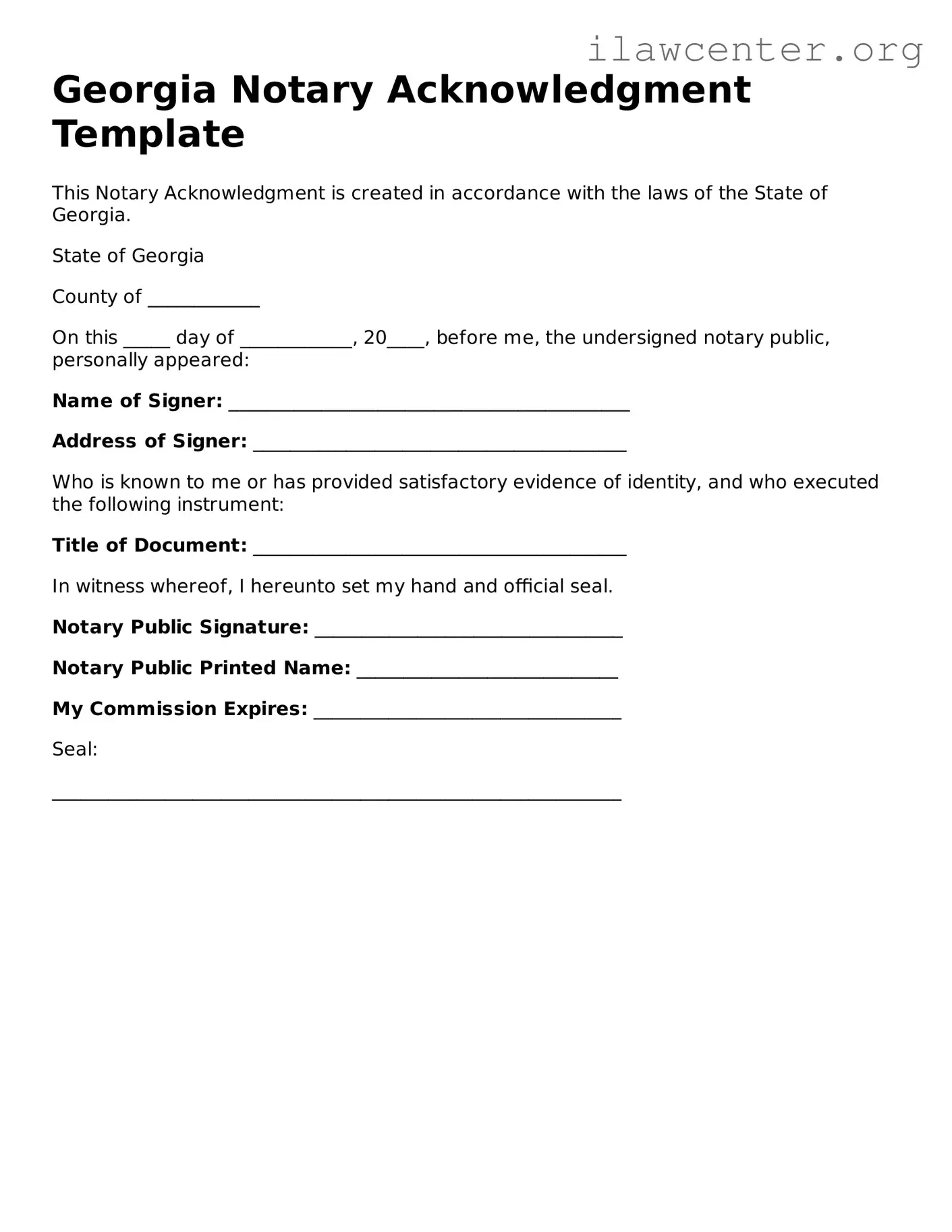
Georgia Notary Acknowledgment Template

This Notary Acknowledgment is created in accordance with the laws of the State of Georgia.

State of Georgia

County of ____________

On this _____ day of ____________, 20____, before me, the undersigned notary public, personally appeared:

Name of Signer: ___________________________________________

Address of Signer: ________________________________________

Who is known to me or has provided satisfactory evidence of identity, and who executed the following instrument:

Title of Document: ________________________________________

In witness whereof, I hereunto set my hand and official seal.

Notary Public Signature: _________________________________

Notary Public Printed Name: ____________________________

My Commission Expires: _________________________________

Seal:

_____________________________________________________________

PDF Form Characteristics

Fact Name Details
Purpose The Georgia Notary Acknowledgement form is used to verify the identity of the signer and confirm their willingness to sign a document.
Governing Law The form is governed by the Official Code of Georgia Annotated (O.C.G.A.) § 45-17-1 et seq.
Signature Requirement The signer must appear in person before the notary public to sign the form.
Identification Acceptable forms of identification include a driver's license, passport, or any government-issued ID.
Notary Seal The notary must affix their official seal to the form, which includes their name and commission details.
Record Keeping Notaries are required to keep a record of all acknowledgments in their notary journal.
Expiration The notary's commission is valid for four years in Georgia, after which it must be renewed.
Legal Use This form is commonly used in real estate transactions, power of attorney documents, and other legal agreements.

Instructions on Utilizing Georgia Notary Acknowledgement

After you have gathered the necessary information and documents, you are ready to fill out the Georgia Notary Acknowledgement form. This form is essential for certifying that a signature is genuine and that the signer appeared before the notary. Follow these steps carefully to ensure accuracy.

  1. Begin by locating the section titled "State of Georgia." This is typically at the top of the form.
  2. Fill in the name of the county where the notarization will take place.
  3. Next, enter the date of the notarization. This is usually the date you are completing the form.
  4. In the space provided, write the name of the person who is signing the document. Ensure that the name matches the identification they will present.
  5. Indicate the type of identification the signer is providing. This could be a driver's license, passport, or other government-issued ID.
  6. In the next section, the notary will sign their name. This should be done in the presence of the signer.
  7. After signing, the notary must fill in their official title, typically "Notary Public," followed by the state of appointment.
  8. Finally, the notary should add their commission expiration date. This is important for the validity of the notarization.

Once the form is completed, it should be retained with the document being notarized. Ensure that all information is accurate to avoid any issues in the future.

Important Facts about Georgia Notary Acknowledgement

What is a Georgia Notary Acknowledgement form?

The Georgia Notary Acknowledgement form is a legal document used to verify the identity of a signer and confirm that they have willingly signed a document. This form is typically used in conjunction with various legal documents, such as contracts or deeds, to provide assurance that the signer is who they claim to be and that they understand the contents of the document they are signing.

Who can act as a notary in Georgia?

In Georgia, a notary public is an individual authorized by the state to perform notarial acts. To become a notary, one must be at least 18 years old, a resident of Georgia, and have no felony convictions. After meeting these criteria, an application must be submitted to the county probate court, along with a fee. Once approved, the notary receives a commission and can begin performing notarial duties.

What information is required on the Notary Acknowledgement form?

The Notary Acknowledgement form typically requires several pieces of information. This includes the name and signature of the person signing the document, the date of the acknowledgment, and the notary's signature and seal. Additionally, the form may ask for the type of identification the signer provided to the notary, which helps confirm their identity.

How do I complete a Notary Acknowledgement form?

To complete a Notary Acknowledgement form, the signer must first appear before the notary. The notary will then ask the signer to provide a valid form of identification. After verifying the identity, the notary will fill out the form, including details such as the date and the signer's name. The signer will then sign the document in the presence of the notary, who will complete the acknowledgment by signing and affixing their seal.

Is a Notary Acknowledgement form necessary for all documents?

No, a Notary Acknowledgement form is not required for every document. However, many legal documents benefit from having a notary acknowledgment to ensure their validity. It's especially important for documents that may be recorded with the county, such as deeds or powers of attorney. Always check the specific requirements for the type of document you are dealing with to determine if a notary acknowledgment is necessary.

Common mistakes

Filling out the Georgia Notary Acknowledgment form can seem straightforward, but many people make common mistakes that can lead to delays or rejections. One frequent error is failing to include the correct date. The date should reflect when the acknowledgment takes place, and omitting or incorrectly entering it can create confusion.

Another mistake is not providing the signer’s name clearly. The name must match the identification presented to the notary. If there is a discrepancy, the acknowledgment may be deemed invalid. Additionally, some individuals neglect to include the appropriate title or capacity of the signer, which is essential for clarity.

People often forget to sign the form themselves. While the notary’s signature is crucial, the signer must also provide their signature to complete the acknowledgment. Skipping this step can lead to the document being rejected.

Inaccurate information about the notary can also be a problem. This includes failing to include the notary’s commission number or expiration date. Both pieces of information are necessary to verify the notary's authority and ensure the acknowledgment is valid.

Another common oversight is using the wrong format for the notary seal. The seal must be clear and legible. If it’s smudged or unclear, it can raise questions about the authenticity of the acknowledgment.

Some people mistakenly use an outdated version of the form. Always ensure you are using the most current version of the Georgia Notary Acknowledgment form to avoid issues. Additionally, forgetting to check the form for completeness before submission can lead to unnecessary complications.

Another frequent error is failing to include the proper venue. The venue should indicate where the acknowledgment took place. Omitting this detail can create confusion about jurisdiction and authority.

People sometimes overlook the importance of using black or blue ink. Using other colors can make the document difficult to read or reproduce, which may cause issues later on.

Lastly, not reviewing the entire document before submission can result in multiple errors. Taking a moment to double-check all entries can save time and prevent rejections.

Documents used along the form

When working with the Georgia Notary Acknowledgement form, you may encounter several other documents that are commonly used in conjunction with it. Each of these forms serves a specific purpose and can help streamline your legal processes. Below is a list of these documents, along with a brief description of each.

  • This document allows one person to authorize another to act on their behalf in legal or financial matters. It is often used when someone is unable to be present for a transaction.
  • A living will outlines an individual’s preferences for medical treatment in case they become unable to communicate their wishes. It is crucial for ensuring that a person’s healthcare decisions are respected.
  • A will is a legal document that specifies how a person's assets should be distributed after their death. It can also name guardians for minor children, making it an essential part of estate planning.
  • A deed is a legal document that transfers ownership of real property from one party to another. It often requires notarization to ensure its validity.
  • An affidavit is a written statement confirmed by oath or affirmation, used as evidence in court. Notarization is often required to verify the identity of the person making the statement.
  • A contract is a legally binding agreement between two or more parties. Notarization may be necessary to provide additional assurance of authenticity and to prevent disputes.
  • A bill of sale documents the transfer of ownership of personal property from one person to another. It is often used in transactions involving vehicles or equipment.

Understanding these documents can help you navigate legal processes more effectively. Each form plays a vital role in ensuring that your rights and wishes are protected. When preparing these documents, always consider seeking assistance to ensure they meet all legal requirements.

Similar forms

A Notary Acknowledgement form serves a specific purpose in verifying the identity of a signer and the authenticity of their signature. However, several other documents share similar functions. Below are ten documents that resemble the Notary Acknowledgement form in various ways:

  • Affidavit: This is a written statement confirmed by oath or affirmation, often used in legal proceedings. Like a Notary Acknowledgement, it requires a notary's verification of the signer's identity.
  • Power of Attorney: This document allows one person to act on behalf of another. It often requires notarization to ensure the authority of the person granting the power.
  • Deed: A deed is a legal document that transfers ownership of property. Notarization is typically required to validate the transaction and protect against fraud.
  • Mortgage Agreement: This document outlines the terms of a loan secured by real property. Notaries often verify the signatures to ensure all parties understand their obligations.
  • Last Will and Testament: A will outlines how a person's assets should be distributed after their death. Notarization can help confirm the testator's identity and intentions.
  • Release of Liability: This document releases one party from legal claims. Notarization adds a layer of authenticity to the agreement, protecting all parties involved.
  • Certification of Trust: This document verifies the existence of a trust and the authority of the trustee. Notarization helps prevent disputes regarding the trust's validity.
  • Consent Forms: These forms are used to obtain permission for various actions, such as medical procedures. Notarization can help ensure that consent was given freely and knowingly.
  • Business Contracts: Contracts between parties often require notarization to enhance their enforceability and provide a clear record of the agreement.
  • Lease Agreements: This document outlines the terms of renting property. Notarization can help confirm that both parties understand and agree to the terms set forth.

Each of these documents serves a unique purpose but shares the common goal of ensuring authenticity and protecting the interests of all parties involved.

Dos and Don'ts

When filling out the Georgia Notary Acknowledgement form, it is important to follow certain guidelines to ensure accuracy and compliance. Here is a list of things you should and shouldn't do:

  • Do ensure that the signer is present during the acknowledgment.
  • Do verify the identity of the signer with a valid form of identification.
  • Do complete all required fields on the form accurately.
  • Do sign and date the form as the notary.
  • Don't use the form if the signer is not present.
  • Don't alter any information on the form after it has been signed.
  • Don't forget to keep a record of the notarial act in your journal.

Following these guidelines will help ensure that the notarial process is conducted properly and legally.

Misconceptions

Here are nine common misconceptions about the Georgia Notary Acknowledgement form:

  1. All documents need a notary acknowledgement. Not every document requires a notary acknowledgement. Only certain legal documents, such as deeds and powers of attorney, typically need this form to be valid.

  2. A notary can notarize any document. Notaries in Georgia are limited to notarizing documents that comply with state laws. They cannot notarize documents that are illegal or outside their authority.

  3. Notaries must know the signer personally. While personal knowledge can help, it is not a requirement. Notaries can use identification to verify the signer's identity.

  4. Notarization guarantees the legality of a document. A notary does not verify the content of a document. They only confirm the identity of the signer and witness the signing process.

  5. Notaries can give legal advice. Notaries are not allowed to provide legal advice or interpret the law. Their role is strictly to witness signatures and administer oaths.

  6. Notaries can refuse to notarize at any time. While notaries have discretion, they must have a valid reason to refuse. Common reasons include lack of proper identification or suspicion of fraud.

  7. A notary can charge any fee they want. Georgia law sets limits on the fees a notary can charge for their services. It is important to know these limits to avoid overcharging.

  8. Notary acknowledgements are the same in every state. Each state has its own rules and formats for notary acknowledgements. It is crucial to use the correct form for Georgia.

  9. Once notarized, a document cannot be changed. A notarization does not prevent changes to the document. However, any changes after notarization may require a new notarization.

Key takeaways

When filling out and using the Georgia Notary Acknowledgement form, it’s important to keep several key points in mind. Here are ten takeaways to ensure proper use:

  1. Understand the Purpose: The form serves to verify the identity of the signer and confirm that they willingly signed the document.
  2. Use the Correct Form: Make sure you are using the most recent version of the Georgia Notary Acknowledgement form.
  3. Complete All Required Fields: Fill in all necessary information, including the name of the signer and the date of the acknowledgment.
  4. Identify the Signer: The signer must be present during the acknowledgment process. Verify their identity with a valid ID.
  5. Include the Notary's Information: Provide your name, commission number, and the county where you are commissioned.
  6. Sign and Seal: After completing the form, sign it and apply your notary seal to validate the acknowledgment.
  7. Do Not Pre-Sign: Never sign the form before the signer is present. This can lead to legal issues.
  8. Keep Records: Maintain a record of all notarizations for your own accountability and legal compliance.
  9. Follow State Laws: Familiarize yourself with Georgia’s notary laws to ensure you are compliant with all regulations.
  10. Review Before Submission: Always double-check the completed form for accuracy before it is submitted with the associated document.

By adhering to these guidelines, you can ensure that your use of the Georgia Notary Acknowledgement form is effective and legally sound.