


Georgia Notice PDF Template

Georgia Notice PDF Template

The Georgia Notice form is a legal document that serves as a formal notification of the commencement of construction on a property. This form is essential for ensuring that all parties involved in the project are informed and that proper legal procedures are followed. To complete your project smoothly, fill out the form by clicking the button below.

Article Guide

In the realm of construction and real estate in Georgia, the Notice of Commencement serves as a crucial document that marks the beginning of a project. This form is not merely a formality; it is a legal declaration that provides essential information about the construction endeavor. It includes details such as the names and addresses of the owner, contractor, and any agents involved, ensuring transparency and clarity among all parties. Additionally, the Notice outlines the specific location of the project and the legal description of the property, which helps in identifying the exact site of the improvements. Another important aspect is the requirement for the contractor to file this notice within fifteen days after physically commencing work, thereby establishing a timeline that protects the rights of those involved. Furthermore, the document mandates that a copy be provided to any subcontractors or material suppliers upon request, reinforcing the collaborative nature of construction projects. By understanding the nuances of the Georgia Notice of Commencement, stakeholders can navigate the complexities of construction law with greater confidence and assurance.

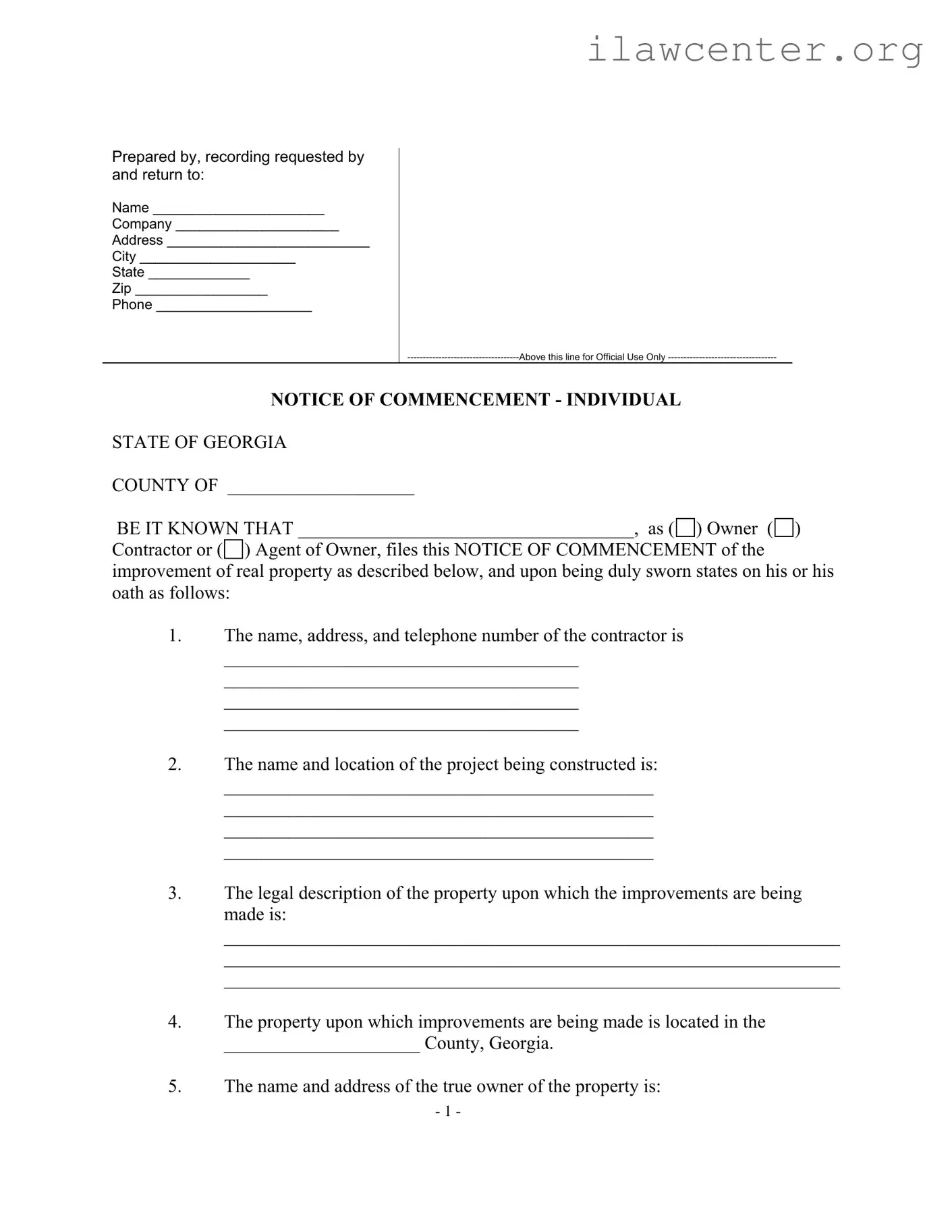
Georgia Notice Preview

- 1 -
Prepared by, recording requested by
and return to:
Name ______________________
Company _____________________
Address __________________________
City ____________________
State _____________
Zip _________________
Phone ____________________
------------------------------------Above this line for Official Use Only -----------------------------------
NOTICE OF COMMENCEMENT - INDIVIDUAL
STATE OF GEORGIA
COUNTY OF ____________________
BE IT KNOWN THAT ____________________________________, as ( ) Owner ( )
Contractor or ( ) Agent of Owner, files this NOTICE OF COMMENCEMENT of the
improvement of real property as described below, and upon being duly sworn states on his or his
oath as follows:
1. The name, address, and telephone number of the contractor is
______________________________________
______________________________________
______________________________________
______________________________________
2. The name and location of the project being constructed is:
______________________________________________
______________________________________________
______________________________________________
______________________________________________
3. The legal description of the property upon which the improvements are being
made is:
__________________________________________________________________
__________________________________________________________________
__________________________________________________________________
4. The property upon which improvements are being made is located in the
_____________________ County, Georgia.
5. The name and address of the true owner of the property is:
- 2 -
__________________________________________________________________
__________________________________________________________________
_________________________________________________________________.
6. The name and address of the person other than the owner at whose instance the
improvements are being made, if not the true owner of the property is:
_________________________________________________________________.
7. The name and the address of the surety for the performance and payment bonds, if
any are:
__________________________________________________________________
__________________________________________________________________
8. The name and address of the construction lender, if any, is:
__________________________________________________________________
_________________________________________________________________.
9. This Notice is filed within fifteen 15 days after the contractor physically
commenced work on the property.
WITNESS my signature on this the _____ day of ____________________, 20_____.
____________________________________
Signature
Print Name: _________________________
Sworn to and executed
in the presence of:
__________________________
Witness
Sworn to (or affirmed) and subscribed before me this ____ day of __________ (month),
__________ (year), by _______________________ (name of person making statement).
_______ Personally Known
_______ Produced Identification
Type and # of ID __________________________
____________________________
(Signature of Notary)
- 3 -
(Seal) _____________________________
(Name of Notary Typed, Stamped or Printed)
Notary Public, State of Georgia
My Commission Expires: ______________
Reference
44-14-361.5.
Notes:
The contractor shall be required to give a copy of the Notice of Commencement to any subcontractor, materialman,
or person who makes a written request of the contractor. Failure to give a copy of the Notice of Commencement
within ten calendar days of receipt of the written request from the subcontractor, materialman, or person shall
render the provision of this Code section inapplicable to the subcontractor, materialman, or person making the
request.

File Properties

Fact Name Details
Governing Law The Georgia Notice form is governed by Georgia Code § 44-14-361.5.
Purpose This form serves to officially notify that construction has commenced on a property.
Filing Deadline The Notice must be filed within 15 days after work begins on the property.
Required Information It requires details such as the contractor's information, project location, and property description.
Owner's Responsibility The contractor must provide a copy of the Notice to any subcontractor or materialman upon request.
Consequences of Non-Compliance Failure to provide the Notice within ten days of a request may affect the rights of subcontractors and materialmen.
Notary Requirement The form must be sworn and executed in the presence of a notary public.

Instructions on Utilizing Georgia Notice

After completing the Georgia Notice form, it will be necessary to submit it to the appropriate county office. Ensure that all required information is accurate and complete to avoid any delays in processing.

  1. Begin by filling in the "Prepared by, recording requested by and return to" section. Include your name, company name, address, city, state, zip code, and phone number.
  2. In the "NOTICE OF COMMENCEMENT" section, indicate your role by checking the appropriate box: Owner, Contractor, or Agent of Owner.
  3. Provide the name, address, and telephone number of the contractor in the designated space.
  4. State the name and location of the project being constructed.
  5. Enter the legal description of the property where improvements are being made.
  6. Specify the county in Georgia where the property is located.
  7. List the name and address of the true owner of the property.
  8. If applicable, provide the name and address of the person requesting the improvements who is not the true owner.
  9. Include the name and address of the surety for any performance and payment bonds.
  10. Provide the name and address of the construction lender, if applicable.
  11. Sign and date the form, ensuring that it is done within fifteen days after the contractor has physically commenced work.
  12. Have a witness sign the form.
  13. Complete the notary section, including the notary's signature, printed name, and commission expiration date.

Important Facts about Georgia Notice

What is the purpose of the Georgia Notice form?

The Georgia Notice form serves as a formal notification that construction work is beginning on a property. It is essential for establishing a public record of the project and provides important information about the contractor, the property owner, and the nature of the improvements. Filing this notice helps protect the rights of contractors and subcontractors by ensuring they can claim payment for their work if necessary.

Who is required to file the Notice of Commencement?

The Notice of Commencement must be filed by the owner, contractor, or an authorized agent of the owner. This form is typically completed shortly after construction begins, specifically within fifteen days of the physical commencement of work on the property. It is crucial that the correct party files the notice to ensure compliance with Georgia law.

What information must be included in the Notice of Commencement?

The form requires several key pieces of information. This includes the name, address, and phone number of the contractor, as well as the project's name and location. A legal description of the property is also necessary, along with details about the true owner and any other parties involved, such as the construction lender or surety. All of this information helps clarify who is responsible for the project and who should be contacted regarding payments or disputes.

What happens if the Notice of Commencement is not filed?

If the Notice of Commencement is not filed, it may jeopardize the rights of contractors and subcontractors to receive payment for their work. Additionally, failure to provide a copy of the notice to any requesting subcontractor or materialman within ten days can result in the provisions of the law not applying to those individuals. This means they could lose their right to file a lien against the property for unpaid work.

How can I obtain a copy of the Notice of Commencement?

Common mistakes

Filling out the Georgia Notice form can be straightforward, but there are common mistakes that individuals often make. One significant error is failing to provide complete information in the "Prepared by, recording requested by and return to" section. Omitting details like the name, company, or address can lead to delays in processing and potential legal complications.

Another mistake is not accurately identifying the role of the filer. The form requires the individual to specify if they are the owner, contractor, or agent of the owner. Misidentifying this role can cause confusion regarding responsibilities and obligations related to the project.

Additionally, many people neglect to include the legal description of the property. This section is crucial as it provides specific details about the location of the improvements. Incomplete or vague descriptions can result in disputes or challenges regarding the property in question.

Another common error involves the timeline for filing the notice. The form must be submitted within fifteen days of the contractor physically commencing work. Failing to adhere to this timeline can jeopardize the rights of the contractor and affect lien rights.

People also often forget to include the name and address of the true owner of the property. This information is essential for establishing ownership and ensuring that all parties involved are accurately represented. Missing this detail can complicate matters if disputes arise later.

Finally, individuals frequently overlook the need for notarization. The signature must be sworn to and executed in the presence of a notary public. Skipping this step can render the notice invalid, leading to further complications down the line.

Documents used along the form

When dealing with construction projects in Georgia, several important documents accompany the Georgia Notice form. Each of these forms serves a specific purpose in the construction process, ensuring that all parties are informed and protected. Below is a list of commonly used documents.

  • Notice of Intent to Lien: This document informs the property owner that a contractor or supplier intends to file a lien against the property if payment is not received. It serves as a warning and can prompt timely payment.
  • Construction Contract: This is the agreement between the property owner and the contractor. It outlines the scope of work, payment terms, and other essential details regarding the project.
  • Change Order: A change order is used to document any modifications to the original construction contract. It may involve changes in the scope of work, costs, or project timeline.
  • Subcontractor Agreement: This agreement outlines the relationship between the general contractor and subcontractors. It specifies the work to be performed, payment terms, and responsibilities of each party.
  • Payment Application: This document is submitted by the contractor to request payment for work completed. It typically includes a breakdown of costs and the percentage of work completed.
  • Final Waiver of Lien: This document is signed by contractors and subcontractors upon receiving final payment. It waives their right to file a lien against the property for the work performed.
  • Certificate of Occupancy: Issued by the local government, this certificate confirms that a building is safe to occupy and complies with all applicable building codes and regulations.
  • As-Built Drawings: These are updated drawings that reflect any changes made during the construction process. They serve as a record of the project as it was actually built.

Understanding these documents is crucial for anyone involved in construction projects in Georgia. Each form plays a vital role in ensuring transparency, accountability, and compliance throughout the construction process.

Similar forms

The Georgia Notice form serves a specific purpose in the construction process, but it shares similarities with several other important documents. Each of these documents plays a role in ensuring transparency and protecting the rights of parties involved in real estate transactions and construction projects. Below is a list of documents that are similar to the Georgia Notice form, along with a brief explanation of each.

  • Notice of Intent to Lien: This document is filed by a contractor or subcontractor to inform the property owner of their intention to file a lien if payment is not received. Like the Georgia Notice form, it serves to notify parties of ongoing construction and potential financial claims.
  • Mechanic's Lien: A mechanic's lien is a legal claim against a property for unpaid work or materials. It requires formal notice to be given to property owners, similar to the notification process outlined in the Georgia Notice form.
  • Construction Contract: This is a formal agreement between the property owner and the contractor detailing the scope of work, payment terms, and timelines. Both the construction contract and the Georgia Notice form establish clear expectations and responsibilities for the parties involved.
  • Change Order: A change order is a document that modifies the original construction contract. It outlines changes in scope, cost, or timeline, ensuring that all parties are aware of adjustments. This is akin to the Georgia Notice form in that it keeps stakeholders informed about the project's progression.
  • Subcontractor Agreement: This agreement is between a contractor and a subcontractor, detailing the work to be performed and payment terms. Like the Georgia Notice form, it formalizes relationships and expectations among various parties in a construction project.
  • Certificate of Occupancy: This document is issued by a local government agency to confirm that a building is safe for occupancy. It is similar to the Georgia Notice form in that it signifies the completion of construction and compliance with local regulations.
  • Warranty Deed: A warranty deed transfers ownership of property from one party to another and guarantees that the title is clear of any claims. While it serves a different purpose, both the warranty deed and the Georgia Notice form are critical in the context of real estate transactions, ensuring that parties are aware of ownership and property rights.

Dos and Don'ts

When filling out the Georgia Notice form, it's important to follow certain guidelines to ensure accuracy and compliance. Here’s a list of things to do and avoid:

  • Do provide complete and accurate information for all fields, including names, addresses, and phone numbers.
  • Do ensure that the form is signed and dated in the appropriate places.
  • Do file the Notice within 15 days after the contractor begins work on the property.
  • Do keep a copy of the Notice for your records and provide it to any subcontractor or materialman who requests it.
  • Don't leave any fields blank; incomplete forms can lead to delays or legal issues.
  • Don't forget to check that the legal description of the property is accurate and detailed.
  • Don't submit the form without verifying all information is correct, as errors can complicate matters later.
  • Don't overlook the requirement to provide a copy of the Notice to anyone who requests it within ten calendar days.

Misconceptions

Understanding the Georgia Notice form is crucial for property owners, contractors, and agents involved in construction projects. However, several misconceptions can lead to confusion and potential legal issues. Here are eight common misconceptions:

  • Misconception 1: The Notice of Commencement is optional.
  • In Georgia, filing a Notice of Commencement is not optional. It is a legal requirement that must be completed within 15 days after the contractor begins work on the property.

  • Misconception 2: Only the property owner can file the Notice.
  • While the property owner typically files the Notice, contractors or agents can also file it on behalf of the owner. This flexibility ensures that the process is streamlined.

  • Misconception 3: The Notice of Commencement is the same as a building permit.
  • The Notice of Commencement is not a building permit. It serves a different purpose, primarily to notify interested parties of the commencement of construction, while a building permit is required to legally begin construction.

  • Misconception 4: Filing the Notice guarantees payment to contractors.
  • Filing a Notice of Commencement does not guarantee payment. It is essential for contractors to ensure they have proper contracts and agreements in place to secure payment for their work.

  • Misconception 5: The Notice must be filed before any work begins.
  • The Notice of Commencement must be filed within 15 days after work has commenced, not before. This timeframe is crucial to comply with Georgia law.

  • Misconception 6: There are no penalties for failing to file the Notice.
  • Failure to file the Notice of Commencement can lead to significant consequences, including the inability of subcontractors or material suppliers to claim liens against the property.

  • Misconception 7: The Notice is only for large construction projects.
  • The Notice of Commencement applies to all construction projects, regardless of size. It is important for both small and large projects to follow the same legal requirements.

  • Misconception 8: The Notice is a one-time requirement.
  • If there are multiple phases of construction or changes in contractors, additional Notices may be required. Each phase or change should be properly documented to maintain compliance.

Being aware of these misconceptions can help individuals navigate the complexities of construction law in Georgia more effectively. Properly understanding and utilizing the Georgia Notice form is essential for protecting the rights and interests of all parties involved in a construction project.

Key takeaways

Filling out the Georgia Notice form is a crucial step in the construction process. Here are some key takeaways to keep in mind:

  • The form must be filled out by the owner, contractor, or agent of the owner.
  • Include the name, address, and phone number of the contractor in the designated section.
  • Clearly state the name and location of the project being constructed.
  • Provide a legal description of the property where improvements will occur.
  • Identify the county in Georgia where the property is located.
  • List the true owner’s name and address accurately.
  • If applicable, include information about the person requesting the improvements who is not the true owner.
  • Detail the surety for any performance and payment bonds, if they exist.
  • Ensure that the Notice is filed within 15 days after the contractor begins work on the property.

Remember, it’s important to provide a copy of the Notice of Commencement to any subcontractor or materialman who requests it. Failing to do so within ten days can affect their rights under the law.