Attorney-Verified  Operating Agreement Document for Georgia

Attorney-Verified Operating Agreement Document for Georgia

The Georgia Operating Agreement form is a crucial document that outlines the management structure and operating procedures of a limited liability company (LLC) in Georgia. This agreement serves to define the roles and responsibilities of the members, ensuring clarity and cohesion within the business. To get started on your LLC, consider filling out the form by clicking the button below.

Article Guide

The Georgia Operating Agreement form is a crucial document for any limited liability company (LLC) operating in the state. This form outlines the internal workings of the LLC, detailing how the business will be managed and the responsibilities of its members. It addresses key aspects such as ownership percentages, profit distribution, and decision-making processes. By clearly defining the roles and expectations of each member, the agreement helps prevent misunderstandings and disputes down the line. Additionally, it can include provisions for adding new members, handling member exits, and resolving conflicts. Having a well-crafted Operating Agreement is not just a good practice; it’s essential for ensuring that your LLC runs smoothly and in accordance with Georgia law. Whether you are starting a new business or revising an existing agreement, understanding this form is vital for your LLC's success.

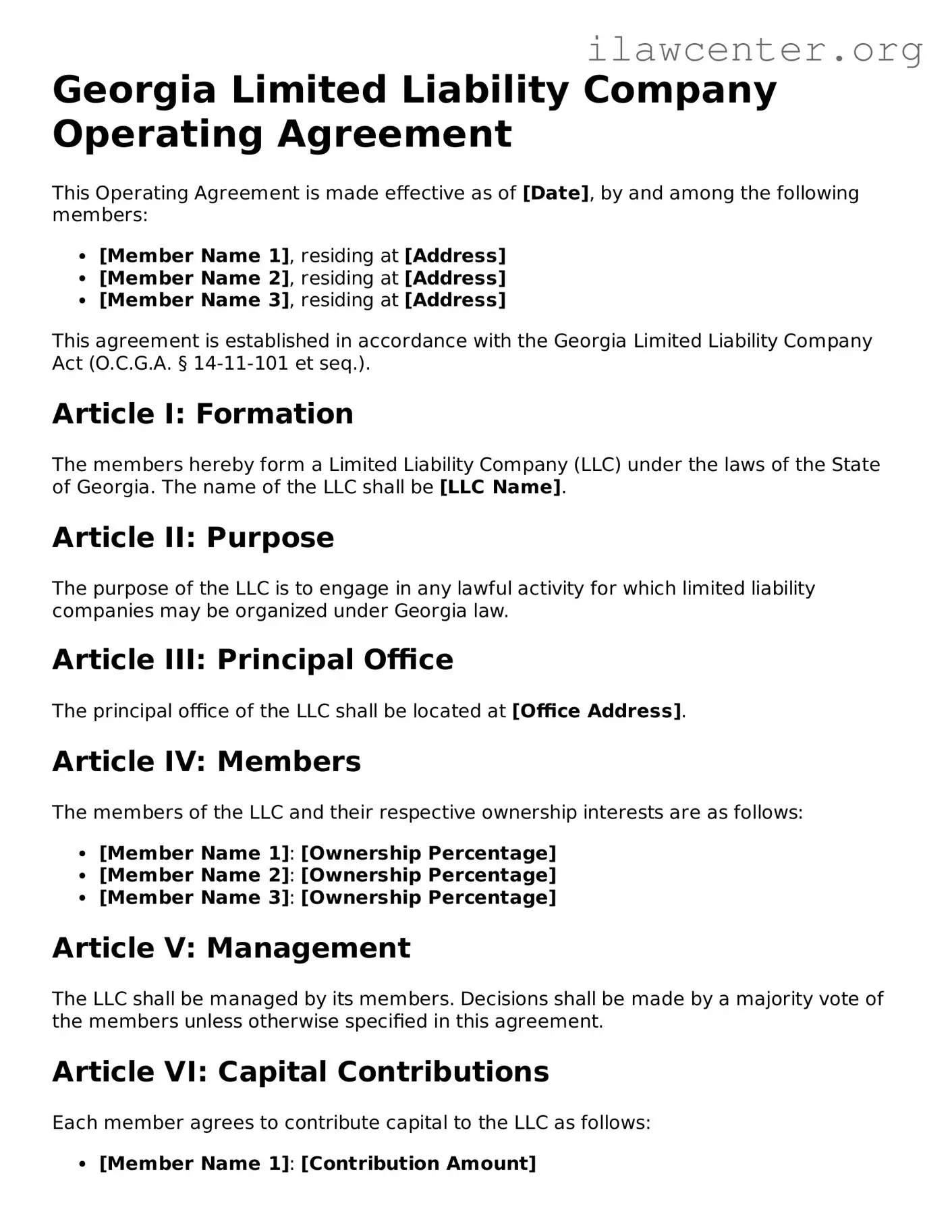
Georgia Operating Agreement Preview

Georgia Limited Liability Company Operating Agreement

This Operating Agreement is made effective as of [Date], by and among the following members:

  • [Member Name 1], residing at [Address]
  • [Member Name 2], residing at [Address]
  • [Member Name 3], residing at [Address]

This agreement is established in accordance with the Georgia Limited Liability Company Act (O.C.G.A. § 14-11-101 et seq.).

Article I: Formation

The members hereby form a Limited Liability Company (LLC) under the laws of the State of Georgia. The name of the LLC shall be [LLC Name].

Article II: Purpose

The purpose of the LLC is to engage in any lawful activity for which limited liability companies may be organized under Georgia law.

Article III: Principal Office

The principal office of the LLC shall be located at [Office Address].

Article IV: Members

The members of the LLC and their respective ownership interests are as follows:

  • [Member Name 1]: [Ownership Percentage]
  • [Member Name 2]: [Ownership Percentage]
  • [Member Name 3]: [Ownership Percentage]

Article V: Management

The LLC shall be managed by its members. Decisions shall be made by a majority vote of the members unless otherwise specified in this agreement.

Article VI: Capital Contributions

Each member agrees to contribute capital to the LLC as follows:

  • [Member Name 1]: [Contribution Amount]
  • [Member Name 2]: [Contribution Amount]
  • [Member Name 3]: [Contribution Amount]

Article VII: Distributions

Distributions of profits and losses shall be made to the members in proportion to their ownership interests as stated in Article IV.

Article VIII: Indemnification

The LLC shall indemnify any member or manager for any losses or damages incurred while acting on behalf of the LLC, except in cases of willful misconduct or gross negligence.

Article IX: Amendments

This Operating Agreement may be amended only by a written agreement signed by all members.

Article X: Governing Law

This Agreement shall be governed by and construed in accordance with the laws of the State of Georgia.

IN WITNESS WHEREOF, the members have executed this Operating Agreement as of the date first above written.

  • _________________________ [Member Name 1]
  • _________________________ [Member Name 2]
  • _________________________ [Member Name 3]

PDF Form Characteristics

Fact Name Description
Purpose The Georgia Operating Agreement outlines the management structure and operational procedures of a limited liability company (LLC).
Governing Law This agreement is governed by the Georgia Limited Liability Company Act, found in Title 14, Chapter 11 of the Official Code of Georgia Annotated.
Members All members of the LLC must agree to the terms of the Operating Agreement for it to be valid.
Flexibility The agreement allows for flexibility in management, enabling members to designate specific roles and responsibilities.
Dispute Resolution It often includes provisions for resolving disputes among members, which can help prevent costly litigation.
Amendments Members can amend the agreement, but typically, a majority vote is required to make changes.
Liability Protection The Operating Agreement helps reinforce the limited liability protection that LLC members enjoy under Georgia law.
Not Required by Law While it is not legally required to have an Operating Agreement in Georgia, it is highly recommended for clarity and protection.

Instructions on Utilizing Georgia Operating Agreement

After obtaining the Georgia Operating Agreement form, you will need to provide specific information about your business and its members. Carefully follow the steps below to complete the form accurately.

  1. Begin by entering the name of your LLC at the top of the form.
  2. Next, fill in the principal office address of the LLC.
  3. List the names and addresses of all members involved in the LLC.
  4. Specify the purpose of the LLC in a clear and concise manner.
  5. Indicate the management structure by selecting either member-managed or manager-managed.
  6. Detail the voting rights of each member, including how decisions will be made.
  7. Outline the distribution of profits and losses among members.
  8. Include provisions for adding or removing members if necessary.
  9. Sign and date the document at the bottom. Ensure all members also sign if required.

Once you have completed the form, review it for accuracy. After verification, proceed to file the agreement with the appropriate state office, if necessary.

Important Facts about Georgia Operating Agreement

What is an Operating Agreement in Georgia?

An Operating Agreement is a legal document that outlines the management structure and operating procedures of a limited liability company (LLC) in Georgia. It serves as an internal guideline for the members of the LLC, detailing how decisions are made, how profits and losses are distributed, and how the company will be managed. While Georgia does not require an Operating Agreement by law, having one is highly recommended to ensure clarity and prevent disputes among members.

Who should create an Operating Agreement?

All members of an LLC should participate in creating the Operating Agreement. This includes both single-member and multi-member LLCs. Even if you are the sole owner, having an Operating Agreement helps establish your business as a separate legal entity and can protect your personal assets. In multi-member situations, it is essential for all parties to agree on the terms to foster cooperation and minimize conflicts.

What should be included in the Operating Agreement?

An effective Operating Agreement should cover several key areas. These include the company’s name and principal address, the purpose of the LLC, the duration of the company, member contributions, profit and loss distribution, management structure, voting rights, and procedures for adding or removing members. Additionally, it should outline how disputes will be resolved and the process for dissolving the LLC if necessary.

Is the Operating Agreement a public document?

No, the Operating Agreement is not filed with the state and is not a public document. It is an internal document that remains with the members of the LLC. This privacy can be beneficial, as it allows members to keep their business operations and agreements confidential. However, it is important to keep the document secure and accessible to all members.

Can the Operating Agreement be amended?

Yes, the Operating Agreement can be amended. Members can make changes to the agreement as needed, but it is essential to follow the amendment procedures outlined in the document itself. Typically, amendments require a vote from the members, and it is advisable to document any changes in writing to maintain clarity and avoid future disputes.

What happens if there is no Operating Agreement?

If an LLC in Georgia does not have an Operating Agreement, the default rules provided by state law will apply. This can lead to unexpected outcomes regarding management and profit distribution. In the absence of an agreement, members may find themselves in disputes over how the business should be run, which could negatively impact operations and relationships among members.

How can I create an Operating Agreement?

Creating an Operating Agreement can be done using templates available online or by consulting with a legal professional. It is crucial to ensure that the document is tailored to your specific business needs and complies with Georgia laws. Once drafted, all members should review the document thoroughly before signing to confirm their understanding and agreement to the terms.

Is legal assistance necessary to draft an Operating Agreement?

While it is not legally required to have a lawyer draft your Operating Agreement, seeking legal assistance can be beneficial, especially for complex businesses or when there are multiple members involved. An attorney can help ensure that the agreement is comprehensive, legally sound, and tailored to the specific needs of the LLC, reducing the likelihood of disputes in the future.
Common mistakes

When filling out the Georgia Operating Agreement form, many individuals overlook critical details that can lead to complications down the line. One common mistake is failing to specify the management structure of the business. This section outlines who will make decisions and how they will be made. Without clarity, disputes may arise among members regarding authority and responsibilities.

Another frequent error involves neglecting to include the initial capital contributions of each member. This information is vital, as it establishes each member's investment in the business and can affect profit distribution. Omitting this detail can lead to misunderstandings and potential conflicts later on.

People often forget to address the process for adding new members. An Operating Agreement should outline how new members can join the business and the criteria for acceptance. Without this provision, the original members may find themselves in a difficult position if they want to expand their team.

Additionally, some individuals do not specify the voting rights of each member. Different members may have different levels of influence based on their contributions or roles. Clearly defining these rights can prevent future disagreements over decision-making processes.

Another mistake is not including a buy-sell agreement. This provision is crucial in situations where a member wants to leave the business or passes away. Having a clear plan in place ensures a smooth transition and protects the interests of remaining members.

Inadequate attention to the dissolution process is also a common oversight. The Operating Agreement should detail how the business will be dissolved if necessary. Without this information, members may face confusion and conflict when trying to close the business.

Some individuals also fail to update the Operating Agreement as the business evolves. Changes in membership, management structure, or business goals should prompt a review and possible revision of the agreement. Sticking to an outdated version can lead to significant issues.

Lastly, many people neglect to consult legal professionals when drafting their Operating Agreement. While it may seem straightforward, having expert guidance can help ensure that all necessary elements are included and that the agreement complies with Georgia laws. This step can save time and resources in the long run.

Documents used along the form

When establishing a business in Georgia, an Operating Agreement is a crucial document for LLCs. However, it is often accompanied by other important forms and documents that help solidify the structure and operations of the business. Here’s a list of some of those documents that you might find useful.

  • Articles of Organization: This is the foundational document that you file with the state to officially create your LLC. It includes basic information such as the LLC's name, address, and registered agent.
  • Employer Identification Number (EIN): Issued by the IRS, this number is essential for tax purposes. It allows your LLC to open a bank account, hire employees, and file tax returns.
  • Bylaws: While not required for LLCs, bylaws outline the internal governance of the business. They detail how decisions are made and the roles of members and managers.
  • Membership Certificates: These are formal documents that represent ownership in the LLC. They can be issued to members to signify their stake in the business.
  • Initial Capital Contributions Agreement: This document outlines the contributions made by each member at the formation of the LLC, detailing cash, property, or services provided.
  • Operating Procedures Manual: This manual serves as a guide for daily operations, outlining standard procedures, roles, and responsibilities within the LLC.
  • Member Buy-Sell Agreement: This agreement sets forth the terms under which a member can sell their interest in the LLC, protecting the interests of remaining members.
  • Annual Reports: Many states, including Georgia, require LLCs to file annual reports to maintain good standing. This document updates the state on any changes in the business structure or contact information.
  • Tax Election Forms: Depending on how you want your LLC to be taxed, you may need to file forms with the IRS to elect a specific tax classification, such as S-Corp status.

Each of these documents plays a vital role in the formation and operation of an LLC in Georgia. Ensuring that you have all necessary forms in place not only helps in compliance but also sets a solid foundation for your business's success.

Similar forms

The Operating Agreement is an important document for a business, especially for LLCs. It outlines the management structure, responsibilities, and financial arrangements among members. Here are nine documents that share similarities with the Operating Agreement:

  • Partnership Agreement: This document outlines the terms of a partnership, detailing each partner's roles, contributions, and profit-sharing arrangements, much like how an Operating Agreement defines member roles in an LLC.
  • Bylaws: Bylaws govern the internal management of a corporation. They specify how the corporation will operate, including meetings and voting procedures, similar to how an Operating Agreement does for an LLC.
  • Shareholder Agreement: This agreement is between shareholders of a corporation. It covers rights and obligations of shareholders, similar to how an Operating Agreement addresses the rights of LLC members.
  • Joint Venture Agreement: This document outlines the terms of a partnership between two or more parties for a specific project. It defines contributions and profit-sharing, akin to an Operating Agreement's focus on member contributions and distributions.
  • LLC Membership Certificate: While not a governing document, it serves as proof of membership in an LLC. It complements the Operating Agreement by formalizing ownership status.
  • Franchise Agreement: This document governs the relationship between a franchisor and franchisee. It outlines operational procedures and obligations, similar to how an Operating Agreement sets out the rules for LLC members.
  • Employment Agreement: This outlines the terms of employment for individuals within a company. It can specify roles and responsibilities, much like the roles defined in an Operating Agreement.
  • Non-Disclosure Agreement (NDA): While focused on confidentiality, an NDA can be part of a broader operating framework. It protects sensitive information, similar to how an Operating Agreement protects the interests of LLC members.
  • Operating Plan: This document outlines the operational strategy of a business. It may include details on management structure and financial goals, paralleling the management and financial aspects covered in an Operating Agreement.

Dos and Don'ts

When filling out the Georgia Operating Agreement form, it's important to be thorough and accurate. Here’s a list of things to do and avoid to ensure your agreement is effective and compliant.

  • Do: Read the entire form carefully before starting.
  • Do: Clearly define the roles and responsibilities of each member.
  • Do: Include provisions for profit and loss distribution.
  • Do: Specify the procedure for adding or removing members.
  • Do: Consider including a dispute resolution process.
  • Do: Review the completed agreement with all members before signing.
  • Do: Keep a copy of the signed agreement for your records.
  • Don't: Rush through the form without understanding each section.
  • Don't: Use vague language that could lead to misunderstandings.
  • Don't: Forget to date the agreement when signing.
  • Don't: Leave any required fields blank.
  • Don't: Ignore state-specific requirements that may apply.
  • Don't: Assume verbal agreements are sufficient; everything should be in writing.
  • Don't: Neglect to consult with a legal professional if unsure about any part.

Misconceptions

  • Misconception 1: An Operating Agreement is only necessary for large businesses.

    This is not true. Even small businesses, including single-member LLCs, benefit from having an Operating Agreement. It outlines the management structure and operational procedures, providing clarity and protection for all members.

  • Misconception 2: The Operating Agreement is a public document.

    In Georgia, the Operating Agreement is a private document. It does not need to be filed with the state, which means that the details remain confidential among the members of the LLC.

  • Misconception 3: The Operating Agreement is not legally binding.

    This is a common misunderstanding. Once the members sign the Operating Agreement, it becomes a legally binding contract. This means that the terms outlined in the agreement must be followed by all members.

  • Misconception 4: You can use a generic Operating Agreement template without modifications.

    While templates can be helpful, they often do not address the specific needs of your business. Customizing the Operating Agreement to reflect your unique circumstances is crucial for it to be effective.

  • Misconception 5: An Operating Agreement is only needed when the LLC is formed.

    Many believe that the Operating Agreement is a one-time document. However, it should be reviewed and updated regularly to reflect changes in the business, such as new members or shifts in management structure.

  • Misconception 6: The Operating Agreement does not impact tax obligations.

    This is incorrect. The Operating Agreement can influence how profits and losses are distributed among members, which can affect individual tax responsibilities. Understanding this connection is essential for compliance and financial planning.

Key takeaways

Filling out and using the Georgia Operating Agreement form is an important step for any business entity. Here are some key takeaways to keep in mind:

  1. Understand the Purpose: The Operating Agreement outlines the management structure and operating procedures of your business.
  2. Identify Members: Clearly list all members of the LLC and their respective ownership percentages.
  3. Define Roles: Specify the roles and responsibilities of each member to avoid confusion later.
  4. Establish Voting Rights: Determine how decisions will be made, including voting rights for each member.
  5. Address Profit Distribution: Outline how profits and losses will be shared among members.
  6. Include a Buyout Clause: Plan for the future by including terms for how a member can sell their interest in the LLC.
  7. Set Procedures for Amendments: Clearly state how changes to the Operating Agreement can be made.
  8. Compliance with State Law: Ensure that your agreement complies with Georgia state laws regarding LLCs.
  9. Consult a Professional: It may be wise to consult with a lawyer or accountant to ensure everything is in order.
  10. Keep it Accessible: Store the Operating Agreement in a safe place and ensure all members have access to it.

By keeping these points in mind, you can create a solid foundation for your business that will help it run smoothly.