Attorney-Verified  Power of Attorney for a Child Document for Georgia

Attorney-Verified Power of Attorney for a Child Document for Georgia

The Georgia Power of Attorney for a Child form is a legal document that allows a parent or guardian to grant another adult the authority to make decisions on behalf of their child. This can include matters related to education, healthcare, and general welfare. If you need to designate someone to care for your child temporarily, consider filling out this important form by clicking the button below.

Article Guide

The Georgia Power of Attorney for a Child form is a vital legal document that allows a parent or legal guardian to grant another individual the authority to make decisions on behalf of their child. This form is particularly useful in situations where the parent may be temporarily unavailable, such as during travel, medical emergencies, or extended absences. By designating a trusted individual, often referred to as an agent, parents can ensure that their child's needs are met without interruption. The document covers various responsibilities, including decisions related to education, healthcare, and general welfare. It is essential to include specific details, such as the duration of the power granted and any limitations on the agent's authority. By understanding the key components of this form, parents can better navigate the complexities of temporary guardianship and ensure their child's well-being is prioritized.

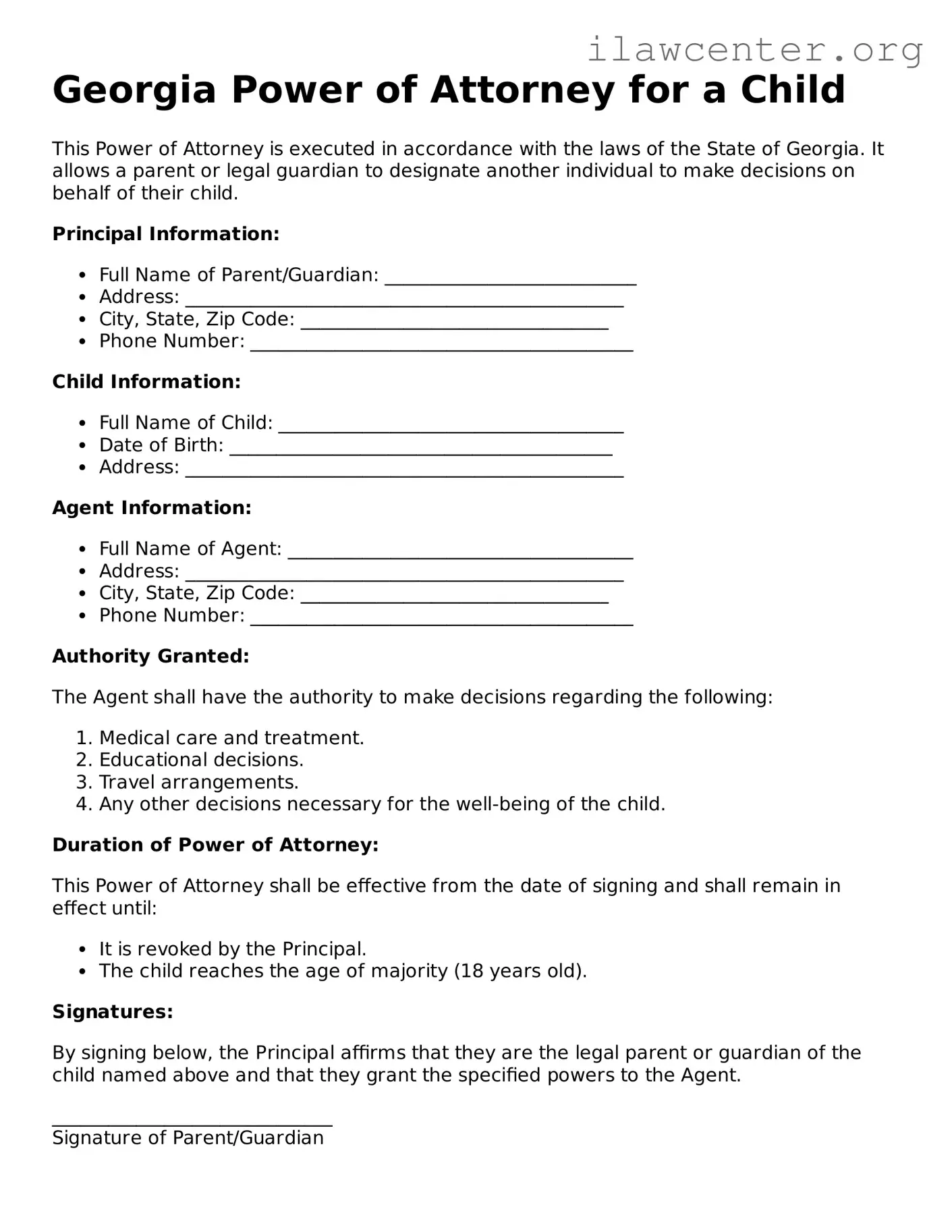
Georgia Power of Attorney for a Child Preview

Georgia Power of Attorney for a Child

This Power of Attorney is executed in accordance with the laws of the State of Georgia. It allows a parent or legal guardian to designate another individual to make decisions on behalf of their child.

Principal Information:

  • Full Name of Parent/Guardian: ___________________________
  • Address: _______________________________________________
  • City, State, Zip Code: _________________________________
  • Phone Number: _________________________________________

Child Information:

  • Full Name of Child: _____________________________________
  • Date of Birth: _________________________________________
  • Address: _______________________________________________

Agent Information:

  • Full Name of Agent: _____________________________________
  • Address: _______________________________________________
  • City, State, Zip Code: _________________________________
  • Phone Number: _________________________________________

Authority Granted:

The Agent shall have the authority to make decisions regarding the following:

  1. Medical care and treatment.
  2. Educational decisions.
  3. Travel arrangements.
  4. Any other decisions necessary for the well-being of the child.

Duration of Power of Attorney:

This Power of Attorney shall be effective from the date of signing and shall remain in effect until:

  • It is revoked by the Principal.
  • The child reaches the age of majority (18 years old).

Signatures:

By signing below, the Principal affirms that they are the legal parent or guardian of the child named above and that they grant the specified powers to the Agent.

______________________________
Signature of Parent/Guardian

______________________________
Date

______________________________
Signature of Agent

______________________________
Date

PDF Form Characteristics

Fact Name Description
Purpose The Georgia Power of Attorney for a Child form allows a parent or legal guardian to designate another adult to make decisions for their child.
Governing Law This form is governed by Georgia Code § 19-9-120 to § 19-9-126.
Duration The power of attorney can be effective for a specific period or until revoked by the parent or guardian.
Eligibility Any adult can be appointed as an agent, provided they are willing and able to act in the child's best interest.
Limitations The agent cannot make decisions regarding the child's medical treatment without additional consent.
Revocation The parent or guardian can revoke the power of attorney at any time, provided they notify the agent.

Instructions on Utilizing Georgia Power of Attorney for a Child

After obtaining the Georgia Power of Attorney for a Child form, you will need to complete it accurately to ensure it meets legal requirements. Following these steps will guide you through the process of filling out the form correctly.

  1. Begin by entering the full name of the child for whom the power of attorney is being granted.
  2. Provide the child's date of birth to confirm their identity.
  3. Enter the full names and addresses of the parents or legal guardians granting the power of attorney.
  4. Designate the individual who will act as the attorney-in-fact by providing their full name and address.
  5. Clearly outline the specific powers being granted to the attorney-in-fact. Be precise about the authority you wish to give.
  6. Include the start date and, if applicable, the end date for the power of attorney. If it is indefinite, state that clearly.
  7. Both parents or legal guardians must sign and date the form. Ensure that all signatures are notarized as required.
  8. Make copies of the completed form for your records and for the attorney-in-fact.

Important Facts about Georgia Power of Attorney for a Child

What is a Georgia Power of Attorney for a Child form?

The Georgia Power of Attorney for a Child form allows a parent or legal guardian to grant temporary authority to another adult to make decisions on behalf of their child. This can include decisions about education, healthcare, and general welfare while the parent is unavailable.

Who can be appointed as an agent in the Power of Attorney for a Child?

Any responsible adult can be appointed as an agent, provided they are willing to accept the responsibility. This could be a relative, family friend, or neighbor. It’s important to choose someone you trust to act in the best interest of your child.

How long does the Power of Attorney for a Child remain valid?

The Power of Attorney for a Child can remain valid for up to one year, unless you specify a shorter duration. However, it can be revoked at any time by the parent or guardian, provided that proper notice is given to the agent.

Do I need to have the Power of Attorney for a Child form notarized?

Yes, the form must be notarized to be legally binding. This step ensures that the document is authentic and that the signatures are valid. It’s advisable to have a notary present when you sign the document.

Can I use the Power of Attorney for a Child form for medical decisions?

Yes, the form can grant authority to make medical decisions, but it's essential to specify this in the document. The agent will then have the power to make healthcare decisions if the parent is unavailable or unable to do so.

What happens if I do not specify what decisions the agent can make?

If you do not specify the decisions the agent can make, they may not have the authority to act in certain situations. It’s crucial to clearly outline the powers granted to avoid any confusion or legal issues down the line.

Can the Power of Attorney for a Child be used in another state?

While the Georgia Power of Attorney for a Child is valid in Georgia, its acceptance in other states may vary. It’s advisable to check the specific laws of the state where the child will be residing or traveling to ensure the document is recognized.

What should I do if I want to revoke the Power of Attorney for a Child?

To revoke the Power of Attorney, you must notify the agent in writing. It’s also wise to inform any institutions or individuals who were aware of the original Power of Attorney to prevent confusion. Keep a copy of the revocation for your records.

Is legal advice necessary when completing the Power of Attorney for a Child form?

While it’s not required, seeking legal advice can be beneficial. An attorney can help ensure that the document meets all legal requirements and accurately reflects your intentions. This can provide peace of mind and help prevent potential disputes in the future.
Common mistakes

Filling out the Georgia Power of Attorney for a Child form can be a straightforward process, but there are common mistakes that many people make. One frequent error is failing to provide accurate information about the child. It’s essential to ensure that the child’s full name, date of birth, and any other identifying details are correct. Mistakes in this section can lead to complications down the line.

Another common mistake is not signing the form in the appropriate places. All parties involved must sign where indicated. Neglecting to do so can render the document invalid. Make sure to double-check that all required signatures are present before submitting the form.

Some individuals forget to specify the duration of the Power of Attorney. This detail is crucial, as it determines how long the appointed agent can act on behalf of the child. If this information is missing, it may lead to misunderstandings about the authority granted.

Additionally, people often overlook the need for witnesses or notarization. In Georgia, having the document signed in front of a notary public is typically required. Failing to follow this step can create legal challenges and might invalidate the Power of Attorney.

Another mistake is not discussing the arrangement with the child. It’s important for the child to understand who will be making decisions on their behalf and why. Open communication can help ease any concerns they may have about the situation.

Some individuals may also use outdated forms or templates. Laws and requirements can change, so it's vital to ensure that you are using the most current version of the Power of Attorney for a Child form. Using an outdated document can lead to legal issues.

Moreover, individuals sometimes forget to include specific powers granted to the agent. Clearly outlining what decisions the agent can make is essential. Without this clarity, there may be confusion about the agent's authority.

Lastly, people may not keep a copy of the completed form. It's important to retain a copy for personal records and to provide a copy to the agent. This ensures that everyone involved has access to the same information and can act in the best interest of the child.

Documents used along the form

When creating a Power of Attorney for a Child in Georgia, several other forms and documents may be necessary to ensure that the arrangement is clear and legally sound. Here is a list of commonly used documents that often accompany the Power of Attorney for a Child form:

  • Parental Consent Form: This document provides written consent from the child's parents, allowing the designated agent to make decisions on behalf of the child.
  • Medical Authorization Form: This form grants permission for the agent to make medical decisions and seek medical treatment for the child in case of emergencies.
  • Child's Birth Certificate: A copy of the child's birth certificate may be required to verify the child's identity and relationship to the parents.
  • School Enrollment Form: If the child will be attending school, this form is needed to enroll them and may require the agent's signature.
  • Emergency Contact Information: This document lists important contacts, including family members and medical providers, in case of emergencies.
  • Travel Consent Form: If the child will be traveling, this form provides consent for the agent to take the child out of state or country.
  • Financial Authorization Form: This document allows the agent to manage financial matters related to the child, such as accessing bank accounts or handling insurance.
  • Affidavit of Guardianship: This form may be necessary if the agent is not a parent and needs to affirm their role in the child's care.
  • Temporary Custody Agreement: This agreement outlines the terms of temporary custody and responsibilities of the agent while caring for the child.

Having these documents prepared and organized can help ensure that the Power of Attorney for a Child is effective and that the child's best interests are prioritized. Each document serves a specific purpose and can provide clarity and protection for both the child and the agent.

Similar forms

  • Guardianship Agreement: This document allows an individual to assume legal responsibility for a child’s care and welfare. Like a Power of Attorney, it grants authority to make decisions on behalf of the child, but it often involves a more permanent arrangement.
  • Medical Consent Form: This form permits a designated person to make medical decisions for a child in the absence of a parent or guardian. It is similar in that it grants specific authority, focusing on health-related matters.
  • Child Custody Agreement: This legal document outlines the terms of custody between parents or guardians. It shares similarities with a Power of Attorney by defining who has the right to make decisions for the child, though it typically pertains to ongoing living arrangements.
  • Travel Consent Form: This document is used when a child is traveling without a parent or legal guardian. It provides permission for the child to travel and is similar in that it authorizes another adult to act on behalf of the child during the trip.

Dos and Don'ts

When filling out the Georgia Power of Attorney for a Child form, there are important dos and don'ts to keep in mind. This will help ensure that the document is completed correctly and serves its intended purpose.

  • Do read the entire form carefully before filling it out.
  • Do provide accurate and complete information about the child and the agent.
  • Do sign the form in the presence of a notary public.
  • Do keep a copy of the completed form for your records.
  • Don't leave any sections blank; fill in all required fields.
  • Don't use outdated versions of the form; ensure you have the most current version.
  • Don't forget to inform the agent about their responsibilities and powers.

By following these guidelines, you can help ensure that the Power of Attorney for a Child form is valid and effective.

Misconceptions

Understanding the Georgia Power of Attorney for a Child form is crucial for parents and guardians. However, several misconceptions can lead to confusion. Here are four common misunderstandings:

  1. It is only for emergencies.

    Many believe that this form is only necessary in urgent situations. In reality, it can be used for various circumstances, such as travel, medical care, or education needs. Planning ahead can prevent complications.

  2. It requires a lawyer to complete.

    Some think that a lawyer must draft the Power of Attorney. While legal advice can be helpful, the form can be completed by parents or guardians without legal representation. Ensure you follow the correct guidelines.

  3. It is permanent.

    People often assume that once the form is signed, it cannot be changed. This is not true. The Power of Attorney can be revoked or altered at any time, as long as the parent or guardian is competent to do so.

  4. It covers all legal matters.

    Some may think that the Power of Attorney grants unlimited authority. However, it only provides specific powers outlined in the document. Be clear about what powers you are granting to avoid misunderstandings.

Addressing these misconceptions can help ensure that the Power of Attorney for a Child is used effectively and appropriately.

Key takeaways

Filling out and using the Georgia Power of Attorney for a Child form can be an important step for parents and guardians. Here are some key takeaways to keep in mind:

  • The form allows a parent or legal guardian to grant another adult the authority to make decisions on behalf of their child.
  • This document can cover various areas, including healthcare decisions, educational choices, and general welfare.
  • It is crucial to choose a trusted individual to act as the agent, as they will have significant responsibilities.
  • The Power of Attorney can be limited to a specific time period or for a particular purpose, providing flexibility.
  • Always ensure that the form is properly signed and notarized to make it legally binding.

Understanding these points can help ensure that the Power of Attorney for a Child form is used effectively and responsibly.