Attorney-Verified  Power of Attorney Document for Georgia

Attorney-Verified Power of Attorney Document for Georgia

The Georgia Power of Attorney form is a legal document that allows one person to grant another the authority to act on their behalf in various matters, such as financial or medical decisions. This form is essential for ensuring that your wishes are respected when you are unable to make decisions for yourself. To get started on filling out the form, please click the button below.

Article Guide

In the state of Georgia, the Power of Attorney (POA) form serves as a crucial legal document that allows an individual, known as the principal, to designate another person, referred to as the agent or attorney-in-fact, to make decisions on their behalf. This form can cover a wide array of responsibilities, from managing financial affairs to making healthcare decisions, depending on the specific type of POA established. There are generally two main categories: a general Power of Attorney, which grants broad powers to the agent, and a durable Power of Attorney, which remains effective even if the principal becomes incapacitated. Additionally, the form can be tailored to fit particular needs, such as limited or special powers for specific tasks or timeframes. Understanding the nuances of the Georgia Power of Attorney form is essential for anyone looking to ensure their wishes are honored and their interests are protected in various situations. Proper execution and adherence to state laws are vital to ensure the document is valid and enforceable, making it imperative for individuals to be well-informed about the requirements and implications of this important legal tool.

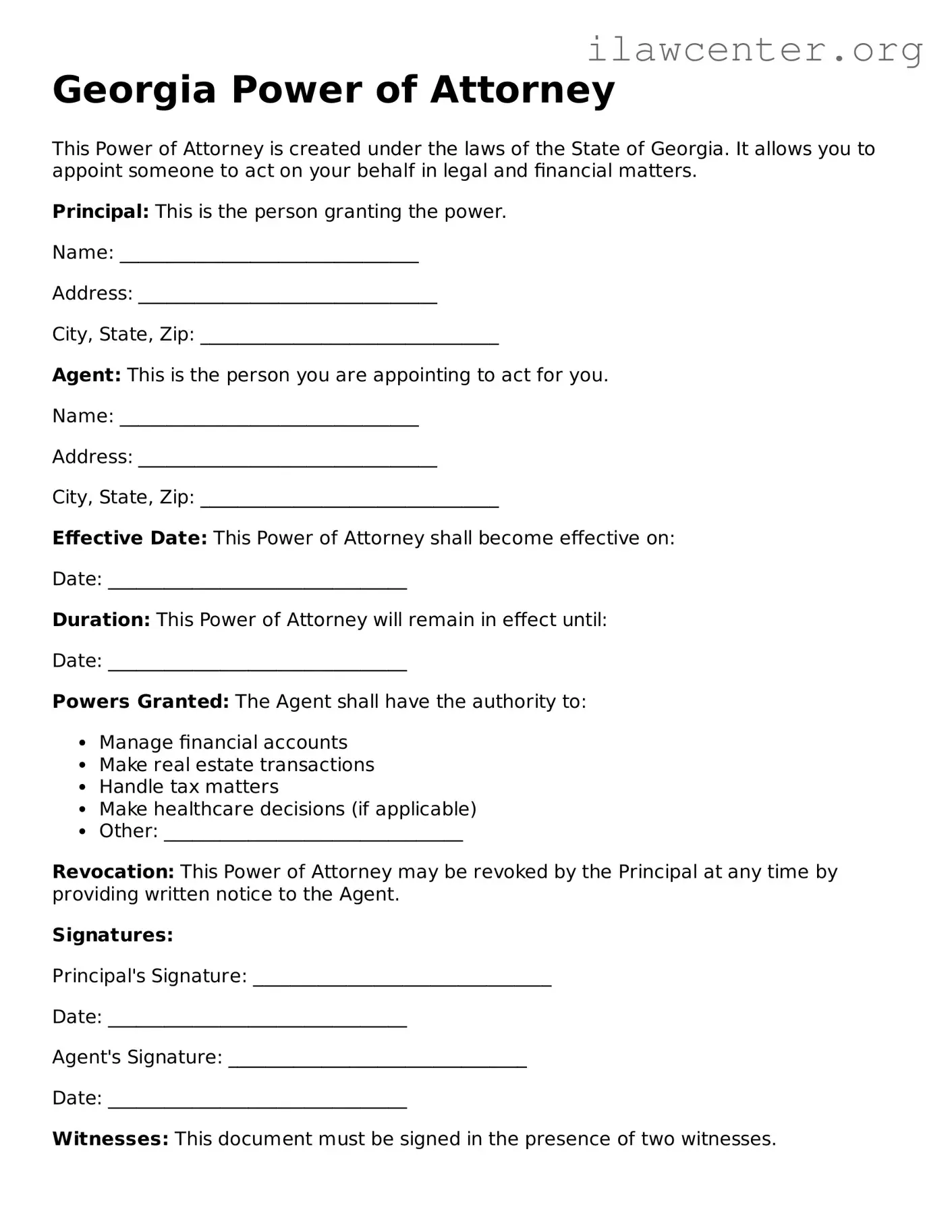
Georgia Power of Attorney Preview

Georgia Power of Attorney

This Power of Attorney is created under the laws of the State of Georgia. It allows you to appoint someone to act on your behalf in legal and financial matters.

Principal: This is the person granting the power.

Name: ________________________________

Address: ________________________________

City, State, Zip: ________________________________

Agent: This is the person you are appointing to act for you.

Name: ________________________________

Address: ________________________________

City, State, Zip: ________________________________

Effective Date: This Power of Attorney shall become effective on:

Date: ________________________________

Duration: This Power of Attorney will remain in effect until:

Date: ________________________________

Powers Granted: The Agent shall have the authority to:

  • Manage financial accounts
  • Make real estate transactions
  • Handle tax matters
  • Make healthcare decisions (if applicable)
  • Other: ________________________________

Revocation: This Power of Attorney may be revoked by the Principal at any time by providing written notice to the Agent.

Signatures:

Principal's Signature: ________________________________

Date: ________________________________

Agent's Signature: ________________________________

Date: ________________________________

Witnesses: This document must be signed in the presence of two witnesses.

Witness 1 Name: ________________________________

Witness 1 Signature: ________________________________

Date: ________________________________

Witness 2 Name: ________________________________

Witness 2 Signature: ________________________________

Date: ________________________________

Notary Public: This document should be notarized to be valid.

Notary Signature: ________________________________

Date: ________________________________

PDF Form Characteristics

Fact Name Description
Definition A Georgia Power of Attorney form allows an individual to appoint someone else to make decisions on their behalf.
Governing Law The form is governed by the Georgia Uniform Power of Attorney Act, O.C.G.A. § 10-6B-1 et seq.
Types There are different types of Power of Attorney forms in Georgia, including general, durable, and limited.
Durability A durable Power of Attorney remains effective even if the principal becomes incapacitated.
Revocation The principal can revoke the Power of Attorney at any time, provided they are mentally competent.
Signing Requirements The form must be signed by the principal and witnessed by two individuals or notarized.
Use Cases This form is commonly used for financial matters, healthcare decisions, and property transactions.

Instructions on Utilizing Georgia Power of Attorney

After obtaining the Georgia Power of Attorney form, you will need to complete it accurately to ensure it meets your needs. This process involves providing specific information about yourself and the person you are designating as your agent. Follow the steps outlined below to fill out the form correctly.

  1. Begin by entering your full name and address in the designated fields at the top of the form.
  2. Next, provide the full name and address of the agent you are appointing. This individual will act on your behalf.
  3. Specify the powers you wish to grant to your agent. You can choose to give general powers or limit them to specific tasks.
  4. Indicate the duration of the Power of Attorney. You can set it to be effective immediately, or you can specify a start date and an expiration date.
  5. Include any additional instructions or limitations regarding the authority of your agent, if necessary.
  6. Sign and date the form in the appropriate section. Your signature must match the name provided at the beginning.
  7. Have your signature witnessed by at least one adult who is not your agent. The witness must also sign and provide their information.
  8. If required, have the form notarized. This may depend on the specific requirements for your situation.

Once you have completed the form, review it for accuracy. Ensure that all signatures and dates are correct before distributing copies to your agent and any relevant parties.

Important Facts about Georgia Power of Attorney

What is a Power of Attorney in Georgia?

A Power of Attorney (POA) in Georgia is a legal document that allows one person, known as the principal, to authorize another person, called the agent or attorney-in-fact, to act on their behalf. This can include making financial decisions, handling legal matters, or managing healthcare decisions, depending on the type of POA established.

What types of Power of Attorney are available in Georgia?

Georgia recognizes several types of Power of Attorney. The most common are General Power of Attorney, which grants broad powers to the agent, and Limited Power of Attorney, which restricts the agent's authority to specific tasks. There is also a Durable Power of Attorney, which remains effective even if the principal becomes incapacitated, and a Springing Power of Attorney, which only becomes effective under certain conditions.

How do I create a Power of Attorney in Georgia?

To create a Power of Attorney in Georgia, you must complete a written document that clearly outlines the powers granted to the agent. The document should be signed by the principal and two witnesses or a notary public. It is crucial to ensure that the form complies with Georgia state laws to be valid.

Can I revoke a Power of Attorney in Georgia?

Yes, a Power of Attorney can be revoked at any time as long as the principal is mentally competent. To revoke a POA, the principal should create a written revocation document, notify the agent, and inform any institutions or individuals that may have relied on the original POA.

What happens if the principal becomes incapacitated?

If the principal becomes incapacitated and a Durable Power of Attorney is in place, the agent can continue to act on behalf of the principal. If a non-durable POA was established, it would become invalid upon the principal's incapacitation. This highlights the importance of choosing the appropriate type of POA based on future needs.

Is it necessary to have a lawyer to create a Power of Attorney in Georgia?

While it is not legally required to have a lawyer to create a Power of Attorney in Georgia, consulting with one can be beneficial. A lawyer can provide guidance on the specific powers to grant, ensure the document complies with state laws, and help avoid potential disputes in the future.

Can an agent be compensated for their services under a Power of Attorney?

Yes, an agent can be compensated for their services if the Power of Attorney document explicitly states this arrangement. If compensation is not mentioned, the agent is generally expected to act without payment. It's essential for the principal to clarify this in the POA to avoid misunderstandings.

What should I consider when choosing an agent for my Power of Attorney?

Choosing an agent for a Power of Attorney is a significant decision. Consider the agent's trustworthiness, financial acumen, and willingness to take on the responsibilities involved. It’s advisable to select someone who understands your wishes and can act in your best interest, especially during critical times.
Common mistakes

Filling out a Power of Attorney form can be a crucial step in ensuring that your affairs are handled according to your wishes. However, many individuals make common mistakes that can lead to complications. One of the most frequent errors is failing to clearly identify the principal and the agent. It is essential to provide full names and addresses to avoid any confusion about who is granting authority and who is receiving it.

Another mistake often made is not specifying the powers granted. The form should clearly outline what decisions the agent is allowed to make on behalf of the principal. Without this clarity, there may be disputes or misunderstandings regarding the agent's authority. In some cases, individuals may assume that general language suffices, but specificity is key.

Many people overlook the importance of signing the document correctly. The principal must sign the Power of Attorney form in the presence of a notary public. If the signature is missing or not properly notarized, the document may not be valid. This can lead to significant issues when the agent attempts to act on behalf of the principal.

Another common error is neglecting to date the form. A Power of Attorney should include the date of signing to establish when the authority takes effect. Without a date, questions may arise about the validity of the document, especially if it is called into question later.

Some individuals forget to discuss their intentions with the chosen agent before completing the form. It is important to ensure that the agent is willing to take on this responsibility and understands the principal's wishes. This conversation can prevent misunderstandings and ensure that the agent is prepared to act in the best interest of the principal.

Additionally, people often fail to keep copies of the signed Power of Attorney. It is vital for both the principal and the agent to have access to the document. Without copies, the agent may face challenges when trying to exercise their authority. Keeping multiple copies can help avoid complications.

Finally, individuals may not review the Power of Attorney form regularly. Life circumstances can change, and so can the needs of the principal. It is wise to review and update the document as necessary to reflect current wishes and ensure that the agent remains the appropriate choice. Regular check-ins can help avoid issues down the line.

Documents used along the form

When creating a Power of Attorney in Georgia, several other forms and documents may be beneficial to ensure comprehensive legal coverage. These documents help clarify the powers granted, establish health care directives, and manage property matters. Here’s a list of commonly used forms that accompany the Georgia Power of Attorney.

  • Advance Directive for Health Care: This document allows individuals to outline their preferences for medical treatment and appoint a health care agent. It ensures that medical decisions align with the person's wishes if they become unable to communicate.
  • Durable Power of Attorney: Similar to the standard Power of Attorney, this document remains effective even if the principal becomes incapacitated. It provides ongoing authority for the agent to manage financial and legal matters.
  • Living Will: A living will specifies an individual's wishes regarding end-of-life medical care. It is crucial for guiding health care providers and loved ones in making difficult decisions during critical times.
  • Financial Power of Attorney: This form specifically grants authority to manage financial affairs, including banking, investments, and real estate transactions. It can be tailored to limit or expand the agent's powers as needed.
  • HIPAA Release Form: This document allows designated individuals to access medical records and health information. It is essential for ensuring that the agent can make informed health care decisions.
  • Real Estate Power of Attorney: A specific type of Power of Attorney that grants authority to manage real estate transactions. This includes buying, selling, or leasing property on behalf of the principal.
  • Will: A will outlines how an individual's assets will be distributed after their death. While not directly related to Power of Attorney, having a will is crucial for comprehensive estate planning.

Utilizing these documents alongside the Georgia Power of Attorney can provide clarity and assurance in managing personal and financial matters. Each form serves a unique purpose and helps protect individual rights and preferences in various situations.

Similar forms

  • Living Will: A living will outlines a person's wishes regarding medical treatment in case they become unable to communicate. Like a Power of Attorney, it allows someone to make decisions on behalf of another, but it specifically focuses on healthcare choices.
  • Health Care Proxy: This document appoints someone to make medical decisions for an individual if they are incapacitated. Similar to a Power of Attorney, it grants authority to act, but it is limited to health-related matters.
  • Durable Power of Attorney: This is a specific type of Power of Attorney that remains effective even if the person becomes incapacitated. It is similar in purpose but ensures that authority continues under certain conditions.
  • Financial Power of Attorney: This document allows someone to manage financial matters on behalf of another. Like the general Power of Attorney, it grants authority, but it focuses solely on financial transactions.
  • Trust Agreement: A trust agreement allows a person to transfer assets to a trustee for the benefit of beneficiaries. Both documents involve delegating authority, but a trust is more about asset management and distribution.
  • Will: A will specifies how a person’s assets should be distributed after their death. While a Power of Attorney is effective during a person's life, a will takes effect upon death, making them similar in their role of directing decisions.
  • Advance Directive: This is a general term that includes both living wills and health care proxies. It allows individuals to outline their healthcare preferences and appoint someone to make decisions, similar to a Power of Attorney.
  • Guardianship Document: This document appoints a guardian for a minor or incapacitated adult. It is similar in that it grants authority to make decisions for someone else, but it usually involves court approval and oversight.
  • Business Power of Attorney: This allows someone to make business decisions on behalf of a company. Like a general Power of Attorney, it provides authority, but it is specifically tailored for business-related matters.

Dos and Don'ts

When filling out the Georgia Power of Attorney form, it’s important to follow certain guidelines to ensure everything is completed correctly. Here are some dos and don’ts to keep in mind:

  • Do read the entire form carefully before starting.
  • Do provide accurate and complete information about yourself and the agent.
  • Do sign the form in the presence of a notary public.
  • Do keep a copy of the completed form for your records.
  • Don't rush through the process; take your time to ensure accuracy.
  • Don't leave any sections blank unless instructed to do so.

By following these guidelines, you can help ensure that your Power of Attorney form is valid and effective.

Misconceptions

Understanding the Georgia Power of Attorney form is essential for anyone considering its use. However, several misconceptions can lead to confusion. Below are six common misconceptions about this important legal document.

  1. All Power of Attorney forms are the same.

    Many people believe that a Power of Attorney form is a one-size-fits-all document. In reality, there are various types, including durable, springing, and limited powers of attorney. Each serves different purposes and has distinct legal implications.

  2. A Power of Attorney can make medical decisions automatically.

    Some individuals assume that a general Power of Attorney grants authority over medical decisions. However, to make healthcare choices, a separate medical power of attorney or advance directive is typically required.

  3. Once signed, a Power of Attorney cannot be revoked.

    This misconception can cause significant concern. In fact, a principal can revoke a Power of Attorney at any time, provided they are mentally competent. The revocation should be documented in writing.

  4. All agents have the same powers.

    People often think that all agents designated in a Power of Attorney have identical powers. The reality is that the principal can specify the extent of authority granted to each agent, allowing for tailored arrangements.

  5. A Power of Attorney is only useful for financial matters.

    While many associate Power of Attorney with financial transactions, it can also encompass legal, real estate, and healthcare decisions. The scope of authority depends on how the document is drafted.

  6. Signing a Power of Attorney means giving up control.

    Some individuals fear that executing a Power of Attorney means losing all control over their affairs. However, the principal retains the right to oversee and revoke the agent's authority at any time, as long as they remain competent.

Addressing these misconceptions can help individuals make informed decisions about using the Georgia Power of Attorney form effectively.

Key takeaways

Filling out and using the Georgia Power of Attorney form requires careful attention to detail. Here are some key takeaways to keep in mind:

  • The Power of Attorney form must be signed by the principal, the person granting the authority.
  • It is essential to choose an agent who is trustworthy and capable of handling the responsibilities assigned.
  • The form can be customized to specify the powers granted, whether broad or limited.
  • Witnesses are required for the signature to be valid; two witnesses must be present during the signing.
  • Notarization is also necessary to ensure the document is legally recognized.
  • Once completed, provide copies of the form to the agent and any relevant institutions, such as banks or healthcare providers.
  • Revocation of the Power of Attorney can be done at any time, as long as the principal is competent.
  • Keep the original document in a safe place, as it may be needed for future reference.

Understanding these points can help ensure that the Power of Attorney is executed properly and serves its intended purpose.