Attorney-Verified  Prenuptial Agreement Document for Georgia

Attorney-Verified Prenuptial Agreement Document for Georgia

A Prenuptial Agreement is a legal document that couples create before marriage to outline the division of assets and responsibilities in the event of a divorce. In Georgia, this form helps ensure that both parties are protected and their wishes are clearly stated. To get started, fill out the form by clicking the button below.

Article Guide

When considering marriage in Georgia, many couples are increasingly recognizing the importance of a prenuptial agreement. This legal document serves as a proactive measure to outline the division of assets and responsibilities in the event of a divorce or separation. A well-drafted prenuptial agreement can address various financial matters, including property ownership, debt obligations, and spousal support. It ensures that both parties have a clear understanding of their rights and obligations, minimizing potential conflicts down the line. In Georgia, the prenuptial agreement form must meet specific legal requirements to be enforceable, including voluntary execution by both parties and full disclosure of assets. Couples should also consider discussing their agreement with legal professionals to ensure that it reflects their unique circumstances and intentions. The urgency of addressing these matters before tying the knot cannot be overstated, as a well-prepared agreement can provide peace of mind and a solid foundation for a successful marriage.

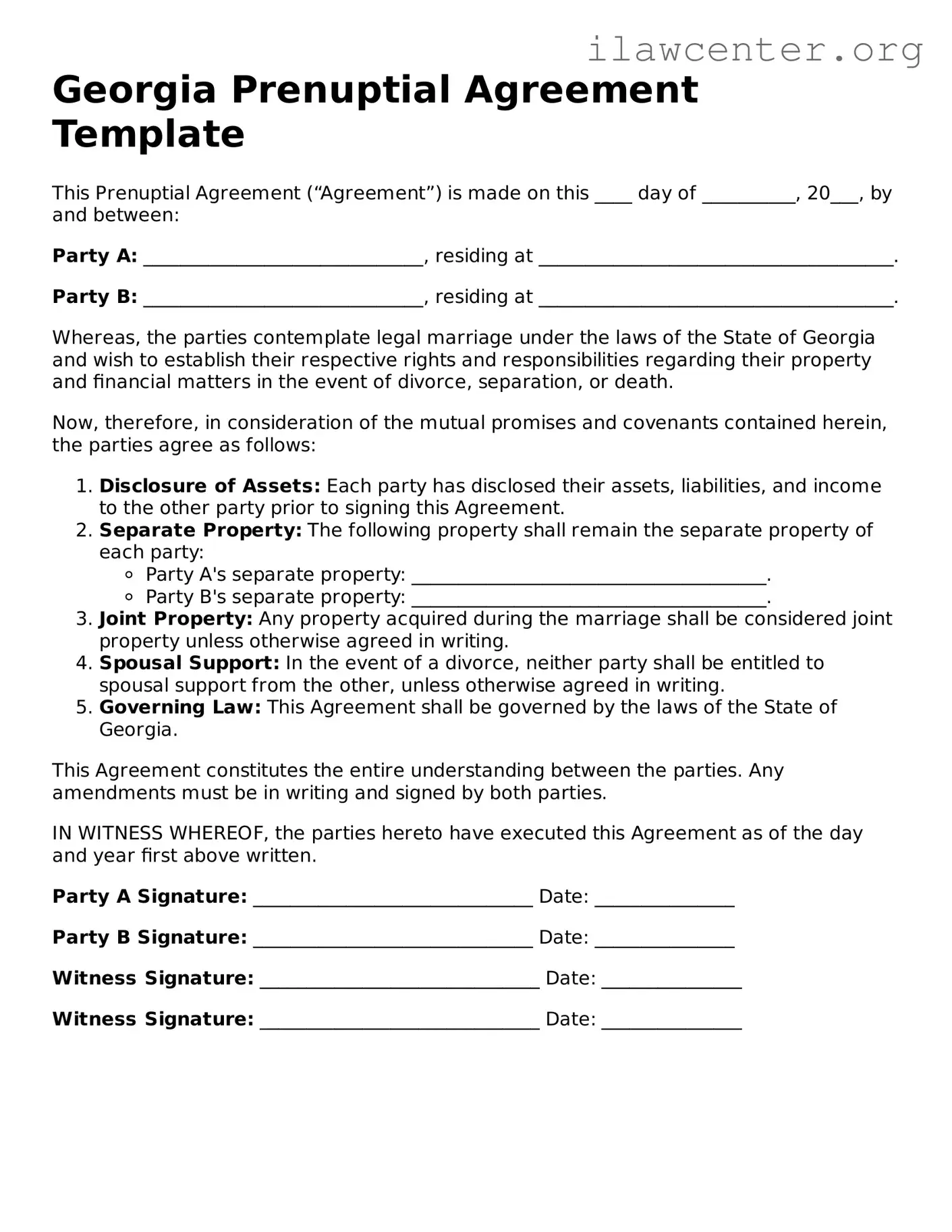
Georgia Prenuptial Agreement Preview

Georgia Prenuptial Agreement Template

This Prenuptial Agreement (“Agreement”) is made on this ____ day of __________, 20___, by and between:

Party A: ______________________________, residing at ______________________________________.

Party B: ______________________________, residing at ______________________________________.

Whereas, the parties contemplate legal marriage under the laws of the State of Georgia and wish to establish their respective rights and responsibilities regarding their property and financial matters in the event of divorce, separation, or death.

Now, therefore, in consideration of the mutual promises and covenants contained herein, the parties agree as follows:

  1. Disclosure of Assets: Each party has disclosed their assets, liabilities, and income to the other party prior to signing this Agreement.
  2. Separate Property: The following property shall remain the separate property of each party:
    • Party A's separate property: ______________________________________.
    • Party B's separate property: ______________________________________.
  3. Joint Property: Any property acquired during the marriage shall be considered joint property unless otherwise agreed in writing.
  4. Spousal Support: In the event of a divorce, neither party shall be entitled to spousal support from the other, unless otherwise agreed in writing.
  5. Governing Law: This Agreement shall be governed by the laws of the State of Georgia.

This Agreement constitutes the entire understanding between the parties. Any amendments must be in writing and signed by both parties.

IN WITNESS WHEREOF, the parties hereto have executed this Agreement as of the day and year first above written.

Party A Signature: ______________________________ Date: _______________

Party B Signature: ______________________________ Date: _______________

Witness Signature: ______________________________ Date: _______________

Witness Signature: ______________________________ Date: _______________

PDF Form Characteristics

Fact Name Description
Definition A prenuptial agreement is a legal document that outlines the division of assets and responsibilities in the event of divorce or separation.
Governing Law In Georgia, prenuptial agreements are governed by the Georgia Uniform Premarital Agreement Act.
Requirements Both parties must voluntarily sign the agreement, and it must be in writing to be enforceable.
Full Disclosure Each party must fully disclose their financial situation, including assets and debts, for the agreement to be valid.
Modification Prenuptial agreements can be modified or revoked at any time, provided both parties agree in writing.
Enforceability Courts in Georgia will enforce prenuptial agreements unless they are found to be unconscionable or signed under duress.
Notarization While notarization is not required, it is recommended to strengthen the agreement's validity.
Timeline It is advisable to create and sign the agreement well in advance of the wedding to avoid any claims of coercion.
Legal Counsel Each party should consider consulting with independent legal counsel to ensure their interests are adequately represented.

Instructions on Utilizing Georgia Prenuptial Agreement

Filling out a prenuptial agreement form is an important step for couples planning to marry. It allows both parties to outline their financial expectations and responsibilities before entering into marriage. The following steps will guide you through the process of completing the form.

  1. Gather necessary information. Collect personal details such as full names, addresses, and dates of birth for both parties.
  2. List assets and liabilities. Each party should prepare a detailed list of their assets, including bank accounts, real estate, and personal property, as well as any debts or liabilities.
  3. Decide on terms. Discuss and agree on how assets and debts will be handled during the marriage and in the event of a divorce.
  4. Fill out the form. Use clear and concise language to input all gathered information and agreed-upon terms into the prenuptial agreement form.
  5. Review the document. Both parties should read through the completed form carefully to ensure accuracy and clarity.
  6. Consult with legal counsel. It is advisable for both parties to seek independent legal advice to understand their rights and obligations.
  7. Sign the agreement. Once both parties are satisfied, sign the document in the presence of a notary public to make it legally binding.

Important Facts about Georgia Prenuptial Agreement

What is a prenuptial agreement in Georgia?

A prenuptial agreement is a legal document created by two individuals before they get married. It outlines how assets and debts will be divided in the event of divorce or death. In Georgia, this agreement can also address spousal support and other financial matters.

Why should I consider a prenuptial agreement?

A prenuptial agreement can provide clarity and protection for both parties. It helps to define financial rights and responsibilities, which can reduce conflict in the event of a separation. Couples with significant assets, children from previous relationships, or those entering a second marriage may particularly benefit from this agreement.

How do I create a prenuptial agreement in Georgia?

To create a prenuptial agreement, both parties should discuss their financial situations and future goals. It is advisable to consult with separate attorneys to ensure that both parties fully understand the terms. The agreement must be in writing, signed by both parties, and executed voluntarily without coercion.

What should be included in a prenuptial agreement?

A prenuptial agreement typically includes details about property division, debt responsibilities, and spousal support. Couples may also include provisions for the management of future income and assets. It is important to be thorough to avoid potential disputes later on.

Can a prenuptial agreement be changed after marriage?

Yes, a prenuptial agreement can be modified after marriage. Both parties must agree to any changes, and it is recommended to document these changes in writing. A postnuptial agreement can be created to formalize any new terms.

Is a prenuptial agreement enforceable in Georgia?

Generally, prenuptial agreements are enforceable in Georgia as long as they meet certain legal standards. These include being in writing, signed by both parties, and entered into voluntarily. If either party can prove that the agreement was signed under duress or without full disclosure of assets, it may not be enforced.

What happens if we don't have a prenuptial agreement?

If a couple does not have a prenuptial agreement, Georgia's laws regarding property division and spousal support will apply in the event of divorce. This may lead to outcomes that are not aligned with either party's expectations or wishes.

How long does a prenuptial agreement last?

A prenuptial agreement remains in effect throughout the marriage unless it is revoked or modified by both parties. It is important to review the agreement periodically, especially after significant life changes, to ensure it still meets both parties' needs.

Can I get a prenuptial agreement if I have children from a previous relationship?

Yes, individuals with children from previous relationships can and often should consider a prenuptial agreement. It can help protect the interests of those children, particularly regarding inheritance and financial support. Clear terms can ensure that both parties understand their responsibilities toward their children.
Common mistakes

Filling out a prenuptial agreement form in Georgia can be a straightforward process, but many people make common mistakes that can lead to complications down the line. One frequent error is not fully understanding the purpose of the agreement. A prenuptial agreement is designed to protect both parties’ interests and clarify financial responsibilities. Without a clear understanding, individuals may overlook important details.

Another mistake is failing to disclose all assets and debts. Transparency is crucial. If one party hides assets or does not fully disclose debts, it can lead to disputes later. Both parties should provide a complete financial picture to ensure fairness and avoid potential legal issues.

Many individuals also rush through the process without considering their unique needs. Each couple has different financial situations and priorities. Taking the time to discuss and outline specific terms can prevent misunderstandings and ensure that the agreement reflects both parties' wishes.

Another common error is using vague language. Clear and precise terms are essential in a prenuptial agreement. Ambiguities can lead to confusion and potential legal battles in the future. It’s important to define terms clearly to avoid misinterpretation.

Some people forget to review state laws. Prenuptial agreements must comply with Georgia law. Not being aware of the legal requirements can result in an invalid agreement. Consulting with a legal professional can help ensure that all necessary elements are included.

Additionally, individuals sometimes neglect to consider future changes. Life events such as children, job changes, or significant financial shifts can impact the agreement. It’s wise to include provisions that address how the agreement may be modified in the future.

Another mistake is not involving legal counsel. While it might seem tempting to save money by filling out the form without professional help, having a lawyer review the agreement can prevent costly errors. A legal expert can provide valuable insights and ensure that the agreement is enforceable.

People often forget to discuss the agreement openly with their partner. Communication is key in any relationship, especially when it comes to financial matters. Not discussing the prenuptial agreement can lead to resentment or misunderstandings.

Some couples may also overlook the importance of signing the agreement well in advance of the wedding. Waiting until the last minute can create pressure and may lead to mistakes or disputes. It’s best to finalize the agreement well before the wedding date.

Lastly, individuals sometimes fail to keep copies of the signed agreement. After everything is finalized, both parties should retain a copy for their records. This ensures that both individuals have access to the agreement in case any issues arise in the future.

Documents used along the form

When preparing for marriage, many couples consider a prenuptial agreement to clarify financial rights and responsibilities. However, there are several other important documents that can complement a Georgia Prenuptial Agreement. Each of these documents serves a unique purpose and can help ensure that both parties are on the same page regarding their financial and legal matters.

  • Postnuptial Agreement: Similar to a prenuptial agreement, this document is created after the marriage has taken place. It outlines the financial arrangements and responsibilities of each spouse, often in response to changes in circumstances.
  • Marital Settlement Agreement: This document is typically used during divorce proceedings. It details the division of assets, debts, and other financial obligations between spouses, helping to facilitate a smoother separation.
  • Will: A will outlines how a person's assets will be distributed upon their death. It can specify beneficiaries and guardians for minor children, ensuring that one's wishes are honored.
  • Power of Attorney: This document allows one person to make legal and financial decisions on behalf of another. It is especially important in situations where one spouse may become incapacitated.
  • Health Care Proxy: A health care proxy designates someone to make medical decisions for an individual if they are unable to do so themselves. This is crucial for ensuring that a spouse's medical preferences are respected.
  • Financial Disclosure Statement: This document provides a comprehensive overview of each spouse's financial situation, including assets, liabilities, and income. Transparency in finances can help prevent misunderstandings.
  • Separation Agreement: In the event of a separation, this document outlines the terms of living apart, including financial support and child custody arrangements.
  • Trust Agreement: A trust can hold assets for the benefit of one or more beneficiaries. This document outlines how the trust will be managed and distributed, providing a level of control over asset distribution.
  • Life Insurance Policy: While not a legal document per se, having a life insurance policy can provide financial security for a spouse in the event of the policyholder's death. It can be an important consideration when planning for the future.

Understanding these various documents can significantly enhance the financial planning process for couples. Each serves a specific purpose and can work in tandem with a prenuptial agreement to create a comprehensive approach to marital and financial responsibilities. Couples should consider discussing these documents with legal professionals to ensure their interests are adequately protected.

Similar forms

  • Postnuptial Agreement: Similar to a prenuptial agreement, a postnuptial agreement is created after a couple gets married. It outlines the division of assets and responsibilities in the event of a divorce or separation. Both documents serve to clarify financial matters and protect individual interests.
  • Separation Agreement: A separation agreement is often used when a couple decides to live apart but is not yet divorced. This document details the terms of the separation, including asset division, child custody, and support obligations. Like a prenuptial agreement, it aims to prevent disputes by clearly outlining expectations.
  • Divorce Settlement Agreement: This document is created during the divorce process and specifies how assets and debts will be divided. It is similar to a prenuptial agreement in that it addresses financial issues, but it is specifically tailored to the circumstances of a divorce rather than a marriage.
  • Living Together Agreement: Also known as a cohabitation agreement, this document is for couples who choose to live together without marrying. It outlines how assets and responsibilities will be handled during the relationship and in case of separation. Both agreements focus on financial arrangements and protecting individual interests.
  • Will: A will is a legal document that specifies how a person's assets will be distributed upon their death. While it serves a different purpose than a prenuptial agreement, both documents address the management and distribution of assets, ensuring that individual wishes are respected.

Dos and Don'ts

When filling out the Georgia Prenuptial Agreement form, it is important to approach the process thoughtfully. Here are ten guidelines to consider, divided into things you should do and things you should avoid.

Things You Should Do:

  • Consult with an attorney who specializes in family law to ensure that your agreement complies with state laws.
  • Be open and honest about your financial situation, including assets and debts.
  • Discuss the agreement with your partner in a calm and respectful manner.
  • Include specific terms regarding property division and spousal support.
  • Review the agreement regularly and update it as necessary, especially after significant life events.

Things You Shouldn't Do:

  • Do not rush the process; take the time to understand all aspects of the agreement.
  • Avoid hiding assets or providing misleading information.
  • Do not pressure your partner into signing the agreement without adequate time to review it.
  • Refrain from using the agreement as a tool for manipulation or control.
  • Do not overlook the importance of having both parties seek independent legal advice.

Misconceptions

Many people have misunderstandings about prenuptial agreements in Georgia. Here are nine common misconceptions:

  1. Prenuptial agreements are only for the wealthy. Many believe that only rich individuals need a prenuptial agreement. In reality, anyone can benefit from one, regardless of their financial situation.
  2. Prenuptial agreements are only for divorce. Some think these agreements are only about what happens if a marriage ends. They can also clarify financial responsibilities during the marriage.
  3. Prenuptial agreements are not enforceable. There is a belief that these agreements hold no legal weight. In Georgia, if properly drafted and executed, they are enforceable in court.
  4. Prenuptial agreements are only about money. While financial matters are often the focus, they can also cover other aspects, such as property rights and responsibilities.
  5. Prenuptial agreements can be created last minute. Some people think they can wait until the last moment to create one. It's important to allow enough time for both parties to review and negotiate the terms.
  6. Prenuptial agreements are one-size-fits-all. Many assume that a standard template will work for everyone. Each agreement should be tailored to the specific needs and circumstances of the couple.
  7. Prenuptial agreements are only for first marriages. There is a misconception that these agreements are unnecessary for those remarrying. However, they can provide clarity and protection for individuals entering a second marriage.
  8. Prenuptial agreements are a sign of distrust. Some view these agreements as a lack of faith in the relationship. In truth, they can promote open communication and understanding about financial matters.
  9. Prenuptial agreements cannot be changed. Many think that once an agreement is signed, it cannot be modified. However, both parties can agree to revise the terms at any time.

Understanding these misconceptions can help couples make informed decisions about prenuptial agreements in Georgia.

Key takeaways

When considering a prenuptial agreement in Georgia, it's important to keep a few key points in mind. Here are some takeaways to help guide you through the process:

  1. Understand the Purpose: A prenuptial agreement outlines how assets and debts will be handled in the event of a divorce or separation.
  2. Full Disclosure: Both parties must fully disclose their financial situations, including income, assets, and debts.
  3. Legal Requirements: The agreement must be in writing and signed by both parties to be enforceable.
  4. Consider Timing: It’s best to create and sign the agreement well in advance of the wedding to avoid any claims of coercion.
  5. Seek Legal Advice: Each party should consult with their own attorney to ensure their rights are protected.
  6. Review and Revise: Life changes, such as the birth of a child or significant financial changes, may necessitate a review of the agreement.
  7. State Laws: Familiarize yourself with Georgia laws regarding prenuptial agreements, as they can vary by state.
  8. Be Clear and Specific: Clearly outline the terms regarding property division, spousal support, and any other relevant issues.
  9. Keep it Fair: An agreement that is overly one-sided may be challenged in court.
  10. Sign in Front of Witnesses: Although not required, having witnesses can strengthen the validity of the agreement.

By keeping these points in mind, you can create a prenuptial agreement that serves both parties well and provides clarity for the future.