Attorney-Verified  Quitclaim Deed Document for Georgia

Attorney-Verified Quitclaim Deed Document for Georgia

A Georgia Quitclaim Deed is a legal document used to transfer ownership of real property from one party to another without any warranties or guarantees. This form is often utilized in situations where the grantor wishes to convey their interest in a property quickly and without the complexities of a traditional sale. To get started on your property transfer, fill out the form by clicking the button below.

Article Guide

When it comes to transferring property ownership in Georgia, the Quitclaim Deed form plays a crucial role. This legal document allows an individual, known as the grantor, to relinquish any claim they may have to a property, thereby enabling another party, the grantee, to assume ownership without any guarantees regarding the title’s validity. It's important to note that a Quitclaim Deed does not provide the same level of protection as other types of deeds, such as warranty deeds, because it does not assure that the grantor holds clear title to the property. This form is often utilized in situations involving family transfers, divorces, or clearing up title issues. The simplicity of the Quitclaim Deed makes it accessible, yet it is essential for both parties to understand the implications of the transfer. Properly completing and filing this form with the county clerk is vital to ensure that the change in ownership is legally recognized. Given the potential complexities involved in property transactions, understanding the Quitclaim Deed and its uses in Georgia can save time and prevent future disputes.

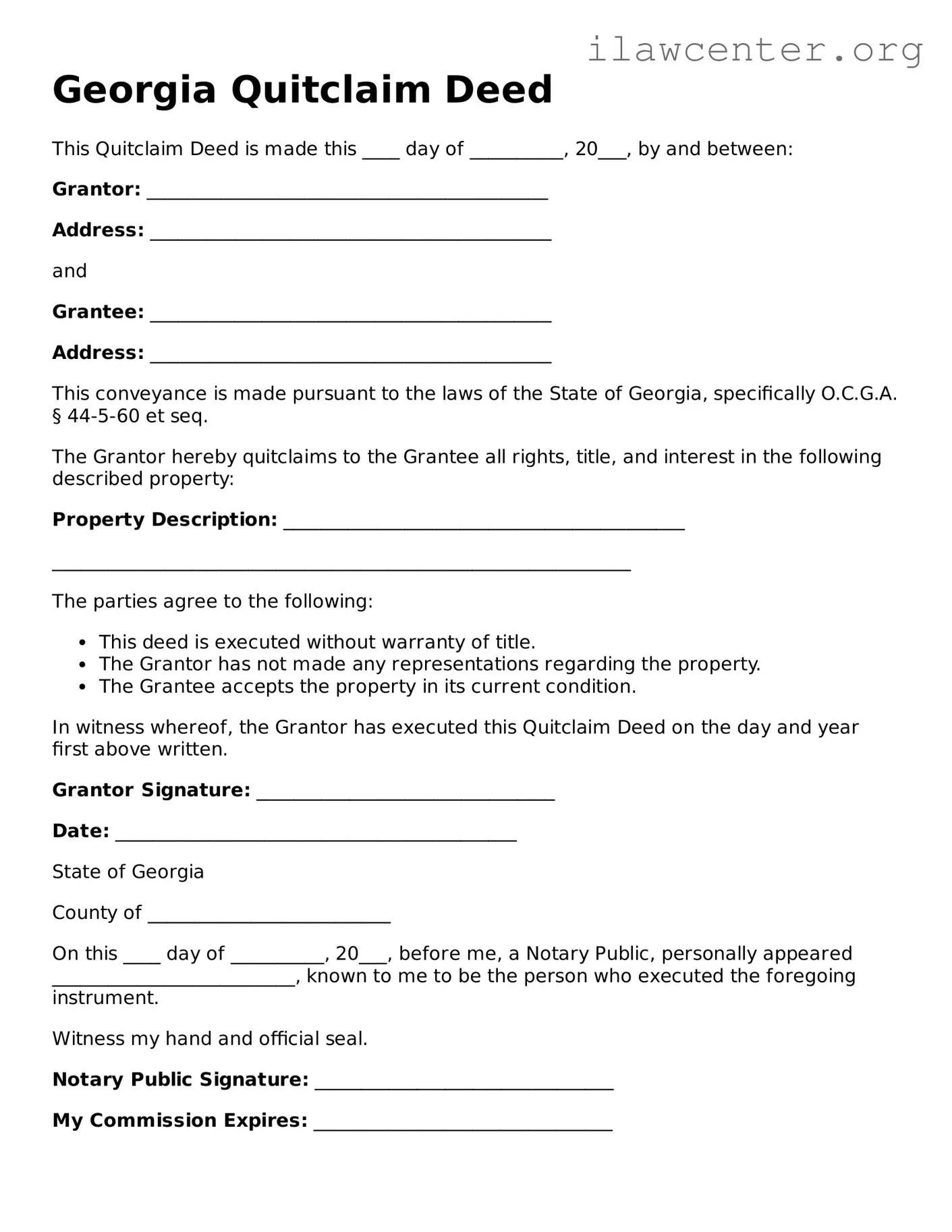
Georgia Quitclaim Deed Preview

Georgia Quitclaim Deed

This Quitclaim Deed is made this ____ day of __________, 20___, by and between:

Grantor: ___________________________________________

Address: ___________________________________________

and

Grantee: ___________________________________________

Address: ___________________________________________

This conveyance is made pursuant to the laws of the State of Georgia, specifically O.C.G.A. § 44-5-60 et seq.

The Grantor hereby quitclaims to the Grantee all rights, title, and interest in the following described property:

Property Description: ___________________________________________

______________________________________________________________

The parties agree to the following:

  • This deed is executed without warranty of title.
  • The Grantor has not made any representations regarding the property.
  • The Grantee accepts the property in its current condition.

In witness whereof, the Grantor has executed this Quitclaim Deed on the day and year first above written.

Grantor Signature: ________________________________

Date: ___________________________________________

State of Georgia

County of __________________________

On this ____ day of __________, 20___, before me, a Notary Public, personally appeared __________________________, known to me to be the person who executed the foregoing instrument.

Witness my hand and official seal.

Notary Public Signature: ________________________________

My Commission Expires: ________________________________

PDF Form Characteristics

Fact Name Description
Definition A quitclaim deed transfers ownership of property without guaranteeing that the title is clear.
Governing Law The Georgia Quitclaim Deed is governed by Georgia state law, specifically O.C.G.A. § 44-5-30.
Use Cases Commonly used among family members, to clear title issues, or in divorce settlements.
Requirements Must include the names of the grantor and grantee, property description, and be signed by the grantor.
Recording To be effective against third parties, the deed must be recorded with the local county clerk.
Limitations The quitclaim deed offers no warranties, meaning the grantee assumes all risks related to the title.

Instructions on Utilizing Georgia Quitclaim Deed

After obtaining the Georgia Quitclaim Deed form, you’ll need to complete it accurately. This form is essential for transferring property ownership from one party to another without any warranties. Once filled out, the deed must be signed and notarized before being filed with the appropriate county office.

  1. Begin by entering the grantor's name (the person transferring the property). Make sure to include their full legal name.
  2. Next, provide the grantee's name (the person receiving the property). Again, use their full legal name.
  3. In the designated space, include the property description. This should be a clear and accurate description of the property being transferred, including any relevant details such as the address or parcel number.
  4. Indicate the consideration amount, which is the value exchanged for the property. This could be a dollar amount or a statement indicating it is a gift.
  5. Sign the form where indicated. The grantor must sign the deed to validate the transfer.
  6. Have the signature notarized. A notary public must witness the signing and provide their seal on the document.
  7. Finally, file the completed Quitclaim Deed with the appropriate county clerk's office. Ensure you keep a copy for your records.

Important Facts about Georgia Quitclaim Deed

What is a Quitclaim Deed in Georgia?

A Quitclaim Deed is a legal document used to transfer ownership of real estate from one person to another in Georgia. Unlike a warranty deed, which guarantees that the property title is clear, a quitclaim deed does not provide any warranties or guarantees. Essentially, it allows the grantor to relinquish any claim they may have to the property, whether or not they actually own it. This type of deed is often used in situations like transferring property between family members or in divorce settlements, where the parties involved have a level of trust in each other.

How do I complete a Quitclaim Deed in Georgia?

Completing a Quitclaim Deed in Georgia involves several steps. First, you need to obtain the form, which can typically be found online or at your local county clerk’s office. Fill in the names of the grantor (the person transferring the property) and the grantee (the person receiving the property), along with a legal description of the property. It's crucial to ensure that the property description is accurate to avoid any future disputes. After filling out the form, both parties must sign it in the presence of a notary public. Finally, you must file the completed quitclaim deed with the county clerk’s office where the property is located to make the transfer official.

Are there any fees associated with filing a Quitclaim Deed in Georgia?

Yes, there are typically fees associated with filing a Quitclaim Deed in Georgia. While the cost can vary by county, you can generally expect to pay a filing fee, which may range from $10 to $50. Additionally, if you choose to have the deed notarized, there may be a small fee for that service as well. It’s a good idea to check with your local county clerk’s office for the exact fees and any additional costs that may be involved in the filing process.

Can a Quitclaim Deed be contested in Georgia?

Yes, a Quitclaim Deed can be contested in Georgia, but doing so can be complex. If someone believes that the deed was executed under duress, fraud, or if the grantor did not have the legal capacity to transfer the property, they may have grounds to challenge the deed. Additionally, if the deed was improperly filled out or filed, it may also be contestable. It’s advisable to consult with a legal professional if you believe you have a valid reason to contest a Quitclaim Deed, as they can provide guidance on the best course of action.

Common mistakes

Completing the Georgia Quitclaim Deed form can be a straightforward process, but several common mistakes can lead to complications. One frequent error is the omission of essential information. When filling out the form, it is crucial to include all required details, such as the names of the parties involved, the property description, and the date of the transfer. Failing to provide complete information may result in delays or even rejection of the deed.

Another common mistake is incorrect property descriptions. The Quitclaim Deed requires a clear and accurate description of the property being transferred. Using vague terms or failing to reference the legal description can create confusion and may invalidate the deed. It is advisable to consult property records or a legal professional to ensure accuracy.

Signatures are a critical component of the Quitclaim Deed. A mistake often made is not having the necessary parties sign the document. Both the grantor and the grantee must sign the deed for it to be legally binding. Additionally, if the grantor is married, their spouse may also need to sign the deed to ensure that both parties relinquish any interest in the property.

Not having the deed notarized is another error that can lead to complications. In Georgia, a Quitclaim Deed must be notarized to be valid. Failing to have the document properly notarized can result in the deed being challenged or not accepted by the county clerk’s office. It is essential to find a qualified notary public to witness the signing of the deed.

Finally, individuals often overlook the importance of recording the Quitclaim Deed. After the form has been filled out, signed, and notarized, it must be filed with the appropriate county office to make the transfer official. Neglecting to record the deed can lead to disputes over property ownership in the future. Recording the deed ensures that the transaction is publicly documented and protects the interests of all parties involved.

Documents used along the form

When completing a property transfer in Georgia, several additional forms and documents may be necessary alongside the Quitclaim Deed. Each document serves a specific purpose in ensuring a smooth transaction and protecting the interests of all parties involved.

  • Property Transfer Tax Form: This form is required to report the transfer of property and calculate any applicable taxes. It ensures compliance with state tax laws.
  • Affidavit of Consideration: This document provides details about the sale price or consideration for the property. It helps clarify the transaction for tax assessment purposes.
  • Title Search Report: A title search report verifies the current ownership of the property and checks for any liens or encumbrances. This protects the buyer from potential legal issues.
  • Closing Statement: This document outlines all financial aspects of the transaction, including fees, taxes, and the final purchase price. It provides a clear summary for both the buyer and seller.

Incorporating these documents into the property transfer process can help ensure that all legal requirements are met and that both parties are fully informed. Proper documentation is key to a successful transaction.

Similar forms

The Quitclaim Deed is a unique legal document, but it shares similarities with several other documents used in property transactions. Understanding these similarities can help clarify their purposes and uses. Here are nine documents that are similar to the Quitclaim Deed:

  • Warranty Deed: This document guarantees that the grantor holds clear title to the property and has the right to transfer it. Unlike a Quitclaim Deed, it provides a warranty against future claims.
  • Grant Deed: A Grant Deed also transfers ownership of property and includes assurances that the property has not been sold to anyone else. It is more secure than a Quitclaim Deed, which does not provide such guarantees.
  • Deed of Trust: This document involves a third party, known as a trustee, who holds the property title as security for a loan. It serves a different purpose but is still related to property ownership.
  • Lease Agreement: While primarily a rental contract, a Lease Agreement can include clauses about the transfer of rights, similar to how a Quitclaim Deed transfers ownership without warranties.
  • Affidavit of Heirship: This document is used to establish the heirs of a deceased person’s property. It can serve a similar purpose in transferring ownership without a formal probate process.
  • Power of Attorney: This document grants someone the authority to act on another's behalf, including signing property documents. It can facilitate property transfers in a manner similar to a Quitclaim Deed.
  • Real Estate Purchase Agreement: This contract outlines the terms of a property sale. Although it does not transfer ownership directly, it is a crucial step leading to the execution of a Quitclaim Deed or similar document.
  • Title Transfer Document: This document is used to formally transfer ownership from one party to another. It serves a similar purpose to a Quitclaim Deed but may involve more formalities.
  • Release of Lien: This document is used to remove a lien from a property, effectively clearing the title. While it does not transfer ownership, it is part of the process of ensuring clear title, similar to the intent of a Quitclaim Deed.

Each of these documents plays a role in property transactions, and understanding their similarities to the Quitclaim Deed can help navigate the complexities of real estate dealings.

Dos and Don'ts

Filling out a Georgia Quitclaim Deed form requires attention to detail and adherence to specific guidelines. Here are some essential dos and don'ts to keep in mind during the process:

  • Do ensure that all names are spelled correctly. Accurate spelling is crucial to avoid future disputes.
  • Do include the legal description of the property. This description should be precise and match what is recorded in public records.
  • Do have the form notarized. A notary public must witness the signing to validate the document.
  • Do provide the correct date of execution. This date marks when the deed is signed and can affect the timing of ownership transfer.
  • Don't leave any blank spaces. Fill in all required fields to prevent delays or rejections.
  • Don't forget to check for any local requirements. Some counties may have additional stipulations for filing.
  • Don't use outdated forms. Always obtain the most current version of the Quitclaim Deed.
  • Don't overlook the filing fees. Be prepared to pay any associated costs when submitting the deed to the county office.

By following these guidelines, you can help ensure that your Quitclaim Deed is completed accurately and efficiently, facilitating a smooth transfer of property ownership.

Misconceptions

When it comes to real estate transactions in Georgia, the Quitclaim Deed is often misunderstood. Here are six common misconceptions about this legal document:

  1. A Quitclaim Deed transfers ownership completely.

    This is not entirely accurate. A Quitclaim Deed transfers whatever interest the grantor has in the property, but it does not guarantee that the grantor actually owns the property or has clear title. If there are any liens or claims against the property, the grantee assumes those risks.

  2. Quitclaim Deeds are only for divorces or family transfers.

    While it is true that Quitclaim Deeds are commonly used in family situations, they can also be utilized in various other scenarios. For instance, they are often used in property transfers between friends, business partners, or to clear up title issues.

  3. A Quitclaim Deed is the same as a Warranty Deed.

    This is a significant misconception. A Warranty Deed provides guarantees about the title and protects the buyer from future claims. In contrast, a Quitclaim Deed offers no such protections, making it a riskier option for buyers.

  4. You do not need to record a Quitclaim Deed.

    While it is not legally required to record a Quitclaim Deed, doing so is highly advisable. Recording the deed provides public notice of the ownership transfer, which can help prevent future disputes over property rights.

  5. Quitclaim Deeds can only be used for residential properties.

    This is incorrect. Quitclaim Deeds can be used for any type of real estate, including commercial properties, vacant land, and even easements. The type of property does not limit the use of a Quitclaim Deed.

  6. Once a Quitclaim Deed is signed, it cannot be revoked.

    This is misleading. While a Quitclaim Deed is generally final once executed, the grantor may have options to contest the deed if there was fraud, undue influence, or other legal issues involved. However, it can be challenging to reverse such transactions.

Understanding these misconceptions can help individuals make informed decisions when dealing with property transfers in Georgia. Always consider consulting a legal professional when navigating real estate transactions.

Key takeaways

Filling out and using the Georgia Quitclaim Deed form involves several important steps and considerations. Here are key takeaways to keep in mind:

  1. Understand the Purpose: A quitclaim deed transfers ownership of property without any warranties. It is often used between family members or to clear up title issues.
  2. Gather Necessary Information: Collect all required details, including the names of the grantor (the person transferring the property) and the grantee (the person receiving the property).
  3. Property Description: Include a clear and accurate description of the property. This may include the address, parcel number, and any relevant legal descriptions.
  4. Consideration: While not always required, it is common to state the consideration (the value exchanged) in the deed. This can be a nominal amount, such as $10.
  5. Signatures: The grantor must sign the quitclaim deed in the presence of a notary public. The grantee does not need to sign.
  6. Notarization: Ensure that the deed is notarized. This adds a layer of authenticity and is often required for recording.
  7. Recording the Deed: After completion, the quitclaim deed should be filed with the local county clerk’s office where the property is located. This makes the transfer official.
  8. Fees: Be aware that there may be recording fees associated with filing the deed. Check with the local clerk’s office for specific amounts.
  9. Consult Legal Advice: If unsure about any part of the process, consider seeking legal advice to ensure that the deed is filled out correctly and meets all legal requirements.
  10. Keep Copies: After recording, keep copies of the signed and recorded quitclaim deed for your records. This can be important for future reference.