Attorney-Verified  Release of Liability Document for Georgia

Attorney-Verified Release of Liability Document for Georgia

The Georgia Release of Liability form is a legal document designed to protect one party from liability for injuries or damages that may occur during a specific activity or event. By signing this form, participants acknowledge the risks involved and agree not to hold the organizer responsible. To ensure your protection, consider filling out the form by clicking the button below.

Article Guide

In Georgia, the Release of Liability form serves as a crucial document that protects individuals and organizations from legal claims arising from various activities. Whether you are hosting an event, running a business, or engaging in recreational activities, this form helps clarify the responsibilities of all parties involved. By signing this document, participants acknowledge the risks associated with the activity and agree not to hold the organizer liable for any injuries or damages that may occur. This form typically includes essential details such as the names of the parties involved, a description of the activity, and a clear statement of the participant’s understanding of the risks. Additionally, it may require signatures and dates to ensure that all parties are in agreement. Understanding the importance of this form can help you protect your interests while promoting a safe environment for everyone involved.

Georgia Release of Liability Preview

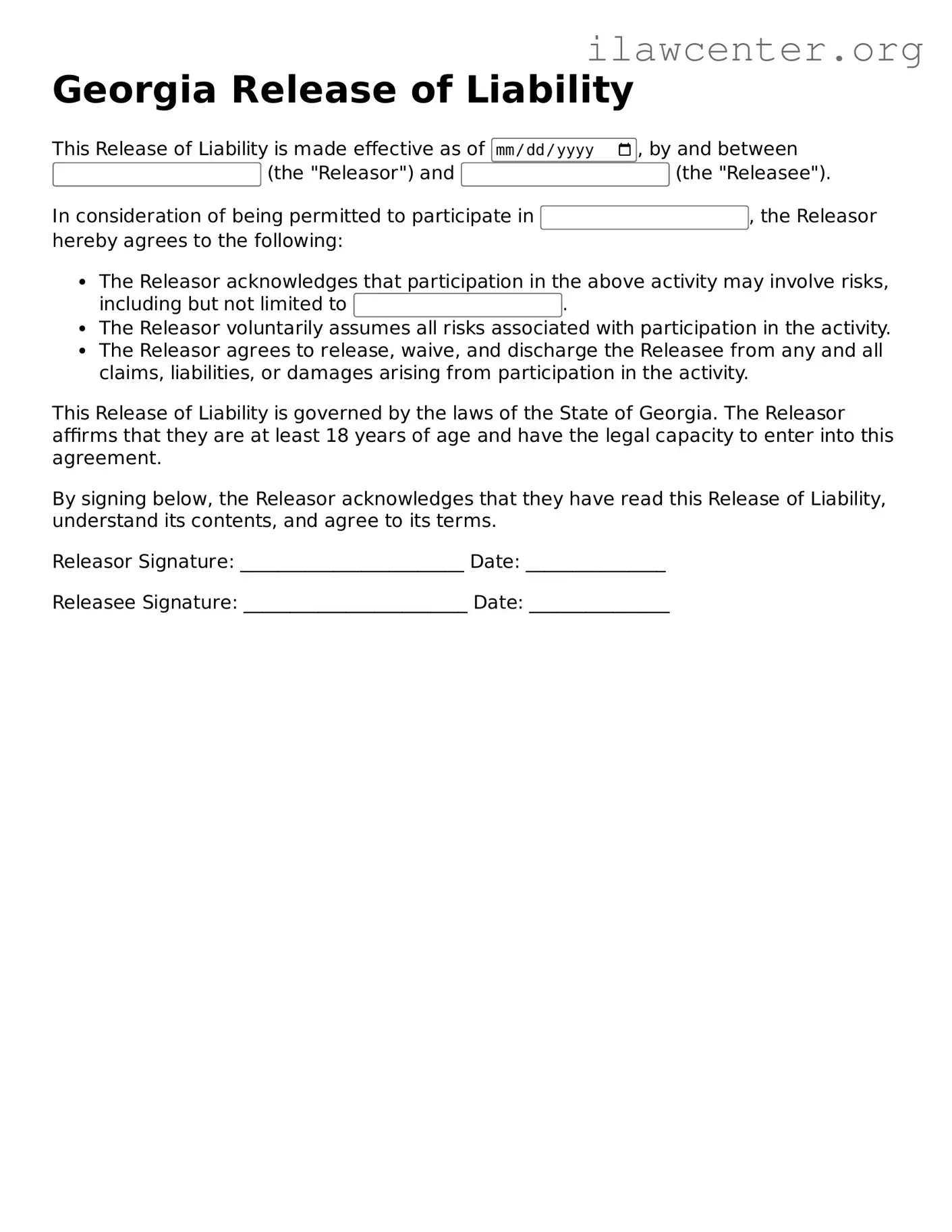
Georgia Release of Liability

This Release of Liability is made effective as of , by and between (the "Releasor") and (the "Releasee").

In consideration of being permitted to participate in , the Releasor hereby agrees to the following:

  • The Releasor acknowledges that participation in the above activity may involve risks, including but not limited to .
  • The Releasor voluntarily assumes all risks associated with participation in the activity.
  • The Releasor agrees to release, waive, and discharge the Releasee from any and all claims, liabilities, or damages arising from participation in the activity.

This Release of Liability is governed by the laws of the State of Georgia. The Releasor affirms that they are at least 18 years of age and have the legal capacity to enter into this agreement.

By signing below, the Releasor acknowledges that they have read this Release of Liability, understand its contents, and agree to its terms.

Releasor Signature: ________________________ Date: _______________

Releasee Signature: ________________________ Date: _______________

PDF Form Characteristics

Fact Name Description
Purpose The Georgia Release of Liability form is designed to protect businesses and individuals from legal claims arising from injuries or damages that occur during an activity.
Governing Law This form is governed by Georgia state law, particularly the principles of tort law and contract law.
Voluntary Participation Participants must voluntarily agree to the terms outlined in the form, acknowledging the risks involved in the activity.
Scope of Liability The release typically covers ordinary negligence but may not protect against gross negligence or willful misconduct.
Minors If a participant is a minor, a parent or guardian must sign the form on their behalf, ensuring that the minor is also protected.
Enforceability For the release to be enforceable, it must be clear, unambiguous, and specific about the risks being assumed.

Instructions on Utilizing Georgia Release of Liability

After obtaining the Georgia Release of Liability form, you will need to carefully complete it to ensure it is valid and effective. This form typically requires specific information related to the parties involved and the activities covered. Follow these steps to fill it out correctly.

  1. Begin by entering the date at the top of the form.
  2. Clearly write your name in the designated area. This is usually where you will identify yourself as the releasor.
  3. Provide your address, including the city, state, and zip code. This information helps to establish your identity.
  4. Identify the individual or organization you are releasing from liability. Write their name in the appropriate section.
  5. Include the address of the individual or organization you are releasing. This should also include the city, state, and zip code.
  6. In the section that describes the activity or event, clearly state what activity you are participating in that requires the release of liability.
  7. Review the language of the release carefully. Make sure you understand what rights you are waiving.
  8. Sign the form where indicated. Your signature indicates your agreement to the terms laid out in the document.
  9. Print your name below your signature to ensure clarity.
  10. If required, have a witness sign the form as well. This may add an extra layer of validity to the document.

Once you have completed the form, make sure to keep a copy for your records. It may be necessary to present this document at the time of the event or activity. Ensure that all parties involved have the necessary documentation before proceeding.

Important Facts about Georgia Release of Liability

What is a Georgia Release of Liability form?

The Georgia Release of Liability form is a legal document designed to protect an individual or organization from being held liable for injuries or damages that may occur during a specific activity or event. By signing this form, participants acknowledge the risks involved and agree not to hold the organizer responsible for any accidents or injuries that may arise.

Who should use a Release of Liability form?

This form is commonly used by businesses, event organizers, sports teams, and recreational facilities. If you are hosting an event or providing a service that carries inherent risks, using this form can help safeguard against potential legal claims from participants.

Is a Release of Liability form enforceable in Georgia?

Yes, a properly drafted and executed Release of Liability form can be enforceable in Georgia. However, certain conditions must be met. The form must be clear, unambiguous, and voluntarily signed by the participant. Additionally, it should not violate public policy or cover gross negligence.

What information should be included in the form?

A well-crafted Release of Liability form should include the names of the parties involved, a detailed description of the activity or event, a statement of risk acknowledgment, and a clause that releases the organizer from liability. It’s also important to include a signature line and date for participants to sign.

Can minors sign a Release of Liability form?

Minors cannot legally sign contracts, including a Release of Liability form. However, a parent or guardian can sign on behalf of a minor. This signature acknowledges the risks and releases liability for the minor’s participation in the activity.

What happens if someone gets injured despite signing the form?

Even with a signed Release of Liability form, an injured party may still pursue legal action. However, the form can serve as a strong defense for the organizer, provided it meets legal requirements. Courts will consider the circumstances of the injury and the clarity of the form.

How can I ensure my Release of Liability form is valid?

To ensure validity, the form should be clear and straightforward. Avoid complex language. It’s advisable to have the form reviewed by a legal professional to confirm that it complies with Georgia laws and adequately protects your interests.

Can a Release of Liability form be revoked?

Generally, once signed, a Release of Liability form cannot be revoked unilaterally. However, if circumstances change significantly or if the form was signed under duress, a court may consider it void. Always communicate clearly with participants about their rights and any changes to the activity.

Where can I obtain a Georgia Release of Liability form?

Release of Liability forms can often be found online through legal document websites or templates. However, it’s crucial to ensure that the form you choose is specifically tailored to Georgia laws and the specific activity in question. Consulting with a legal professional can provide additional guidance.

Common mistakes

Filling out the Georgia Release of Liability form can be straightforward, but many people make common mistakes that can undermine the document's effectiveness. One frequent error is failing to provide complete information. This includes missing names, addresses, or contact details. Omitting any of these can lead to complications if the need arises to enforce the release.

Another mistake is not reading the form carefully. Many individuals rush through the process, overlooking critical clauses or conditions. This can result in misunderstandings about the extent of the release. Understanding what rights are being waived is essential to ensure informed consent.

People often neglect to date the form correctly. A missing or incorrect date can create confusion about when the release was signed. This is particularly important in cases where timing may affect the validity of the release or the statute of limitations for potential claims.

Some individuals fail to sign the document in the appropriate places. A signature is a crucial component of the release, and without it, the form may not hold up in court. Ensure that all required signatures are present, including those of witnesses if necessary.

Not having the form notarized can also be a significant oversight. While notarization may not always be required, having a notary public witness the signing can add an extra layer of legitimacy. This can be particularly beneficial in disputes over the validity of the release.

Finally, individuals sometimes forget to keep a copy of the completed form. Retaining a copy is vital for personal records and can be essential if disputes arise later. Without a copy, proving the terms of the release can become challenging.

Documents used along the form

The Georgia Release of Liability form serves as a crucial document to protect parties from legal claims arising from certain activities. However, it is often accompanied by several other forms and documents that further clarify responsibilities and expectations. Below is a list of these documents, each serving a distinct purpose.

  • Waiver of Liability: This document explicitly states that an individual voluntarily relinquishes their right to pursue legal action against another party for injuries or damages incurred during an activity.
  • Indemnity Agreement: In this agreement, one party agrees to compensate another for any losses or damages that may arise from a specific event or activity, providing an additional layer of protection.
  • Participant Agreement: This document outlines the terms and conditions that participants must agree to before engaging in an activity, ensuring they understand the risks involved.
  • Medical Release Form: This form grants permission for medical treatment in the event of an injury during the activity, allowing organizers to act quickly in emergencies.
  • Parental Consent Form: For minors, this document requires a parent or guardian's approval for participation, acknowledging the risks and responsibilities involved.
  • Emergency Contact Form: This form collects important contact information for individuals who can be reached in case of an emergency, ensuring swift communication during critical situations.
  • Insurance Waiver: This document clarifies that participants are responsible for their own insurance coverage and that the organizing party holds no liability for injuries or damages.
  • Code of Conduct: This outlines expected behavior during the activity, helping to maintain a safe and respectful environment for all participants.
  • Event Registration Form: This form collects essential information about participants, including their consent to the terms outlined in other documents, facilitating organization and accountability.

Each of these documents plays a vital role in establishing clear communication and understanding between parties involved in activities that carry inherent risks. Together, they help to minimize legal disputes and enhance safety for all participants.

Similar forms

  • Waiver of Liability: This document, like the Release of Liability form, is used to protect an individual or organization from legal claims. It typically involves a participant agreeing not to hold the provider responsible for any injuries or damages that may occur during an activity.
  • Indemnity Agreement: Similar to a Release of Liability, an indemnity agreement involves one party agreeing to compensate another for any losses or damages incurred. This document often requires the indemnifying party to cover legal fees as well.
  • Hold Harmless Agreement: This agreement is closely related to the Release of Liability. It protects one party from being held responsible for any injuries or damages that may arise from the activities of another party.
  • Consent Form: A consent form is often used in medical or research settings. It ensures that individuals understand the risks involved in a procedure or study, similar to how a Release of Liability informs participants about potential risks.
  • Participation Agreement: This document outlines the terms and conditions of participation in an event or activity. It often includes a clause that releases the organizers from liability, much like a Release of Liability form.
  • Service Agreement: While primarily focused on the services provided, this agreement may also contain liability clauses that limit the provider's responsibility, similar to the intent of a Release of Liability form.

Dos and Don'ts

When filling out the Georgia Release of Liability form, it's important to approach the task carefully. Here are some guidelines to consider:

  • Do read the entire form thoroughly before filling it out.
  • Do provide accurate and complete information to avoid any misunderstandings.
  • Do sign and date the form in the designated areas.
  • Do keep a copy of the completed form for your records.
  • Don't leave any sections blank unless instructed to do so.
  • Don't rush through the process; take your time to ensure everything is correct.

Misconceptions

Understanding the Georgia Release of Liability form can be challenging, and several misconceptions often arise. Here are seven common misunderstandings about this important document:

  1. It completely absolves liability.

    Many believe that signing a release of liability means a party cannot be held responsible for any wrongdoing. However, this is not entirely true. While it can limit liability for certain activities, it does not protect against gross negligence or intentional misconduct.

  2. It is only necessary for high-risk activities.

    Some people think that releases are only needed for extreme sports or dangerous activities. In reality, any organization or individual can benefit from a release of liability, even for low-risk events.

  3. All releases are the same.

    This misconception leads to the assumption that one release form can be used for any situation. Each release should be tailored to the specific activity and the risks involved, ensuring it meets legal standards.

  4. Minors cannot sign a release.

    While it’s true that minors cannot legally bind themselves to contracts, a parent or guardian can sign on their behalf. This allows the organization to protect itself while still involving minors in activities.

  5. Signing a release means you waive all rights.

    People often think that by signing a release, they give up all their legal rights. In fact, individuals retain certain rights, and the release typically only applies to specific risks associated with the activity.

  6. Releases are only for participants.

    Some assume that only those directly participating in an activity need to sign a release. However, spectators and volunteers may also need to sign, depending on the circumstances and potential risks involved.

  7. A verbal agreement is sufficient.

    Many believe that a simple verbal agreement can replace a written release. However, verbal agreements can be difficult to enforce and may not hold up in court. A written release provides clear documentation of the agreement.

By addressing these misconceptions, individuals and organizations can better understand the purpose and limitations of the Georgia Release of Liability form, ensuring they take the necessary precautions to protect themselves legally.

Key takeaways

When considering the use of the Georgia Release of Liability form, it is essential to understand its purpose and implications. Here are some key takeaways to keep in mind:

  • The form is designed to protect organizations and individuals from legal claims arising from injuries or damages that may occur during an activity.
  • It is crucial to clearly identify all parties involved, including the person or organization being released from liability and the individual signing the form.
  • Participants should read the form carefully to understand what rights they are waiving. This includes the right to sue for negligence or other claims related to the activity.
  • The language used in the form should be straightforward and unambiguous. Any confusing terms may lead to disputes about the form's enforceability.
  • While the form can limit liability, it may not protect against gross negligence or willful misconduct. Courts may not enforce a release if they find it to be unconscionable.
  • It is advisable to have the form reviewed by a legal professional to ensure it complies with Georgia laws and adequately protects the interests of the party seeking the release.
  • Participants should be encouraged to consult with their own legal advisors before signing the form to ensure they fully understand its implications.