Attorney-Verified  Self-Proving Affidavit Document for Georgia

Attorney-Verified Self-Proving Affidavit Document for Georgia

The Georgia Self-Proving Affidavit is a legal document that allows a testator’s will to be validated without the need for witnesses to appear in court. This form simplifies the probate process by providing a sworn statement that confirms the authenticity of the will. To ensure your wishes are honored, consider filling out the Self-Proving Affidavit by clicking the button below.

Article Guide

The Georgia Self-Proving Affidavit is an essential legal document that plays a crucial role in the estate planning process. This form allows a testator, or the person making a will, to affirm the validity of their will in the presence of witnesses. By executing this affidavit, individuals can streamline the probate process, ensuring that their wishes are honored without unnecessary delays. The form requires the signatures of the testator and at least two witnesses, all of whom must affirm that they understand the contents of the will and are signing voluntarily. Additionally, the affidavit must be notarized, adding an extra layer of authenticity. Utilizing the Self-Proving Affidavit can significantly reduce complications during probate, as it eliminates the need for witnesses to testify in court regarding the will's validity. Understanding the importance of this document can help individuals make informed decisions about their estate planning needs.

Georgia Self-Proving Affidavit Preview

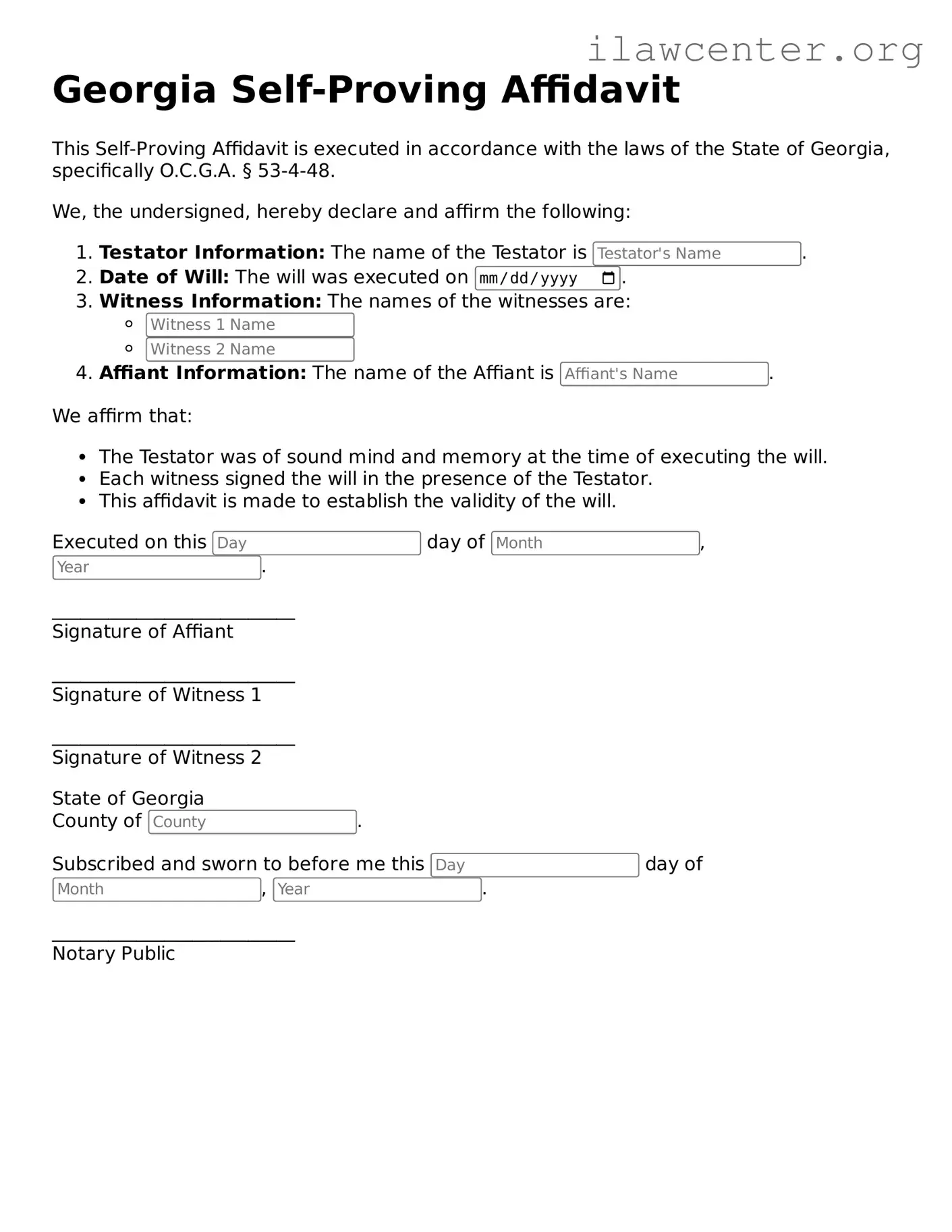
Georgia Self-Proving Affidavit

This Self-Proving Affidavit is executed in accordance with the laws of the State of Georgia, specifically O.C.G.A. § 53-4-48.

We, the undersigned, hereby declare and affirm the following:

  1. Testator Information: The name of the Testator is .
  2. Date of Will: The will was executed on .
  3. Witness Information: The names of the witnesses are:
  4. Affiant Information: The name of the Affiant is .

We affirm that:

  • The Testator was of sound mind and memory at the time of executing the will.
  • Each witness signed the will in the presence of the Testator.
  • This affidavit is made to establish the validity of the will.

Executed on this day of , .

__________________________
Signature of Affiant

__________________________
Signature of Witness 1

__________________________
Signature of Witness 2

State of Georgia
County of .

Subscribed and sworn to before me this day of , .

__________________________
Notary Public

PDF Form Characteristics

Fact Name Description
Purpose The Georgia Self-Proving Affidavit allows a will to be validated without the need for witnesses to testify in court.
Governing Law This form is governed by Georgia Code § 53-4-25, which outlines the requirements for self-proving wills.
Signatures Required The testator and two witnesses must sign the affidavit in the presence of a notary public.
When to Use It is advisable to complete this affidavit at the same time as executing the will to simplify the probate process.
Legal Effect Once executed, the affidavit serves as evidence of the will's validity, reducing potential disputes during probate.

Instructions on Utilizing Georgia Self-Proving Affidavit

After gathering the necessary information, you are ready to fill out the Georgia Self-Proving Affidavit form. This form is an important document that helps streamline the probate process by confirming the validity of a will. Follow these steps carefully to ensure that all required information is accurately provided.

  1. Begin by entering the date on which the affidavit is being signed at the top of the form.
  2. Next, write the name of the testator, the person who created the will, in the designated space.
  3. In the following section, provide the names of the witnesses who will be signing the affidavit. Typically, there should be two witnesses.
  4. Each witness must then sign their name in the space provided. Ensure that they sign in the presence of the testator.
  5. After the witnesses have signed, the testator should also sign the affidavit to confirm their intent.
  6. Next, include the address of the testator and the witnesses. This information is crucial for identification purposes.
  7. If applicable, have a notary public witness the signing of the affidavit. The notary will complete their section by signing and affixing their seal.
  8. Finally, review the entire form for any missing information or errors before submitting it with the will.

Important Facts about Georgia Self-Proving Affidavit

What is a Georgia Self-Proving Affidavit?

A Georgia Self-Proving Affidavit is a legal document that allows a will to be validated without the need for witnesses to testify in court. This affidavit is typically signed by the testator (the person who created the will) and the witnesses in front of a notary public. It simplifies the probate process by providing a sworn statement that the will was executed properly.

Why should I use a Self-Proving Affidavit?

Using a Self-Proving Affidavit can save time and reduce complications during the probate process. If a will is self-proving, the court can accept it without requiring the witnesses to appear. This can be especially beneficial if witnesses are unavailable or if their memories of the signing are unclear.

What are the requirements for a Self-Proving Affidavit in Georgia?

In Georgia, a Self-Proving Affidavit must be signed by the testator and at least two witnesses. All parties must sign in the presence of a notary public. The affidavit must clearly state that the testator signed the will and that the witnesses observed this signing. It is important that the affidavit complies with Georgia law to be considered valid.

Can I create a Self-Proving Affidavit after my will has been signed?

Yes, you can create a Self-Proving Affidavit after your will has been signed, as long as the original will and the required witnesses are available. However, it is best to do this at the time of signing the will to avoid any future issues. If circumstances change, consulting with a legal professional may be helpful.

Where should I keep my Self-Proving Affidavit?

It is advisable to keep your Self-Proving Affidavit with your will in a safe place. This could be a safe deposit box, a fireproof safe, or with a trusted family member or attorney. Ensuring that your loved ones know where to find these documents can help facilitate the probate process when the time comes.

Common mistakes

Filling out the Georgia Self-Proving Affidavit form can be a straightforward process, but many individuals make common mistakes that can lead to complications. One prevalent error occurs when signers fail to include all necessary information. Each section of the form must be completed accurately to ensure the affidavit is valid. Omitting details such as the date of execution or the names of witnesses can render the document ineffective.

Another mistake involves the signatures. The form requires the testator's signature, along with those of the witnesses. Sometimes, people neglect to have witnesses sign the affidavit in the presence of the testator, which is a crucial requirement. If the witnesses do not sign correctly, the affidavit may not hold up in court.

Additionally, individuals often overlook the importance of notarization. In Georgia, a Self-Proving Affidavit must be notarized to be legally binding. Failing to have the document notarized can lead to challenges regarding its authenticity, especially if the will is contested. It is essential to ensure that a notary public is present at the time of signing.

Another common error is misunderstanding the purpose of the affidavit. Some people mistakenly believe that a Self-Proving Affidavit replaces the need for a will. In reality, it serves to simplify the probate process by affirming the validity of the will. Without a properly executed will, the affidavit cannot function as intended.

Lastly, individuals sometimes fail to keep the affidavit with the original will. After completing the Self-Proving Affidavit, it should be stored alongside the will to ensure that it can be easily located when needed. If the affidavit is lost or separated from the will, it may not serve its purpose effectively, potentially complicating the probate process.

Documents used along the form

The Georgia Self-Proving Affidavit is an important document that allows a testator's will to be validated without requiring the witnesses to appear in court. This form is often used in conjunction with other legal documents to ensure a smooth probate process. Below is a list of additional forms and documents that are commonly associated with the Self-Proving Affidavit in Georgia.

  • Last Will and Testament: This is the primary document that outlines how a person's assets will be distributed after their death. It must be signed and witnessed to be valid.
  • Executor's Affidavit: This document is signed by the executor of the estate, affirming their role and responsibilities in managing the estate according to the will.
  • Petition for Probate: This form is filed with the probate court to initiate the probate process. It requests the court to validate the will and appoint the executor.
  • Notice of Probate: After the will is probated, this notice is sent to interested parties, informing them of the proceedings and their rights regarding the estate.
  • Inventory and Appraisal: This document lists all assets of the estate, along with their estimated values. It helps in assessing the total worth of the estate.
  • Final Accounting: This form provides a detailed report of all financial transactions related to the estate, including income, expenses, and distributions to beneficiaries.
  • Waiver of Notice: Beneficiaries may sign this document to waive their right to receive formal notice of probate proceedings, expediting the process.
  • Consent to Serve: This document is signed by the executor, indicating their acceptance of the role and responsibilities associated with managing the estate.

Understanding these documents can help individuals navigate the probate process more effectively. Each form plays a specific role in ensuring that the wishes of the deceased are honored and that the estate is managed properly.

Similar forms

The Self-Proving Affidavit is an important legal document often used in the estate planning process. It serves to validate a will by confirming that the testator signed it in the presence of witnesses. Several other documents share similarities with the Self-Proving Affidavit in terms of purpose and function. Here are eight such documents:

  • Last Will and Testament: This document outlines how a person's assets will be distributed after their death. Like the Self-Proving Affidavit, it requires signatures and may need witnesses to be legally binding.
  • Living Will: A living will provides instructions regarding medical treatment in case an individual becomes incapacitated. Both documents are crucial for expressing personal wishes and require formal execution processes.
  • Powers of Attorney: This document grants someone the authority to act on another's behalf in legal or financial matters. Similar to a Self-Proving Affidavit, it often needs to be notarized to be effective.
  • Trust Agreement: A trust agreement establishes a trust to manage assets on behalf of beneficiaries. It shares the need for clear documentation and signatures, much like a Self-Proving Affidavit.
  • Affidavit of Death: This document confirms a person's death and is often used in probate proceedings. It requires sworn statements, similar to the affirmations made in a Self-Proving Affidavit.
  • Certificate of Trust: This document provides evidence of the existence of a trust and its terms. Both documents serve to validate intentions and may need to be presented in legal settings.
  • Durable Power of Attorney for Health Care: This document allows someone to make health care decisions on behalf of another. Like the Self-Proving Affidavit, it emphasizes the importance of personal choice and may require witnesses.
  • Codicil: A codicil is an amendment to an existing will. It must be executed with the same formalities as the original will, similar to the requirements of a Self-Proving Affidavit.

Understanding these documents can help individuals navigate the complexities of estate planning and ensure their wishes are honored. Each document plays a unique role, but they all share the common goal of providing clarity and legal validation in personal affairs.

Dos and Don'ts

When filling out the Georgia Self-Proving Affidavit form, it is essential to follow specific guidelines to ensure accuracy and compliance. Here is a list of things you should and shouldn't do:

  • Do read the form thoroughly before starting to fill it out.
  • Do provide accurate information about the testator and witnesses.
  • Do sign the affidavit in the presence of a notary public.
  • Do ensure that all required fields are completed.
  • Do keep a copy of the signed affidavit for your records.
  • Don't rush through the form; take your time to avoid mistakes.
  • Don't leave any sections blank unless instructed.
  • Don't sign the affidavit without the notary present.
  • Don't forget to check the signature dates of all parties involved.

Misconceptions

Understanding the Georgia Self-Proving Affidavit can be tricky. Many people hold misconceptions about this important legal document. Here are ten common misunderstandings, clarified for your benefit:

  1. It is only for wealthy individuals. Many believe that only those with significant assets need a Self-Proving Affidavit. In reality, anyone with a will can benefit from this form, regardless of their financial situation.
  2. It is the same as a standard affidavit. While both are affidavits, a Self-Proving Affidavit specifically relates to wills and confirms that the will was executed properly.
  3. It eliminates the need for witnesses. Some think that using this form means witnesses are not required at all. However, witnesses are still necessary during the signing of the will itself.
  4. It must be filed with the court immediately. Many assume that the Self-Proving Affidavit must be submitted right away. In truth, it can be presented during the probate process when the will is submitted.
  5. Only lawyers can prepare it. While having legal assistance can be beneficial, individuals can fill out a Self-Proving Affidavit on their own if they understand the requirements.
  6. It guarantees the will will be accepted. A Self-Proving Affidavit does not guarantee that a will will be accepted by the court. It simply helps streamline the probate process.
  7. It is only for handwritten wills. Some people think this form is only applicable to handwritten documents. In fact, it can be used for both typed and handwritten wills.
  8. It can be signed after the will is executed. This is a common misconception. The Self-Proving Affidavit must be signed at the same time as the will to be valid.
  9. It is not legally binding. Many believe that this affidavit holds no legal weight. On the contrary, it is a legally binding document that can expedite the probate process.
  10. It is only necessary in Georgia. While this form is specific to Georgia, similar self-proving affidavits exist in other states, each with its own rules and requirements.

Being aware of these misconceptions can help you navigate the process of estate planning more effectively. Understanding the Self-Proving Affidavit can ensure that your wishes are honored and that your loved ones are taken care of after your passing.

Key takeaways

When filling out and using the Georgia Self-Proving Affidavit form, keep these key takeaways in mind:

  • The Self-Proving Affidavit is a legal document that helps prove the validity of a will without needing witnesses in court.
  • It must be signed by the testator (the person making the will) and two witnesses in the presence of a notary public.
  • Ensure all signatures are notarized at the same time to avoid complications later.
  • Keep the affidavit with the will to streamline the probate process when the time comes.
  • Filling it out correctly can save time and reduce legal challenges to the will.
  • Consulting with a legal professional can provide clarity and ensure everything is in order.