Attorney-Verified  Small Estate Affidavit Document for Georgia

Attorney-Verified Small Estate Affidavit Document for Georgia

The Georgia Small Estate Affidavit is a legal document that allows individuals to claim property and assets of a deceased person without going through the lengthy probate process. This form is particularly useful for estates that do not exceed a certain value, simplifying the transfer of assets to rightful heirs. To get started on your Small Estate Affidavit, click the button below.

Article Guide

In Georgia, managing the estate of a deceased individual can often feel overwhelming, especially when it comes to navigating the legal requirements. For those dealing with smaller estates, the Georgia Small Estate Affidavit offers a streamlined process to transfer assets without the need for formal probate. This form is particularly useful for estates valued at $10,000 or less, excluding certain property types. By utilizing the Small Estate Affidavit, heirs can claim personal property, bank accounts, and other assets more efficiently. The affidavit requires specific information, including details about the deceased, the heirs, and the assets involved. Additionally, it must be signed under oath, ensuring that all provided information is accurate and truthful. This process not only simplifies the transfer of assets but also helps families avoid the lengthy and often costly probate process, allowing them to focus on what truly matters during a difficult time.

Georgia Small Estate Affidavit Preview

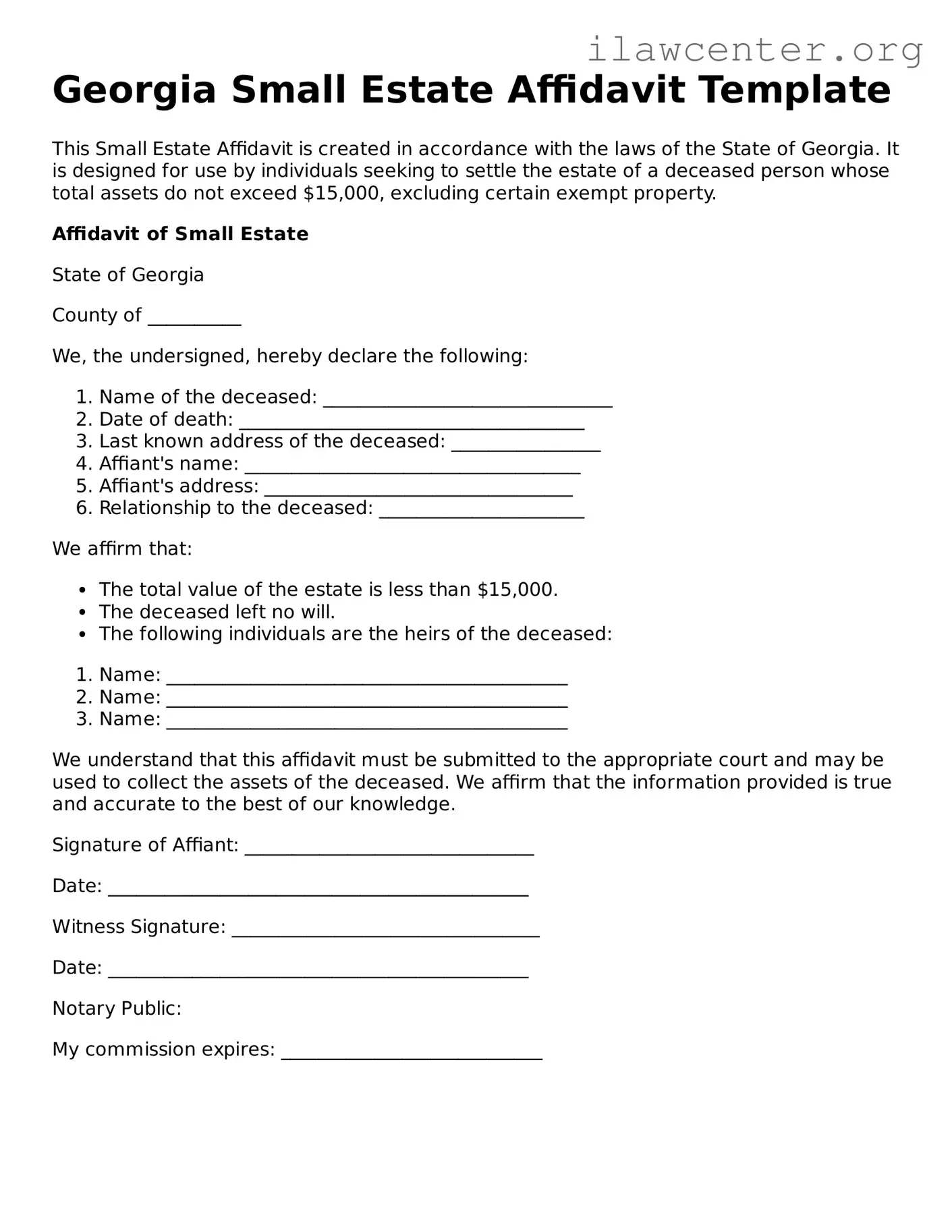
Georgia Small Estate Affidavit Template

This Small Estate Affidavit is created in accordance with the laws of the State of Georgia. It is designed for use by individuals seeking to settle the estate of a deceased person whose total assets do not exceed $15,000, excluding certain exempt property.

Affidavit of Small Estate

State of Georgia

County of __________

We, the undersigned, hereby declare the following:

  1. Name of the deceased: _______________________________
  2. Date of death: _____________________________________
  3. Last known address of the deceased: ________________
  4. Affiant's name: ____________________________________
  5. Affiant's address: _________________________________
  6. Relationship to the deceased: ______________________

We affirm that:

  • The total value of the estate is less than $15,000.
  • The deceased left no will.
  • The following individuals are the heirs of the deceased:
  1. Name: ___________________________________________
  2. Name: ___________________________________________
  3. Name: ___________________________________________

We understand that this affidavit must be submitted to the appropriate court and may be used to collect the assets of the deceased. We affirm that the information provided is true and accurate to the best of our knowledge.

Signature of Affiant: _______________________________

Date: _____________________________________________

Witness Signature: _________________________________

Date: _____________________________________________

Notary Public:

My commission expires: ____________________________

PDF Form Characteristics

Fact Name Description
Purpose The Georgia Small Estate Affidavit is used to simplify the process of settling small estates without going through formal probate.
Eligibility This form is applicable for estates where the total value of the property is $10,000 or less, excluding certain exemptions.
Governing Law The use of the Small Estate Affidavit in Georgia is governed by O.C.G.A. § 53-2-40.
Filing Requirements The affidavit must be signed by the heirs or beneficiaries of the estate and filed with the appropriate court.
Required Information The form requires details such as the deceased's name, date of death, and a list of assets.
Assets Excluded Certain types of assets, such as jointly owned property and life insurance policies, may not be included in the estate value calculation.
Timeframe Heirs must wait a minimum of 30 days after the death before filing the affidavit.
Legal Assistance While individuals can complete the affidavit without an attorney, seeking legal advice is recommended for clarity and compliance.

Instructions on Utilizing Georgia Small Estate Affidavit

After obtaining the Georgia Small Estate Affidavit form, you will need to provide specific information about the deceased and the estate. Follow these steps carefully to ensure that the form is completed accurately.

  1. Begin by entering the full name of the deceased at the top of the form.
  2. Provide the date of death of the deceased in the designated area.
  3. Fill in the last known address of the deceased, including the city, state, and zip code.
  4. List the names and addresses of all heirs or beneficiaries who are entitled to the estate.
  5. Indicate the total value of the estate, making sure to include all relevant assets.
  6. Sign the affidavit, affirming that the information provided is true and correct.
  7. Have the affidavit notarized by a licensed notary public.
  8. Make copies of the completed and notarized affidavit for your records and for any heirs or beneficiaries.

Once you have filled out the form, you will need to file it with the appropriate probate court in Georgia. This step is crucial to ensure that the estate is handled according to state laws and that the heirs receive their rightful shares.

Important Facts about Georgia Small Estate Affidavit

What is a Small Estate Affidavit in Georgia?

A Small Estate Affidavit is a legal document that allows individuals to settle the estate of someone who has passed away without going through the full probate process. In Georgia, this option is available when the total value of the deceased's estate is below a certain threshold, which is currently set at $15,000 for personal property and $10,000 for real property, excluding certain debts and liabilities.

Who can use a Small Estate Affidavit?

Typically, the surviving spouse, adult children, or other close relatives of the deceased can use the Small Estate Affidavit. It is essential that the person filing the affidavit is entitled to inherit under Georgia law. If there are no surviving relatives, a close friend or individual named in the will may also qualify.

What are the requirements to file a Small Estate Affidavit?

To file a Small Estate Affidavit in Georgia, the estate must meet specific criteria. The total value of the estate must be below the limits mentioned earlier. Additionally, the deceased must have been a resident of Georgia at the time of death. The affidavit must be signed by the person filing it and notarized. It is also important to provide a copy of the death certificate.

How do I complete the Small Estate Affidavit form?

Completing the Small Estate Affidavit form involves filling in information about the deceased, the affiant (the person filing), and the assets of the estate. Be sure to include details about any debts and liabilities. The form should be signed in front of a notary public. It is advisable to double-check all information for accuracy before submission.

Where do I file the Small Estate Affidavit?

The Small Estate Affidavit must be filed with the probate court in the county where the deceased lived at the time of death. After filing, the court will review the affidavit and may issue an order allowing the distribution of the estate's assets.

What happens after I file the Small Estate Affidavit?

Once the Small Estate Affidavit is filed and accepted by the probate court, the affiant can begin distributing the assets of the estate according to Georgia law. This includes transferring ownership of property and settling any outstanding debts. It is important to keep records of all transactions related to the estate.

Are there any fees associated with filing the Small Estate Affidavit?

Yes, there are typically fees associated with filing a Small Estate Affidavit. These fees can vary by county, so it is a good idea to check with the local probate court for specific amounts. Additionally, there may be fees for obtaining certified copies of the affidavit or other documents.

Can I use a Small Estate Affidavit if there is a will?

Yes, you can use a Small Estate Affidavit even if there is a will. However, the will must be submitted to the probate court along with the affidavit. The court will ensure that the distribution of the estate aligns with the wishes expressed in the will, as long as it complies with Georgia law.

What if there are disputes among heirs?

If there are disputes among heirs regarding the estate, it may complicate the use of a Small Estate Affidavit. In such cases, it may be necessary to seek legal advice or consider formal probate proceedings to resolve the issues. Open communication among heirs can often help in reaching an agreement.
Common mistakes

Filling out the Georgia Small Estate Affidavit can seem straightforward, but many people make common mistakes that can delay the process or even lead to rejection. One frequent error is failing to provide accurate information about the deceased. It is essential to include the full legal name, date of death, and last known address. Omitting any of these details can result in complications.

Another mistake is neglecting to list all the assets of the deceased. The Small Estate Affidavit is only valid if it includes a complete inventory of the estate’s assets. This includes bank accounts, real estate, and personal property. Leaving out even one asset can invalidate the affidavit.

Many individuals also forget to include the necessary signatures. The affidavit must be signed by the affiant, who is typically the person claiming the estate. Additionally, witnesses may need to sign as well, depending on the situation. Missing signatures can halt the process entirely.

Inaccurate valuations of assets can lead to problems too. People often underestimate or overestimate the value of property or accounts. Accurate valuations are crucial for ensuring the estate meets the small estate threshold set by Georgia law. Double-checking these values can save time and effort later.

Not providing proper identification is another common issue. When submitting the affidavit, the affiant must include a copy of their government-issued ID. Failing to do so can result in the affidavit being rejected. Always attach the necessary identification to avoid this pitfall.

Some individuals may not understand the requirement for notarization. The Small Estate Affidavit must be notarized to be considered valid. Skipping this step can lead to significant delays in the estate settlement process.

Another frequent oversight is not checking for updates in the law. Georgia’s estate laws can change, and it’s vital to ensure that the form being used is the most current version. Using outdated forms can lead to complications and additional paperwork.

Finally, many people underestimate the importance of reviewing the completed affidavit for accuracy. A thorough review can catch mistakes before submission. Errors can lead to delays or even the need to start the process over. Taking the time to double-check everything can prevent unnecessary headaches.

Documents used along the form

The Georgia Small Estate Affidavit is a useful document for settling the estate of a deceased person when the estate's value is below a certain threshold. Along with this affidavit, several other forms and documents may be necessary to ensure a smooth process. Here is a list of commonly used documents that can accompany the Small Estate Affidavit.

  • Death Certificate: This official document confirms the death of the individual and is typically required to initiate the estate settlement process.
  • Will: If the deceased left a will, it may need to be submitted along with the Small Estate Affidavit to clarify the distribution of assets.
  • List of Assets: A detailed inventory of the deceased's assets helps provide clarity on what is included in the small estate.
  • Affidavit of Heirship: This document may be used to establish the legal heirs of the deceased, especially if there is no will.
  • Notice to Creditors: This form notifies creditors of the estate's settlement, allowing them to make claims against the estate if necessary.
  • Bank Account Statements: Recent statements can help identify the deceased's financial holdings and any outstanding obligations.
  • Tax Returns: The deceased's last tax returns may be required to assess any tax liabilities or refunds due to the estate.
  • Petition for Letters of Administration: If no will exists, this petition may be necessary to appoint an administrator for the estate.
  • Release of Claims: This document can be used to confirm that heirs or beneficiaries waive their rights to make further claims against the estate.

These documents work together with the Georgia Small Estate Affidavit to facilitate the efficient resolution of an estate. Properly preparing and submitting these forms can help ensure that the estate is settled in accordance with the law and the wishes of the deceased.

Similar forms

  • Affidavit of Heirship: This document identifies the rightful heirs of a deceased person, similar to how a Small Estate Affidavit establishes who is entitled to inherit the estate. Both documents help streamline the transfer of assets without the need for probate.
  • Will: A will outlines a person's wishes regarding the distribution of their assets after death. Like the Small Estate Affidavit, it serves to clarify the intent of the deceased and can expedite the transfer of property.
  • Probate Petition: This legal document initiates the probate process for larger estates. While the Small Estate Affidavit allows for a simplified process, both documents aim to ensure that assets are distributed according to the law.
  • Trust: A trust is a legal arrangement that holds assets for beneficiaries. Similar to the Small Estate Affidavit, it provides a mechanism for transferring property outside of probate, ensuring a smooth transition of assets.
  • Letters of Administration: This document grants authority to an administrator to manage a deceased person’s estate. While the Small Estate Affidavit allows heirs to claim assets directly, both documents facilitate the management and distribution of the estate.
  • Release of Claim: This document is used to relinquish any claims against an estate. Like the Small Estate Affidavit, it helps clarify the rights of individuals regarding the estate, ensuring that assets are distributed without dispute.
  • Declaration of Trust: Similar to a Small Estate Affidavit, this document outlines the terms of a trust and the beneficiaries involved. Both serve to protect the wishes of the deceased and ensure proper distribution of assets.
  • Transfer on Death Deed: This document allows property to be transferred directly to a beneficiary upon death. Like the Small Estate Affidavit, it simplifies the transfer process and avoids probate for certain assets.

Dos and Don'ts

When filling out the Georgia Small Estate Affidavit form, it’s essential to approach the process carefully. Here are ten important dos and don’ts to keep in mind:

  • Do ensure you meet the eligibility requirements for a small estate.
  • Do provide accurate information about the deceased’s assets and liabilities.
  • Do include the full legal name of the deceased as it appears on official documents.
  • Do sign the affidavit in front of a notary public.
  • Do keep copies of the completed affidavit for your records.
  • Don't omit any required information; incomplete forms can lead to delays.
  • Don't use outdated versions of the form; always check for the latest version.
  • Don't attempt to file the affidavit without understanding the process.
  • Don't forget to list all beneficiaries accurately.
  • Don't rush through the process; take your time to ensure everything is correct.

Following these guidelines will help you navigate the Small Estate Affidavit process more smoothly, ensuring that you honor the memory of your loved one while fulfilling legal obligations.

Misconceptions

Misconceptions about the Georgia Small Estate Affidavit form can lead to confusion for individuals navigating the estate settlement process. Here are five common misconceptions:

  • The Small Estate Affidavit can only be used for estates under $10,000. This is incorrect. In Georgia, the Small Estate Affidavit can be used for estates valued at $10,000 or less, excluding certain types of property, such as real estate. However, the total value of the estate must still meet the criteria set forth by the law.
  • Only family members can file a Small Estate Affidavit. This is a misconception. While family members often file the affidavit, any person who is entitled to inherit from the estate may file it. This includes friends or other beneficiaries, as long as they meet the legal requirements.
  • The Small Estate Affidavit eliminates the need for probate. While the affidavit simplifies the process and can avoid formal probate, it does not completely eliminate the need for probate in all situations. If disputes arise or if the estate includes certain assets, formal probate may still be necessary.
  • All debts must be paid before filing the Small Estate Affidavit. This is misleading. While it is advisable to settle debts, the affidavit can be filed even if some debts remain unpaid. However, the estate must still be responsible for settling these debts before distributing assets to heirs.
  • The Small Estate Affidavit is a legal document that requires an attorney to complete. This is not entirely true. Individuals can complete the affidavit without an attorney, as long as they understand the requirements. However, seeking legal advice may help ensure that the process is handled correctly.

Key takeaways

Filling out and using the Georgia Small Estate Affidavit form can be a straightforward process, but there are important considerations to keep in mind. Below are key takeaways to ensure you navigate this process effectively.

  • The Small Estate Affidavit is designed for estates valued at $10,000 or less, excluding certain types of property.
  • To use the affidavit, you must be an heir or a beneficiary of the deceased's estate.
  • Gather necessary documents, including the death certificate and proof of relationship to the deceased.
  • The form must be signed in the presence of a notary public to validate the information provided.
  • Once completed, the affidavit can be presented to banks, financial institutions, or other entities holding the deceased's assets.
  • It is essential to ensure that all information is accurate and complete to avoid delays in asset distribution.
  • Filing the affidavit does not require court approval, making it a quicker option for settling small estates.
  • Consulting with a legal professional can provide guidance and help address any specific questions or concerns.

Understanding these points can simplify the process and help ensure that the estate is settled efficiently.