Attorney-Verified  Trailer Bill of Sale Document for Georgia

Attorney-Verified Trailer Bill of Sale Document for Georgia

The Georgia Trailer Bill of Sale form is a legal document used to record the sale and transfer of ownership of a trailer in the state of Georgia. This form serves as proof of the transaction and outlines essential details such as the buyer and seller's information, trailer description, and sale price. To ensure a smooth transfer of ownership, it is important to fill out this form accurately.

Ready to complete your transaction? Click the button below to fill out the form.

Article Guide

The Georgia Trailer Bill of Sale form serves as a crucial document in the transfer of ownership for trailers within the state. This form captures essential information about the trailer, including its make, model, year, and Vehicle Identification Number (VIN). It also requires the names and addresses of both the seller and the buyer, ensuring that all parties involved are clearly identified. In addition to these details, the form typically includes the purchase price and the date of the transaction, which are important for record-keeping and potential tax purposes. Signatures from both the seller and the buyer are necessary to validate the agreement, providing a legal acknowledgment of the transfer. This document plays a vital role in protecting the interests of both parties and ensuring compliance with state regulations during the sale process.

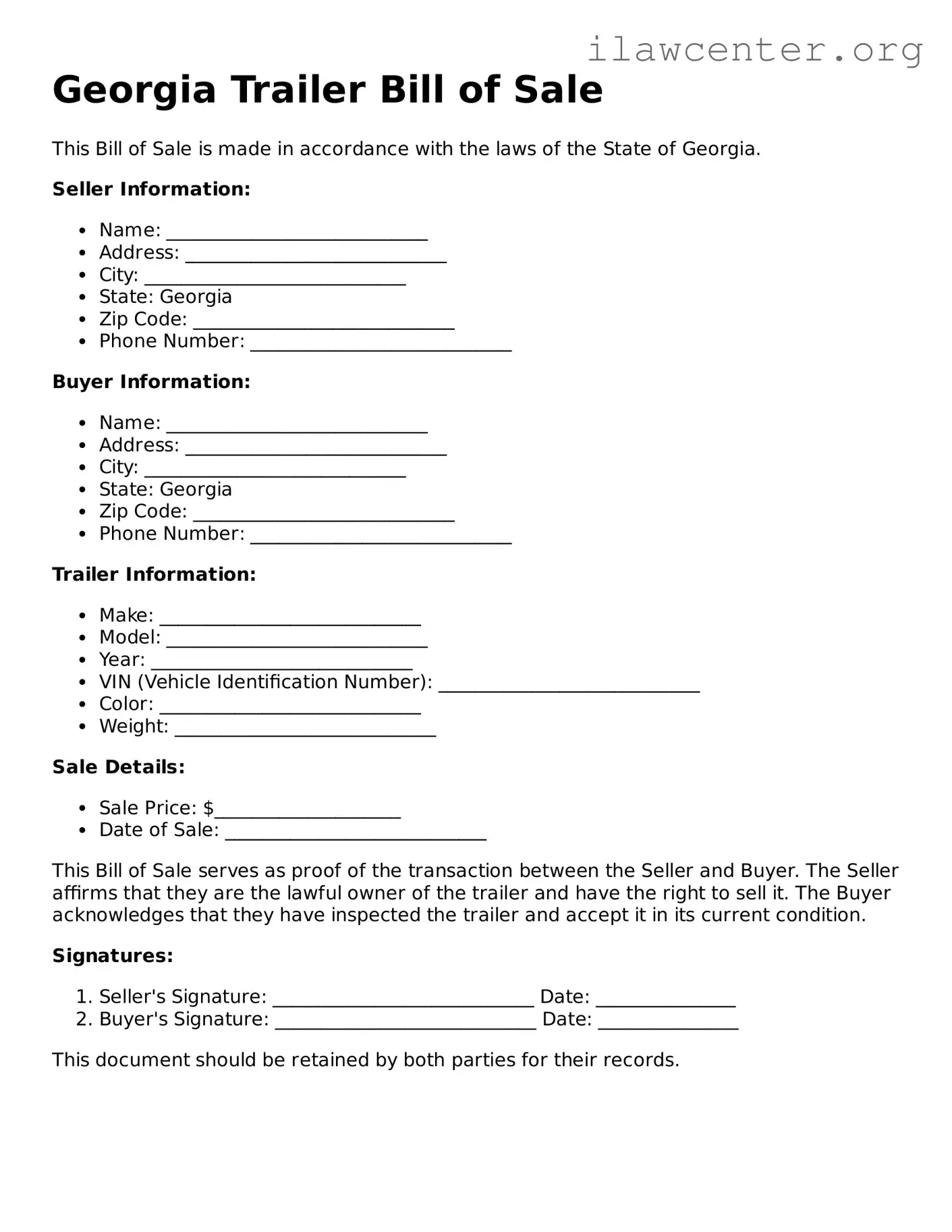
Georgia Trailer Bill of Sale Preview

Georgia Trailer Bill of Sale

This Bill of Sale is made in accordance with the laws of the State of Georgia.

Seller Information:

  • Name: ____________________________
  • Address: ____________________________
  • City: ____________________________
  • State: Georgia
  • Zip Code: ____________________________
  • Phone Number: ____________________________

Buyer Information:

  • Name: ____________________________
  • Address: ____________________________
  • City: ____________________________
  • State: Georgia
  • Zip Code: ____________________________
  • Phone Number: ____________________________

Trailer Information:

  • Make: ____________________________
  • Model: ____________________________
  • Year: ____________________________
  • VIN (Vehicle Identification Number): ____________________________
  • Color: ____________________________
  • Weight: ____________________________

Sale Details:

  • Sale Price: $____________________
  • Date of Sale: ____________________________

This Bill of Sale serves as proof of the transaction between the Seller and Buyer. The Seller affirms that they are the lawful owner of the trailer and have the right to sell it. The Buyer acknowledges that they have inspected the trailer and accept it in its current condition.

Signatures:

  1. Seller's Signature: ____________________________ Date: _______________
  2. Buyer's Signature: ____________________________ Date: _______________

This document should be retained by both parties for their records.

PDF Form Characteristics

Fact Name Description
Purpose The Georgia Trailer Bill of Sale form is used to document the sale and transfer of ownership of a trailer in the state of Georgia.
Legal Requirement While not mandated by law, using a Bill of Sale is highly recommended to protect both the buyer and seller during the transaction.
Governing Law The form is governed by Georgia state law, specifically the Official Code of Georgia Annotated (O.C.G.A.) § 40-2-20.
Information Included The form typically includes details such as the trailer's make, model, year, Vehicle Identification Number (VIN), and sale price.
Signatures Required Both the seller and buyer must sign the document to validate the transfer of ownership.
Notarization Although notarization is not required, having the Bill of Sale notarized can add an extra layer of security and authenticity.
Use for Registration The completed Bill of Sale can be used to register the trailer with the Georgia Department of Revenue.
Retention of Copy Both parties should retain a copy of the Bill of Sale for their records, as it serves as proof of the transaction.
Potential Tax Implications Sales tax may be applicable based on the sale price, and it is the buyer's responsibility to pay this tax during registration.

Instructions on Utilizing Georgia Trailer Bill of Sale

After you have gathered all the necessary information, you can begin filling out the Georgia Trailer Bill of Sale form. This document is essential for transferring ownership of a trailer from one party to another. Make sure to provide accurate details to ensure a smooth transaction.

  1. Start by entering the date of the sale at the top of the form.
  2. Fill in the name and address of the seller. This should include the seller's full legal name, street address, city, state, and ZIP code.
  3. Next, provide the buyer's name and address. Just like with the seller, include the buyer's full legal name, street address, city, state, and ZIP code.
  4. In the designated section, describe the trailer being sold. Include details such as the make, model, year, color, and Vehicle Identification Number (VIN).
  5. Indicate the sale price of the trailer. Make sure to write the amount clearly in both numbers and words.
  6. Both the seller and buyer need to sign the form. Ensure that signatures are dated as well.
  7. If applicable, include any additional terms or conditions of the sale in the provided section.

Once you have completed the form, review it for accuracy. Both parties should keep a copy for their records after signing. This will help ensure that the transfer of ownership is officially documented.

Important Facts about Georgia Trailer Bill of Sale

What is a Georgia Trailer Bill of Sale?

A Georgia Trailer Bill of Sale is a legal document that records the sale and transfer of ownership of a trailer in the state of Georgia. This form includes important details such as the seller's and buyer's information, the trailer's description, and the sale price. Having a properly completed bill of sale is crucial for both parties, as it serves as proof of the transaction and can be used for registration purposes.

Do I need a bill of sale to sell a trailer in Georgia?

Yes, while it is not legally required to have a bill of sale for every trailer sale in Georgia, it is highly recommended. A bill of sale provides legal protection for both the seller and the buyer. It helps establish ownership and can be essential if any disputes arise in the future. Additionally, the Georgia Department of Revenue may require a bill of sale when registering the trailer in the new owner's name.

What information should be included in the bill of sale?

The bill of sale should include several key pieces of information. This includes the full names and addresses of both the seller and buyer, a detailed description of the trailer (including make, model, year, and VIN), the sale price, and the date of the transaction. Both parties should sign the document to confirm the agreement. It’s also wise to keep a copy for personal records.

Can I create my own bill of sale, or do I need a specific form?

You can certainly create your own bill of sale as long as it includes all the necessary information. However, using a specific form designed for Georgia can simplify the process and ensure that you don’t miss any important details. Many online resources offer templates tailored to Georgia's requirements, making it easy to fill out and complete the transaction correctly.

Common mistakes

When individuals fill out the Georgia Trailer Bill of Sale form, they often overlook critical details that can lead to complications down the line. One common mistake is failing to provide accurate identification information. This includes not only the names of the buyer and seller but also their addresses and contact numbers. Incomplete or incorrect information can cause delays in the transfer of ownership and may lead to disputes.

Another frequent error involves the description of the trailer itself. Buyers and sellers sometimes neglect to include essential details such as the trailer's make, model, year, and Vehicle Identification Number (VIN). This omission can create confusion regarding the specific trailer being sold, potentially resulting in legal issues if the trailer's identity is called into question.

Additionally, individuals often forget to include the purchase price of the trailer. This figure is crucial for both parties, as it establishes the financial terms of the sale. Without this information, the transaction may be deemed incomplete, and the buyer could face challenges when attempting to register the trailer with the state.

Another mistake is the failure to sign and date the form. Both the buyer and seller must sign the bill of sale to validate the transaction. If either party neglects to do so, the document may be rendered ineffective, leading to potential disputes over ownership or the terms of the sale.

People also tend to overlook the importance of notary acknowledgment. While not always required, having the bill of sale notarized can provide an extra layer of protection for both parties. A notarized document is often considered more credible and can help prevent future disputes.

Furthermore, individuals may not retain copies of the completed bill of sale. Keeping a copy is essential for record-keeping purposes. It serves as proof of the transaction and can be useful for future reference, particularly if issues arise regarding ownership or registration.

Lastly, many fail to check for any additional requirements specific to their county or municipality. Local regulations may impose additional stipulations that need to be met when completing a trailer sale. Ignoring these local requirements can result in fines or complications during the registration process.

Documents used along the form

When purchasing or selling a trailer in Georgia, several documents may accompany the Trailer Bill of Sale form to ensure a smooth transaction. Each of these documents serves a specific purpose and helps protect both the buyer and seller. Below is a list of common forms and documents used in conjunction with the Trailer Bill of Sale.

  • Title Transfer Document: This document officially transfers ownership of the trailer from the seller to the buyer. It includes details about the trailer, such as the Vehicle Identification Number (VIN) and the names of both parties.
  • Registration Application: After the sale, the buyer must register the trailer with the state. This application collects information necessary for the state to issue a new registration and license plate.
  • Odometer Disclosure Statement: If the trailer is equipped with a motor, this statement records the odometer reading at the time of sale. It helps prevent fraud by ensuring the buyer is aware of the trailer's mileage.
  • Bill of Sale for Personal Property: In some cases, a general bill of sale may be used to document the transaction. This document outlines the terms of the sale and can serve as proof of the agreement.
  • Proof of Insurance: Buyers may be required to provide proof of insurance before the trailer can be registered. This document confirms that the buyer has obtained the necessary insurance coverage for the trailer.

Having these documents ready can streamline the buying or selling process and ensure compliance with state regulations. Each form plays a crucial role in safeguarding the interests of both parties involved in the transaction.

Similar forms

The Trailer Bill of Sale form is an important document used in the transfer of ownership for trailers. Several other documents serve similar purposes in various contexts. Here are six documents that are comparable to the Trailer Bill of Sale:

  • Vehicle Bill of Sale: This document is used for the sale of motor vehicles, including cars and trucks. Like the Trailer Bill of Sale, it provides proof of the transfer of ownership and includes details about the vehicle and the buyer and seller.
  • Boat Bill of Sale: Similar to the Trailer Bill of Sale, this document is used when buying or selling a boat. It outlines the terms of the sale and serves as proof of ownership transfer.
  • Motorcycle Bill of Sale: This document is specifically for motorcycles. It includes information about the motorcycle, the buyer, and the seller, ensuring a clear record of the transaction, much like the Trailer Bill of Sale.
  • RV Bill of Sale: When purchasing or selling a recreational vehicle (RV), this document is used. It details the transaction and serves as proof of ownership, paralleling the purpose of the Trailer Bill of Sale.
  • Equipment Bill of Sale: This document is used for the sale of heavy machinery or equipment. It functions similarly to the Trailer Bill of Sale by providing a record of the transaction and confirming the transfer of ownership.
  • Personal Property Bill of Sale: This broader document can be used for various types of personal property transactions. It captures essential details of the sale and acts as proof of ownership transfer, akin to the Trailer Bill of Sale.

Dos and Don'ts

When filling out the Georgia Trailer Bill of Sale form, it’s important to follow certain guidelines to ensure accuracy and compliance. Below is a list of dos and don'ts to help you navigate the process effectively.

Things You Should Do:

  • Provide complete and accurate information about the trailer, including make, model, year, and VIN.
  • Include the names and addresses of both the buyer and seller.
  • Clearly state the sale price of the trailer.
  • Sign and date the form to validate the transaction.

Things You Shouldn't Do:

  • Do not leave any fields blank; incomplete forms may cause delays.
  • Avoid using incorrect or outdated information about the trailer.
  • Do not forget to provide a copy of the bill of sale to the buyer.
  • Refrain from altering the form after it has been signed by both parties.

Misconceptions

The Georgia Trailer Bill of Sale form is an important document for anyone buying or selling a trailer in the state. However, there are several misconceptions that can lead to confusion. Here are eight common misunderstandings about this form:

  • It’s not necessary for all trailer sales. Some people believe that a bill of sale is only needed for large transactions. In Georgia, a bill of sale is recommended for all trailer sales, regardless of the price.
  • It doesn’t need to be notarized. Many assume that a bill of sale does not require notarization. While notarization is not mandatory in Georgia, having a notary can add an extra layer of security and validity.
  • Only the seller needs to sign it. Some think that only the seller's signature is required. In reality, both the buyer and seller should sign the document to confirm the transaction.
  • It’s the same as a title. There’s a belief that a bill of sale is equivalent to a trailer title. However, the bill of sale serves as proof of the transaction, while the title proves ownership.
  • It can be verbal. Some people think that a verbal agreement is sufficient. A written bill of sale is essential to protect both parties in the event of a dispute.
  • All information is optional. Many believe that they can leave out details. In fact, including accurate information, such as the trailer's VIN, is crucial for proper documentation.
  • It’s only for used trailers. There’s a misconception that this form is only necessary for used trailers. New trailer sales also benefit from a bill of sale to document the transaction.
  • It’s only needed for private sales. Some think that only private sales require a bill of sale. In reality, even dealerships may provide a bill of sale for transparency in transactions.

Understanding these misconceptions can help ensure that the buying or selling process goes smoothly. Always consider using a bill of sale to safeguard your interests in any trailer transaction.

Key takeaways

When dealing with the Georgia Trailer Bill of Sale form, several key points are essential for ensuring a smooth transaction. Below are five important takeaways:

  1. Accurate Information: Ensure that all details, including the seller's and buyer's names, addresses, and the trailer's identification number, are filled out correctly. Mistakes can lead to complications in ownership transfer.
  2. Purchase Price: Clearly state the agreed-upon purchase price. This amount is crucial for both parties and may be referenced for tax purposes.
  3. Signatures Required: Both the seller and buyer must sign the form. Without these signatures, the bill of sale is not legally binding.
  4. Notarization: While notarization is not mandatory in Georgia, having the bill of sale notarized can provide an additional layer of protection and legitimacy to the transaction.
  5. Keep Copies: After completing the form, both parties should retain copies for their records. This documentation can be important for future reference or if disputes arise.