Attorney-Verified  Transfer-on-Death Deed Document for Georgia

Attorney-Verified Transfer-on-Death Deed Document for Georgia

The Georgia Transfer-on-Death Deed form allows property owners to transfer their real estate to beneficiaries upon their death, without the need for probate. This legal tool simplifies the process of passing on property, ensuring that loved ones receive their inheritance efficiently. To get started, fill out the form by clicking the button below.

Article Guide

In the state of Georgia, property owners have a valuable tool at their disposal for estate planning: the Transfer-on-Death Deed (TODD). This form allows individuals to designate a beneficiary who will automatically receive ownership of real estate upon the owner's death, bypassing the often lengthy and costly probate process. By utilizing a TODD, property owners can maintain control over their property during their lifetime while ensuring a seamless transfer to their chosen heirs. The form must be properly executed and recorded to be valid, which involves specific requirements that must be met to avoid complications later on. Importantly, the TODD can be revoked or altered at any time before the owner's death, providing flexibility in estate planning. Understanding the nuances of this deed can empower property owners to make informed decisions that align with their wishes and provide peace of mind for their loved ones.

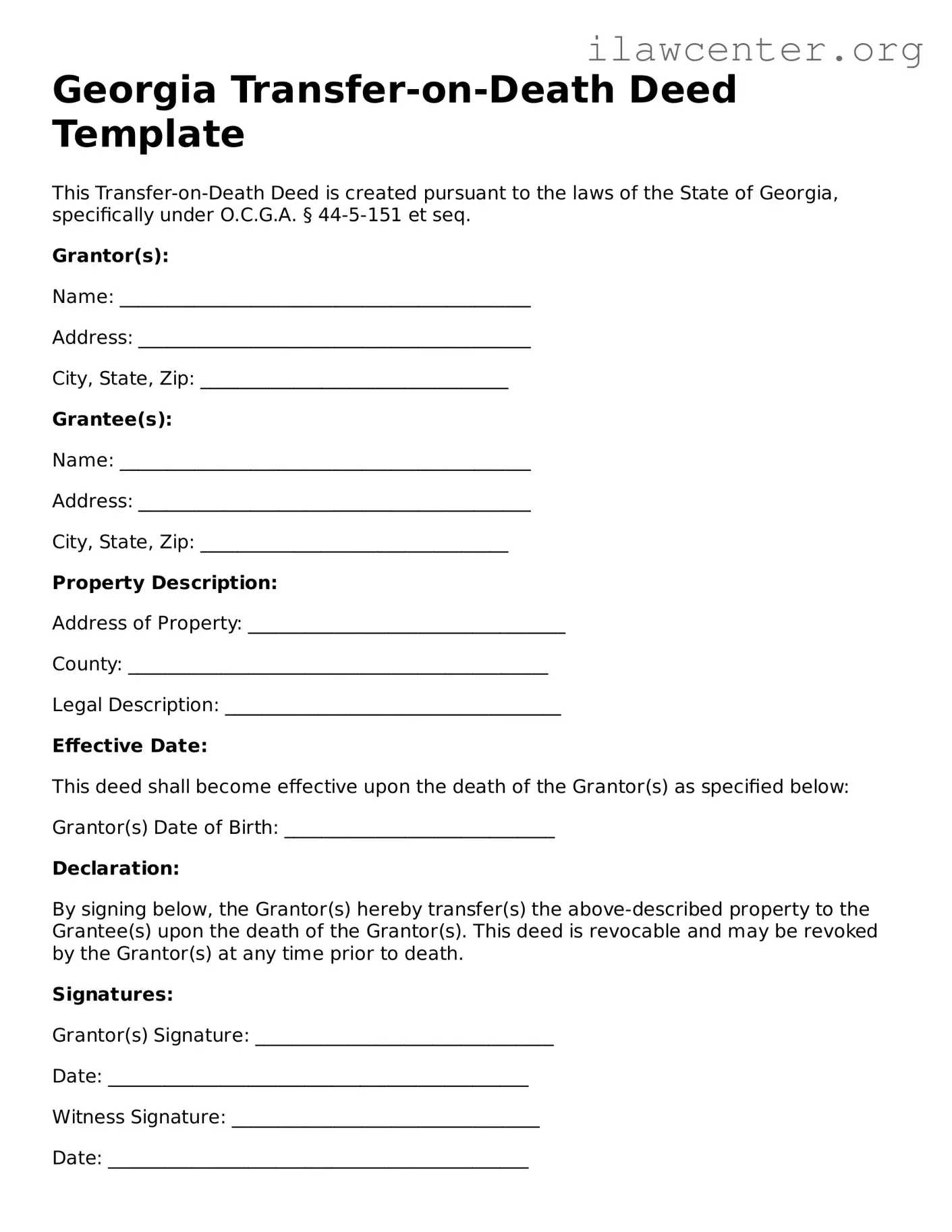
Georgia Transfer-on-Death Deed Preview

Georgia Transfer-on-Death Deed Template

This Transfer-on-Death Deed is created pursuant to the laws of the State of Georgia, specifically under O.C.G.A. § 44-5-151 et seq.

Grantor(s):

Name: ____________________________________________

Address: __________________________________________

City, State, Zip: _________________________________

Grantee(s):

Name: ____________________________________________

Address: __________________________________________

City, State, Zip: _________________________________

Property Description:

Address of Property: __________________________________

County: _____________________________________________

Legal Description: ____________________________________

Effective Date:

This deed shall become effective upon the death of the Grantor(s) as specified below:

Grantor(s) Date of Birth: _____________________________

Declaration:

By signing below, the Grantor(s) hereby transfer(s) the above-described property to the Grantee(s) upon the death of the Grantor(s). This deed is revocable and may be revoked by the Grantor(s) at any time prior to death.

Signatures:

Grantor(s) Signature: ________________________________

Date: _____________________________________________

Witness Signature: _________________________________

Date: _____________________________________________

Notary Public:

State of Georgia

County of ________________________________________

On this _____ day of ______________, 20____, before me, a Notary Public, personally appeared ______________________, known to me to be the person(s) whose name(s) is/are subscribed to the within instrument, and acknowledged to me that he/she/they executed the same for the purposes therein contained.

In witness whereof, I have hereunto set my hand and official seal.

Notary Public Signature: ___________________________

My Commission Expires: ___________________________

PDF Form Characteristics

Fact Name Description
Definition A Transfer-on-Death Deed (TOD) allows an individual to transfer real property to a designated beneficiary upon the owner's death without going through probate.
Governing Law The TOD deed in Georgia is governed by O.C.G.A. § 44-6-90 through § 44-6-95.
Eligibility Only individuals who own real property can create a TOD deed. This includes homeowners and property owners who wish to designate beneficiaries.
Beneficiary Designation The deed allows the owner to name one or more beneficiaries who will receive the property upon the owner's death.
Revocation A Transfer-on-Death Deed can be revoked at any time before the owner's death. This can be done by recording a new deed or a formal revocation document.
Effectiveness The deed becomes effective immediately upon signing and recording, but the transfer of property occurs only upon the owner's death.

Instructions on Utilizing Georgia Transfer-on-Death Deed

After completing the Georgia Transfer-on-Death Deed form, it is essential to ensure that it is properly executed and filed with the appropriate county office. This will help in transferring property upon the owner's death without going through probate.

  1. Obtain the Georgia Transfer-on-Death Deed form from a reliable source, such as the Georgia Secretary of State's website or a local legal office.
  2. Fill in the name of the property owner in the designated section. This should be the individual who currently holds the title to the property.
  3. Provide the property owner's address. Ensure that the address is complete and accurate.
  4. Identify the property to be transferred. Include the legal description, which can typically be found on the current deed or property tax records.
  5. List the name(s) of the beneficiary or beneficiaries who will receive the property upon the owner's death. Include their complete names and any relevant identifying information.
  6. Include the address of each beneficiary. This information is necessary for legal purposes.
  7. Sign and date the form in the presence of a notary public. The notary will verify the identity of the signers and witness the signing process.
  8. Make copies of the completed and notarized form for personal records and for the beneficiaries.
  9. File the original Transfer-on-Death Deed with the county clerk's office in the county where the property is located. Check for any specific filing requirements or fees.

Important Facts about Georgia Transfer-on-Death Deed

What is a Transfer-on-Death Deed in Georgia?

A Transfer-on-Death Deed (TOD Deed) is a legal document that allows a property owner to transfer real estate to a designated beneficiary upon the owner's death. This deed enables the property to bypass probate, simplifying the transfer process. The beneficiary gains ownership automatically, which can help avoid delays and additional costs associated with probate proceedings.

How do I create a Transfer-on-Death Deed in Georgia?

To create a TOD Deed, the property owner must fill out the appropriate form, providing details such as the property description and the beneficiary's information. After completing the form, the owner must sign it in the presence of a notary public. Once notarized, the deed should be filed with the county clerk's office where the property is located to ensure it is legally recognized.

Can I change or revoke a Transfer-on-Death Deed?

Yes, a property owner can change or revoke a TOD Deed at any time before their death. To do this, the owner must create a new deed that explicitly revokes the previous one or file a formal revocation document with the county clerk. It is essential to ensure that the new or revoked deed is properly recorded to avoid any confusion regarding the property transfer.

What happens if the beneficiary predeceases the property owner?

If the designated beneficiary dies before the property owner, the TOD Deed will not automatically transfer the property to that beneficiary's heirs. Instead, the property will remain part of the owner's estate and may need to go through probate. To avoid this situation, property owners can name alternate beneficiaries in the deed.

Are there any tax implications with a Transfer-on-Death Deed?

Generally, a Transfer-on-Death Deed does not trigger any immediate tax consequences for the property owner. However, the beneficiary may be responsible for property taxes once they inherit the property. It is advisable for both the property owner and the beneficiary to consult a tax professional to understand any potential tax implications that may arise upon transfer.

Is a Transfer-on-Death Deed suitable for all types of property?

A Transfer-on-Death Deed can be used for most types of real estate, including residential homes and vacant land. However, it cannot be used for certain types of property, such as personal property or property held in a trust. Before proceeding, it is wise to confirm that the property qualifies for a TOD Deed and to seek legal advice if needed.

Common mistakes

Filling out the Georgia Transfer-on-Death Deed form can be a straightforward process, but there are common mistakes that individuals often make. One significant error is failing to include the full legal description of the property. This description should be precise and detailed, as it ensures that the correct property is transferred upon the owner’s passing. Omitting or inaccurately describing the property can lead to complications and disputes among heirs.

Another frequent mistake is neglecting to properly sign and date the document. The deed must be signed by the property owner in the presence of a notary public. If the signature is missing or the date is not included, the deed may be considered invalid. It is crucial to ensure that all required signatures are obtained to avoid any issues in the future.

Individuals sometimes overlook the importance of naming the beneficiaries clearly. Using vague terms or nicknames can create confusion. It is advisable to use the full legal names of the beneficiaries to prevent any misunderstandings. This clarity helps ensure that the intended recipients receive their inheritance without unnecessary delays or legal challenges.

In addition, failing to record the Transfer-on-Death Deed with the appropriate county office can be a significant oversight. Once the deed is completed and notarized, it must be filed with the county where the property is located. If this step is skipped, the deed will not take effect, and the property may be subject to probate proceedings.

Another common mistake involves not reviewing the deed for errors before submission. Simple typographical errors or incorrect information can have serious consequences. Taking the time to carefully review the document can prevent potential issues and ensure that everything is accurate and in order.

Finally, individuals may not seek professional guidance when needed. While the Transfer-on-Death Deed is designed to be user-friendly, complexities can arise, especially in unique situations. Consulting with a legal professional can provide valuable insights and help navigate any challenges, ensuring that the deed is filled out correctly and serves its intended purpose.

Documents used along the form

The Georgia Transfer-on-Death Deed allows property owners to designate beneficiaries who will receive their property upon their passing, bypassing the probate process. While this deed is a powerful tool for estate planning, several other forms and documents can complement it to ensure a smooth transfer of assets and clarity in the estate plan.

  • Last Will and Testament: This document outlines an individual's wishes regarding the distribution of their assets after death. It can address any property not transferred via the Transfer-on-Death Deed and appoint an executor to manage the estate.
  • Durable Power of Attorney: This form grants someone the authority to make financial or legal decisions on behalf of another person, particularly if they become incapacitated. It is crucial for managing assets during one's lifetime.
  • Living Will: A living will specifies an individual's preferences for medical treatment in case they become unable to communicate their wishes. It is an essential part of advance care planning and complements estate planning documents.
  • Beneficiary Designation Forms: These forms are used for accounts such as life insurance policies and retirement accounts. They allow individuals to designate beneficiaries directly, ensuring that these assets pass outside of probate.

Incorporating these documents into an estate plan can provide clarity and ensure that an individual's wishes are honored. Each document serves a unique purpose and collectively contributes to a comprehensive estate strategy.

Similar forms

The Transfer-on-Death Deed (TODD) allows individuals to transfer property to beneficiaries upon their death without going through probate. Several other documents serve similar purposes in estate planning. Here are six documents that share similarities with the TODD:

  • Will: A will outlines how a person's assets will be distributed after their death. Like a TODD, it specifies beneficiaries but typically requires probate to enforce the distribution.
  • Living Trust: A living trust holds assets during a person's lifetime and allows for distribution after death. It avoids probate, similar to a TODD, but requires more management during the person's life.
  • Beneficiary Designation: Certain accounts, like retirement plans and life insurance, allow for direct beneficiary designations. This is akin to a TODD, as it enables assets to pass outside of probate.
  • Joint Tenancy with Right of Survivorship: This form of property ownership allows co-owners to inherit the property automatically upon the death of one owner. It functions similarly to a TODD by bypassing probate.
  • Payable-on-Death (POD) Accounts: These bank accounts allow the account holder to name a beneficiary who will receive the funds upon the account holder's death. Like a TODD, it avoids probate and directly transfers assets.
  • Transfer-on-Death Registration for Securities: This allows individuals to designate beneficiaries for their securities. It operates similarly to a TODD by ensuring a direct transfer of ownership without probate.

Dos and Don'ts

When filling out the Georgia Transfer-on-Death Deed form, it is essential to follow specific guidelines to ensure the document is valid and effective. Below is a list of things you should and shouldn't do:

  • Do ensure that you are eligible to use the Transfer-on-Death Deed.
  • Do accurately identify the property you wish to transfer.
  • Do include the names of all beneficiaries clearly.
  • Do sign the deed in front of a notary public.
  • Do record the deed with the county clerk's office.
  • Don't forget to check for any local regulations that may apply.
  • Don't use vague language when describing the property.
  • Don't neglect to inform your beneficiaries about the deed.
  • Don't attempt to transfer property that is not solely owned by you.
  • Don't wait too long to record the deed after signing it.

By adhering to these guidelines, you can help ensure that your intentions are honored and that the transfer process goes smoothly for your loved ones.

Misconceptions

Understanding the Georgia Transfer-on-Death Deed form is crucial for property owners. However, several misconceptions can lead to confusion and potential issues. Here are four common misconceptions:

  • It only applies to residential properties. Many believe the Transfer-on-Death Deed is limited to homes. In reality, it can be used for various types of real estate, including commercial properties and vacant land.
  • It requires the consent of all heirs. Some individuals think that all heirs must agree to the Transfer-on-Death Deed. This is not the case. The owner can designate beneficiaries without needing consent from others.
  • It automatically avoids probate. There is a misconception that using a Transfer-on-Death Deed completely bypasses probate. While it does allow for direct transfer upon death, other aspects of the estate may still require probate proceedings.
  • It can be changed or revoked easily. Many assume that once a Transfer-on-Death Deed is filed, it can be altered or revoked without any formal process. In fact, revoking or changing the deed requires specific legal actions to ensure validity.

Clarifying these misconceptions is essential for making informed decisions regarding property transfer in Georgia. Proper understanding can prevent complications and ensure that the transfer process aligns with the owner's intentions.

Key takeaways

Filling out and using the Georgia Transfer-on-Death Deed form can be a straightforward process, but it is essential to understand the key aspects to ensure its effectiveness. Here are some important takeaways:

  • Eligibility: The Transfer-on-Death Deed can only be used for real property, such as land or homes. Ensure that the property you wish to transfer qualifies under this deed.
  • Beneficiary Designation: Clearly name the beneficiary or beneficiaries who will receive the property upon your passing. This designation should be precise to avoid confusion later.
  • Execution Requirements: The deed must be signed in the presence of a notary public and recorded with the county clerk’s office where the property is located. This step is crucial for the deed to be legally valid.
  • Revocation: You can revoke the Transfer-on-Death Deed at any time before your death. This revocation must also be executed and recorded to ensure clarity regarding your intentions.

Understanding these elements can help you navigate the process smoothly and ensure that your wishes are honored after your passing.