


Gift Deed Texas PDF Template

Gift Deed Texas PDF Template

The Gift Deed Texas form is a legal document used to transfer property ownership from one individual, known as the Grantor, to another or others, referred to as Grantees, without any exchange of money. This form is particularly significant for those wishing to convey property as a gift, emphasizing love and affection. To ensure a smooth process, consider filling out the form by clicking the button below.

Article Guide

The Gift Deed Texas form serves as a crucial legal document for individuals wishing to transfer property ownership without monetary exchange. This form captures the essence of a gift, emphasizing the love and affection the Grantor holds for the Grantees. It outlines essential details, including the names of both the Grantor and Grantees, the specific property being transferred, and the legal acknowledgment required for such a transaction. Notably, the form includes a section on confidentiality rights, allowing individuals to protect sensitive information like social security or driver’s license numbers before filing. The document specifies that the property will be held by Grantees as joint tenants, ensuring that if one Grantee passes away, the surviving Grantee automatically inherits the entire interest in the property. Additionally, the form stipulates that the transfer is subject to existing restrictions, covenants, and zoning laws that may affect the property. This comprehensive approach ensures clarity and legal protection for all parties involved, making the Gift Deed Texas form an essential tool for property gifting in Texas.

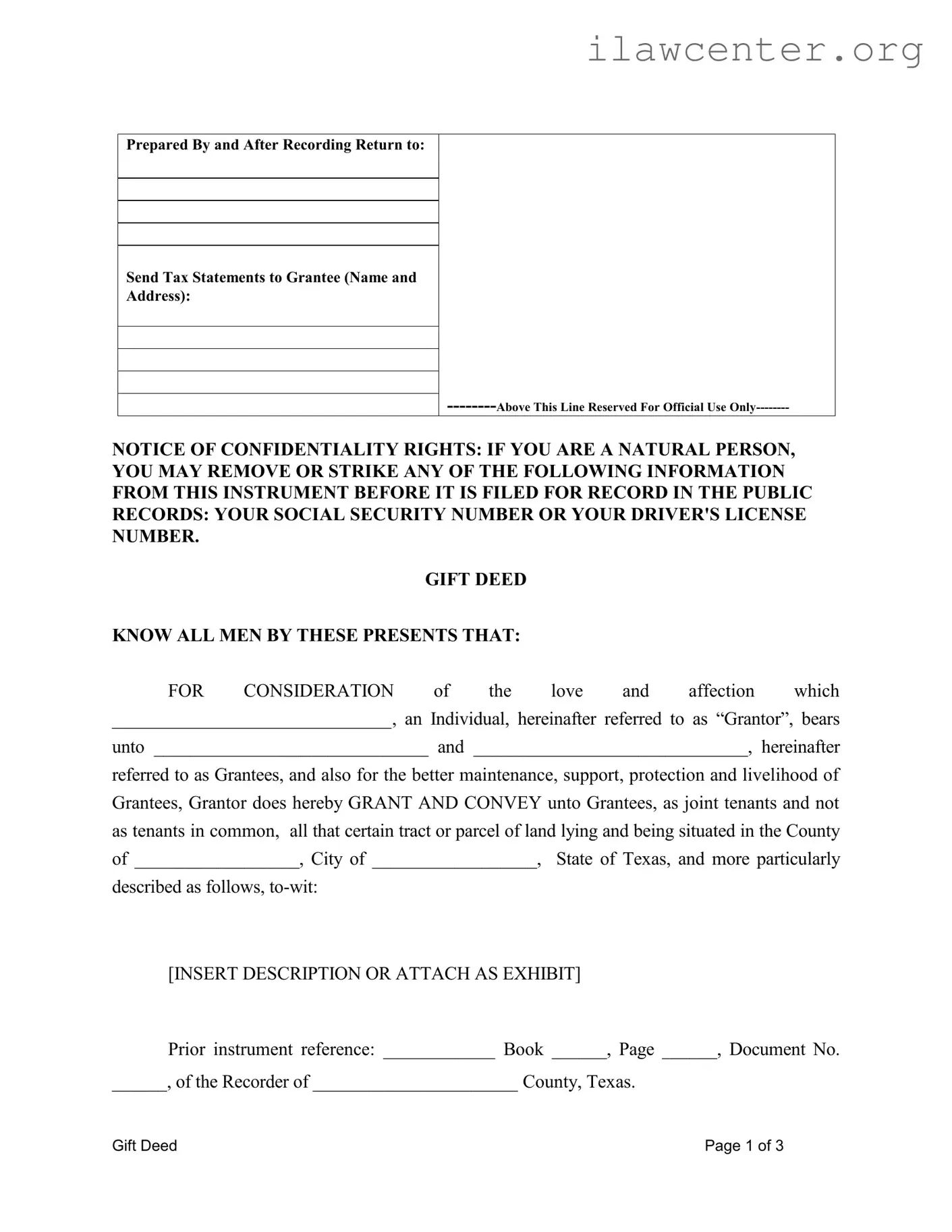
Gift Deed Texas Preview

Prepared By and After Recording Return to:
--------Above This Line Reserved For Official Use Only--------
Send Tax Statements to Grantee (Name and
Address):
NOTICE OF CONFIDENTIALITY RIGHTS: IF YOU ARE A NATURAL PERSON,
YOU MAY REMOVE OR STRIKE ANY OF THE FOLLOWING INFORMATION
FROM THIS INSTRUMENT BEFORE IT IS FILED FOR RECORD IN THE PUBLIC
RECORDS: YOUR SOCIAL SECURITY NUMBER OR YOUR DRIVER'S LICENSE
NUMBER.
GIFT DEED
KNOW ALL MEN BY THESE PRESENTS THAT:
FOR CONSIDERATION of the love and affection which
______________________________, an Individual, hereinafter referred to as “Grantor”, bears
unto ______________________________ and ______________________________, hereinafter
referred to as Grantees, and also for the better maintenance, support, protection and livelihood of
Grantees, Grantor does hereby GRANT AND CONVEY unto Grantees, as joint tenants and not
as tenants in common, all that certain tract or parcel of land lying and being situated in the County
of __________________, City of __________________, State of Texas, and more particularly
described as follows, to-wit:
[INSERT DESCRIPTION OR ATTACH AS EXHIBIT]
Prior instrument reference: ____________ Book ______, Page ______, Document No.
______, of the Recorder of ______________________ County, Texas.
Gift Deed Page 1 of 3
TO HAVE AND TO HOLD the above described premises together with all and singular the
rights and appurtenances thereto in anywise belonging unto the above named Grantees, their
successors and assigns forever; and Grantor herein hereby binds itself, its successors, assigns, and
administrators to WARRANT AND FOREVER DEFEND all and singular the said premises unto
the above named Grantee, their successors and assigns, against every person whomsoever lawfully
claiming or to claim the same or any part thereof.
Grantees, TO HAVE AND TO HOLD as joint tenants, with right of survivorship and not
as tenants in common, their heirs, personal representatives, executors and assigns forever: it
being the intention of the parties to this conveyance, that (unless the joint tenancy hereby created
is severed or terminated during the joint lives of the grantees herein) in the event one Grantee
herein survives the other, the entire interest in fee simple shall pass to the surviving Grantee, and
if one does not survive the other, then the heirs and assigns of the Grantees herein shall take as
tenants in common.
This conveyance is made and accepted subject to the following matters, to the extent
same are in effect at this time: Any and all restrictions, covenants, conditions and easements, if
any, relating to the hereinabove described property, but only to the extent they are still in effect,
shown of record in the hereinabove mentioned County and State; and to all zoning laws,
regulations and ordinances of municipal and/or other governmental authorities, if any, but only to
the extent that they are still in effect, relating to the hereinabove described property.
The property herein conveyed is not a part of the homestead of Grantor, or is part of the
homestead of Grantor and the conveyance is joined by both Husband and Wife.
WITNESS Grantor’s hand this the ______ day of __________________, 20______.
Grantor
Type or Print Name
Gift Deed Page 2 of 3
STATE OF TEXAS
COUNTY OF __________________
This instrument was acknowledged before me on __________________ (date) by
____________________________________ (name of representative) as
____________________________________ (title of representative) of
________________________________________________ (name of entity or person
represented).
My commission expires:
Mailing Address of Grantee:
Name
Address
Notary Public
Type or Print Name
Gift Deed Page 3 of 3

File Properties

Fact Name Description
Purpose The Gift Deed in Texas is used to transfer property ownership without monetary exchange, typically between family members or close friends.
Governing Law This form is governed by Texas Property Code, Title 1, Chapter 5.
Joint Tenancy The deed allows for joint tenancy with right of survivorship, ensuring that if one grantee passes away, their share automatically transfers to the surviving grantee.
Confidentiality Notice Individuals can remove sensitive information, such as Social Security numbers or driver's license numbers, before filing the deed.
Homestead Status The property conveyed may or may not be part of the Grantor's homestead, affecting how the deed is executed.

Instructions on Utilizing Gift Deed Texas

Completing the Gift Deed Texas form is a straightforward process that involves filling in specific details about the grantor, grantees, and the property being transferred. After completing the form, it must be signed and notarized before being filed with the appropriate county office.

  1. Prepare the Form: Obtain the Gift Deed Texas form from a reliable source or legal office.
  2. Fill in Grantor Information: Enter the name of the individual granting the property in the space provided for "Grantor."
  3. Fill in Grantee Information: Enter the names of the individuals receiving the property in the designated area for "Grantees."
  4. Property Description: Clearly describe the property being gifted, including its location and any relevant details. If necessary, attach an exhibit with the full description.
  5. Prior Instrument Reference: If applicable, provide details of any prior instrument related to the property, including book, page, and document number.
  6. Indicate Joint Tenancy: Specify that the property is to be held as joint tenants with right of survivorship.
  7. Homestead Status: State whether the property is part of the grantor's homestead and ensure both spouses sign if required.
  8. Sign the Document: The grantor must sign the form on the designated line, including the date.
  9. Notarization: Take the completed form to a notary public for acknowledgment. Fill in the notary's details as required.
  10. Submit the Form: File the signed and notarized form with the county clerk's office where the property is located.

Important Facts about Gift Deed Texas

What is a Gift Deed in Texas?

A Gift Deed in Texas is a legal document used to transfer ownership of property from one individual (the Grantor) to another (the Grantees) without any exchange of money. This transfer is typically made out of love and affection. The deed specifies that the Grantees will hold the property as joint tenants, meaning if one Grantee passes away, the surviving Grantee automatically receives full ownership of the property.

What information is required to complete a Gift Deed?

To complete a Gift Deed, you will need to provide the names of the Grantor and Grantees, a detailed description of the property being transferred, and the county and city where the property is located. Additionally, it is important to indicate whether the property is part of the Grantor's homestead and to include any relevant prior instrument references. You may also need to sign the document in front of a notary public.

Are there any confidentiality rights associated with the Gift Deed?

Yes, Texas law allows natural persons to remove certain personal information from the Gift Deed before it is filed for public record. Specifically, you can strike out your Social Security number or driver's license number. This helps protect your privacy when the document is made public.

What happens if one Grantee dies?

If one Grantee dies, the surviving Grantee will automatically inherit the entire interest in the property, provided that the joint tenancy has not been severed. This means the surviving Grantee does not have to go through probate to claim the property. If both Grantees pass away, their heirs will inherit the property as tenants in common.

Do I need a lawyer to prepare a Gift Deed?

While it is not legally required to have a lawyer prepare a Gift Deed, consulting with one can be beneficial. A legal professional can ensure that the deed complies with Texas laws and that all necessary information is accurately included. This can help prevent any future disputes or issues regarding the property transfer.

Common mistakes

Filling out the Gift Deed Texas form requires attention to detail. One common mistake is failing to provide complete names for both the Grantor and Grantees. It is crucial to ensure that the names are spelled correctly and that all parties involved are clearly identified. Incomplete or incorrect names can lead to complications in the future.

Another frequent error is neglecting to include a proper description of the property being conveyed. The form requires a detailed description or an attachment that outlines the property. Without this information, the deed may not be valid, which can create legal issues down the line.

Many individuals overlook the importance of specifying the county and city where the property is located. This information is essential for proper recording and future reference. Failure to include the correct location can result in delays or rejections when the deed is submitted for recording.

Additionally, some people forget to indicate whether the property is part of the Grantor's homestead. This distinction is vital, as it affects the legal implications of the transfer. If the property is part of the homestead, both spouses must sign the deed to ensure its validity.

Another common mistake involves the acknowledgment section. Individuals may not properly complete this section, which requires the presence of a notary public. An incomplete acknowledgment can render the deed unenforceable, leading to potential disputes.

It is also important to remember to date the document correctly. The date of signing should be clearly indicated, as it establishes the timeline of the transfer. Omitting the date can lead to confusion and disputes regarding the effective date of the gift.

Lastly, individuals often forget to provide the mailing address for the Grantee. This information is necessary for tax statements and future correspondence. Without a complete address, the Grantee may not receive important documents related to the property.

Documents used along the form

When completing a Gift Deed in Texas, several other forms and documents may also be needed to ensure everything is in order. Each of these documents serves a specific purpose and helps clarify the terms of the gift, protect the parties involved, and comply with local laws. Here’s a brief overview of some commonly used forms alongside the Gift Deed.

  • Affidavit of Heirship: This document establishes the heirs of a deceased person. It helps clarify ownership of property when transferring assets, especially when the original owner did not leave a will.
  • Property Description: This is a detailed description of the property being gifted. It may include the lot number, block number, and any other specific identifiers to ensure the property is accurately identified in legal terms.
  • Title Search Report: Conducting a title search is essential to confirm that the property is free of liens or other claims. This report provides peace of mind to the grantor and grantee regarding the ownership status.
  • Tax Statement Request: This form allows the grantee to receive future tax statements for the property. It ensures that the new owner is aware of any property tax obligations after the transfer.
  • Notice of Confidentiality Rights: This document informs individuals about their rights to keep certain personal information private when filing legal documents. It highlights the importance of protecting sensitive data.
  • Notarization Form: A notarized document confirms that the signatures on the Gift Deed are legitimate. This form is crucial for the validity of the deed and often required for recording purposes.

Understanding these documents can simplify the process of transferring property through a Gift Deed in Texas. Each form plays a vital role in ensuring that the transaction is legally sound and protects everyone's interests. Always consider consulting with a legal expert if you have questions about any of these forms or the gifting process.

Similar forms

  • Warranty Deed: A Warranty Deed transfers ownership of property and guarantees that the grantor holds clear title to the property. Like a Gift Deed, it conveys property but includes warranties regarding the title, which are not present in a Gift Deed.
  • Quitclaim Deed: This type of deed transfers whatever interest the grantor has in the property without any guarantees. Similar to a Gift Deed, it can be used to transfer property without consideration, but it does not provide the same level of assurance regarding the title.
  • Transfer on Death Deed: This deed allows property to pass directly to a beneficiary upon the death of the owner. Both the Gift Deed and Transfer on Death Deed facilitate the transfer of property, but the latter does so without immediate transfer of ownership.
  • Deed of Trust: A Deed of Trust secures a loan by transferring property to a trustee until the loan is paid off. While a Gift Deed transfers property as a gift, a Deed of Trust involves a financial obligation.
  • Lease Agreement: A Lease Agreement allows one party to use another's property for a specified time in exchange for rent. Both documents deal with property rights, but a Lease Agreement does not transfer ownership, whereas a Gift Deed does.
  • Partition Deed: This document divides jointly owned property among co-owners. Similar to a Gift Deed, it involves the transfer of property interests, but it is typically used to resolve disputes among co-owners rather than as a gift.
  • Bill of Sale: A Bill of Sale transfers ownership of personal property. While a Gift Deed pertains to real estate, both documents serve to formally document the transfer of ownership without consideration.

Dos and Don'ts

When filling out the Gift Deed Texas form, it is essential to follow certain guidelines to ensure accuracy and compliance. Below is a list of things you should and shouldn't do.

  • Do include the full names of both the Grantor and Grantees.
  • Do provide a complete and accurate description of the property being conveyed.
  • Do ensure that the form is signed and dated by the Grantor.
  • Do have the document notarized to validate the transaction.
  • Do indicate whether the property is part of the Grantor's homestead.
  • Don't leave any sections of the form blank, especially the names and property details.
  • Don't forget to strike out any confidential information, such as Social Security numbers.
  • Don't use vague language when describing the property; specificity is crucial.
  • Don't overlook local zoning laws or restrictions that may affect the property.

Misconceptions

When dealing with the Gift Deed Texas form, several misconceptions often arise. Understanding these can help clarify the process and ensure a smooth transfer of property. Here are five common misconceptions:

  • Gift Deeds Are Only for Family Members: Many believe that gift deeds can only be used to transfer property between family members. In reality, anyone can give a gift deed to another person, regardless of their relationship. Friends, colleagues, or even charitable organizations can be grantees.
  • Gift Deeds Do Not Require Legal Documentation: Some think that a verbal agreement is sufficient for a gift deed. However, a gift deed must be a written document, properly executed and recorded, to be legally binding and recognized by the state.
  • Gift Deeds Are Always Tax-Free: While gift deeds can often be tax-exempt, this is not universally true. Depending on the value of the property and the relationship between the grantor and grantee, there may be tax implications. It's important to consult a tax professional to understand potential liabilities.
  • Once a Gift Deed Is Signed, It Cannot Be Changed: Some individuals believe that a gift deed is final and cannot be altered. In fact, if the grantor wishes to revoke or change the terms of the deed, it can be done, provided the proper legal procedures are followed.
  • Gift Deeds Are the Same as Sale Deeds: Many confuse gift deeds with sale deeds, thinking they serve the same purpose. While both transfer property, a sale deed involves a transaction where payment is exchanged, whereas a gift deed is a transfer without compensation.

By addressing these misconceptions, individuals can approach the process of creating a gift deed with greater confidence and understanding.

Key takeaways

When filling out and using the Gift Deed Texas form, there are several important points to keep in mind. Here are ten key takeaways:

  • Understand the Purpose: A Gift Deed is used to transfer property without any payment, typically as a gift to family or friends.
  • Identify the Parties: Clearly identify the Grantor (the person giving the gift) and the Grantees (the recipients of the gift).
  • Property Description: Provide a detailed description of the property being transferred. This can include a legal description or an attachment if necessary.
  • Joint Tenancy: Specify if the Grantees will hold the property as joint tenants with right of survivorship, which allows the surviving Grantee to inherit the entire property.
  • Confidentiality Rights: Remember that you can remove personal information, such as Social Security numbers or driver's license numbers, before filing.
  • Signatures Required: The Grantor must sign the document, and it may need to be acknowledged by a notary public.
  • Tax Implications: Be aware of any potential tax implications related to the gift, including gift tax considerations.
  • Restrictions and Easements: Note any existing restrictions, covenants, or easements that may affect the property.
  • Homestead Status: Indicate whether the property is part of the Grantor's homestead, as this can impact the transfer.
  • Record the Deed: After completing the form, ensure it is filed with the appropriate county office to make the transfer official.

By keeping these key points in mind, you can navigate the process of completing and using the Gift Deed Texas form more effectively.