Gift Letter PDF Template

Gift Letter PDF Template

The Gift Letter form is a document used to confirm that a monetary gift has been given to a borrower, often for the purpose of a home purchase. This form helps clarify that the funds are a gift and not a loan, which can affect the borrower’s financial qualifications. To ensure compliance and transparency, consider filling out the form by clicking the button below.

Article Guide

When individuals consider purchasing a home, they often explore various financing options to help with the down payment. One common method involves receiving financial assistance from family members or friends, which is where the Gift Letter form comes into play. This document serves as a formal acknowledgment that a monetary gift has been given, rather than a loan that would require repayment. Typically, it includes essential details such as the donor's name, the recipient's name, the amount of the gift, and a statement confirming that the funds do not need to be repaid. Lenders often require this form to ensure transparency in the source of funds and to comply with regulations regarding gift contributions. By clearly outlining the nature of the financial support, the Gift Letter form helps facilitate smoother transactions in the home-buying process, providing both the buyer and lender with necessary documentation that confirms the legitimacy of the gift. Understanding the importance of this form can help individuals navigate the complexities of financing a home purchase more effectively.

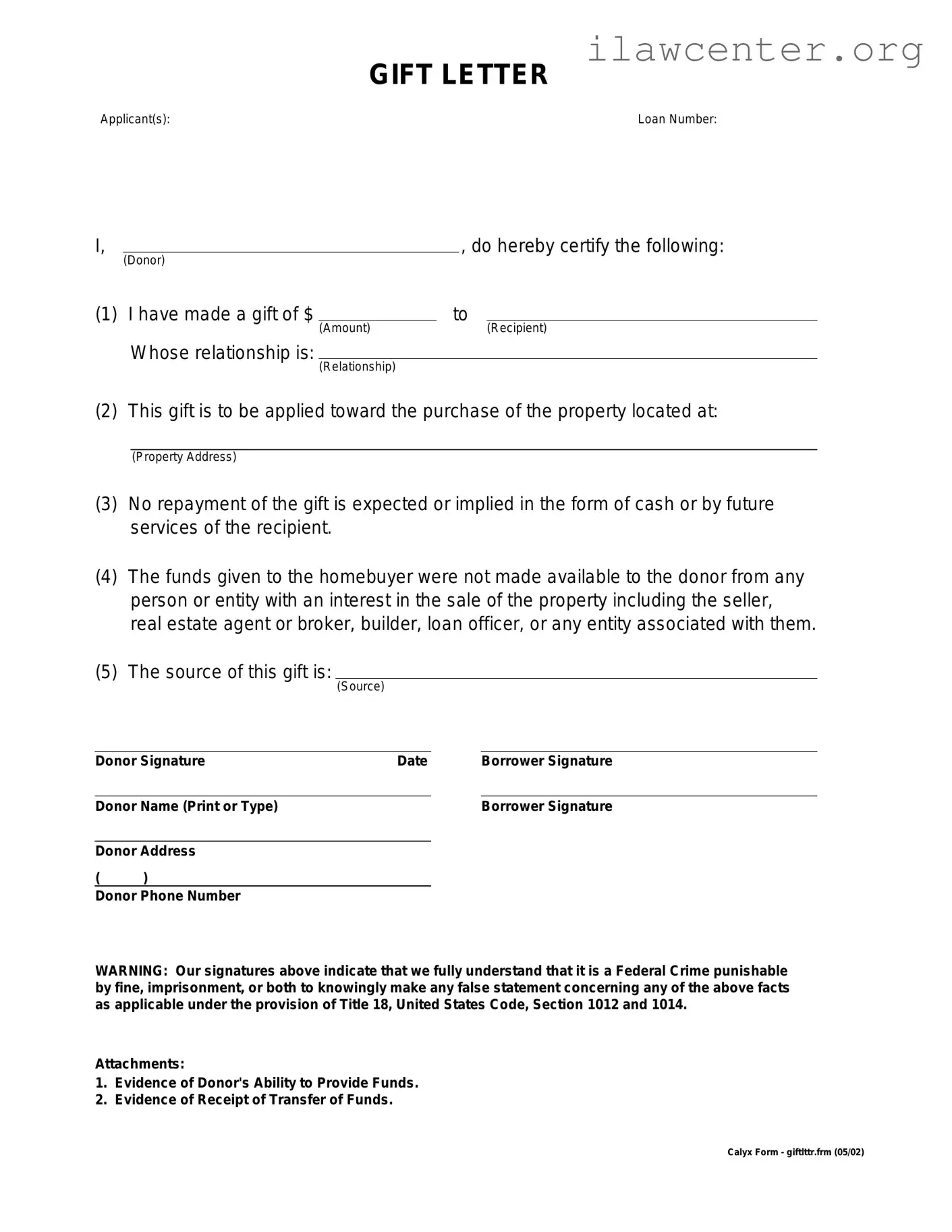
Gift Letter Preview

GIFT LETTER
Applicant(s): Loan Number:
I, , do hereby certify the following:
(Donor)
(1) I have made a gift of $ to
(Amount) (Recipient)
Whose relationship is:
(Relationship)
(2) This gift is to be applied toward the purchase of the property located at:
(Property Address)
(3) No repayment of the gift is expected or implied in the form of cash or by future
services of the recipient.
(4) The funds given to the homebuyer were not made available to the donor from any
person or entity with an interest in the sale of the property including the seller,
real estate agent or broker, builder, loan officer, or any entity associated with them.
(5) The source of this gift is:
(Source)
Donor Signature Date Borrower Signature
Donor Name (Print or Type) Borrower Signature
Donor Address
( )
Donor Phone Number
WARNING: Our signatures above indicate that we fully understand that it is a Federal Crime punishable
by fine, imprisonment, or both to knowingly make any false statement concerning any of the above facts
as applicable under the provision of Title 18, United States Code, Section 1012 and 1014.
Attachments:
1. Evidence of Donor's Ability to Provide Funds.
2. Evidence of Receipt of Transfer of Funds.
Calyx Form - giftlttr.frm (05/02)

File Properties

Fact Name Details
Purpose A gift letter form is used to document financial gifts, typically for down payments on real estate, ensuring transparency in the source of funds.
Requirements The form generally requires the donor's name, the recipient's name, the amount of the gift, and a statement affirming that the funds do not need to be repaid.
State-Specific Considerations Different states may have specific requirements or governing laws regarding gift letters. For example, in California, the California Civil Code Section 1624 outlines certain formalities for gifts over a specific amount.
Importance for Lenders Lenders often require a gift letter to verify that the funds are indeed a gift and not a loan, which could affect the borrower's debt-to-income ratio.

Instructions on Utilizing Gift Letter

Once you have the Gift Letter form in hand, the next steps involve carefully filling it out to ensure that all necessary information is accurately provided. This form is essential for documenting the gift you are receiving, especially in relation to financing a home purchase. Follow the steps below to complete the form correctly.

  1. Begin by entering the date at the top of the form.
  2. Provide the name and address of the donor, the person giving the gift.
  3. Clearly state the recipient's name, the person receiving the gift.
  4. Specify the amount of the gift in the designated space.
  5. Indicate the relationship between the donor and the recipient.
  6. Include a brief description of the gift, if required.
  7. Have the donor sign and date the form at the bottom.
  8. Double-check all entries for accuracy and completeness.

After filling out the form, ensure that it is submitted along with any other required documentation to the relevant parties involved in the transaction.

Important Facts about Gift Letter

What is a Gift Letter form?

A Gift Letter form is a document used to confirm that a monetary gift has been given to an individual, typically for the purpose of assisting with a home purchase. This form outlines the amount of the gift, the relationship between the donor and the recipient, and states that the funds do not need to be repaid. It is often required by lenders to ensure that the funds are indeed a gift and not a loan.

Who needs to provide a Gift Letter?

The donor, or the person giving the gift, is responsible for providing the Gift Letter. This individual must be willing to confirm the details of the gift in writing. The recipient, usually the homebuyer, will need to present this letter to their lender as part of the mortgage application process.

What information should be included in a Gift Letter?

A Gift Letter should include several key pieces of information. It must state the donor's name, the recipient's name, the amount of the gift, and the relationship between the two parties. Additionally, the letter should clearly indicate that the funds are a gift and do not require repayment. Some lenders may also request the donor’s contact information and a statement regarding the source of the funds.

Are there any restrictions on who can give a gift?

While there are no strict rules on who can give a gift, lenders typically prefer that the donor be a family member, such as a parent, sibling, or grandparent. Some lenders may allow gifts from close friends or other individuals, but this can vary. It is essential to check with the lender regarding their specific requirements and guidelines.

What happens if the Gift Letter is not provided?

If a Gift Letter is not provided when required, it may result in delays or complications in the mortgage application process. Lenders need to verify the source of funds to ensure that the borrower can meet financial obligations. Without this documentation, the lender may question the legitimacy of the funds, potentially jeopardizing the loan approval.

Common mistakes

Filling out a Gift Letter form can be a straightforward process, but many individuals make common mistakes that can lead to complications. Understanding these pitfalls can help ensure that the form is completed correctly and serves its intended purpose.

One frequent mistake is failing to include the donor's complete information. The form requires the donor's full name, address, and contact information. Omitting any of these details can create confusion and delay the processing of the gift. It is essential to provide accurate and complete information to avoid any issues later on.

Another error involves not specifying the relationship between the donor and the recipient. The Gift Letter form typically asks for this information to establish the nature of the gift. Without this clarification, the financial institution may question the legitimacy of the gift, potentially complicating the transaction.

Many people also neglect to indicate the exact amount of the gift. This detail is crucial as it helps the recipient's lender understand the financial support being provided. Leaving this section blank or providing vague information can lead to misunderstandings or even rejection of the application.

Additionally, some individuals fail to sign and date the Gift Letter. A signature is not just a formality; it serves as proof that the donor is indeed giving the gift willingly. Without a signature and date, the letter may be considered incomplete, raising doubts about its authenticity.

Another common oversight is not providing a clear statement that the gift does not need to be repaid. It is vital to explicitly state that the funds are a gift and not a loan. This clarification helps avoid any future misunderstandings regarding repayment expectations.

People often forget to keep a copy of the Gift Letter for their records. Having a copy can be beneficial for both the donor and the recipient, especially if questions arise later about the transaction. It is wise to maintain a record for future reference.

Some individuals also make the mistake of using vague language in the letter. Clear and concise wording is essential to convey the intent of the gift. Ambiguities can lead to misinterpretations and complications down the line.

Lastly, it is important to remember that the Gift Letter should be submitted in a timely manner. Delays in providing the form can hold up the entire process, especially if the recipient is in the middle of a financial transaction. Prompt submission ensures that everything proceeds smoothly.

By being aware of these common mistakes and taking steps to avoid them, individuals can complete the Gift Letter form accurately. Doing so will facilitate a smoother process and help maintain clarity in financial transactions.
Documents used along the form

When applying for a mortgage or financial assistance, a Gift Letter form is often accompanied by several other important documents. These documents help verify the legitimacy of the gift and ensure compliance with lending requirements. Here’s a list of commonly used forms and documents that may accompany the Gift Letter:

  • Bank Statement: This document shows the donor's account balance and transaction history. It helps confirm that the funds are available for the gift.
  • Proof of Relationship: Documents such as birth certificates or marriage licenses may be required to establish the relationship between the donor and the recipient.
  • Donor's Identification: A copy of the donor's government-issued ID may be requested to verify their identity and ensure the legitimacy of the gift.
  • Settlement Statement: Also known as the HUD-1 form, this document outlines the financial details of the real estate transaction, including how the gift will be applied.
  • Gift Tax Return: If the gift exceeds a certain amount, the donor may need to file a gift tax return to report the transaction to the IRS.
  • Loan Application: The recipient’s loan application provides details about the mortgage being sought and is essential for the lender’s review process.
  • Gift Agreement: This document outlines the terms of the gift, including the amount and any conditions, ensuring clarity for both parties involved.

Having these documents ready can streamline the process and help avoid delays. Each piece plays a critical role in ensuring that the gift is properly documented and accepted by the lender.

Similar forms

The Gift Letter form serves a specific purpose in financial transactions, particularly in real estate. It is similar to several other documents used to verify financial support or gifts. Here are four documents that share similarities with the Gift Letter form:

  • Affidavit of Support: This document is often used in immigration cases to demonstrate that a sponsor has sufficient income or financial resources to support a visa applicant. Like the Gift Letter, it outlines the relationship between the parties and confirms the intent to provide financial assistance.
  • Loan Gift Letter: This letter is specifically designed for situations where a family member or friend provides a monetary gift to help with a loan down payment. It details the amount gifted and clarifies that the funds do not need to be repaid, similar to the Gift Letter's purpose of confirming a gift.
  • Financial Support Letter: This letter is used to indicate that one party is providing financial assistance to another. It includes details about the amount and purpose of the support, paralleling the Gift Letter's role in documenting a gift.
  • Donor Letter: A Donor Letter is often used in charitable contexts to confirm a donation. It provides details about the donation amount and the relationship between the donor and the recipient, much like the Gift Letter confirms the nature of the gift being provided.

Dos and Don'ts

When filling out a Gift Letter form, it’s important to ensure that all information is accurate and complete. Here are some guidelines to help you through the process.

Things You Should Do:

  • Provide accurate information about the donor, including their name, address, and relationship to the recipient.
  • Clearly state the amount of the gift being given.
  • Include a signature from the donor to validate the gift.

Things You Shouldn't Do:

  • Do not leave any sections of the form blank, as this may cause delays.
  • Avoid using vague language that may confuse the intent of the gift.
  • Do not forget to check for any specific requirements that your lender may have regarding the Gift Letter.

By following these guidelines, you can help ensure that the Gift Letter is completed correctly, making the process smoother for everyone involved.

Misconceptions

Understanding the Gift Letter form is crucial for anyone involved in real estate transactions, particularly when it comes to financial assistance from family or friends. However, several misconceptions often arise. Below is a list of five common misconceptions along with clarifications.

  • Gift Letters are only for first-time homebuyers. Many believe that only first-time buyers need gift letters. In reality, anyone receiving financial assistance for a home purchase may need to provide this documentation, regardless of their buying history.
  • Gift Letters are not legally binding. Some people think that gift letters are informal and lack legal weight. While they are not contracts, they do serve an important purpose in verifying the source of funds and can be scrutinized by lenders.
  • All gifts require a Gift Letter. Not every financial gift necessitates a gift letter. For example, smaller gifts or those that do not contribute significantly to the down payment may not require this form, depending on the lender’s policies.
  • Gift Letters can be handwritten. A common belief is that any written note suffices. However, lenders typically prefer a formal letter that includes specific details, such as the donor’s relationship to the recipient and the amount of the gift.
  • Gift Letters can be submitted after closing. Many assume that timing is flexible. In truth, lenders usually require the gift letter to be submitted before closing to ensure that all financial sources are documented and verified.

By addressing these misconceptions, individuals can better navigate the complexities associated with the Gift Letter form and ensure a smoother home buying process.

Key takeaways

When filling out and using a Gift Letter form, keep these key takeaways in mind:

  1. Purpose: A Gift Letter is used to document a monetary gift, often for a home purchase.
  2. Donor Information: Clearly include the name, address, and relationship of the donor to the recipient.
  3. Recipient Information: Provide the name and address of the person receiving the gift.
  4. Gift Amount: Specify the exact amount of the gift. This is crucial for financial records.
  5. No Repayment: State that the gift does not need to be repaid. This clarifies the intent of the gift.
  6. Signature: Both the donor and recipient should sign the letter to validate it.
  7. Additional Documentation: Consider attaching bank statements or other proof of funds if required.
  8. Consult Professionals: If in doubt, seek advice from a financial advisor or attorney.

Following these steps ensures a smooth process and helps avoid any misunderstandings down the line.