Goodwill donation receipt PDF Template

Goodwill donation receipt PDF Template

The Goodwill donation receipt form serves as a record for individuals who donate items to Goodwill Industries, providing proof of the donation for tax purposes. This form typically includes details such as the donor's name, the date of the donation, and a description of the items donated. To ensure proper documentation, it is essential to fill out this form accurately; start by clicking the button below.

Article Guide

When donating items to Goodwill, many individuals may overlook the importance of obtaining a donation receipt. This simple yet essential document serves multiple purposes, both for the donor and the organization. A Goodwill donation receipt form typically includes details such as the date of the donation, a description of the items donated, and the estimated value of those items. This information is crucial for tax purposes, as it allows donors to claim deductions on their income tax returns. Additionally, the form may contain the name and address of the donor, ensuring that all parties involved have a clear record of the transaction. Understanding how to properly fill out and utilize this receipt can enhance the donation experience, providing both a sense of contribution to the community and potential financial benefits during tax season.

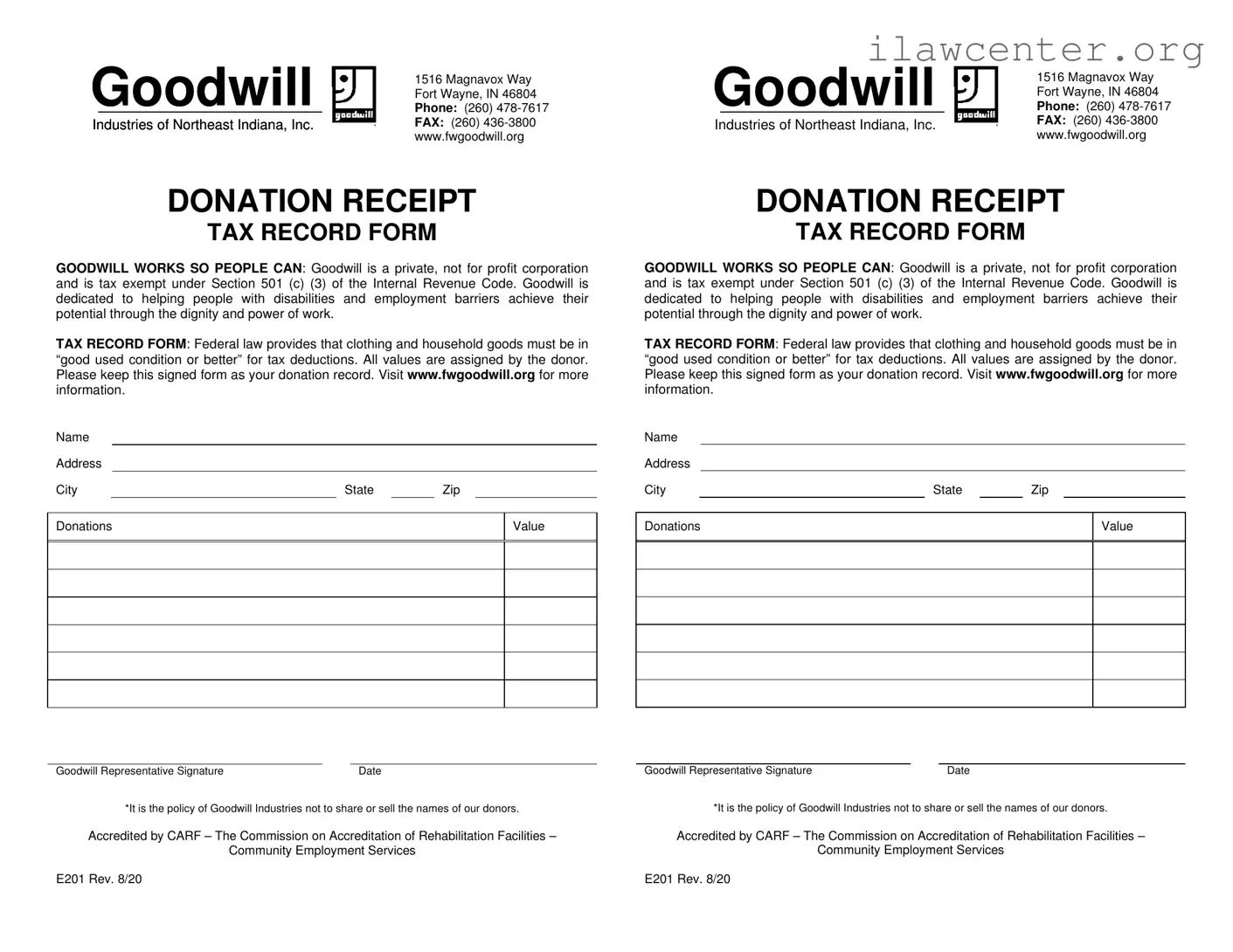
Goodwill donation receipt Preview

DONATION RECEIPT
TAX RECORD FORM
GOODWILL WORKS SO PEOPLE CAN: Goodwill is a private, not for profit corporation
and is tax exempt under Section 501 (c) (3) of the Internal Revenue Code. Goodwill is
dedicated to helping people with disabilities and employment barriers achieve their
potential through the dignity and power of work.
TAX RECORD FORM: Federal law provides that clothing and household goods must be in
“good used condition or better” for tax deductions. All values are assigned by the donor.
Please keep this signed form as your donation record. Visit www.fwgoodwill.org for more
information.
Name
Address
City
State
Zip
Donations Value
Goodwill Representative Signature
*It is the policy of Goodwill Industries not to share or sell the names of our donors.
Accredited by CARF – The Commission on Accreditation of Rehabilitation Facilities –
Community Employment Services
E201 Rev. 8/20
DONATION RECEIPT
TAX RECORD FORM
GOODWILL WORKS SO PEOPLE CAN: Goodwill is a private, not for profit corporation
and is tax exempt under Section 501 (c) (3) of the Internal Revenue Code. Goodwill is
dedicated to helping people with disabilities and employment barriers achieve their
potential through the dignity and power of work.
TAX RECORD FORM: Federal law provides that clothing and household goods must be in
“good used condition or better” for tax deductions. All values are assigned by the donor.
Please keep this signed form as your donation record. Visit www.fwgoodwill.org for more
information.
Name
Address
City
State
Zip
Donations Value
Goodwill Representative Signature
*It is the policy of Goodwill Industries not to share or sell the names of our donors.
Accredited by CARF – The Commission on Accreditation of Rehabilitation Facilities –
Community Employment Services
E201 Rev. 8/20
Goodwill
Industries of Northeast Indiana, Inc.
1516 Magnavox Way
Fort Wayne, IN 46804
Phone: (260) 478-7617
FAX: (260) 436-3800
www.fwgoodwill.org
Goodwill
Industries of Northeast Indiana, Inc.
Goodwill
Industries of Northeast Indiana, Inc.
1516 Magnavox Way
Fort Wayne, IN 46804
Phone: (260) 478-7617
FAX: (260) 436-3800
www.fwgoodwill.org

File Properties

Fact Name Description
Purpose The Goodwill donation receipt form serves as proof of a charitable donation for tax purposes.
Tax Deduction Donors may claim a tax deduction for the value of items donated, as allowed by IRS regulations.
Itemization The form typically requires a detailed list of items donated, including their estimated value.
State-Specific Requirements Some states may have specific requirements for donation receipts, including additional information or disclosures.
Governing Laws IRS Publication 526 outlines federal regulations for charitable contributions, while state laws may vary.
Retention Period Donors should keep the receipt for at least three years after filing their tax return in case of an audit.

Instructions on Utilizing Goodwill donation receipt

Filling out the Goodwill donation receipt form is a straightforward process. Once completed, you will have a record of your donation, which can be useful for tax purposes or personal tracking. Follow these steps to ensure that your form is filled out correctly.

  1. Begin by locating the Goodwill donation receipt form. This form is typically available at your local Goodwill store or on their website.
  2. In the top section of the form, enter the date of your donation. Make sure to use the correct format, which is usually month/day/year.
  3. Next, fill in your name and address. This information is essential for record-keeping and for any potential follow-up.
  4. List the items you are donating. Be specific about each item, including its condition. This helps in accurately assessing the value of your donation.
  5. If applicable, assign a fair market value to each item. This value should reflect what you believe the item would sell for in a thrift store.
  6. Sign and date the form at the bottom. Your signature confirms that the information provided is accurate.
  7. Keep a copy of the completed form for your records. This is important for tax purposes and personal tracking.

Important Facts about Goodwill donation receipt

What is a Goodwill donation receipt form?

A Goodwill donation receipt form is a document provided by Goodwill to donors who contribute items to the organization. This form serves as proof of your donation and can be used for tax purposes. It typically includes information about the items donated and their estimated value.

How do I obtain a Goodwill donation receipt?

You can receive a Goodwill donation receipt at the time you make your donation. Simply ask a staff member for a receipt after you drop off your items. If you donate items at a Goodwill store, the cashier can also provide you with a receipt upon request.

What information is included on the receipt?

The receipt usually includes your name, address, the date of the donation, a description of the items donated, and a statement indicating that no goods or services were provided in exchange for the donation. Some receipts may also include a suggested value for the donated items.

Can I claim a tax deduction for my donation?

Yes, you can claim a tax deduction for your donation to Goodwill, provided you itemize your deductions on your tax return. The amount you can deduct generally depends on the fair market value of the items donated. Keep your receipt as documentation for your tax records.

What items can I donate to Goodwill?

Goodwill accepts a wide variety of items, including clothing, household goods, electronics, and furniture. However, certain items, such as hazardous materials, food, and items in poor condition, may not be accepted. It's best to check with your local Goodwill for specific guidelines.

Is there a limit to how much I can donate?

There is no set limit on the number of items you can donate to Goodwill. However, if you are donating a large quantity of items, it is advisable to contact your local Goodwill in advance to ensure they can accommodate your donation.

What if I lose my Goodwill donation receipt?

If you lose your donation receipt, it may be difficult to recover it, as Goodwill does not keep records of individual donations. To avoid this issue, it is recommended to keep your receipts in a safe place and consider making copies for your records.

Can I use the Goodwill donation receipt for other purposes?

The Goodwill donation receipt is primarily intended for tax purposes. While it serves as proof of your charitable contribution, it is not valid for other uses, such as returns or exchanges. Always check with Goodwill for their specific policies regarding receipts.
Common mistakes

When donating items to Goodwill, many people appreciate the opportunity to receive a donation receipt for tax purposes. However, mistakes can occur while filling out the Goodwill donation receipt form, potentially leading to complications later. One common error is failing to accurately describe the items donated. It's important to provide a detailed list of the items, including their condition and estimated value. This information is crucial for tax deductions and can help avoid disputes with the IRS.

Another frequent mistake involves not signing or dating the receipt. A signature serves as verification of the donation, while the date marks when the items were given. Without these elements, the receipt may be deemed incomplete. Donors should ensure that both their signature and the date are clearly indicated on the form before submitting it.

Many individuals also overlook the importance of keeping a copy of the receipt for their records. Once the donation is made, it can be easy to misplace the receipt, especially if it is not stored properly. Keeping a copy ensures that you have the necessary documentation should you need to reference it in the future, particularly during tax season.

Lastly, some people fail to check the organization’s guidelines regarding acceptable items. Goodwill has specific policies about what can and cannot be accepted. Donating items that do not meet these guidelines can lead to confusion and may result in the donation not being recognized. Always review the list of acceptable items before filling out the receipt to ensure a smooth process.

Documents used along the form

When donating items to Goodwill or similar organizations, several forms and documents may accompany the Goodwill donation receipt form. These documents help ensure a smooth donation process and can provide essential information for both the donor and the organization. Below is a list of commonly used forms that you might encounter.

  • Donation Inventory List: This document allows donors to list the items they are donating, including descriptions and estimated values. It serves as a record for both the donor and the organization.
  • Tax Deduction Worksheet: This worksheet helps donors calculate the potential tax deductions they may claim based on the value of their donated items. It provides guidance on how to determine fair market value.
  • Charitable Contribution Form: Some organizations require a form that outlines the donor's information, the value of the donation, and the date of the donation. This form may be used for record-keeping and tax purposes.
  • Receipt for Non-Cash Contributions: This is a formal receipt provided by the organization, acknowledging the donation of non-cash items. It typically includes details about the items and their estimated value.
  • Donor Acknowledgment Letter: After a donation is made, organizations may send a letter thanking the donor. This letter often includes information about the donation and can serve as a record for tax purposes.

Having these documents on hand can make the donation process easier and more organized. They provide clarity and help ensure that donors receive the appropriate acknowledgment for their generous contributions.

Similar forms

  • Charitable Donation Receipt: This document serves as proof of a donation made to a charity. Like the Goodwill receipt, it details the items donated and their estimated value.
  • Tax Deduction Form: This form helps individuals claim tax deductions for charitable donations. It includes information similar to what is found on a Goodwill receipt, such as the date of donation and the charity’s name.
  • Itemized Donation List: This is a detailed list of items donated to a charity. It mirrors the Goodwill receipt by providing item descriptions and values for tax purposes.
  • Donation Acknowledgment Letter: Charities often send these letters to donors. They acknowledge the donation and include similar details, such as the date and description of items donated.
  • Non-Cash Charitable Contribution Form: This form is used to report non-cash donations to the IRS. It requires similar information about the donated items and their fair market value.
  • IRS Form 8283: This form is specifically for reporting non-cash charitable contributions over a certain value. It requires details akin to those on a Goodwill receipt, ensuring compliance with tax regulations.
  • Donation Agreement: This document outlines the terms of a donation between a donor and a charity. It often includes item descriptions and values, similar to the Goodwill receipt.
  • Charity Registration Form: While primarily for charities, this form may include sections on donations received. It can resemble a Goodwill receipt by documenting contributions and their values.

Dos and Don'ts

When filling out the Goodwill donation receipt form, it's important to follow certain guidelines to ensure that your donation is properly documented. Here’s a list of things you should and shouldn’t do:

  • Do fill out the form completely. Make sure to include your name, address, and the date of the donation.
  • Don't forget to list all items you are donating. Be as specific as possible to avoid confusion.
  • Do estimate the value of your donated items. This helps with tax deductions.
  • Don't leave out the condition of the items. Indicate whether they are new, gently used, or in need of repair.
  • Do keep a copy of the receipt for your records. This is important for tax purposes.
  • Don't ignore the instructions on the form. Follow them carefully to ensure accuracy.
  • Do sign and date the receipt. This confirms your donation.
  • Don't forget to double-check your information before submitting the form.
  • Do ask for assistance if you have questions. Goodwill staff are there to help.

By following these guidelines, you can ensure a smooth process when donating to Goodwill.

Misconceptions

When donating items to Goodwill, many individuals have questions about the donation receipt form. Unfortunately, several misconceptions can lead to confusion regarding its purpose and use. Below are five common misconceptions, along with clarifications to help you understand the process better.

  1. Misconception 1: The receipt is only for tax purposes.

    While the receipt can indeed be used for tax deductions, its primary purpose is to acknowledge your donation. It serves as proof of your generosity and the items you contributed to Goodwill.

  2. Misconception 2: You must list every item on the receipt.

    It is not necessary to list every single item you donate. Instead, you can provide a general description of the items, such as "clothing" or "household goods." This simplifies the process and still fulfills the requirements for tax deductions.

  3. Misconception 3: The value of donated items is determined by Goodwill.

    Goodwill does not assign a value to your donations. Instead, you are responsible for estimating the fair market value of the items you donate. Various resources are available to help you determine these values.

  4. Misconception 4: You need to get a receipt for every small donation.

    While it is helpful to have receipts for larger donations, you do not need a receipt for every small item you give. However, keeping track of your larger donations can be beneficial for tax records.

  5. Misconception 5: The receipt is not important after the donation is made.

    The receipt remains important even after your donation. It serves as a record of your charitable contribution and can be essential during tax season. Keeping it in a safe place is advisable.

Understanding these misconceptions can help ensure that your donation experience is smooth and fulfilling. Goodwill appreciates every contribution, and being informed can enhance the impact of your generosity.

Key takeaways

When filling out and using the Goodwill donation receipt form, there are several important points to keep in mind. These takeaways can help ensure that the process is smooth and that you receive the appropriate acknowledgment for your charitable contributions.

  1. Obtain the receipt: Always request a receipt when making a donation to Goodwill. This serves as proof of your contribution.
  2. Fill out the form accurately: Ensure that all required fields are completed accurately to avoid any issues later.
  3. List donated items: Provide a detailed description of the items you are donating. This can help with valuation and tax deductions.
  4. Estimate the value: Assign a fair market value to each item. Goodwill may provide guidelines for valuation.
  5. Keep a copy: Retain a copy of the receipt for your records. This is essential for tax purposes.
  6. Understand tax implications: Familiarize yourself with the IRS rules regarding charitable donations to ensure you maximize your tax benefits.
  7. Use the receipt for tax deductions: When filing your taxes, include the receipt as documentation for your charitable contributions.
  8. Check for additional requirements: Be aware of any specific requirements that may apply to your state or local area regarding charitable donations.
  9. Follow up if necessary: If you do not receive a receipt after your donation, contact Goodwill to request one.

By adhering to these key takeaways, individuals can navigate the donation process more effectively and ensure compliance with relevant tax regulations.