Fillable Grant Letter of Intent Document

Fillable Grant Letter of Intent Document

A Grant Letter of Intent form is a preliminary document that outlines an organization's intention to apply for a grant. It serves as a way to communicate your project idea to potential funders before submitting a full application. To get started on your grant journey, fill out the form by clicking the button below.

Article Guide

When seeking funding for a project, one of the essential steps in the process is the submission of a Grant Letter of Intent (LOI). This form serves as a preliminary proposal, allowing organizations and individuals to express their interest in applying for a grant before submitting a full application. Typically, the LOI outlines the project’s purpose, objectives, and anticipated outcomes, providing a concise overview of what the funding will support. It often includes information about the applicant, such as their qualifications and relevant experience, as well as a brief budget summary. By submitting an LOI, applicants can gauge the funder's interest and receive feedback, which can be invaluable in refining the full proposal. Understanding the nuances of the Grant Letter of Intent form is crucial for anyone looking to secure funding, as it sets the stage for a successful application process.

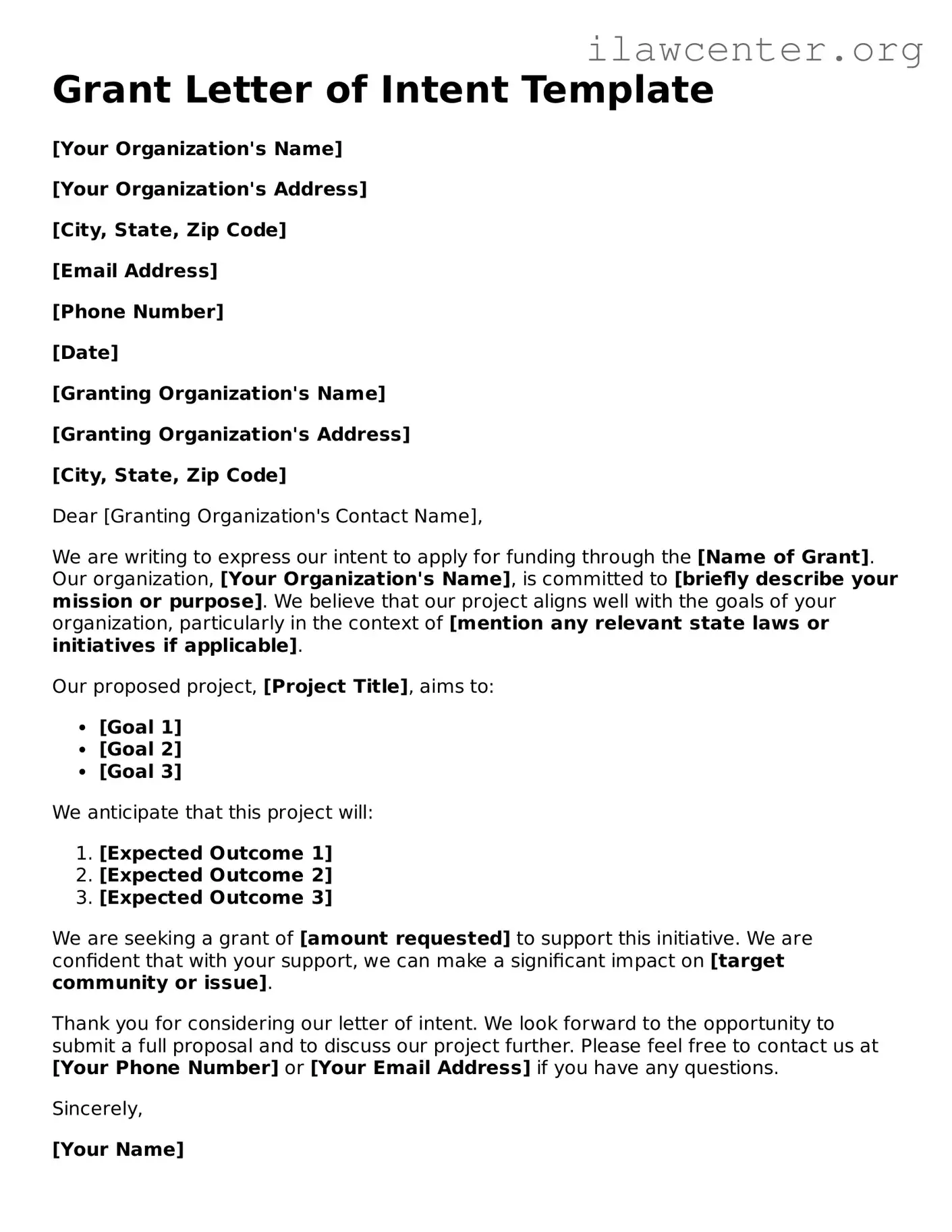
Grant Letter of Intent Preview

Grant Letter of Intent Template

[Your Organization's Name]

[Your Organization's Address]

[City, State, Zip Code]

[Email Address]

[Phone Number]

[Date]

[Granting Organization's Name]

[Granting Organization's Address]

[City, State, Zip Code]

Dear [Granting Organization's Contact Name],

We are writing to express our intent to apply for funding through the [Name of Grant]. Our organization, [Your Organization's Name], is committed to [briefly describe your mission or purpose]. We believe that our project aligns well with the goals of your organization, particularly in the context of [mention any relevant state laws or initiatives if applicable].

Our proposed project, [Project Title], aims to:

  • [Goal 1]
  • [Goal 2]
  • [Goal 3]

We anticipate that this project will:

  1. [Expected Outcome 1]
  2. [Expected Outcome 2]
  3. [Expected Outcome 3]

We are seeking a grant of [amount requested] to support this initiative. We are confident that with your support, we can make a significant impact on [target community or issue].

Thank you for considering our letter of intent. We look forward to the opportunity to submit a full proposal and to discuss our project further. Please feel free to contact us at [Your Phone Number] or [Your Email Address] if you have any questions.

Sincerely,

[Your Name]

[Your Title]

[Your Organization's Name]

PDF Form Characteristics

Fact Name Description
Purpose The Grant Letter of Intent form is used to express an organization's intent to apply for a grant.
Eligibility Organizations must meet specific eligibility criteria outlined by the grant provider.
Submission Deadline Each grant has its own submission deadline, which must be strictly followed.
Required Information The form typically requires details about the organization, project description, and funding needs.
State-Specific Forms Some states have specific forms that must be used, governed by state laws such as the California Nonprofit Corporation Law.
Review Process After submission, the grant provider reviews the letter of intent to determine eligibility for the full application.
Notification Organizations will receive notification regarding the acceptance or rejection of their letter of intent.
Confidentiality Information submitted may be kept confidential, depending on the grant provider's policies.

Instructions on Utilizing Grant Letter of Intent

After completing the Grant Letter of Intent form, it will be reviewed by the relevant committee. They will assess your submission and determine the next steps in the grant application process.

  1. Begin by downloading the Grant Letter of Intent form from the designated website.
  2. Open the form and read the instructions carefully to ensure you understand the requirements.
  3. Fill in your organization’s name and contact information at the top of the form.
  4. Provide a brief overview of your project, including its purpose and goals.
  5. Outline the target population and the specific needs your project addresses.
  6. Include a summary of the funding amount you are requesting.
  7. List any partners or collaborators involved in the project.
  8. Review your entries for clarity and accuracy.
  9. Save the completed form to your device.
  10. Submit the form according to the provided submission guidelines, ensuring you meet the deadline.

Important Facts about Grant Letter of Intent

What is a Grant Letter of Intent (LOI)?

A Grant Letter of Intent is a preliminary proposal that outlines your project idea and intentions to seek funding. It serves as an introduction to your organization and the project you wish to fund. By submitting an LOI, you give grantors a snapshot of your goals, objectives, and the potential impact of your project, allowing them to assess whether to invite you to submit a full grant application.

Why is submitting an LOI important?

Submitting an LOI can save you time and resources. Many grantors require an LOI before they will consider a full proposal. It allows you to gauge the interest of the funding organization in your project before investing significant effort into a detailed application. Additionally, it opens the door for feedback, which can strengthen your final proposal.

What should be included in a Grant LOI?

Your LOI should include key elements such as a brief description of your organization, the project you are proposing, the need for the project, and the expected outcomes. It’s also important to mention your target audience and how the project aligns with the mission of the funding organization. Keeping it concise, typically one to two pages, is crucial for maintaining the reader’s interest.

How do I know if I should submit an LOI?

Before submitting an LOI, review the funding organization’s guidelines. Many grantors will specify whether they require an LOI. If you’re unsure, consider reaching out to the organization for clarification. Additionally, if your project aligns with their mission and priorities, it’s likely a good candidate for an LOI submission.

What are common mistakes to avoid when writing an LOI?

Common pitfalls include being too vague or overly detailed. Stick to the essentials and avoid jargon. Ensure your project’s goals are clear and measurable. Also, don’t forget to proofread. Typos and grammatical errors can undermine your credibility. Lastly, tailor your LOI to the specific grantor; a generic letter can easily get overlooked.

What happens after I submit my LOI?

After submitting your LOI, the grantor will review it to determine if your project aligns with their funding priorities. They may invite you to submit a full proposal or provide feedback. If you receive an invitation, take the time to refine your proposal based on any insights or suggestions given. If not selected, consider it a learning opportunity and seek feedback to improve future submissions.
Common mistakes

Filling out a Grant Letter of Intent (LOI) can be a critical step in securing funding for your project or organization. However, many individuals make common mistakes that can jeopardize their chances of success. Understanding these pitfalls can help you present a stronger case to potential funders.

One frequent error is failing to follow the guidelines provided by the funding organization. Each grant may have specific requirements regarding format, length, and content. Ignoring these details can lead to an automatic disqualification of your application. It is essential to read the instructions thoroughly and ensure that your LOI adheres to the specified criteria.

Another common mistake is being vague or unclear about the project's goals and objectives. Funders want to understand precisely what you aim to achieve and how their support will make a difference. Providing concrete details and measurable outcomes can enhance your proposal. Instead of general statements, use specific examples to illustrate your project's impact.

Additionally, many applicants underestimate the importance of demonstrating alignment with the funder's mission and priorities. Your LOI should clearly articulate how your project aligns with the funder's goals. Failing to make this connection can leave reviewers questioning why they should invest in your initiative. Take the time to research the funder’s interests and tailor your message accordingly.

Lastly, neglecting to proofread the document can be detrimental. Spelling errors, grammatical mistakes, and typos can detract from the professionalism of your submission. A polished LOI reflects your commitment and attention to detail. Before submitting, review your document carefully or ask a colleague to provide feedback. This step can make a significant difference in how your proposal is perceived.

Documents used along the form

When applying for grants, several documents often accompany the Grant Letter of Intent (LOI) to provide additional context and support for the application. Each document serves a unique purpose and helps grant reviewers understand the project’s scope, objectives, and feasibility.

  • Project Proposal: This document outlines the specifics of the project, including goals, methodologies, and expected outcomes. It provides a comprehensive view of what the funding will support.
  • Budget Justification: A detailed breakdown of the project's financial needs. This document explains how funds will be allocated and justifies each expense to ensure transparency and accountability.
  • Organizational Background: This includes information about the organization applying for the grant. It highlights the organization’s mission, history, and relevant experience, demonstrating its capacity to manage the proposed project.
  • Letters of Support: These letters come from partners, stakeholders, or community members. They affirm the project's importance and can enhance credibility by showing community involvement and backing.

Each of these documents plays a crucial role in the grant application process. Together, they create a compelling case for funding and help establish the applicant's readiness to undertake the proposed project.

Similar forms

  • Proposal Letter: Similar to a Grant Letter of Intent, a proposal letter outlines the intent to seek funding. It details the project goals, budget, and how the funds will be used.
  • Funding Application: This document is a formal request for financial support. Like the Grant Letter of Intent, it includes information about the project and the organization seeking funding.
  • Project Summary: A project summary provides a brief overview of a proposed initiative. It shares key details and objectives, similar to the information found in a Grant Letter of Intent.
  • Letter of Inquiry: A letter of inquiry serves as an introduction to a funding organization. It expresses interest in funding and summarizes the project, much like a Grant Letter of Intent does.

Dos and Don'ts

When filling out a Grant Letter of Intent form, it's important to approach the process with care. Here’s a list of things you should and shouldn't do to ensure your submission stands out.

  • Do read the instructions carefully before starting. Understanding the requirements is key to a successful application.
  • Don't rush through the form. Take your time to provide thoughtful and detailed responses.
  • Do be clear and concise in your writing. Use straightforward language to convey your ideas.
  • Don't include unnecessary jargon or complex terms. This can confuse the reviewers.
  • Do double-check for spelling and grammatical errors. A polished submission reflects professionalism.
  • Don't ignore the word limits or formatting guidelines. Adhering to these shows respect for the process.

By following these tips, you can enhance your chances of making a positive impression with your Grant Letter of Intent.

Misconceptions

When it comes to the Grant Letter of Intent (LOI) form, misunderstandings can lead to confusion and missed opportunities. Here are five common misconceptions about the LOI that you should be aware of:

  • Misconception 1: The LOI is the same as a grant application.
  • Many people think that the LOI serves the same purpose as a full grant application. In reality, the LOI is a preliminary step. It outlines your project idea and helps funders decide if they want to see a full proposal.

  • Misconception 2: The LOI is not important.
  • Some believe that an LOI is a mere formality. However, it plays a critical role in the funding process. A well-crafted LOI can capture the funder's interest and set the stage for a successful application.

  • Misconception 3: There are no specific guidelines for writing an LOI.
  • It's a common belief that LOIs are free-form documents. In truth, many funders provide guidelines or templates. Following these can significantly enhance your chances of making a good impression.

  • Misconception 4: You can submit the same LOI to multiple funders.
  • While it may be tempting to use a one-size-fits-all approach, this can backfire. Each funder has unique priorities and interests. Tailoring your LOI to each specific funder shows that you have done your homework.

  • Misconception 5: The LOI is only for large projects.
  • Some individuals think that only big organizations or major initiatives require an LOI. In reality, even small projects can benefit from this initial communication. It helps clarify your goals and the impact of your work.

Understanding these misconceptions can empower you as you navigate the grant application process. With the right approach, your LOI can serve as a strong foundation for securing funding.

Key takeaways

When preparing to fill out and use the Grant Letter of Intent form, consider the following key takeaways:

  • Understand the Purpose: The Letter of Intent (LOI) serves as a preliminary proposal to express interest in applying for a grant.
  • Follow Guidelines: Each grant opportunity may have specific requirements. Always review the guidelines provided by the funding organization.
  • Be Concise: Keep your LOI brief and to the point. Clearly outline your project idea without unnecessary details.
  • Highlight Key Information: Include essential details such as the project’s objectives, target audience, and expected outcomes.
  • Proofread: Review your LOI for clarity and grammatical accuracy. A well-written document reflects professionalism.
  • Submit on Time: Ensure that you meet the submission deadlines. Late submissions may disqualify your proposal.
  • Follow Up: After submission, it’s acceptable to follow up with the grant provider to confirm receipt and inquire about the next steps.

By keeping these points in mind, you can enhance your chances of making a strong impression with your Grant Letter of Intent.