Attorney-Verified  Bill of Sale Document for Hawaii

Attorney-Verified Bill of Sale Document for Hawaii

A Hawaii Bill of Sale form is a legal document that serves as proof of the transfer of ownership of personal property from one party to another. This form outlines essential details such as the buyer and seller's information, a description of the item being sold, and the sale price. To ensure a smooth transaction, consider filling out the form by clicking the button below.

Article Guide

The Hawaii Bill of Sale form is an essential document for anyone looking to buy or sell personal property in the state. This form provides a clear record of the transaction, detailing important information such as the names and addresses of both the buyer and seller, a description of the item being sold, and the sale price. It serves as proof of ownership transfer, protecting both parties in the event of disputes. Additionally, the form may include specific terms and conditions related to the sale, ensuring that both parties understand their rights and responsibilities. By utilizing the Bill of Sale, individuals can facilitate a smooth transaction while adhering to state regulations, making it a vital tool for residents engaged in buying or selling goods in Hawaii.

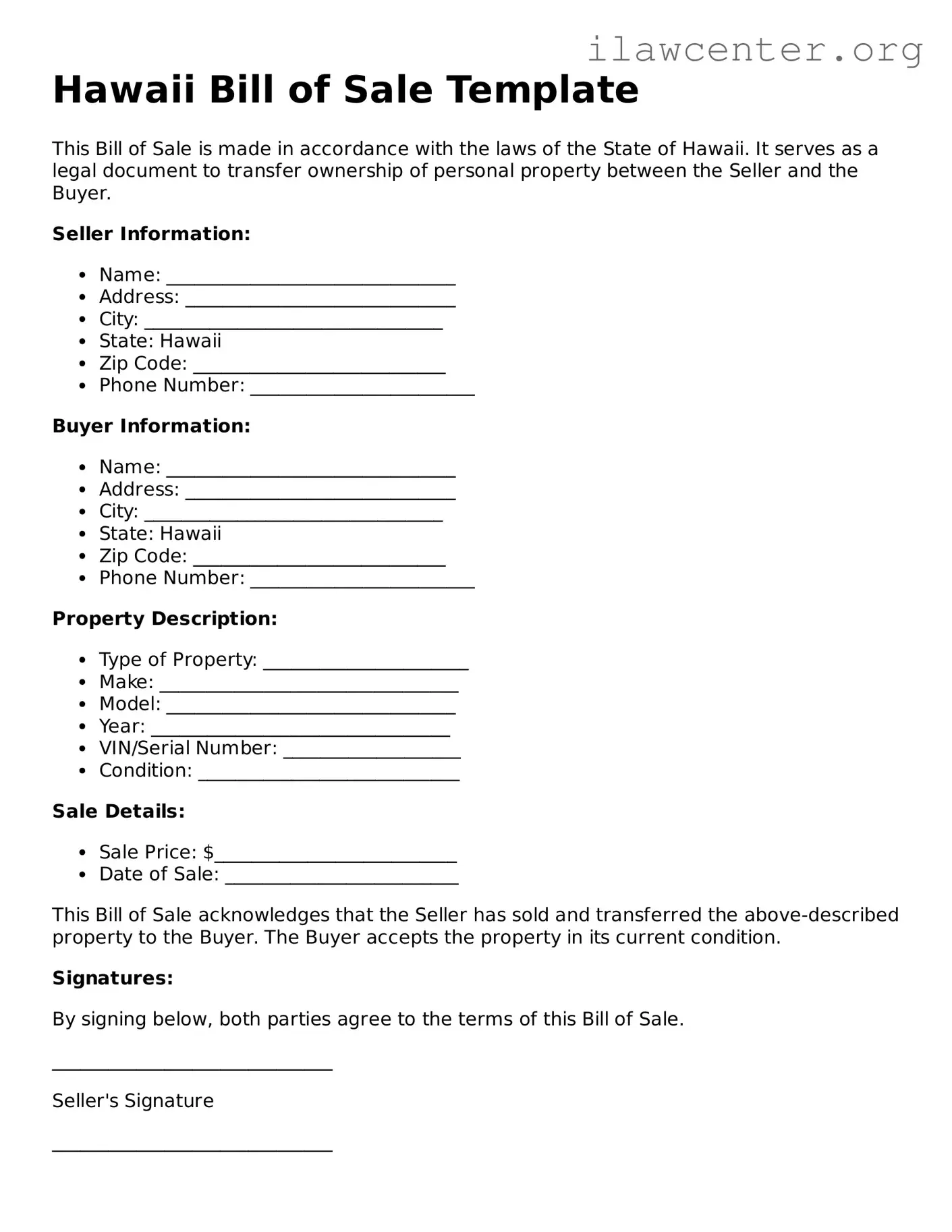
Hawaii Bill of Sale Preview

Hawaii Bill of Sale Template

This Bill of Sale is made in accordance with the laws of the State of Hawaii. It serves as a legal document to transfer ownership of personal property between the Seller and the Buyer.

Seller Information:

  • Name: _______________________________
  • Address: _____________________________
  • City: ________________________________
  • State: Hawaii
  • Zip Code: ___________________________
  • Phone Number: ________________________

Buyer Information:

  • Name: _______________________________
  • Address: _____________________________
  • City: ________________________________
  • State: Hawaii
  • Zip Code: ___________________________
  • Phone Number: ________________________

Property Description:

  • Type of Property: ______________________
  • Make: ________________________________
  • Model: _______________________________
  • Year: ________________________________
  • VIN/Serial Number: ___________________
  • Condition: ____________________________

Sale Details:

  • Sale Price: $__________________________
  • Date of Sale: _________________________

This Bill of Sale acknowledges that the Seller has sold and transferred the above-described property to the Buyer. The Buyer accepts the property in its current condition.

Signatures:

By signing below, both parties agree to the terms of this Bill of Sale.

______________________________

Seller's Signature

______________________________

Buyer's Signature

Date: _____________________________

PDF Form Characteristics

Fact Name Details
Purpose The Hawaii Bill of Sale is used to document the transfer of ownership of personal property.
Governing Law The form is governed by Hawaii Revised Statutes, Chapter 490.
Types of Property This form can be used for various types of personal property, including vehicles and equipment.
Requirements Both the seller and buyer must sign the Bill of Sale for it to be valid.
Notarization Notarization is not required but can add an extra layer of security.
Consideration The form should state the purchase price or other consideration involved in the sale.
Record Keeping It is advisable for both parties to keep a copy of the completed Bill of Sale for their records.
Additional Information Including a description of the item being sold can help avoid disputes later.
Transfer of Title For vehicles, a Bill of Sale may be required to complete the title transfer process.
Availability The Hawaii Bill of Sale form can be found online or at legal stationery stores.

Instructions on Utilizing Hawaii Bill of Sale

Filling out the Hawaii Bill of Sale form is an important step in documenting the transfer of ownership of personal property. Once completed, this form serves as proof of the transaction and can be used for future reference. Follow these steps carefully to ensure all necessary information is accurately provided.

  1. Begin by entering the date of the sale at the top of the form.
  2. Provide the full name and address of the seller. Ensure all details are correct to avoid any issues later.
  3. Next, fill in the buyer's full name and address. This information must match the buyer's identification.
  4. Clearly describe the item being sold. Include details such as make, model, year, and any identifying numbers like a VIN for vehicles.
  5. Indicate the sale price of the item. This should be the agreed-upon amount between the buyer and seller.
  6. Both the seller and buyer must sign and date the form. This signifies that both parties agree to the terms outlined.
  7. If applicable, include any warranties or guarantees regarding the item in the designated section.

After completing the form, keep a copy for your records. This document can be crucial if any disputes arise in the future or for tax purposes.

Important Facts about Hawaii Bill of Sale

What is a Bill of Sale in Hawaii?

A Bill of Sale is a legal document that serves as proof of the transfer of ownership of personal property from one person to another. In Hawaii, it is commonly used for the sale of vehicles, boats, and other tangible items. This document outlines the details of the transaction, including the names of the buyer and seller, a description of the item, the sale price, and the date of the transaction. Having a Bill of Sale can protect both parties by providing a clear record of the sale and its terms.

Is a Bill of Sale required in Hawaii?

While a Bill of Sale is not always legally required in Hawaii, it is highly recommended, especially for significant transactions like vehicles or boats. For vehicle sales, the state requires sellers to provide a Bill of Sale to the buyer for registration purposes. This document helps establish the buyer's ownership and can be crucial in the event of disputes regarding the sale or the condition of the item sold.

What information should be included in a Hawaii Bill of Sale?

A comprehensive Bill of Sale should include several key pieces of information. First, it should identify the buyer and seller with their full names and addresses. Next, it should provide a detailed description of the item being sold, including its make, model, year, and Vehicle Identification Number (VIN) if applicable. The sale price must be clearly stated, along with the date of the transaction. Additionally, both parties should sign the document to validate the agreement. Including any warranties or conditions of the sale can also be beneficial.

Can a Bill of Sale be used for items other than vehicles?

Absolutely! A Bill of Sale can be used for a wide range of personal property transactions beyond vehicles. This includes boats, motorcycles, furniture, electronics, and even livestock. Essentially, any time one person sells an item to another, a Bill of Sale can help document the transaction. It provides clarity and can serve as a reference in case questions arise about ownership or the condition of the item in the future.

Where can I obtain a Bill of Sale form in Hawaii?

You can find a Bill of Sale form in various places. Many online legal service websites offer free or paid templates that you can customize to fit your needs. Additionally, local office supply stores may carry generic Bill of Sale forms. If you prefer a more tailored document, consulting with a legal professional can ensure that all necessary details are included and that the form complies with Hawaii's laws.
Common mistakes

Filling out the Hawaii Bill of Sale form can seem straightforward, but many people make common mistakes that can lead to complications later. One frequent error is failing to include all necessary information about the buyer and seller. Each party’s full name, address, and contact information should be clearly stated. Omitting any of these details can create confusion and may complicate future transactions.

Another common mistake involves inaccurate descriptions of the item being sold. The form should include a detailed description of the item, including its make, model, year, and any identifying numbers, such as a VIN for vehicles. Without this information, the bill of sale may not serve as a valid proof of ownership.

Some individuals neglect to date the document properly. The date on the Bill of Sale is crucial as it establishes when the transaction took place. If the date is missing or incorrect, it could lead to disputes regarding ownership and rights to the item.

Moreover, failing to sign the document is a significant oversight. Both the buyer and seller must sign the Bill of Sale for it to be legally binding. A lack of signatures can render the document ineffective, leaving both parties vulnerable in the event of a disagreement.

People often forget to check for state-specific requirements. Hawaii may have particular regulations or additional forms that need to accompany the Bill of Sale, especially for certain items like vehicles or boats. Ignoring these requirements can lead to legal issues down the line.

Another mistake is not keeping copies of the completed Bill of Sale. After the transaction, both parties should retain a copy for their records. This serves as proof of the sale and can be crucial if any disputes arise in the future.

Lastly, many individuals do not seek legal advice when necessary. While the form is designed to be user-friendly, consulting with a legal expert can provide clarity and ensure that all aspects of the sale are handled correctly. Taking this precaution can prevent costly mistakes and protect both parties’ interests.

Documents used along the form

When engaging in a transaction that involves the transfer of ownership, such as buying or selling a vehicle or personal property in Hawaii, several documents may accompany the Hawaii Bill of Sale. Each of these forms serves a unique purpose, ensuring that both parties are protected and that the transaction is recorded properly. Below is a list of common forms that you might encounter alongside the Bill of Sale.

  • Title Transfer Document: This document officially transfers ownership of the item, such as a vehicle, from the seller to the buyer. It includes details like the vehicle identification number (VIN) and the names of both parties.
  • Odometer Disclosure Statement: Required for vehicle sales, this statement certifies the mileage on the vehicle at the time of sale. It protects the buyer from odometer fraud.
  • Sales Agreement: This is a more detailed contract outlining the terms of the sale, including payment methods, warranties, and contingencies. It provides clarity and security for both parties.
  • Affidavit of Identity: In some cases, sellers may need to prove their identity. This sworn statement verifies the seller's identity and ensures that they have the legal right to sell the item.
  • Release of Liability: This form protects the seller from future claims related to the item after the sale. It confirms that the buyer assumes all responsibility once the sale is completed.
  • Inspection Report: If the item being sold requires inspection, this report documents the condition of the item at the time of sale. It can help resolve disputes regarding the item's condition later on.
  • Payment Receipt: This simple document serves as proof of payment for the item. It typically includes the amount paid, the date of the transaction, and the names of both parties.
  • Warranty Deed (for real estate): In real estate transactions, a warranty deed transfers ownership and guarantees that the property is free of liens or claims. It provides a high level of protection for the buyer.

Understanding these accompanying documents can significantly enhance your confidence in any transaction. Each form plays a vital role in ensuring that the sale is conducted smoothly and legally, safeguarding the interests of both the buyer and the seller. Always consider consulting with a professional if you have questions about these forms or the overall process.

Similar forms

The Bill of Sale form shares similarities with several other documents. Each serves a specific purpose in the transfer of ownership or rights. Below are four documents that are comparable to a Bill of Sale:

  • Purchase Agreement: This document outlines the terms and conditions of a sale between a buyer and a seller. It details the items being sold, the purchase price, and any contingencies, similar to how a Bill of Sale confirms the transfer of ownership.
  • Title Transfer Document: Used primarily for vehicles, this document transfers the legal title from the seller to the buyer. Like a Bill of Sale, it serves as proof of ownership and includes details about the item being sold.
  • Lease Agreement: This document outlines the terms under which one party rents property from another. While it does not transfer ownership, it establishes the rights and responsibilities of both parties, much like a Bill of Sale does for ownership transfer.
  • Gift Deed: This document is used when property is transferred as a gift. It provides proof of the transfer without any exchange of money, akin to a Bill of Sale in that it formalizes the change in ownership.

Dos and Don'ts

When filling out the Hawaii Bill of Sale form, it's important to ensure accuracy and clarity. Here’s a helpful list of things you should and shouldn't do:

  • Do provide accurate information about the buyer and seller.
  • Do include a detailed description of the item being sold.
  • Do sign and date the document to validate the transaction.
  • Do keep a copy of the Bill of Sale for your records.
  • Don't leave any fields blank; this can lead to confusion later.
  • Don't use vague language when describing the item; specifics matter.

Following these guidelines will help ensure that your Bill of Sale is legally sound and clear for all parties involved.

Misconceptions

When it comes to the Hawaii Bill of Sale form, there are several misconceptions that can lead to confusion for buyers and sellers alike. Understanding these misconceptions can help ensure a smooth transaction. Here’s a list of ten common misunderstandings:

  1. A Bill of Sale is only needed for vehicles.

    Many people believe that a Bill of Sale is necessary only for vehicle transactions. In reality, it can be used for various items, including boats, trailers, and personal property.

  2. All Bills of Sale must be notarized.

    While notarization can add an extra layer of security, it is not a requirement for all Bills of Sale in Hawaii. Many transactions can be completed without a notary.

  3. A verbal agreement is sufficient.

    Some may think that a verbal agreement is enough to finalize a sale. However, having a written Bill of Sale is crucial for protecting both parties and providing proof of the transaction.

  4. The seller must provide a warranty.

    Buyers often assume that a Bill of Sale includes a warranty on the item. In Hawaii, the seller is not legally obligated to provide any warranties unless explicitly stated in the Bill of Sale.

  5. Only the seller needs to sign the Bill of Sale.

    It's a common belief that only the seller's signature is required. In fact, both the buyer and seller should sign the document to make it valid and enforceable.

  6. All Bills of Sale are the same.

    Not all Bills of Sale are created equal. Different types of transactions may require specific information or clauses, so it’s important to use the correct form for your situation.

  7. Once signed, the Bill of Sale cannot be changed.

    While it’s best to finalize all terms before signing, changes can be made if both parties agree and initial the modifications. Just be sure to keep clear records of any changes.

  8. A Bill of Sale is not necessary for gifts.

    Even if an item is given as a gift, a Bill of Sale can still be beneficial. It serves as documentation of the transfer and can help avoid disputes later on.

  9. You can only use a Bill of Sale in Hawaii for in-state transactions.

    Some people think that a Bill of Sale is only valid for transactions within Hawaii. However, it can be used for out-of-state transactions as well, as long as it meets the legal requirements.

  10. A Bill of Sale is not legally binding.

    This is a major misconception. A properly completed and signed Bill of Sale is a legally binding document that can be enforced in court if necessary.

By clearing up these misconceptions, individuals can navigate the process of buying and selling items in Hawaii with greater confidence and clarity. Always consider consulting with a professional if there are any uncertainties about the Bill of Sale or the transaction itself.

Key takeaways

Filling out and using the Hawaii Bill of Sale form is a straightforward process, but it is essential to pay attention to detail. Here are key takeaways to keep in mind:

  1. Understand the Purpose: A Bill of Sale serves as a legal document to transfer ownership of personal property, such as vehicles or equipment.
  2. Gather Necessary Information: Collect details about the buyer, seller, and the item being sold, including make, model, and VIN for vehicles.
  3. Use the Correct Form: Ensure you are using the official Hawaii Bill of Sale form to avoid any issues during the transaction.
  4. Complete All Sections: Fill out every required field accurately. Missing information can lead to complications later.
  5. Signatures Are Crucial: Both the buyer and seller must sign the form to validate the transaction.
  6. Consider Notarization: Although not always required, having the Bill of Sale notarized can add an extra layer of legitimacy.
  7. Keep Copies: Both parties should retain a copy of the Bill of Sale for their records. This helps in future disputes or verification.
  8. Check Local Regulations: Different counties may have specific requirements or additional forms needed for certain transactions.
  9. Use Clear Language: Avoid ambiguous terms. Clearly describe the item and the terms of the sale to prevent misunderstandings.
  10. Review Before Finalizing: Take a moment to double-check the information before signing to ensure everything is correct.

By following these guidelines, you can ensure a smooth transaction when using the Hawaii Bill of Sale form.