Attorney-Verified  Deed Document for Hawaii

Attorney-Verified Deed Document for Hawaii

A Hawaii Deed form is a legal document used to transfer ownership of real property in the state of Hawaii. This form outlines the details of the transaction, including the parties involved and the property description. To ensure a smooth transfer of ownership, consider filling out the form by clicking the button below.

Article Guide

When navigating the complexities of real estate transactions in Hawaii, understanding the Hawaii Deed form is essential for both buyers and sellers. This legal document serves as a crucial instrument in the transfer of property ownership, ensuring that the rights and interests of the parties involved are clearly defined and protected. The form typically includes vital information such as the names of the grantor and grantee, a detailed description of the property being conveyed, and any relevant conditions or covenants that may apply. Additionally, the Hawaii Deed form may vary in type, with options such as warranty deeds, quitclaim deeds, and special warranty deeds, each serving distinct purposes and offering different levels of protection. Familiarity with these variations can empower individuals to make informed decisions, whether they are engaging in a straightforward sale, gifting property, or navigating a more complex transaction involving multiple parties. Furthermore, the proper execution of the deed, including notarization and recording with the appropriate county office, is vital to ensure the legality and enforceability of the transfer. Understanding these key aspects can greatly enhance one's confidence in the real estate process, ultimately leading to smoother transactions and greater peace of mind.

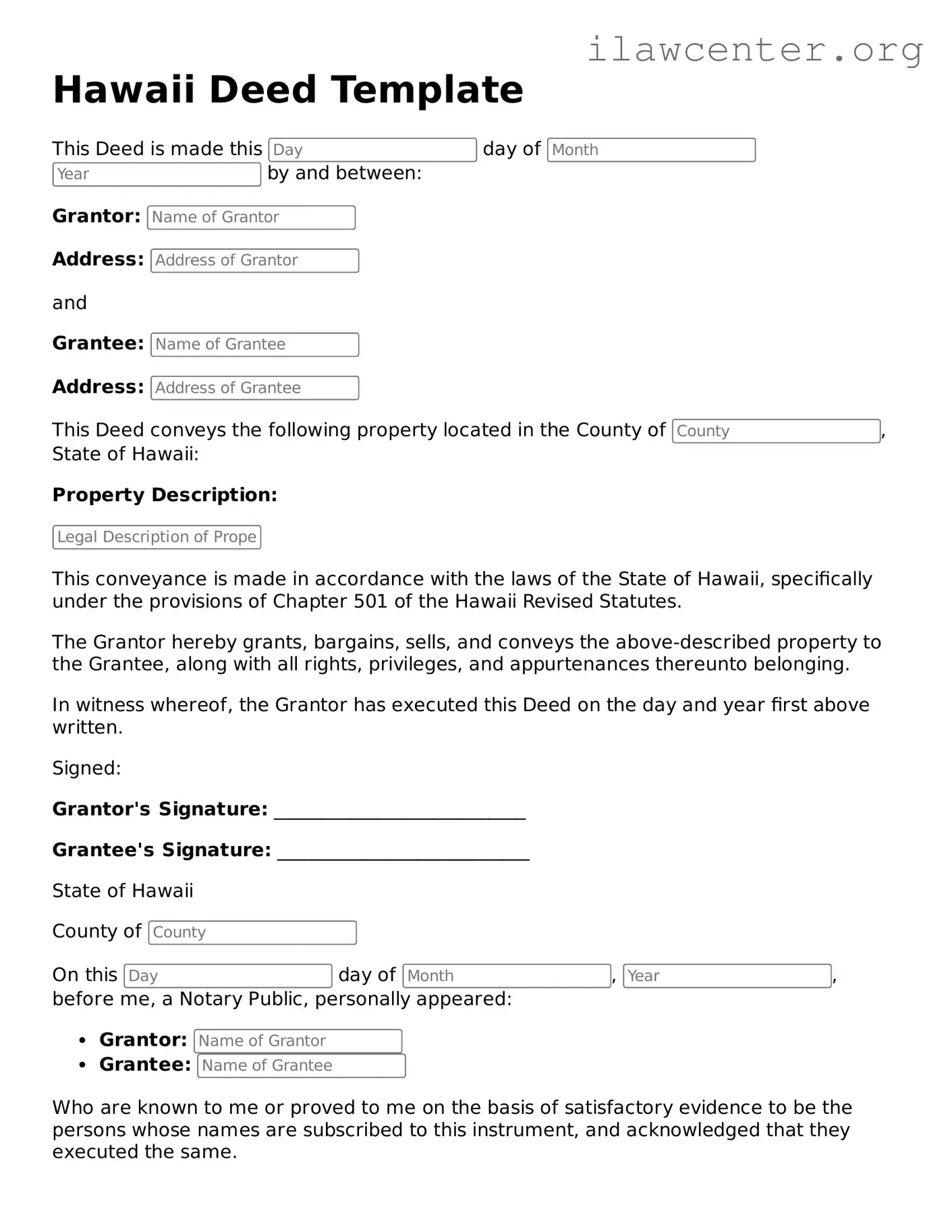
Hawaii Deed Preview

Hawaii Deed Template

This Deed is made this day of by and between:

Grantor:

Address:

and

Grantee:

Address:

This Deed conveys the following property located in the County of , State of Hawaii:

Property Description:

This conveyance is made in accordance with the laws of the State of Hawaii, specifically under the provisions of Chapter 501 of the Hawaii Revised Statutes.

The Grantor hereby grants, bargains, sells, and conveys the above-described property to the Grantee, along with all rights, privileges, and appurtenances thereunto belonging.

In witness whereof, the Grantor has executed this Deed on the day and year first above written.

Signed:

Grantor's Signature: ___________________________

Grantee's Signature: ___________________________

State of Hawaii

County of

On this day of , , before me, a Notary Public, personally appeared:

  • Grantor:
  • Grantee:

Who are known to me or proved to me on the basis of satisfactory evidence to be the persons whose names are subscribed to this instrument, and acknowledged that they executed the same.

In witness whereof, I hereunto set my hand and official seal.

Notary Public Signature: ___________________________

My Commission Expires: ___________________________

PDF Form Characteristics

Fact Name Description
Purpose The Hawaii Deed form is used to transfer real property ownership from one party to another.
Types of Deeds Common types include Warranty Deed, Quitclaim Deed, and Special Warranty Deed.
Governing Law The transfer of property in Hawaii is governed by Hawaii Revised Statutes, Chapter 501.
Signature Requirement The deed must be signed by the grantor (the person transferring the property).
Notarization A notary public must witness the signing of the deed for it to be valid.
Recording The completed deed must be recorded with the Bureau of Conveyances in Hawaii to provide public notice.
Transfer Tax A conveyance tax may apply when transferring property, based on the sale price or value of the property.

Instructions on Utilizing Hawaii Deed

After obtaining the Hawaii Deed form, it is essential to fill it out accurately to ensure proper recording. This process will involve providing specific details about the property and the parties involved. Once completed, the form will need to be submitted to the appropriate county office for recording.

  1. Begin by entering the date at the top of the form.
  2. Clearly state the names of the grantor(s) (the person(s) transferring the property).
  3. Provide the names of the grantee(s) (the person(s) receiving the property).
  4. Include the full legal description of the property. This information can typically be found in previous property records.
  5. Indicate the address of the property, ensuring it is complete and accurate.
  6. Fill in the consideration amount, which is the value exchanged for the property.
  7. Sign the form in the designated area. If there are multiple grantors, each must sign.
  8. Have the signatures notarized. This is a crucial step for the deed to be valid.
  9. Review the completed form for any errors or omissions before submission.

Important Facts about Hawaii Deed

What is a Hawaii Deed form?

A Hawaii Deed form is a legal document used to transfer ownership of real property in the state of Hawaii. It serves as evidence of the transfer and outlines the parties involved, the property being transferred, and any conditions related to the transfer. Various types of deeds exist, including warranty deeds and quitclaim deeds, each serving different purposes in property transactions.

Who needs to use a Hawaii Deed form?

Individuals or entities involved in the sale, transfer, or gifting of real estate in Hawaii need to use a Hawaii Deed form. This includes homeowners selling their property, family members transferring property to one another, or businesses conveying real estate assets. It is essential for anyone engaging in these transactions to ensure the proper deed form is utilized to protect their interests.

How do I fill out a Hawaii Deed form?

To fill out a Hawaii Deed form, start by gathering necessary information, such as the names of the grantor (seller) and grantee (buyer), a legal description of the property, and any specific terms of the transfer. It is crucial to accurately complete all sections of the form. After filling it out, both parties must sign the deed in the presence of a notary public to validate the document. Ensure that all details are correct to avoid complications in the future.

Is it necessary to have a lawyer review the Hawaii Deed form?

What happens after the Hawaii Deed form is completed?

Once the Hawaii Deed form is completed and signed, the next step is to record the deed with the Bureau of Conveyances in Hawaii. Recording the deed provides public notice of the property transfer and protects the rights of the new owner. After recording, the grantee should keep a copy of the deed for their records, as it serves as proof of ownership.

Common mistakes

Filling out the Hawaii Deed form can seem straightforward, but many individuals encounter pitfalls that can lead to complications. One common mistake is failing to include the correct legal description of the property. This description must be precise, detailing the boundaries and location. Omitting or inaccurately describing this information can result in disputes or delays in the transfer process.

Another frequent error is neglecting to include all necessary parties in the deed. Both the grantor (the person transferring the property) and the grantee (the person receiving the property) must be clearly identified. If any party is missing or incorrectly named, it can invalidate the deed. It’s crucial to double-check names and their spelling to avoid this issue.

Many people also overlook the requirement for notarization. The Hawaii Deed form must be signed in the presence of a notary public. Failing to obtain a notary’s signature can render the document legally ineffective. Always ensure that the signing process is completed correctly to prevent future legal complications.

Additionally, some individuals mistakenly use outdated forms. Laws and regulations can change, and using an old version of the deed form may not comply with current requirements. It’s essential to obtain the most recent form from a reliable source to ensure compliance with Hawaii’s legal standards.

Another common mistake involves the failure to record the deed promptly. After the deed is signed and notarized, it must be filed with the Bureau of Conveyances in Hawaii. Delaying this step can lead to problems, especially if there are disputes over ownership. Timely recording helps protect the rights of the new property owner.

Inaccurate tax information can also pose challenges. When filling out the deed, individuals must provide the correct tax map key (TMK) number. An incorrect TMK can lead to issues with property taxes and ownership records. Always verify this information before submission to avoid potential headaches later on.

People often forget to check for any liens or encumbrances on the property before completing the deed. If the property has outstanding debts or legal claims, these issues must be addressed before the transfer can be finalized. Ignoring this step can lead to unexpected financial burdens for the new owner.

Lastly, some individuals fail to understand the implications of the deed’s wording. The choice of language can significantly affect the rights and responsibilities of both parties. It’s vital to use clear and precise language to prevent misunderstandings. Consulting with a professional can help clarify any uncertainties regarding the deed’s terms.
Documents used along the form

When dealing with property transactions in Hawaii, several important forms and documents are often utilized alongside the Hawaii Deed form. Each of these documents serves a specific purpose and contributes to the overall process of transferring property ownership. Below is a list of commonly used forms that you may encounter.

  • Title Search Report: This document provides a comprehensive history of the property's ownership. It reveals any liens, encumbrances, or claims against the property, ensuring that the buyer is fully informed before completing the transaction.
  • Purchase Agreement: This contract outlines the terms and conditions of the sale between the buyer and seller. It includes details such as the sale price, payment terms, and any contingencies that must be met before the sale can proceed.
  • Escrow Agreement: This document establishes an arrangement where a neutral third party holds funds and documents until all conditions of the sale are met. It protects both the buyer and seller during the transaction process.
  • Property Disclosure Statement: Sellers are often required to provide this statement, which discloses any known issues or defects with the property. This helps ensure transparency and allows buyers to make informed decisions.
  • Closing Statement: Also known as a HUD-1 Settlement Statement, this document itemizes all the costs associated with the property transaction. It outlines the financial aspects of the closing process, including fees, taxes, and the final purchase price.
  • Affidavit of Title: This sworn statement by the seller confirms their ownership of the property and that there are no undisclosed claims or liens. It serves to protect the buyer from future disputes regarding ownership.
  • Power of Attorney: In some cases, a seller may grant someone else the authority to act on their behalf in the transaction. This document specifies the powers granted and is essential when the seller cannot be present for the closing.

Understanding these documents is crucial for anyone involved in a property transaction in Hawaii. Each form plays a vital role in ensuring a smooth transfer of ownership and protecting the rights of all parties involved. It is always advisable to consult with a professional for guidance throughout this process.

Similar forms

The Deed form shares similarities with several other legal documents. Below are seven documents that are comparable to the Deed form, along with a brief explanation of how they relate:

  • Title Transfer Document: This document formally transfers ownership of property from one party to another, similar to how a Deed conveys title.
  • Lease Agreement: A lease outlines the terms under which one party may occupy property owned by another, similar to a Deed in that it establishes rights to use the property.
  • Bill of Sale: This document transfers ownership of personal property, much like a Deed transfers real property ownership.
  • Quitclaim Deed: A type of Deed that transfers any interest the grantor has in the property without guaranteeing clear title, reflecting the essence of a Deed's purpose.
  • Mortgage Agreement: This document secures a loan with real property as collateral, similar to how a Deed secures ownership rights.
  • Trust Agreement: A Trust can hold property for beneficiaries, paralleling the Deed's role in establishing ownership and rights to property.
  • Power of Attorney: This document grants authority to another person to act on one's behalf, particularly in property transactions, which can include signing a Deed.

Dos and Don'ts

When filling out the Hawaii Deed form, it is important to follow certain guidelines to ensure the document is completed correctly. Below is a list of things to do and avoid during this process.

  • Do double-check the names of all parties involved to ensure accuracy.
  • Do use clear and legible handwriting or type the information if possible.
  • Do include the legal description of the property as required.
  • Do sign the deed in the presence of a notary public.
  • Do keep a copy of the completed deed for your records.
  • Don't leave any required fields blank; fill in all necessary information.
  • Don't use abbreviations or informal language in the deed.
  • Don't forget to check the local recording requirements for the deed.
  • Don't alter the form or make unauthorized changes to its content.

Misconceptions

Many people have misunderstandings about the Hawaii Deed form. Here are five common misconceptions:

  1. All deeds are the same. Many believe that all deed forms are interchangeable. However, each type of deed serves a specific purpose. For instance, a warranty deed offers guarantees about the property title, while a quitclaim deed transfers whatever interest the grantor has without warranties.

  2. Hawaii deeds do not need to be recorded. Some think that recording a deed is optional. In reality, recording a deed in Hawaii is crucial for establishing public notice of ownership and protecting your rights to the property.

  3. Only attorneys can prepare a deed. While legal assistance can be beneficial, it is not mandatory. Individuals can prepare their own deeds, provided they follow the correct format and include all necessary information.

  4. Once a deed is signed, it cannot be changed. Many assume that a deed is final once executed. However, deeds can be amended or revoked, depending on the circumstances and the type of deed involved.

  5. All property transfers require a new deed. Some people believe that every transfer of property necessitates a new deed. In certain situations, such as inheriting property, the existing deed may suffice, depending on local laws.

Key takeaways

Filling out and using the Hawaii Deed form requires careful attention to detail. Here are nine key takeaways to keep in mind:

  1. Understand the Purpose: A deed is a legal document that transfers property ownership from one party to another.
  2. Identify the Parties: Clearly list the names of the grantor (seller) and grantee (buyer) in the deed.
  3. Provide Accurate Property Description: Include a detailed legal description of the property being transferred. This often involves the parcel number and physical address.
  4. Consider the Type of Deed: Choose the appropriate type of deed, such as warranty deed or quitclaim deed, based on the nature of the transaction.
  5. Signatures Required: Ensure that all parties involved sign the deed. Notarization is also typically required to validate the document.
  6. File with the County: After completion, the deed must be filed with the appropriate county office to make the transfer official.
  7. Check for Liens: Before transferring property, verify that there are no outstanding liens or encumbrances that could affect ownership.
  8. Consult Legal Advice: It may be beneficial to seek legal counsel to ensure that the deed is filled out correctly and complies with state laws.
  9. Keep Copies: Retain copies of the signed deed for your records, as this document serves as proof of ownership.

By following these guidelines, you can navigate the process of filling out and using the Hawaii Deed form more effectively.