Attorney-Verified  Do Not Resuscitate Order Document for Hawaii

Attorney-Verified Do Not Resuscitate Order Document for Hawaii

A Do Not Resuscitate (DNR) Order in Hawaii is a legal document that allows individuals to express their wishes regarding resuscitation efforts in the event of a medical emergency. This form ensures that healthcare providers honor a person's desire to forego life-saving measures. Understanding and completing this form is essential for anyone wishing to make their healthcare preferences known.

Ready to take control of your healthcare decisions? Fill out the form by clicking the button below.

Article Guide

In the serene landscape of Hawaii, where the spirit of Aloha permeates everyday life, the Do Not Resuscitate (DNR) Order form serves as a vital tool for individuals facing serious health decisions. This document empowers patients to express their wishes regarding resuscitation efforts in the event of a medical emergency. By completing the DNR Order, individuals indicate their preference to forgo cardiopulmonary resuscitation (CPR) and other life-sustaining treatments. It is essential for patients to discuss their choices with healthcare providers, ensuring that their values and desires are respected. The form requires signatures from both the patient and a physician, affirming the legitimacy of the decision. In addition, it is crucial for individuals to communicate their wishes to family members and caregivers, fostering understanding and support during challenging times. Ultimately, the DNR Order embodies a compassionate approach to end-of-life care, allowing individuals to maintain dignity and autonomy in their healthcare journey.

Hawaii Do Not Resuscitate Order Preview

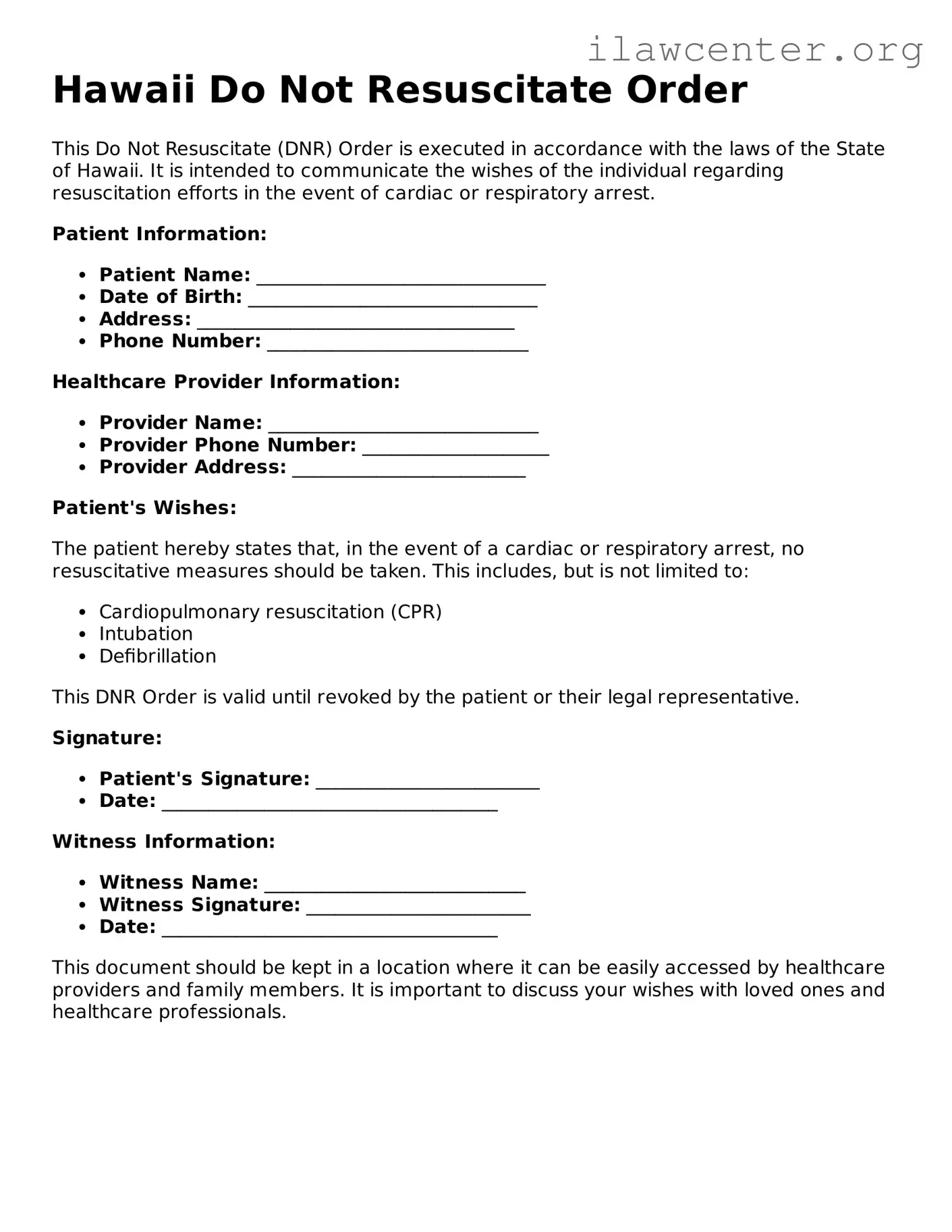
Hawaii Do Not Resuscitate Order

This Do Not Resuscitate (DNR) Order is executed in accordance with the laws of the State of Hawaii. It is intended to communicate the wishes of the individual regarding resuscitation efforts in the event of cardiac or respiratory arrest.

Patient Information:

  • Patient Name: _______________________________
  • Date of Birth: _______________________________
  • Address: __________________________________
  • Phone Number: ____________________________

Healthcare Provider Information:

  • Provider Name: _____________________________
  • Provider Phone Number: ____________________
  • Provider Address: _________________________

Patient's Wishes:

The patient hereby states that, in the event of a cardiac or respiratory arrest, no resuscitative measures should be taken. This includes, but is not limited to:

  • Cardiopulmonary resuscitation (CPR)
  • Intubation
  • Defibrillation

This DNR Order is valid until revoked by the patient or their legal representative.

Signature:

  • Patient's Signature: ________________________
  • Date: ____________________________________

Witness Information:

  • Witness Name: ____________________________
  • Witness Signature: ________________________
  • Date: ____________________________________

This document should be kept in a location where it can be easily accessed by healthcare providers and family members. It is important to discuss your wishes with loved ones and healthcare professionals.

PDF Form Characteristics

Fact Name Description
Definition The Hawaii Do Not Resuscitate Order (DNR) form allows individuals to express their wish not to receive cardiopulmonary resuscitation (CPR) in the event of cardiac or respiratory arrest.
Governing Law The DNR form is governed by Hawaii Revised Statutes §327-1 through §327-6, which outline the legal framework for advance health care directives.
Eligibility Any adult who is capable of making their own medical decisions can complete a DNR order in Hawaii.
Signature Requirement The DNR form must be signed by the individual or their authorized representative, along with the signature of a physician.
Form Availability The DNR order form is available through various healthcare providers, hospitals, and the Hawaii Department of Health.
Revocation Individuals can revoke their DNR order at any time, verbally or in writing, and must inform their healthcare providers of the change.
Emergency Medical Services Emergency medical services (EMS) personnel are required to honor valid DNR orders, ensuring that individuals' wishes are respected during emergencies.
Public Awareness Hawaii promotes public awareness regarding DNR orders through educational initiatives, helping individuals understand their rights and options.

Instructions on Utilizing Hawaii Do Not Resuscitate Order

Completing the Hawaii Do Not Resuscitate Order form is an important step in expressing your medical preferences. After filling out the form, it will need to be signed and witnessed to ensure its validity. This document can provide peace of mind for you and your loved ones regarding your healthcare decisions.

  1. Obtain the Hawaii Do Not Resuscitate Order form from a reliable source, such as a healthcare provider or the state’s official website.
  2. Carefully read the instructions provided on the form to understand the requirements.
  3. Fill in your full name, date of birth, and any other personal identification information requested.
  4. Indicate your preferences regarding resuscitation by selecting the appropriate options on the form.
  5. Provide the name and contact information of your healthcare provider, if applicable.
  6. Sign and date the form in the designated area to validate your decision.
  7. Have the form witnessed by at least one person, as required by state law.
  8. Make copies of the completed form for your records and for your healthcare provider.
  9. Ensure that the original form is placed in a location where it can be easily accessed in case of a medical emergency.

Important Facts about Hawaii Do Not Resuscitate Order

What is a Do Not Resuscitate (DNR) Order in Hawaii?

A Do Not Resuscitate Order is a legal document that allows a person to express their wishes regarding resuscitation efforts in the event of a medical emergency. In Hawaii, this order specifically instructs medical personnel not to perform cardiopulmonary resuscitation (CPR) if the individual’s heart stops or they stop breathing.

Who can request a DNR Order in Hawaii?

In Hawaii, a DNR Order can be requested by any adult who is capable of making their own healthcare decisions. This includes individuals who are terminally ill or have a serious medical condition. It is essential that the person understands the implications of the order.

How do I obtain a DNR Order form in Hawaii?

You can obtain a DNR Order form from various sources, including healthcare providers, hospitals, or online from the Hawaii Department of Health’s website. It is important to ensure that the form is the official version recognized by the state.

What information is required on the DNR Order form?

The DNR Order form typically requires personal information such as the individual's name, date of birth, and medical condition. Additionally, it must include the signatures of the individual and their physician to validate the order.

Is a DNR Order valid in all healthcare settings in Hawaii?

Yes, a properly completed DNR Order is generally valid across all healthcare settings in Hawaii, including hospitals, nursing homes, and at home. However, it is advisable to keep a copy of the order accessible and inform family members and healthcare providers of its existence.

Can a DNR Order be revoked or changed?

Yes, a DNR Order can be revoked or changed at any time. The individual who created the order can do this verbally or in writing. It is important to notify healthcare providers of any changes to ensure that they have the most current information.

What happens if a DNR Order is not followed?

If a DNR Order is not followed, it may lead to unwanted medical interventions that go against the individual’s wishes. In such cases, healthcare providers may face legal consequences, and family members may experience significant emotional distress.

Can family members override a DNR Order?

Generally, family members cannot override a valid DNR Order if the individual is competent and made the decision themselves. However, if the individual is unable to communicate their wishes, family members may need to make decisions based on what they believe the individual would have wanted.

How does a DNR Order affect other medical treatments?

A DNR Order specifically addresses resuscitation efforts. It does not prevent the individual from receiving other medical treatments, such as pain management or comfort care. Healthcare providers will still provide necessary care that aligns with the individual’s overall treatment plan.

Is it necessary to have a DNR Order if I have an advance healthcare directive?

While an advance healthcare directive outlines your overall healthcare preferences, a DNR Order specifically addresses resuscitation. Having both documents can provide clearer guidance to healthcare providers regarding your wishes in various medical situations.
Common mistakes

Filling out a Do Not Resuscitate (DNR) Order form in Hawaii is a significant decision that requires careful consideration. However, many individuals make common mistakes that can lead to confusion or complications later on. Understanding these pitfalls can help ensure that your wishes are clearly communicated and respected.

One frequent mistake is failing to discuss the DNR decision with family members or loved ones. Open communication is crucial. When individuals do not share their wishes, it can lead to misunderstandings or disagreements among family members during critical moments. Taking the time to explain your choices can provide peace of mind for everyone involved.

Another common error is not obtaining the required signatures. The DNR Order must be signed by both the patient and a physician. Without these signatures, the document may not be considered valid. It is essential to ensure that all necessary parties have signed the form before it is filed or presented in a medical setting.

Many people also overlook the importance of keeping the DNR Order accessible. Storing the document in a drawer or filing cabinet can render it ineffective when it is needed most. It is advisable to keep copies in easily accessible locations, such as with a trusted family member or in a medical file that healthcare providers can quickly access.

Additionally, individuals sometimes fail to update their DNR Orders when their health status changes. Life circumstances can shift, and what once seemed like the right decision may no longer apply. Regularly reviewing and, if necessary, revising the DNR Order ensures that it accurately reflects current wishes and medical conditions.

Lastly, misunderstanding the implications of a DNR Order can lead to unintended consequences. Some individuals mistakenly believe that a DNR means they will not receive any medical care. In reality, a DNR specifically addresses resuscitation efforts, while other forms of treatment and care continue as needed. Clarifying this distinction is vital for ensuring comprehensive care.

Documents used along the form

When considering end-of-life care options in Hawaii, it’s essential to have a comprehensive understanding of various documents that may accompany the Do Not Resuscitate (DNR) Order form. These forms help ensure that individuals’ wishes regarding medical treatment are respected and clearly communicated to healthcare providers. Below is a list of common documents that are often used alongside the DNR Order form.

  • Advance Healthcare Directive: This document allows individuals to outline their preferences for medical treatment in case they become unable to communicate their wishes. It can include specific instructions about medical procedures and appoint a healthcare proxy.
  • Living Will: A living will specifies what types of medical treatment a person does or does not want in situations where they are terminally ill or permanently unconscious. It serves as a guide for healthcare providers and family members.
  • Healthcare Proxy: This document designates a trusted individual to make medical decisions on behalf of someone if they are unable to do so. It ensures that someone familiar with the person’s values and wishes is making decisions.
  • POLST (Physician Orders for Life-Sustaining Treatment): A POLST form translates a patient’s wishes into medical orders that healthcare providers must follow. It is particularly useful for those with serious illnesses or frailty.
  • Do Not Hospitalize Order: This order instructs healthcare providers not to transfer a patient to a hospital under certain circumstances, emphasizing comfort care instead of aggressive treatments.
  • Organ Donation Form: This document allows individuals to express their wishes regarding organ donation after death. It can be included as part of an advance directive or completed separately.
  • Authorization for Release of Medical Records: This form permits healthcare providers to share an individual’s medical records with designated persons, ensuring that family members or proxies have access to necessary information.
  • Patient Advocate Designation: This document allows individuals to appoint someone to advocate for their healthcare needs and preferences, providing an additional layer of support in medical decision-making.
  • End-of-Life Care Plan: This plan outlines the individual’s preferences for care in their final days, covering aspects such as pain management, spiritual care, and personal wishes regarding environment and visitors.

Having these documents in place can provide peace of mind for individuals and their families. They ensure that everyone is on the same page regarding medical treatment and end-of-life care preferences. It’s crucial to discuss these options with loved ones and healthcare professionals to ensure that wishes are honored and respected.

Similar forms

The Do Not Resuscitate (DNR) Order form is a critical document in healthcare, indicating a patient's wishes regarding resuscitation efforts. Several other documents serve similar purposes in expressing healthcare preferences. Here are seven documents that share similarities with the DNR Order form:

  • Advance Directive: This document outlines a person's healthcare preferences in case they become unable to communicate. It can include instructions about resuscitation, similar to a DNR.
  • Living Will: A type of advance directive, a living will specifies the types of medical treatments a person wishes or does not wish to receive, including resuscitation measures.
  • Healthcare Power of Attorney: This document designates an individual to make healthcare decisions on behalf of a person if they are incapacitated. It often includes DNR preferences.
  • POLST (Physician Orders for Life-Sustaining Treatment): This form translates patient preferences into actionable medical orders, covering resuscitation and other treatments.
  • Do Not Intubate (DNI) Order: Similar to a DNR, a DNI specifies that a patient should not be intubated if they cannot breathe on their own.
  • Comfort Care Order: This document focuses on providing comfort rather than aggressive treatments, often aligning with DNR wishes.
  • Patient Preferences Form: This form allows patients to express their preferences for various medical interventions, including resuscitation, ensuring their wishes are known.

Dos and Don'ts

Filling out a Do Not Resuscitate (DNR) Order form in Hawaii is a significant decision. Here are some important things to consider:

  • Do consult with your healthcare provider before completing the form. They can provide valuable guidance.
  • Do ensure that the form is signed by you and a witness. This is crucial for its validity.
  • Do keep a copy of the completed form in a safe place. It should be easily accessible for medical personnel.
  • Do discuss your wishes with family members. Clear communication can prevent confusion during critical times.
  • Don't fill out the form if you are under duress or feeling pressured. Your decision must be voluntary.
  • Don't forget to review and update the form as your health status or preferences change.
  • Don't assume that medical staff will know your wishes without the form. It must be documented properly.

Misconceptions

Understanding the Hawaii Do Not Resuscitate (DNR) Order form is crucial for making informed healthcare decisions. However, several misconceptions can lead to confusion. Here are six common misunderstandings:

  1. A DNR means no medical care at all.

    This is false. A DNR order specifically addresses resuscitation efforts in the event of cardiac arrest. It does not prevent other types of medical treatment, such as pain management or comfort care.

  2. A DNR is only for terminally ill patients.

    This misconception can be misleading. While many people with terminal conditions choose to have a DNR, anyone can request one, regardless of their health status. The decision is personal and should reflect individual wishes.

  3. A DNR is permanent and cannot be changed.

    This is not true. Individuals have the right to revoke or modify a DNR order at any time, as long as they are mentally competent to do so. It’s important to communicate any changes to healthcare providers.

  4. Healthcare providers will ignore a DNR order.

    This is a serious misconception. Medical professionals are legally obligated to respect a valid DNR order. They are trained to recognize and follow these directives as part of their ethical responsibilities.

  5. A DNR is the same as a living will.

    While both documents relate to end-of-life care, they serve different purposes. A DNR specifically addresses resuscitation, whereas a living will outlines a person's wishes regarding other medical treatments and interventions.

  6. A DNR order is only valid in hospitals.

    This is incorrect. In Hawaii, a DNR order is valid in any healthcare setting, including at home or in long-term care facilities. It’s essential to ensure that the order is communicated to all relevant parties.

Understanding these points can help individuals make informed decisions about their healthcare preferences and ensure their wishes are respected.

Key takeaways

The Hawaii Do Not Resuscitate (DNR) Order form is a crucial document for individuals who wish to express their preferences regarding resuscitation efforts in medical emergencies. Here are key takeaways to consider when filling out and using this form:

  • The DNR Order form must be signed by a licensed physician to be valid.
  • It is essential for individuals to discuss their wishes with family members and healthcare providers before completing the form.
  • The form should be easily accessible, ideally kept in a prominent location, such as on the refrigerator or with medical records.
  • Patients can revoke or modify the DNR Order at any time, provided they communicate their wishes clearly.
  • The DNR Order applies only to resuscitation efforts, not to other medical treatments or care.
  • Healthcare providers are required to honor the DNR Order once it is properly executed.
  • Individuals should review the DNR Order periodically, especially if their health status changes.
  • It is advisable to keep copies of the DNR Order for personal records and to share with family and caregivers.