Attorney-Verified  Hold Harmless Agreement Document for Hawaii

Attorney-Verified Hold Harmless Agreement Document for Hawaii

The Hawaii Hold Harmless Agreement form is a legal document designed to protect one party from liability for any injuries or damages that may occur during a specific activity or event. This agreement is commonly used in various situations, such as recreational activities, construction projects, and events held on private property. To ensure your interests are safeguarded, consider filling out the form by clicking the button below.

Article Guide

The Hawaii Hold Harmless Agreement form serves as a vital tool for individuals and organizations looking to protect themselves from potential legal liabilities. This form outlines the responsibilities and risks associated with specific activities or events, ensuring that one party agrees to assume the risk of injury or damage that may occur. By signing this agreement, participants acknowledge that they understand the inherent risks involved and agree not to hold the other party responsible for any resulting harm. Typically used in various contexts, such as recreational activities, construction projects, and community events, the form emphasizes the importance of clear communication and mutual understanding between the parties involved. It is essential to ensure that the language is straightforward and that all parties fully comprehend the implications of the agreement before signing. This proactive approach not only fosters a sense of security but also encourages responsible behavior during potentially hazardous activities.

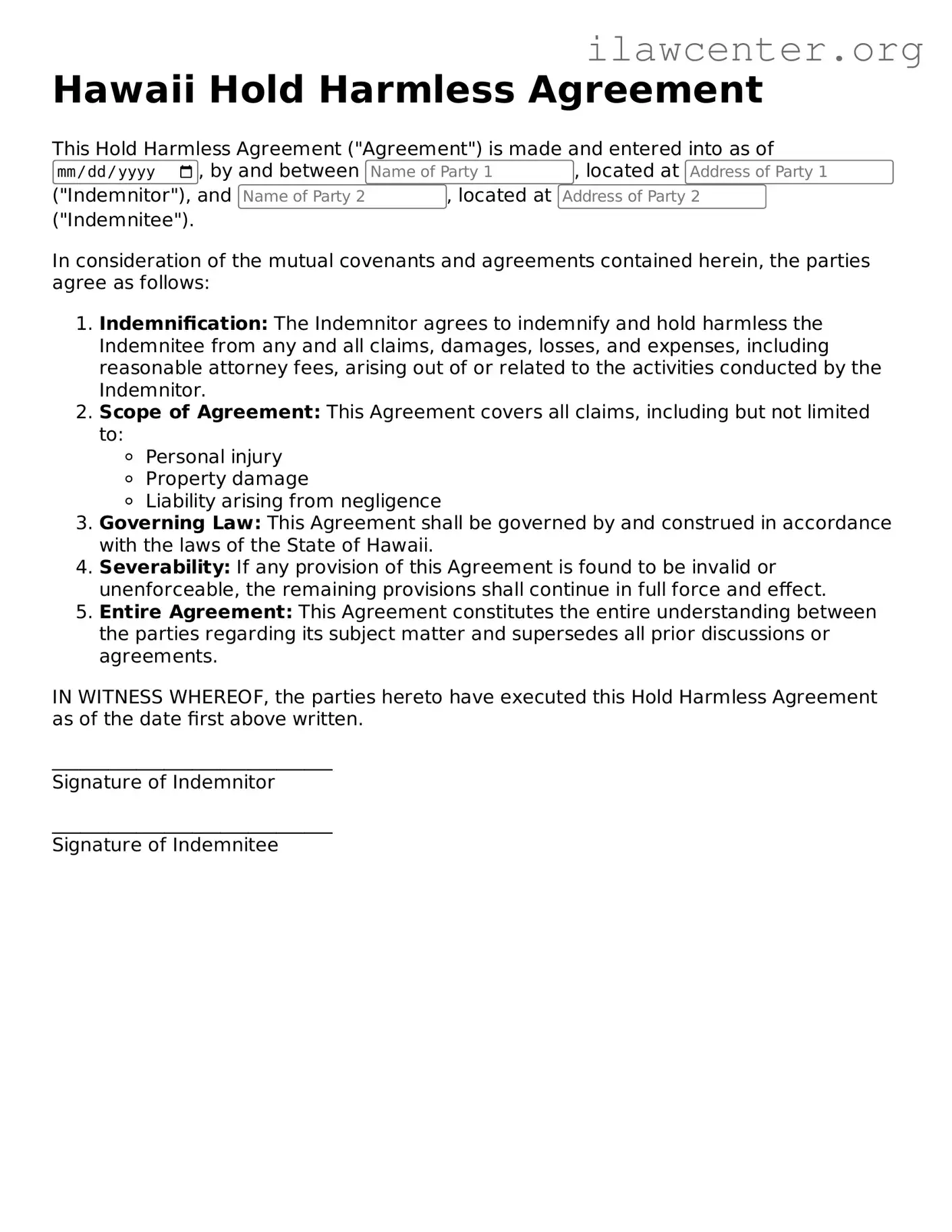
Hawaii Hold Harmless Agreement Preview

Hawaii Hold Harmless Agreement

This Hold Harmless Agreement ("Agreement") is made and entered into as of , by and between , located at ("Indemnitor"), and , located at ("Indemnitee").

In consideration of the mutual covenants and agreements contained herein, the parties agree as follows:

  1. Indemnification: The Indemnitor agrees to indemnify and hold harmless the Indemnitee from any and all claims, damages, losses, and expenses, including reasonable attorney fees, arising out of or related to the activities conducted by the Indemnitor.
  2. Scope of Agreement: This Agreement covers all claims, including but not limited to:
    • Personal injury
    • Property damage
    • Liability arising from negligence
  3. Governing Law: This Agreement shall be governed by and construed in accordance with the laws of the State of Hawaii.
  4. Severability: If any provision of this Agreement is found to be invalid or unenforceable, the remaining provisions shall continue in full force and effect.
  5. Entire Agreement: This Agreement constitutes the entire understanding between the parties regarding its subject matter and supersedes all prior discussions or agreements.

IN WITNESS WHEREOF, the parties hereto have executed this Hold Harmless Agreement as of the date first above written.

______________________________
Signature of Indemnitor

______________________________
Signature of Indemnitee

PDF Form Characteristics

Fact Name Description
Definition A Hawaii Hold Harmless Agreement is a legal document that protects one party from liability for certain actions or events.
Purpose This agreement is often used in contracts to ensure that one party will not hold the other liable for damages or injuries.
Governing Law The agreement is governed by the laws of the State of Hawaii.
Parties Involved Typically, the agreement involves two parties: the indemnitor (the one providing protection) and the indemnitee (the one being protected).
Key Components Essential elements include a clear statement of indemnity, scope of protection, and any limitations on liability.
Enforceability For the agreement to be enforceable, it must be signed by both parties and clearly outline the terms of indemnity.
Common Uses It is commonly used in construction contracts, event planning, and rental agreements.
Limitations Some limitations may apply, such as gross negligence or intentional misconduct, which may not be covered by the agreement.

Instructions on Utilizing Hawaii Hold Harmless Agreement

After obtaining the Hawaii Hold Harmless Agreement form, you will need to complete it accurately. Follow the steps below to ensure all necessary information is provided.

  1. Begin by entering your name in the designated space at the top of the form.
  2. Provide your address, including the city, state, and zip code.
  3. Fill in the date on which you are completing the form.
  4. Identify the event or activity for which the agreement is being signed.
  5. Include any relevant details about the location of the event or activity.
  6. Sign the form in the space provided, confirming your agreement.
  7. Print your name below your signature.
  8. Provide any additional information requested in the form.

Make sure to review your entries for accuracy before submitting the form. This will help ensure that all required information is complete and correct.

Important Facts about Hawaii Hold Harmless Agreement

What is a Hawaii Hold Harmless Agreement?

A Hawaii Hold Harmless Agreement is a legal document that protects one party from liability for any injuries or damages that may occur during a specific activity or event. This agreement is often used in situations where one party is providing a service or facility to another party, such as in rental agreements, events, or recreational activities.

Who typically uses a Hold Harmless Agreement in Hawaii?

Various individuals and organizations use Hold Harmless Agreements in Hawaii. Common users include property owners, event organizers, businesses, and recreational facilities. Anyone providing a service or venue may want to limit their liability through this agreement.

What are the key components of a Hold Harmless Agreement?

A typical Hold Harmless Agreement includes several important components: identification of the parties involved, a clear description of the activity or event, a statement of liability waiver, and the signatures of all parties. It may also outline specific risks associated with the activity.

Is a Hold Harmless Agreement legally binding in Hawaii?

Yes, a Hold Harmless Agreement can be legally binding in Hawaii, provided it meets certain legal requirements. These requirements include clarity in language, mutual consent, and the absence of coercion. It is advisable to consult with a legal expert to ensure the agreement is enforceable.

Can a Hold Harmless Agreement protect against all types of liability?

No, a Hold Harmless Agreement cannot protect against all types of liability. It typically does not cover gross negligence or willful misconduct. Courts may also refuse to enforce agreements that are overly broad or ambiguous, so specificity is crucial.

How do I create a Hold Harmless Agreement in Hawaii?

Creating a Hold Harmless Agreement involves drafting a document that clearly outlines the terms and conditions. It is essential to include the names of the parties, the nature of the activity, and the specific liabilities being waived. Consulting with a legal professional can help ensure that the document is properly structured and compliant with state laws.

Do I need a lawyer to draft a Hold Harmless Agreement?

What should I do if someone refuses to sign a Hold Harmless Agreement?

If someone refuses to sign a Hold Harmless Agreement, consider discussing their concerns openly. They may have valid reasons for their hesitation. If an agreement is crucial for the activity or event, you may need to evaluate the risks involved and decide whether to proceed without the agreement or seek alternative solutions.
Common mistakes

Filling out the Hawaii Hold Harmless Agreement form can be a straightforward process, but there are common mistakes that individuals often make. One significant error is failing to read the entire document thoroughly. Many people skim through the agreement, missing crucial details that could affect their rights and responsibilities. Understanding the terms is essential to ensure that all parties are aware of what they are agreeing to.

Another frequent mistake is not providing accurate personal information. This includes names, addresses, and contact details. Inaccurate information can lead to complications down the line, especially if any disputes arise. It is vital to double-check all entries for correctness before submitting the form.

Some individuals overlook the importance of signatures. A common error is forgetting to sign the document or having it signed by someone who is not authorized. Signatures validate the agreement and indicate that all parties consent to the terms. Without proper signatures, the agreement may not hold up legally.

Additionally, people sometimes neglect to include the date on which the agreement is signed. The date is a critical element that establishes when the agreement takes effect. Omitting this detail can create confusion about the timeline of the agreement's enforcement.

Another mistake involves misunderstanding the scope of the agreement. Some individuals may believe that signing the Hold Harmless Agreement absolves them of all responsibility. However, it is important to recognize that the agreement typically limits liability rather than eliminates it entirely. Clarity about the extent of the agreement's protections is essential.

Finally, failing to keep a copy of the signed agreement is a common oversight. After completing the form, individuals should retain a copy for their records. This ensures that they have access to the terms in case any issues arise in the future. Keeping a record can provide peace of mind and serve as a reference point if needed.

Documents used along the form

The Hawaii Hold Harmless Agreement is an important document that helps protect parties from liability. When using this agreement, several other forms and documents may be relevant to ensure comprehensive legal protection and clarity in various situations. Below is a list of commonly associated documents.

  • Liability Waiver: This document releases a party from liability for injuries or damages that may occur during an event or activity. It is often signed by participants to acknowledge the risks involved.
  • Indemnity Agreement: This agreement outlines the responsibilities of one party to compensate another for any losses or damages. It serves to protect against financial loss resulting from claims made by third parties.
  • Insurance Policy: An insurance policy provides coverage against specific risks. It is crucial to review this document alongside a Hold Harmless Agreement to ensure adequate protection is in place.
  • Event Permit: For events held in public spaces, an event permit may be required. This document grants permission from local authorities and often includes stipulations regarding liability and safety measures.
  • Contract for Services: If services are being provided, a contract outlines the terms and conditions of the agreement. It can include liability clauses that complement the Hold Harmless Agreement.

Understanding these documents can help parties navigate their legal responsibilities and ensure that they are adequately protected. Always consider consulting a legal professional for tailored advice regarding specific situations.

Similar forms

  • Indemnity Agreement: Similar to a Hold Harmless Agreement, this document also protects one party from financial loss or legal liability due to the actions of another party.
  • Liability Waiver: This form releases a party from liability for injuries or damages that may occur during an activity, similar to how a Hold Harmless Agreement functions.
  • Release of Liability: Like the Hold Harmless Agreement, this document ensures that one party cannot hold another responsible for specific risks associated with an activity.
  • Service Agreement: Often includes indemnification clauses that parallel the protections found in a Hold Harmless Agreement, ensuring one party is not liable for the other's actions.
  • Contractor Agreement: Frequently contains hold harmless provisions to protect contractors from claims related to their work, mirroring the intent of a Hold Harmless Agreement.
  • Rental Agreement: May include hold harmless clauses, ensuring that landlords are not liable for tenant actions or accidents on the property.
  • Event Participation Agreement: Participants often sign this document to acknowledge risks and waive liability, similar to the Hold Harmless Agreement.
  • Insurance Policy: Some insurance policies include hold harmless provisions, indicating that one party will not hold another responsible for certain liabilities.
  • Non-Disclosure Agreement (NDA): While primarily focused on confidentiality, some NDAs include indemnification clauses that relate to liability, akin to a Hold Harmless Agreement.

Dos and Don'ts

When filling out the Hawaii Hold Harmless Agreement form, it's important to follow certain guidelines to ensure accuracy and compliance. Here are eight things to consider:

  • Do read the entire form carefully before filling it out.
  • Do provide accurate and complete information.
  • Do sign and date the form in the appropriate sections.
  • Do keep a copy of the completed form for your records.
  • Don't leave any required fields blank.
  • Don't use abbreviations or shorthand that may cause confusion.
  • Don't rush through the process; take your time to ensure everything is correct.
  • Don't ignore any instructions provided with the form.

Misconceptions

The Hawaii Hold Harmless Agreement form is often misunderstood. Here are four common misconceptions about this legal document:

  • It eliminates all liability. Many believe that signing a Hold Harmless Agreement means they cannot be held liable for any actions. In reality, it typically protects one party from claims arising from specific activities, but it does not absolve all responsibility.
  • It is only for businesses. While businesses frequently use Hold Harmless Agreements, individuals can also benefit from them. They can be useful in various personal situations, such as renting property or participating in recreational activities.
  • It is a standard form with no need for customization. Some assume that a generic Hold Harmless Agreement suffices for any situation. However, each agreement should be tailored to reflect the specific circumstances and risks involved to ensure its effectiveness.
  • It is legally binding in all circumstances. People often think that once signed, the agreement is enforceable under all conditions. However, courts may not enforce a Hold Harmless Agreement if it is deemed unconscionable or if it violates public policy.

Understanding these misconceptions can help individuals and businesses navigate liability issues more effectively.

Key takeaways

When dealing with the Hawaii Hold Harmless Agreement form, it is essential to understand its purpose and implications. Here are key takeaways to consider:

  1. Understand the Purpose: The Hold Harmless Agreement is designed to protect one party from legal liability for any injuries or damages that may occur during an event or activity.
  2. Read the Terms Carefully: Before signing, ensure you fully understand the terms. Know what you are agreeing to and the extent of your liability waiver.
  3. Identify All Parties: Clearly list all parties involved in the agreement. This includes individuals and organizations that may be affected.
  4. Consult a Legal Professional: If you have any doubts or questions, seek legal advice. A professional can provide clarity and help you avoid potential pitfalls.
  5. Keep a Copy: After filling out and signing the agreement, retain a copy for your records. This can serve as important documentation in case of disputes.

By following these guidelines, you can navigate the Hold Harmless Agreement process with confidence.