Attorney-Verified  Homeschool Letter of Intent Document for Hawaii

Attorney-Verified Homeschool Letter of Intent Document for Hawaii

The Hawaii Homeschool Letter of Intent form is a crucial document that parents must submit to officially notify the state of their decision to homeschool their children. This form helps establish a clear educational path for students outside of traditional schooling, ensuring compliance with state regulations. If you're ready to take the next step in your homeschooling journey, fill out the form by clicking the button below.

Article Guide

Hawaii offers a unique opportunity for families who choose to educate their children at home. To begin this journey, parents must complete the Hawaii Homeschool Letter of Intent form. This essential document serves as a formal notification to the state that you intend to homeschool your child. It requires basic information such as the names and ages of the children being homeschooled, as well as the name and address of the parent or guardian. Submitting this letter is a crucial first step, as it ensures that your homeschooling plans are recognized and recorded by the state. Additionally, the form helps to establish your commitment to providing a quality education tailored to your child’s needs. Understanding the requirements and process for submitting this letter is vital for a smooth homeschooling experience in Hawaii.

Hawaii Homeschool Letter of Intent Preview

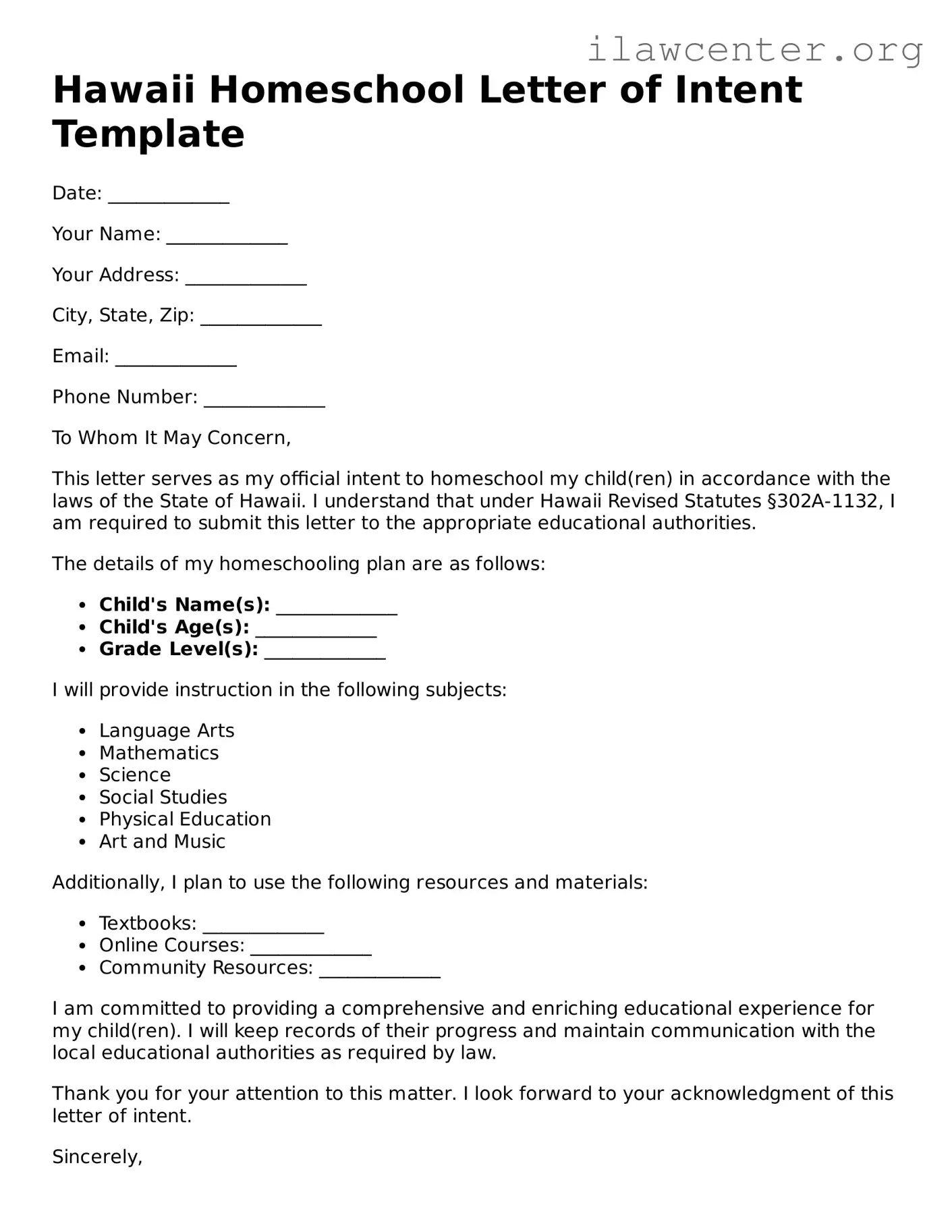
Hawaii Homeschool Letter of Intent Template

Date: _____________

Your Name: _____________

Your Address: _____________

City, State, Zip: _____________

Email: _____________

Phone Number: _____________

To Whom It May Concern,

This letter serves as my official intent to homeschool my child(ren) in accordance with the laws of the State of Hawaii. I understand that under Hawaii Revised Statutes §302A-1132, I am required to submit this letter to the appropriate educational authorities.

The details of my homeschooling plan are as follows:

  • Child's Name(s): _____________
  • Child's Age(s): _____________
  • Grade Level(s): _____________

I will provide instruction in the following subjects:

  • Language Arts
  • Mathematics
  • Science
  • Social Studies
  • Physical Education
  • Art and Music

Additionally, I plan to use the following resources and materials:

  • Textbooks: _____________
  • Online Courses: _____________
  • Community Resources: _____________

I am committed to providing a comprehensive and enriching educational experience for my child(ren). I will keep records of their progress and maintain communication with the local educational authorities as required by law.

Thank you for your attention to this matter. I look forward to your acknowledgment of this letter of intent.

Sincerely,

__________________________

(Your Signature)

PDF Form Characteristics

Fact Name Description
Purpose The Hawaii Homeschool Letter of Intent form is used to notify the state of a family's intention to homeschool their child.
Governing Law The form is governed by Hawaii Revised Statutes, Section 302A-1132.
Submission Deadline Parents must submit the form at least 10 days before the start of the school year.
Child's Information The form requires basic information about the child, including name and age.
Parent's Information Parents must provide their names and contact information on the form.
Signature Requirement The form must be signed by a parent or legal guardian to be valid.
Record Keeping Parents should keep a copy of the submitted form for their records.
Annual Renewal The Letter of Intent must be submitted annually for each child being homeschooled.
Submission Method The form can be submitted via mail or in person to the local school district office.
Additional Requirements Some parents may need to provide an educational plan along with the Letter of Intent.

Instructions on Utilizing Hawaii Homeschool Letter of Intent

Once you have the Hawaii Homeschool Letter of Intent form in hand, you can proceed to fill it out. This form is essential for notifying the Department of Education about your intent to homeschool your child. Completing it accurately ensures you meet the state's requirements.

  1. Download the Form: Obtain the Hawaii Homeschool Letter of Intent form from the official Hawaii Department of Education website.
  2. Fill in Your Information: Enter your full name, address, and contact information at the top of the form.
  3. Child's Information: Provide the name, date of birth, and grade level of each child you intend to homeschool.
  4. Educational Plan: Outline your educational plan briefly. Include the subjects you plan to cover and any specific curriculum you intend to use.
  5. Signature: Sign and date the form at the bottom. This confirms your intent to homeschool.
  6. Submission: Send the completed form to the appropriate district office of the Hawaii Department of Education. Check for any specific submission guidelines or deadlines.

Important Facts about Hawaii Homeschool Letter of Intent

What is the Hawaii Homeschool Letter of Intent form?

The Hawaii Homeschool Letter of Intent form is a document that parents or guardians must submit to inform the local education authority of their decision to homeschool their children. This form serves as an official notification and outlines the intent to provide home-based education for the child or children listed in the document.

Who needs to fill out the Letter of Intent?

Any parent or guardian who wishes to homeschool their child in Hawaii must complete the Letter of Intent. This includes families with children of compulsory school age, typically between 6 and 18 years old. It’s essential to submit this form before starting the homeschooling process.

When should the Letter of Intent be submitted?

The Letter of Intent should be submitted at least 10 days before the start of the homeschooling program. This ensures that the local education authority is aware of your homeschooling plans and can process your intent in a timely manner. If you’re withdrawing a child from a public or private school, it’s best to submit the form before the withdrawal date.

What information is required on the form?

The form typically requires basic information such as the names and ages of the children being homeschooled, the address of the home, and the name of the parent or guardian. Additional details about the educational plan may also be requested, although specifics can vary by district.

Is there a deadline for submitting the Letter of Intent?

While there is no strict annual deadline, it’s crucial to submit the Letter of Intent before the homeschooling year begins. If you plan to homeschool your child for the upcoming school year, ensure that the form is submitted well in advance to avoid any issues.

What happens after I submit the Letter of Intent?

Once the Letter of Intent is submitted, the local education authority will review it. You may receive confirmation of receipt, but no further action is typically required unless additional information is needed. It’s advisable to keep a copy of the submitted form for your records.

Can I change my homeschooling plans after submitting the Letter of Intent?

Yes, you can change your homeschooling plans after submitting the Letter of Intent. However, if there are significant changes, such as a change in educational philosophy or curriculum, it’s a good idea to inform the local education authority. Keeping open communication helps ensure compliance with state regulations.
Common mistakes

Filling out the Hawaii Homeschool Letter of Intent form can be straightforward, but many people still make common mistakes that can lead to delays or complications. One frequent error is not providing complete information. This includes failing to include all required details about the student, such as their full name, age, and the address where they will be homeschooled. Incomplete forms may be returned, requiring additional time and effort to correct.

Another mistake involves incorrect dates. Parents sometimes forget to update the school year or fail to indicate the start date for homeschooling. Accurate dates are crucial for compliance with state regulations. If the start date is ambiguous or incorrect, it can create confusion about when the homeschooling officially begins.

Additionally, some individuals neglect to sign the form. A signature is necessary to validate the intent to homeschool. Without it, the form is considered incomplete. This oversight can lead to unnecessary delays in the approval process.

People also often overlook the submission method. Some may assume they can submit the form via email or fax, but the Hawaii Department of Education requires that the letter be mailed. Ignoring this requirement can result in the form not being received, leaving parents without the necessary approval to begin homeschooling.

Another common issue is misunderstanding the educational plan. While the form does not require a detailed curriculum outline, parents must provide a general idea of their educational approach. Failing to do so can lead to questions from the state, potentially delaying the approval process.

Finally, some parents forget to keep a copy of the submitted form. Having a record of what was sent is important for future reference. If there are any questions or issues later on, having a copy can help clarify any misunderstandings.

Documents used along the form

When families decide to homeschool in Hawaii, they often need to complete several forms and documents in addition to the Homeschool Letter of Intent. These documents help ensure compliance with state regulations and provide a clear framework for the educational journey. Here are some commonly used forms and documents that can accompany the Homeschool Letter of Intent:

  • Educational Plan: This document outlines the curriculum and learning objectives for the school year. It serves as a roadmap for what the student will study and how progress will be measured.
  • Attendance Records: Keeping track of attendance is essential. These records help demonstrate that the student is receiving an adequate education throughout the year.
  • Progress Reports: These reports summarize the student’s academic achievements and areas needing improvement. They can be shared with educational authorities if required.
  • Portfolio of Work: A collection of the student’s completed assignments, projects, and assessments. This portfolio showcases the student's learning and growth over the year.
  • Standardized Test Results: Depending on the state’s requirements, families may need to submit results from standardized tests to ensure educational benchmarks are being met.
  • Notification of Withdrawal: If a child is transitioning from public or private school to homeschooling, a formal notification to the previous school may be necessary.
  • Health Records: Some families choose to maintain health records, including vaccinations, to comply with state health regulations, although this may not be a strict requirement for all homeschoolers.
  • Extracurricular Activity Forms: If students wish to participate in sports or other activities offered by local schools, these forms may be required to secure their eligibility.

Gathering these documents not only helps in maintaining compliance with state laws but also enhances the educational experience for the student. Being well-prepared can make the homeschooling journey smoother and more fulfilling for both parents and children.

Similar forms

The Homeschool Letter of Intent is an essential document for families choosing to educate their children at home. It serves as a formal notification to the local school district of your intent to homeschool. This document shares similarities with several other forms and letters used in educational and legal contexts. Here’s a look at nine documents that are similar to the Homeschool Letter of Intent:

  • Withdrawal Letter from Public School: This letter formally notifies the school that a child will no longer be attending. It outlines the reason for withdrawal, similar to how the Letter of Intent states the intention to homeschool.
  • Private School Enrollment Form: When enrolling in a private school, parents submit a form indicating their intent to enroll. Like the Letter of Intent, this document communicates educational choices to authorities.
  • Charter School Application: Families interested in charter schools must submit an application expressing their desire for their child to attend. This mirrors the intent expressed in the homeschooling letter.
  • Educational Plan Submission: Some states require parents to submit an educational plan outlining their curriculum. This is similar in purpose, as both documents inform authorities about the educational path chosen.
  • Notice of Intent to Homeschool: In some jurisdictions, this is a specific form that serves the same function as the Homeschool Letter of Intent, notifying the district of homeschooling plans.
  • Child Custody Agreement: When parents separate, they may create a custody agreement detailing educational decisions for their children. This document, like the Letter of Intent, communicates important decisions regarding a child's education.
  • Special Education Services Request: Parents may submit a request for special education services, outlining their child's needs. This is similar in that it informs the school system of specific educational intentions.
  • Transfer of Educational Records Request: When moving from one school to another, parents request the transfer of records. This document communicates educational transitions, akin to the intent to homeschool.
  • Home Education Affidavit: In some states, an affidavit is required to formally declare a family's intent to homeschool. This document is closely related to the Homeschool Letter of Intent, serving the same primary purpose.

Understanding these documents can empower families to navigate the educational landscape with confidence. Each serves a unique purpose but shares the common goal of communicating educational intentions clearly.

Dos and Don'ts

When filling out the Hawaii Homeschool Letter of Intent form, it is important to follow certain guidelines to ensure a smooth process. Here are some key dos and don'ts to consider:

  • Do provide accurate information about the student’s name and age.
  • Do include your contact information, such as your address and phone number.
  • Do submit the form before the school year starts, ideally at least 10 days in advance.
  • Do keep a copy of the submitted form for your records.
  • Don't leave any sections blank; fill out all required fields.
  • Don't forget to sign and date the form before submission.
  • Don't use incorrect or outdated information; verify all details.
  • Don't wait until the last minute to submit the form; allow time for processing.

Misconceptions

Understanding the Hawaii Homeschool Letter of Intent form is crucial for families looking to educate their children at home. However, there are several misconceptions that can lead to confusion. Below is a list of ten common misunderstandings regarding this important document.

  1. Homeschooling is illegal in Hawaii. Many people believe that homeschooling is not permitted in Hawaii. In reality, homeschooling is legal, and the state encourages families to take this educational route.
  2. Only certain subjects need to be covered. Some assume that the form only requires a focus on specific subjects. However, the law mandates a comprehensive education, covering a range of subjects similar to those taught in public schools.
  3. Submitting the form guarantees approval. While submitting the Letter of Intent is a necessary step, it does not guarantee approval. Families must also meet other state requirements to ensure compliance.
  4. There is a strict deadline for submission. Many believe that the Letter of Intent must be submitted by a specific date. In fact, families can submit this form at any time during the year, although timely submission is recommended.
  5. Parents must have teaching credentials. Some think that parents need formal teaching qualifications to homeschool. This is not true; parents can educate their children without any specific credentials.
  6. Once submitted, the form cannot be changed. A common misconception is that the Letter of Intent is set in stone. Families can amend the form if their educational plans change.
  7. Homeschooling means no socialization. Many worry that homeschooling isolates children. In fact, there are numerous opportunities for social interaction through co-ops, community activities, and extracurricular programs.
  8. All homeschooling methods are the same. Some people believe that homeschooling must follow a traditional structure. In reality, families can choose various educational philosophies and methods that suit their child’s learning style.
  9. Parents must provide daily lesson plans. There is a misconception that detailed daily lesson plans must be submitted. While families are encouraged to keep records, they do not need to submit daily plans to the state.
  10. Homeschooling is only for certain types of families. Some think that only specific families can homeschool. In truth, families from all backgrounds and circumstances can successfully choose this educational path.

By addressing these misconceptions, families can better navigate the process of homeschooling in Hawaii and ensure a fulfilling educational experience for their children.

Key takeaways

When filling out and using the Hawaii Homeschool Letter of Intent form, consider the following key takeaways:

  • Understand the Purpose: The form notifies the Hawaii Department of Education of your intent to homeschool your child. It is an essential first step in the homeschooling process.
  • Complete All Required Information: Ensure that you provide all necessary details, including your child's name, age, and the educational plan you intend to follow.
  • Submit on Time: The form must be submitted within the required timeframe. Late submissions may affect your homeschooling status.
  • Keep a Copy: After submitting the form, retain a copy for your records. This documentation can be useful for future reference.
  • Stay Informed: Familiarize yourself with Hawaii's homeschooling laws and regulations. This knowledge will help you comply with ongoing requirements.