Attorney-Verified  Marital Separation Agreement Document for Hawaii

Attorney-Verified Marital Separation Agreement Document for Hawaii

A Hawaii Marital Separation Agreement is a legal document that outlines the terms and conditions agreed upon by spouses who wish to live separately while remaining legally married. This form addresses various aspects of the separation, including property division, child custody, and financial responsibilities. To ensure clarity and mutual understanding, it is essential to fill out this form accurately.

To begin the process, please click the button below to fill out the form.

Article Guide

When couples in Hawaii decide to separate, a Marital Separation Agreement can serve as a crucial tool to outline the terms of their separation. This legally binding document addresses various important aspects, including the division of property, spousal support, and child custody arrangements. By clearly defining each party's rights and responsibilities, the agreement helps to minimize misunderstandings and conflicts during a challenging time. Additionally, it can serve as a framework for future negotiations, should the couple decide to reconcile or pursue divorce. Understanding the components of this agreement is essential for anyone navigating the separation process in Hawaii, ensuring that both parties feel secure and informed as they move forward.

Hawaii Marital Separation Agreement Preview

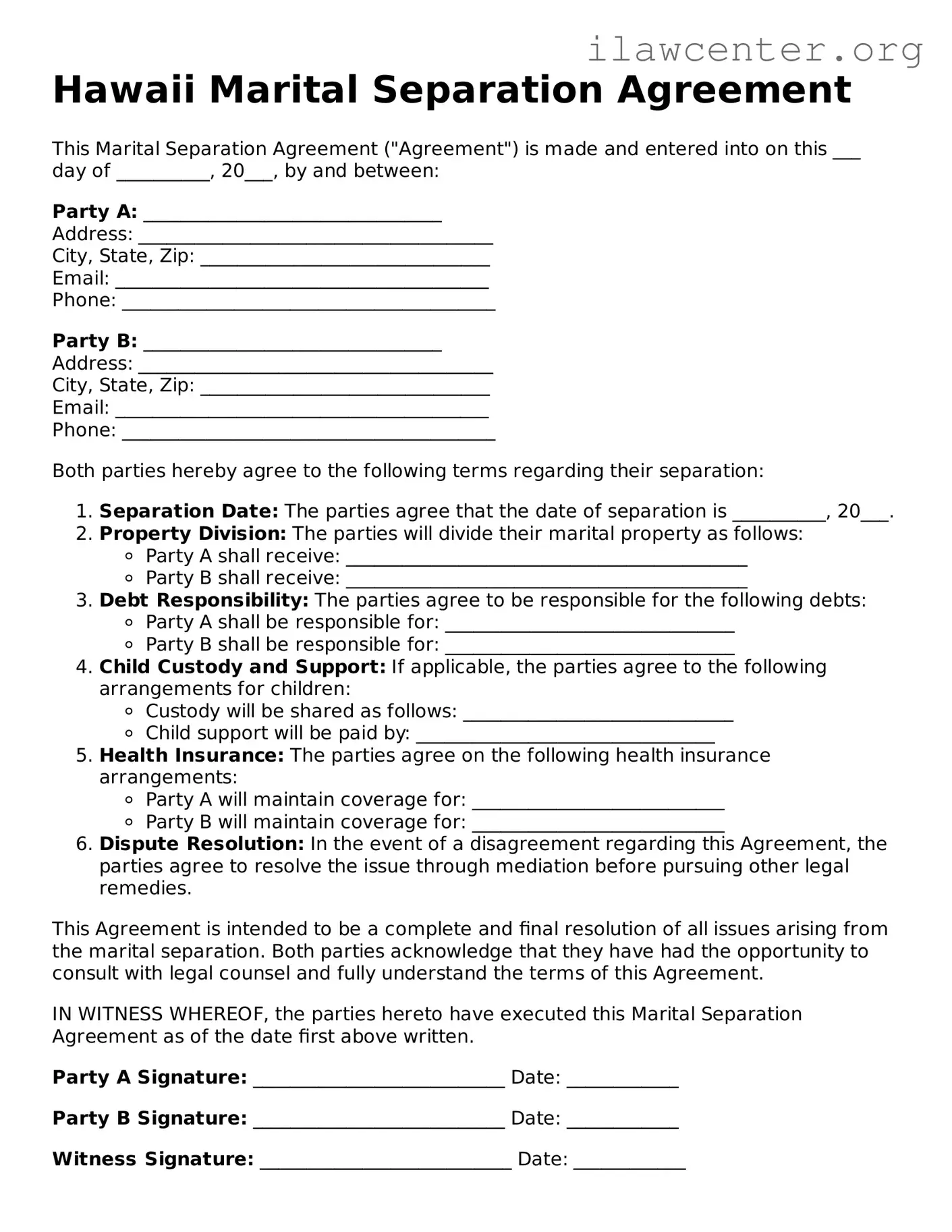
Hawaii Marital Separation Agreement

This Marital Separation Agreement ("Agreement") is made and entered into on this ___ day of __________, 20___, by and between:

Party A: ________________________________
Address: ______________________________________
City, State, Zip: _______________________________
Email: ________________________________________
Phone: ________________________________________

Party B: ________________________________
Address: ______________________________________
City, State, Zip: _______________________________
Email: ________________________________________
Phone: ________________________________________

Both parties hereby agree to the following terms regarding their separation:

  1. Separation Date: The parties agree that the date of separation is __________, 20___.
  2. Property Division: The parties will divide their marital property as follows:
    • Party A shall receive: ___________________________________________
    • Party B shall receive: ___________________________________________
  3. Debt Responsibility: The parties agree to be responsible for the following debts:
    • Party A shall be responsible for: _______________________________
    • Party B shall be responsible for: _______________________________
  4. Child Custody and Support: If applicable, the parties agree to the following arrangements for children:
    • Custody will be shared as follows: _____________________________
    • Child support will be paid by: ________________________________
  5. Health Insurance: The parties agree on the following health insurance arrangements:
    • Party A will maintain coverage for: ___________________________
    • Party B will maintain coverage for: ___________________________
  6. Dispute Resolution: In the event of a disagreement regarding this Agreement, the parties agree to resolve the issue through mediation before pursuing other legal remedies.

This Agreement is intended to be a complete and final resolution of all issues arising from the marital separation. Both parties acknowledge that they have had the opportunity to consult with legal counsel and fully understand the terms of this Agreement.

IN WITNESS WHEREOF, the parties hereto have executed this Marital Separation Agreement as of the date first above written.

Party A Signature: ___________________________ Date: ____________

Party B Signature: ___________________________ Date: ____________

Witness Signature: ___________________________ Date: ____________

PDF Form Characteristics

Fact Name Description
Definition A Hawaii Marital Separation Agreement is a legal document that outlines the terms of separation between spouses.
Governing Law The agreement is governed by Hawaii Revised Statutes, Chapter 580.
Purpose This form helps clarify rights and responsibilities during separation.
Property Division The agreement addresses how marital property will be divided.
Child Custody It may include provisions for child custody and support arrangements.
Voluntary Agreement Both parties must voluntarily agree to the terms outlined in the document.
Legal Advice It is advisable for both parties to seek independent legal counsel before signing.
Notarization The agreement should be notarized to ensure its validity.
Enforceability If properly executed, the agreement can be enforced in court.

Instructions on Utilizing Hawaii Marital Separation Agreement

Filling out the Hawaii Marital Separation Agreement form is an important step in managing your separation. This form helps outline the terms of your separation, addressing key issues such as property division, child custody, and financial responsibilities. Once completed, you will be ready to move forward with the next steps in your separation process.

  1. Begin by downloading the Hawaii Marital Separation Agreement form from a reliable source or the appropriate government website.
  2. Read through the entire form carefully to understand what information is required.
  3. At the top of the form, enter your full name and your spouse's full name.
  4. Provide your current addresses, including city and zip code, for both you and your spouse.
  5. Fill in the date of your marriage and the date you separated.
  6. In the next section, outline the terms of property division. Clearly list any assets and debts, specifying who will receive what.
  7. If you have children, include their names and ages in the designated section. Specify custody arrangements and visitation rights.
  8. Detail any child support or spousal support obligations, including amounts and payment schedules.
  9. Review the entire form to ensure all information is accurate and complete.
  10. Sign and date the form at the bottom. Your spouse should also sign, indicating agreement to the terms outlined.
  11. Make copies of the completed form for both parties and keep them in a safe place.

Important Facts about Hawaii Marital Separation Agreement

What is a Hawaii Marital Separation Agreement?

A Hawaii Marital Separation Agreement is a legal document that outlines the terms of separation between spouses. This agreement addresses various aspects of the couple's relationship, including the division of property, child custody, child support, and spousal support. It serves as a roadmap for both parties during their separation, ensuring clarity and reducing potential conflicts.

Who should consider a Marital Separation Agreement?

Couples who are contemplating separation but are not ready to pursue divorce may find a Marital Separation Agreement beneficial. It is particularly useful for those who want to establish clear terms regarding finances and child custody while they take time apart to evaluate their relationship.

Is a Marital Separation Agreement legally binding in Hawaii?

Yes, a Marital Separation Agreement can be legally binding in Hawaii, provided that both parties voluntarily agree to its terms and sign the document. However, it is crucial for both parties to fully understand the agreement and consider seeking legal advice before signing to ensure their rights are protected.

What should be included in a Marital Separation Agreement?

A comprehensive Marital Separation Agreement should include several key elements: division of property and debts, arrangements for child custody and visitation, child support obligations, spousal support terms, and any other relevant issues that may arise during the separation. Clear and detailed terms can help prevent misunderstandings later on.

Can a Marital Separation Agreement be modified?

Yes, a Marital Separation Agreement can be modified if both parties agree to the changes. It is advisable to document any modifications in writing and have both parties sign the revised agreement. This helps maintain clarity and ensures that all parties are on the same page regarding the new terms.

How does a Marital Separation Agreement affect divorce proceedings?

A Marital Separation Agreement can simplify divorce proceedings by already establishing the terms of property division, child custody, and support obligations. Courts often respect the agreements made by both parties, which can lead to a smoother and faster divorce process. However, it is important to note that the agreement must be fair and reasonable for it to be upheld in court.

Do I need a lawyer to create a Marital Separation Agreement?

While it is not legally required to have a lawyer to create a Marital Separation Agreement, it is highly recommended. A legal professional can help ensure that the agreement is fair, comprehensive, and compliant with Hawaii law. Additionally, having legal representation can provide both parties with peace of mind and reduce the likelihood of disputes in the future.

What happens if one party violates the Marital Separation Agreement?

If one party violates the terms of the Marital Separation Agreement, the other party may seek legal remedies. This could involve filing a motion in court to enforce the agreement or seeking modifications to address the violation. Courts generally take violations seriously, especially when they pertain to child custody or support issues.

How do I start the process of creating a Marital Separation Agreement?

To start the process, both parties should discuss their needs and preferences openly. It may be helpful to outline the key issues that need to be addressed. After reaching a mutual understanding, consider drafting the agreement and consulting with a lawyer to ensure it meets legal standards. Once both parties are satisfied with the terms, they can sign the document to formalize the agreement.
Common mistakes

Filling out the Hawaii Marital Separation Agreement form can be a daunting task. Many people make mistakes that can lead to delays or complications in the separation process. One common error is failing to provide complete and accurate personal information. This includes names, addresses, and other identifying details. Missing or incorrect information can cause the form to be rejected or require additional steps to correct.

Another mistake involves not clearly outlining the terms of the separation. Some individuals may assume that verbal agreements are sufficient. However, it is crucial to detail all arrangements regarding property division, child custody, and support. Ambiguities can lead to misunderstandings and disputes later on.

People often overlook the need for both parties to sign the agreement. A common misconception is that only one signature is necessary. In reality, both spouses must agree to the terms and sign the document for it to be valid. Without both signatures, the agreement may not hold up in court.

Additionally, many individuals fail to date the form. A date indicates when the agreement was made and can be important for legal purposes. Neglecting to include a date can lead to confusion about the timeline of the separation.

Another frequent error is not considering the implications of the agreement. Some people rush through the process without fully understanding how the terms will affect their future. It’s essential to think about long-term consequences, especially regarding financial matters and child custody arrangements.

Omitting necessary attachments is another mistake. If there are additional documents or evidence that support the agreement, they should be included. This can help clarify terms and provide a complete picture of the situation.

Many individuals also fail to review the form thoroughly before submission. Rushing through the process can lead to overlooked mistakes. Taking the time to proofread can prevent unnecessary complications.

Not seeking legal advice is a mistake that can have lasting consequences. While it may seem unnecessary, consulting with a legal professional can provide clarity and ensure that the agreement meets all legal requirements.

Finally, some people do not keep copies of the signed agreement. It is vital to retain a copy for personal records. This can serve as a reference in the future and protect against disputes over the terms.

Documents used along the form

When navigating a marital separation in Hawaii, several forms and documents may accompany the Hawaii Marital Separation Agreement. Each of these documents serves a specific purpose and can help clarify the terms of the separation. Below is a list of commonly used forms that may be relevant to your situation.

  • Child Custody Agreement: This document outlines the arrangements for the care and custody of any children involved. It addresses where the children will live, visitation rights, and decision-making responsibilities.
  • Property Settlement Agreement: This agreement details how marital assets and debts will be divided between the spouses. It aims to ensure a fair distribution of property acquired during the marriage.
  • Financial Disclosure Statement: This form requires both parties to provide a comprehensive overview of their financial situations. It includes income, expenses, assets, and liabilities, ensuring transparency during the separation process.
  • Spousal Support Agreement: This document specifies any financial support one spouse may provide to the other during or after the separation. It outlines the amount, duration, and conditions of the support.

Understanding these documents can facilitate a smoother separation process. Each form plays a vital role in ensuring that both parties' rights and responsibilities are clearly defined and respected. It is advisable to seek guidance to navigate these forms effectively and to address any concerns that may arise during this challenging time.

Similar forms

  • Separation Agreement: This document outlines the terms of separation between spouses, including asset division, child custody, and support obligations. It serves a similar purpose as a Marital Separation Agreement but may not be specifically tied to divorce proceedings.
  • Divorce Decree: A legal order that finalizes the dissolution of marriage. It includes details on asset division, custody arrangements, and support, similar to the Marital Separation Agreement, but is issued by a court.
  • Child Custody Agreement: This document specifically addresses the custody arrangements for children. While the Marital Separation Agreement may include custody terms, this agreement focuses solely on the parenting plan.
  • Property Settlement Agreement: This document details the division of marital property. Like the Marital Separation Agreement, it ensures both parties understand their rights regarding assets and debts.
  • Spousal Support Agreement: This agreement outlines the financial support one spouse will provide to the other after separation. It is similar to the support provisions in a Marital Separation Agreement.
  • Pre-Nuptial Agreement: A contract made before marriage that outlines asset distribution in the event of divorce or separation. While it is created prior to marriage, it serves to clarify expectations similar to a Marital Separation Agreement.
  • Post-Nuptial Agreement: This document is similar to a pre-nuptial agreement but is created after marriage. It outlines how assets will be divided in case of separation or divorce, akin to the Marital Separation Agreement.
  • Child Support Agreement: This focuses specifically on financial support for children. It is part of the broader Marital Separation Agreement but can stand alone to address child support obligations.
  • Mutual Release Agreement: This document releases both parties from future claims against each other. It can be included in a Marital Separation Agreement to ensure both parties agree to waive further legal claims.

Dos and Don'ts

When filling out the Hawaii Marital Separation Agreement form, it's important to approach the task with care and attention to detail. This document is a significant step in the process of separating from a spouse, and ensuring that it is completed correctly can help avoid complications down the line. Below is a list of things you should and shouldn't do while filling out this form.

  • Do read the entire form carefully before starting to fill it out.
  • Do ensure that all information is accurate and up-to-date.
  • Do discuss the terms of the agreement with your spouse, if possible.
  • Do seek legal advice if you have any questions or concerns.
  • Do keep a copy of the completed form for your records.
  • Don't rush through the form; take your time to understand each section.
  • Don't leave any sections blank unless specifically instructed to do so.
  • Don't make assumptions about what should be included; clarify any uncertainties.
  • Don't forget to sign and date the form before submission.

By following these guidelines, you can help ensure that your Marital Separation Agreement is completed properly. This attention to detail can contribute to a smoother separation process and help both parties move forward with clarity and understanding.

Misconceptions

When it comes to the Hawaii Marital Separation Agreement form, several misconceptions can lead to confusion. Understanding these myths can help individuals navigate their separation process more effectively. Here are ten common misconceptions:

  1. It is the same as a divorce. Many believe that a marital separation agreement is equivalent to a divorce. In reality, it is a temporary arrangement that allows couples to live separately while still being legally married.
  2. It can only be used by couples who are filing for divorce. Some think that only couples intending to divorce can use this agreement. However, it can also be beneficial for couples who want to separate but may not want to pursue divorce immediately.
  3. It is not legally binding. A common myth is that these agreements lack legal enforceability. In fact, once properly executed, they are legally binding and can be enforced in court.
  4. All assets and debts must be divided equally. People often assume that separation means a 50/50 split of all assets and debts. The agreement can outline different terms based on the couple’s unique situation.
  5. Children's custody and support are automatically decided. There is a misconception that custody and support arrangements are automatically included in a separation agreement. While they can be addressed, it is essential to specify these terms clearly in the document.
  6. It is a one-time document. Many believe that once the separation agreement is signed, it cannot be changed. In reality, couples can modify the agreement if both parties consent to the changes.
  7. Legal representation is not necessary. Some think they can create a separation agreement without legal help. While it is possible, consulting with an attorney can ensure that all legal requirements are met and that the agreement is comprehensive.
  8. It is only for couples with significant assets. There is a belief that only couples with considerable wealth need a separation agreement. However, it can be useful for any couple wanting to clarify their rights and responsibilities during separation.
  9. Signing it means you cannot reconcile. Some individuals fear that signing a separation agreement means they cannot get back together. This is not true; the agreement simply outlines the terms of separation and does not preclude reconciliation.
  10. It can be verbal. Many think that a verbal agreement is sufficient. However, a written and signed agreement is essential for legal enforceability and clarity.

Understanding these misconceptions can help individuals make informed decisions regarding their marital separation. Clear communication and proper documentation are key to navigating this challenging time.

Key takeaways

Filling out and using the Hawaii Marital Separation Agreement form is a crucial step for couples considering separation. Here are some key takeaways to keep in mind:

  • Understand the Purpose: This agreement outlines the terms of separation, including division of property, child custody, and support obligations.
  • Legal Requirements: Ensure that both parties sign the agreement voluntarily. It must be notarized to be legally binding.
  • Be Comprehensive: Address all relevant issues, such as financial responsibilities and parenting plans, to avoid future disputes.
  • Consult an Attorney: While you can fill out the form without legal help, consulting an attorney can provide valuable guidance and ensure that your rights are protected.
  • Review State Laws: Familiarize yourself with Hawaii's specific laws regarding separation and divorce, as these can impact your agreement.
  • Update as Necessary: Life circumstances change. Revisit and modify the agreement if needed, especially regarding child custody or financial situations.
  • Communication is Key: Open and honest communication between both parties can lead to a more amicable separation process.
  • File with the Court: After completion, file the agreement with the family court to ensure it is recognized and enforceable.

By keeping these points in mind, individuals can navigate the complexities of separation more effectively.